Filed under: Embroidery Guild of America, Pomegranate Heart by Melissa Sherbring, Seminar 2023 - Boston
More Ceylon/Ladder stitches for the outer heart. Glad to say now that the Ceylon/Ladder stitches got easier. Leaving more slack is good. It also allowed me to get rid of the magnifying glass. But, I could only do about 4 threads (18″) before having to take a break for my eyes. This seems much more tedious than canvaswork. I was pleased with the consistency of spacing for the rungs and the angle achieved turning the rounded sides.

We were given 2 options for the pair-wrapped ladder. No way was I going to try French Knots with this passing thread like Melinda’s pilot stitcher did. I stuck with the original teacher’s choice of wrap 2 skip 3.

The Woven Laidwork wasn’t too bad. I managed to use longer lengths of the silver passing thread. It took some effort to make straight lines. Melinda’s is tighter than mine, but I will take straight. I worked the Stem stitch left to right to outline all edges. I did start that (can you see where) in this photo. It covers up any imperfect areas along the edges.

For Stem stitch, which if you work from left to right (for right-handers) and right to left (for left handers), always keep your working thread below your needle. For Outline stitch, always keep your working thread above your needle. This is supposed to make it easy to remember: Stem=under and Outline=over (O=o). It’s completely done in this photo and ready for finishing!
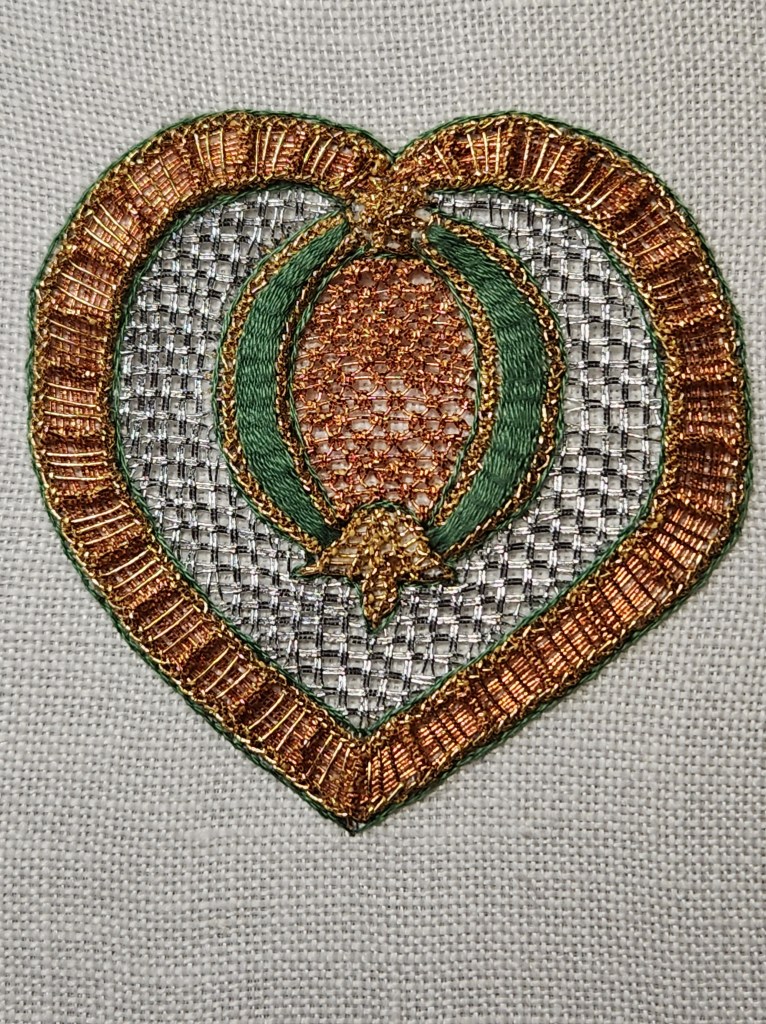
This is actually upside down because the crown upside down. I will finish it with the crown uprighted. Since it is a heart, I am posting this today, October 3, to mark our 36th Anniversary!
Filed under: Embroidery Guild of America, Pomegranate Heart by Melissa Sherbring, Seminar 2023 - Boston
It’d been almost 2 weeks since returning from EGA Seminar and I had not stitched on the Pomegranate Heart, the one-day class with Melinda Sherbring.
Glad to say, I picked up easily where I left off with the Ceylon/Ladder stitch.

The pair-wrapped ladder worked up well.

This is a 4-column Crown (working on this upside down). The center rungs got lost until I got to the center pointed tip. Since I’m not sure it would rip out easily, I am leaving it alone.
I’m working with Gold,Silver, and Copper Passing Thread. It is a thin flat metal thread wrapped around silk or cotton. It does fray but wax applied at the end helps. Because these threads are more expensive, Melinda makes up smaller spools for kits to keep costs down. Very considerate but certainly adds kit preparation time. The white spool is a harder plastic tube than the green plastic straw. Each have cuts in the end for anchoring the end of the thread. They would make a great spool for leftover threads.

The Ceylon Circle is a little too small so maybe I should have placed the framework stitches further out. I only looped around twice, and I think Melinda got around 3 times. Oh well!

The Corded Lark’s Head Filling offset stitch was tricky – going down and over, up under, and down and under repeated. Working with a magnifying glass didn’t help much. Then, I realized that my tension was probably too tight. Looser thread and the magnifying glass made working the bottom half go easier. So, you can see it is a little denser on the upper half. Again, I am leaving it alone.
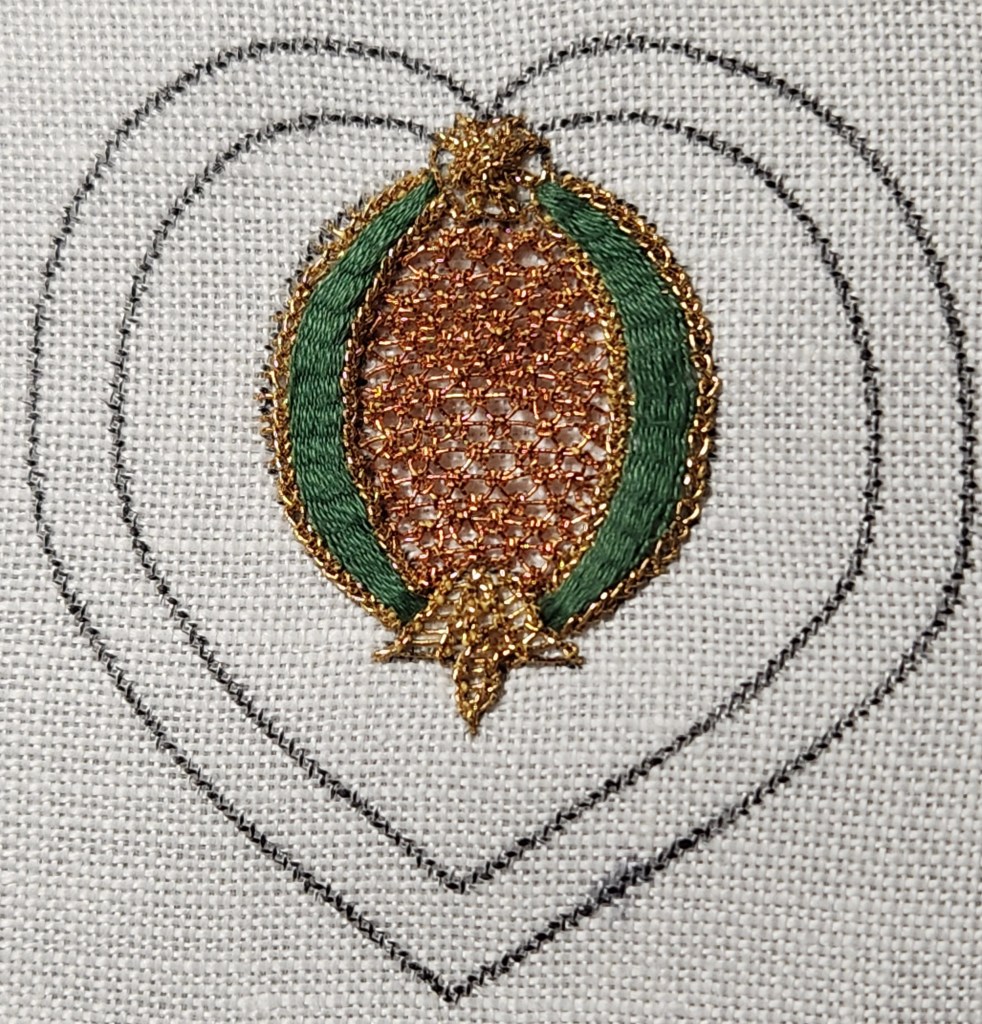
It’s kind of slow going because I can only stitch with the magnifying glass so long.
Filed under: Embroidery Guild of America, Pomegranate Heart by Melissa Sherbring, Seminar 2023 - Boston, Understanding Color Relationships: Luster and Luminosity with Patricia Goaley
My second class, a two-day class, was Understanding Color Relationships: Luster and Luminosity with Patricia Goaley.
Class description from EGA’s website: Using simple forms, we will experiment with advanced color relationships using various colors of number 8 pearl cotton and 18 count canvas and 28 count overdyed linen. This low stress class will play with luminosity and luster over 2 days. If you have overdyed linen that you are at a loss how to use, bring it and look at the future possibilities. There will be some choice in color chosen for fibers and foundation materials. Tricks will be discussed for improving overall appearance of your needlework and increasing the intensity of the color relationships.
I looked up the definition for luster. It is a gentle sheen or soft glow, especially that of a partly reflective surface. And, luminosity is the relative brightness of something.
Learning more about color and low stress sounded good!
In our first day, we made our own grayscale and hue color chart.
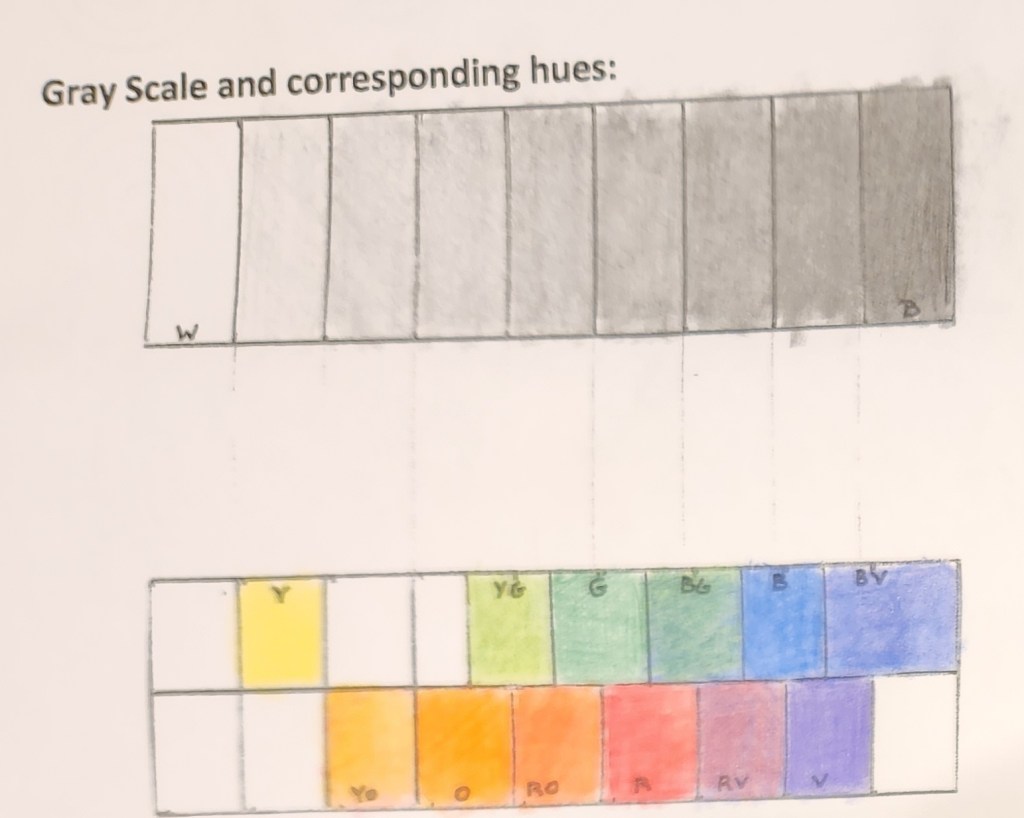
We added value with color (red example below) and density of stitches (green example below).

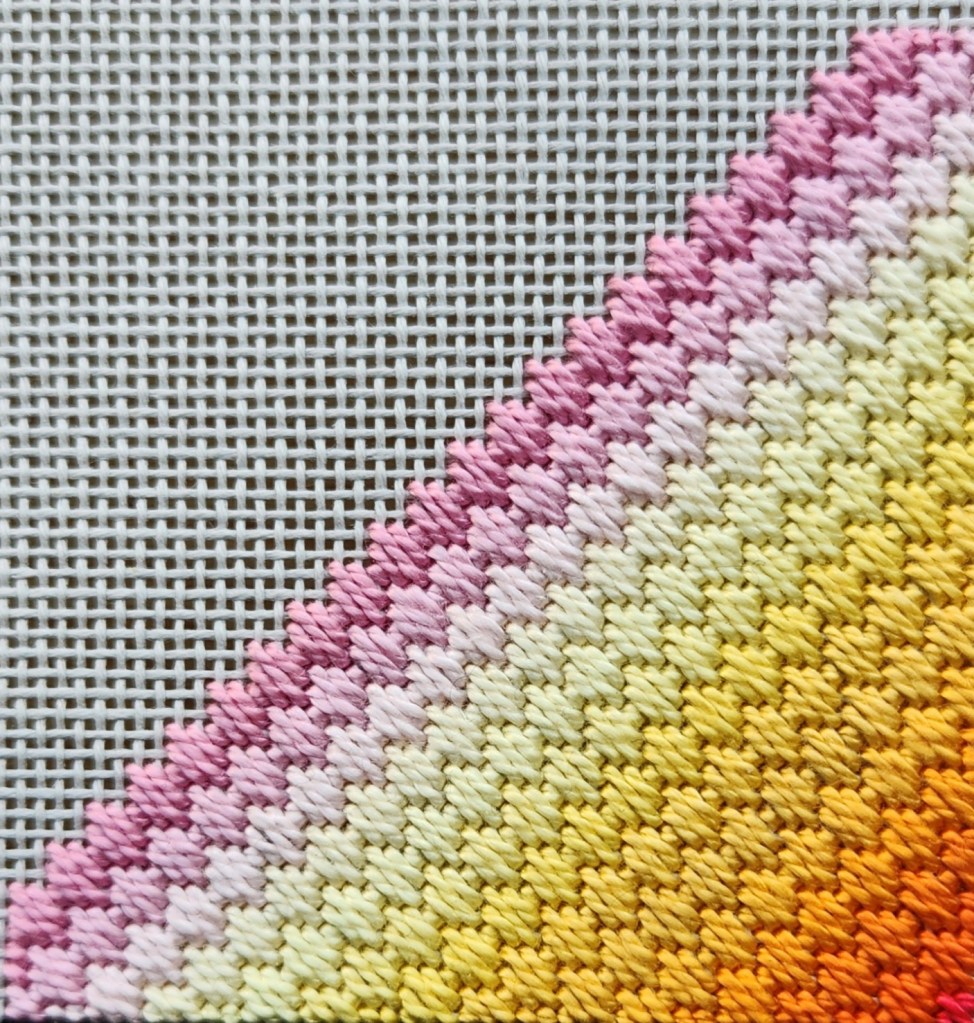
Then, we stitched to watch the interaction of color as you add each color.

The luminosity is created with the lightest values and the luster will appear as reflected light becoming more evident when a significant value difference is incorporated. Because I am working on the gray canvas, I added a black border to make it pop (after dinner and a delicious Espresso Martini). This isn’t fully stitched yet. Does the bottom one look a little washed out compared to the one with the back border?

Thanks to the other students who pitched in to distribute Day 2 class materials. Lots of stuff!

These were my morning paintings – masterpieces! We went from black and white to color. We had QTips and paint brushes to play with. I could have done this all afternoon.


But, it was time to move onto weaving. Look at this teeny, tiny loom! The fork was used to push down the threads.
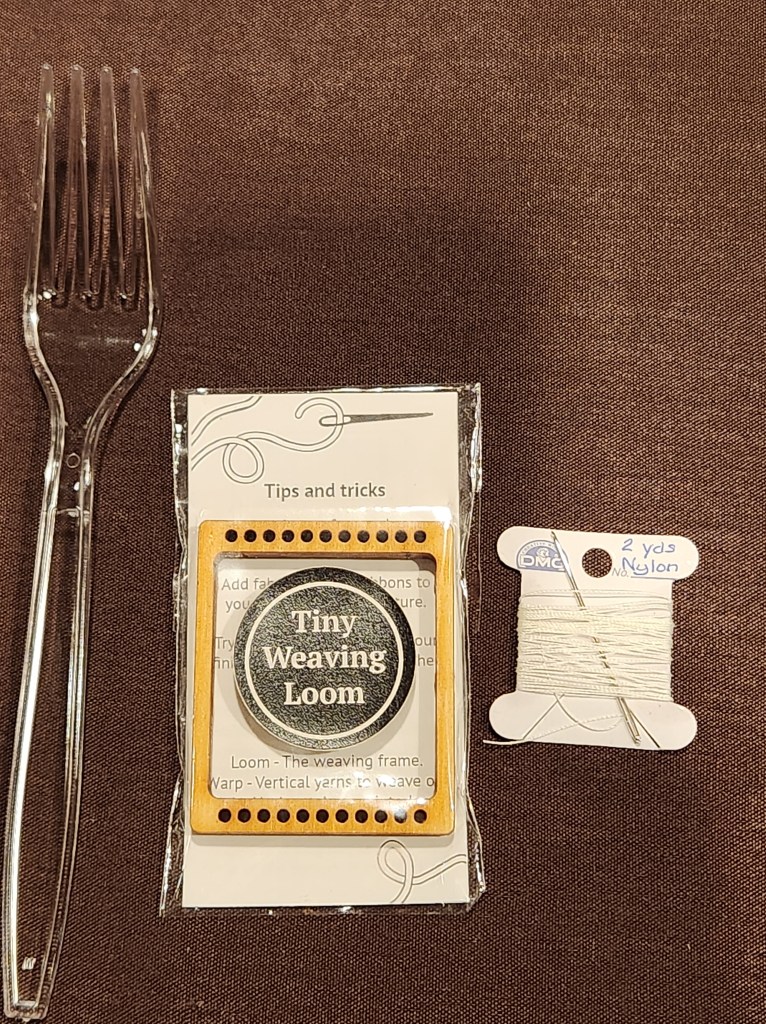
This was my afternoon’s weaving project. At one point, Pat mentioned that you can stitch on the weave you produce. So, I am going to trash this and restart it. My tension got tighter in the middle which is the same thing that happened to me with the larger loom.

Working on linen as described in the class description would have been nice but getting to weave again was fun and let me learn that Surface embroidery could be combined with weaving. A fun mixed media project. I’m thinking about what to do!
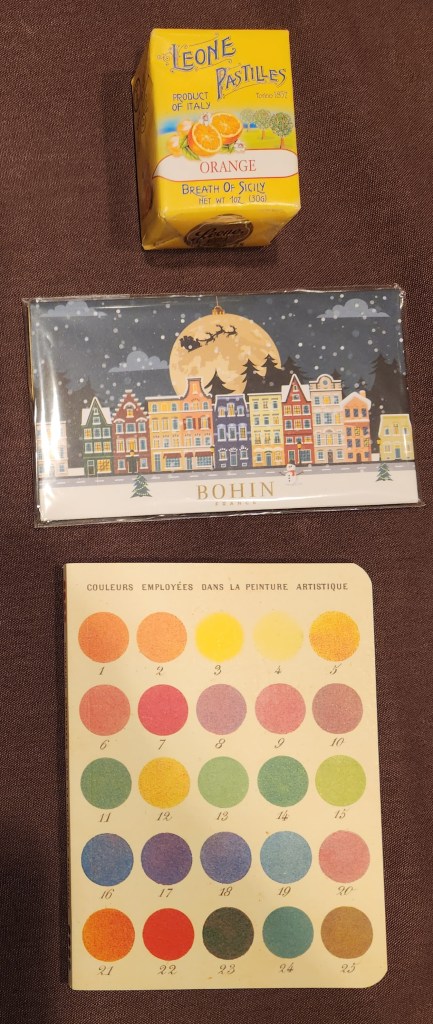
Pat gave me an entirely unexpected gift bag for being Class Angel. The Bohin needlecase has 40 different needles in a variety of sizes. Orange is my favorite flavor of hard candy. And, can always use a notebook.
Filed under: Embroidery Guild of America, Pomegranate Heart by Melissa Sherbring, Seminar 2023 - Boston
Pomegranate Heart by Melissa Sherbring is a 3″ x 3″ heart surrounds a pomegranate and is worked in three late 16th / early 17th century English embroidery stitches including a copper-colored, bumpy-textured Corded Larks Head filling stitch [a.k.a. Up and Down Buttonhole with Straight Stitch Return]. The remaining areas – rind, calyx, crown, attachment circlworked in three late 16th / early 17th century English embroidery stitches, and surrounding heart – are worked with gold passing thread in variations of Ceylon stitch. Outlines are worked in Stem stitch in cotton, both over the linen ground and over the rungs of Ceylon stitch. The background is a Woven Laidwork design in silver passing thread.
That is the description from the EGA website. The only part I understood before class in that description is Stem stitch which I didn’t get to anyway!
It’s a lovely piece and I thought learning 3 new stitches for a one-day class was reasonable. The time goes by so quickly. And, it did and it was paced well.
In the morning session, I did the four samples (bottom using red and yellow braiding cord) and the stitched part on linen is using gold passing thread for the Ceylon/Ladder stitch. Tricky getting tension even. I am glad I brought my magnifying clip-on light. Very helpful.

In the afternoon, I practiced the Lark’s Head Filling, Offset (top stitched sample in the next photo) using the yellow braiding cord. My sample shows a half-hitch on the right side but not the left side. The Woven Laidwork (bottom stitched sample) was a breeze. I didn’t worry about tension – so, it doesn’t look pretty.

Then, I read through the instructions and inquired more about how she transferred the design. To my surprise, her design is stamped! She uploaded an image to rubberstamps.com and used an ink pad. For $5, she had the stamp. That might be fun to try for my EGA Brandywine chapter.
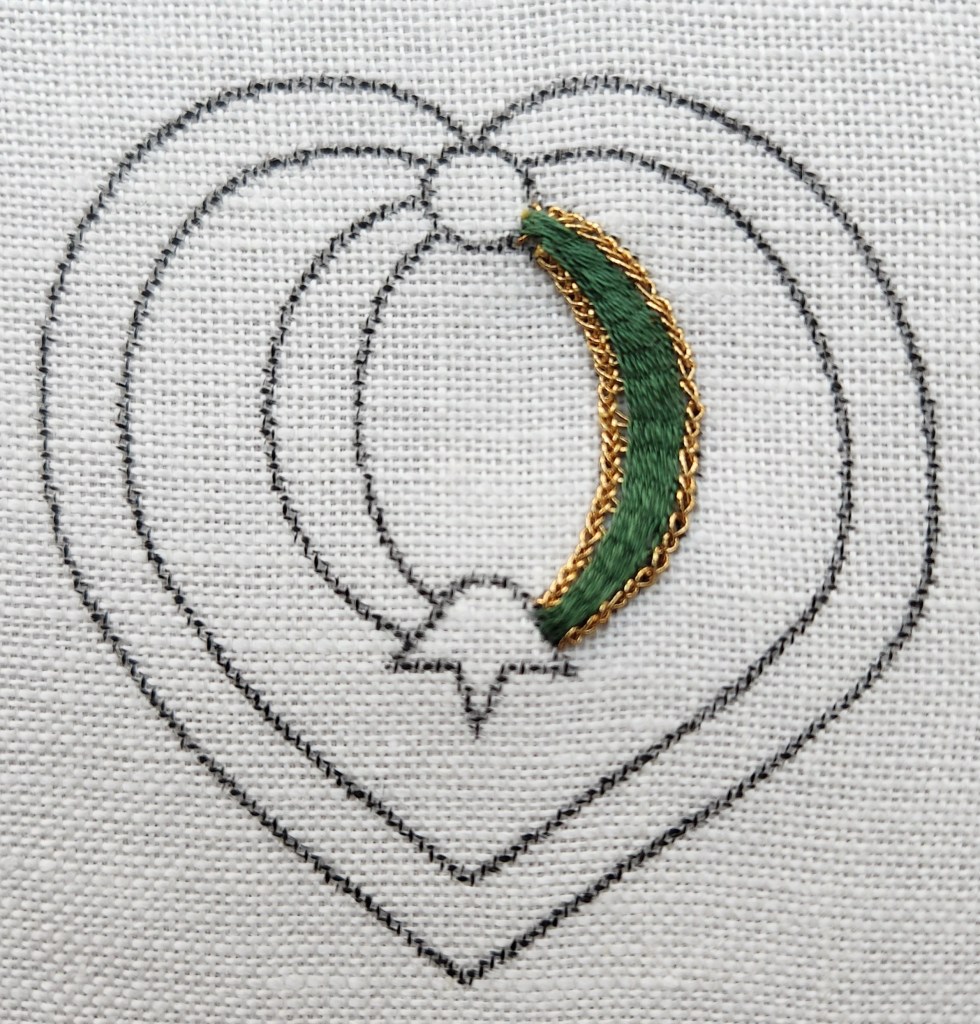
With the last 45 minutes she had us stitch the raised Stem stitch with a single strand of green DMC floss. I know it’s not a race but the one woman next to me might be done tonight (I am exaggerating) and the woman on my other side didn’t get off the plastic canvas!
 Melitastitches4fun's Blog