A few Christmases ago, my sister-in-law, Sher, gave me a wooden cutting board on which she had painted a bluebird because I had raved about how good it was when I saw her post it on Facebook. I knew she was crafty but hadn’t known she studied art or painted!

Since Sher had made three similar bluebirds, I used Photoshop to morph my favorite face on my favorite body. And, after taking several classes on how to paint on canvas, I was ready to paint and stitch it for her Christmas gift.
Step 1. I made a line drawing using Vellum tracing paper. This allowed me to focus on the main elements of the design.

Step 2. Initially, I was going draw the tracing onto the canvas. Instead, I placed Congress Cloth on top of the photo. I could see the photo clearly when it was on my light box. My first attempt was heavy on the paint and holes got clogged.
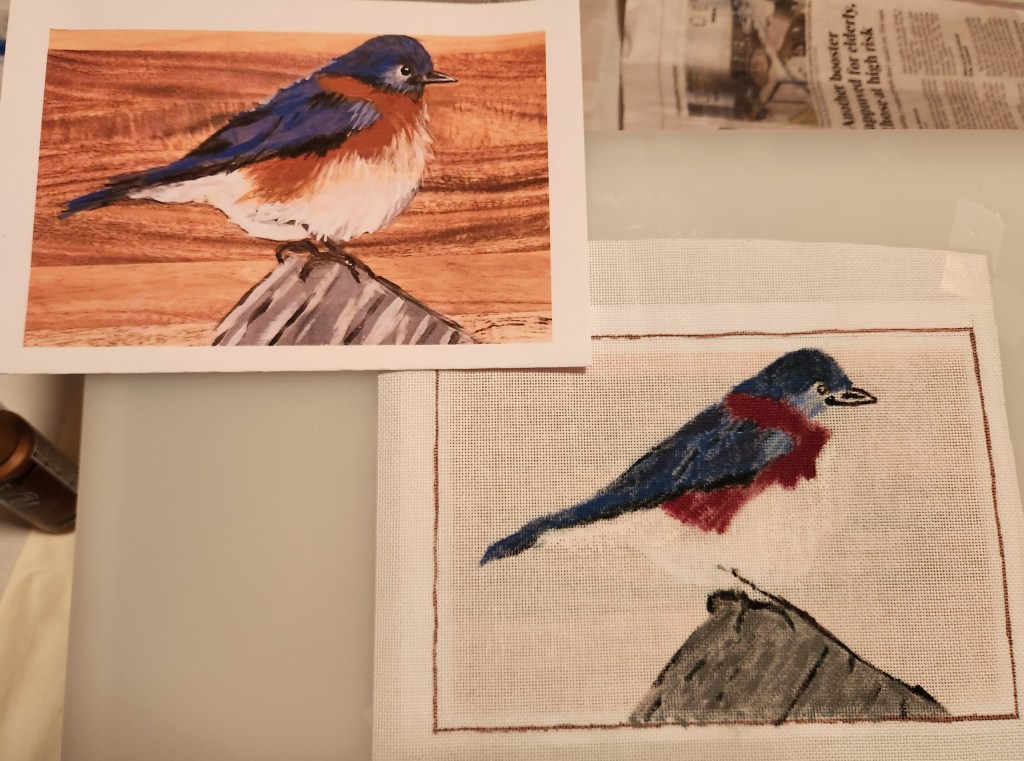
Step 3. In my second painting attempt, I used less paint and waited for each color to dry before starting on the next. I didn’t try to get the exact coloration of the bird’s feathers onto the canvas because I knew I’d cover them completely with threads. I especially loved how the background turned out.

Step 4. I selected threads and a stitch for the log. The grays are Cosmo, a 6-strand cotton floss in 3 values of grey (from dark to light, including 2154, 153A, and 2151) and black DMC 310 for his perch (3 strands). The stitch is from Patchwork of Peace (page 68), which I saw stitched on Facebook’s Virtual Notebooks by Meg W. The pattern created a bit of a vertical appearance, but from a distance, it is ok.

For his feet and leg, I used Trio T12 Black with an outline stitch.

Step 5. I definitely wanted to do the background first in case the feathers needed to cover that up some along the edges. The background is a brown wooden board. I love how my painted canvas turned out. So, I don’t want full coverage.
I tested a Woven Trame (too heavy), Woven (the holes show more than canvas), Alternating Oblong Cross Trame (some canvas would show but still heavy), a Horizontal Wave Double Running Stitch (photo makes it look more open than it actually was and it was tough to see the holes with brown thread on brown canvas), and finally the Horizontal Wave Running Stitch without the short stitch (from Sandra Arthur’s Shapes of Needlepoint Series IV page 46). It is open so my painted canvas will show through.
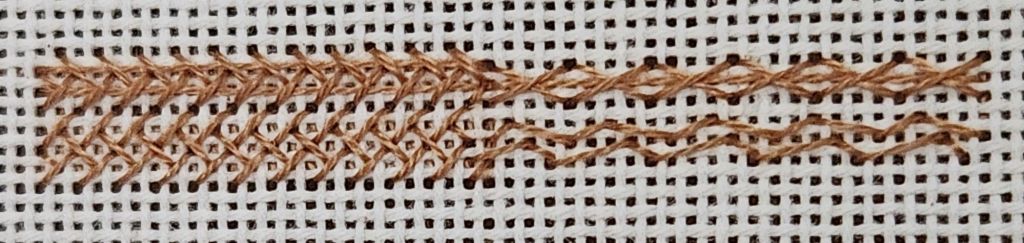

I had intended to use 5 different values of browns to follow my paint coverage. I realized that it would be difficult to switch threads so often. Then I remembered that Amy Bunger (in her DVD #6 Barely There) suggested matching the thread to the middle value of a shaded painted area and used the same stitch throughout. Here are the top 10 rows and the right side stitched.
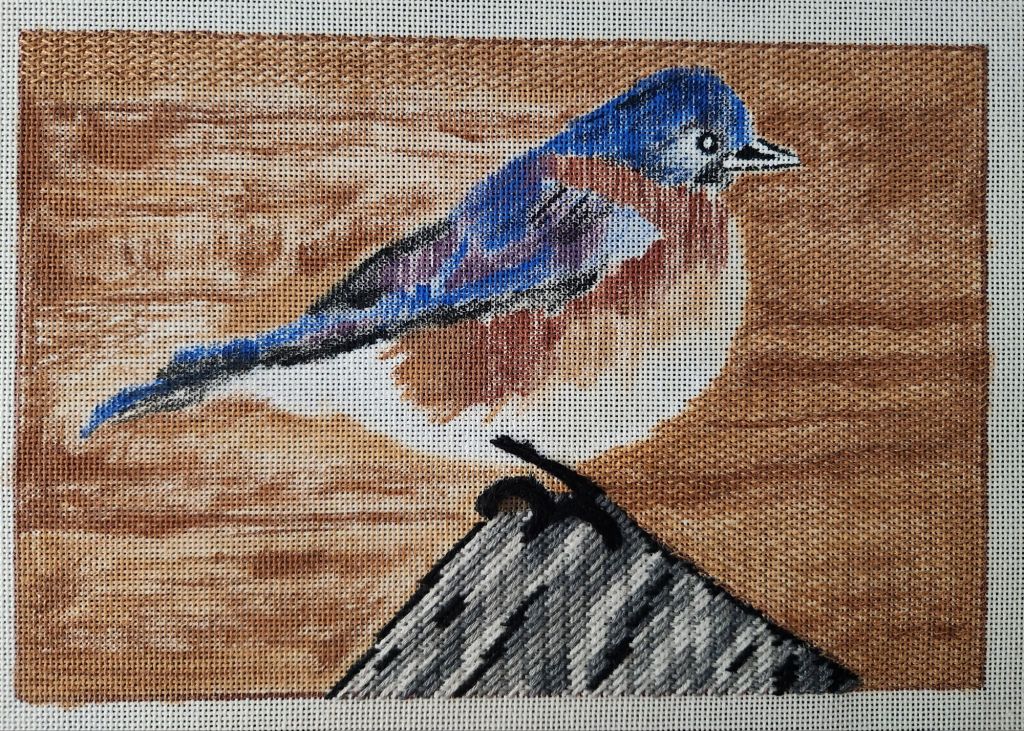
It really evened out the paint and allowed the painted color variation to show through. I couldn’t be happier with the result. But, the background seemed to take forever to stitch.
Once I got to the bird, I stayed with it and was done in about 5 days of concentrated stitching (thanks in large part to the US Open for keeping my husband occupied for 4 days!).
I used Splendor threads for the bird’s body using 1 white, 3 grays, 3 blues, a brown, and a rust. I used 2 strands in the needle varying the combinations: 2 black, 2 bright blue, 1 black with 1 bright blue, 1 black with dark gray, etc. A couple of other threads for the leg and beak.
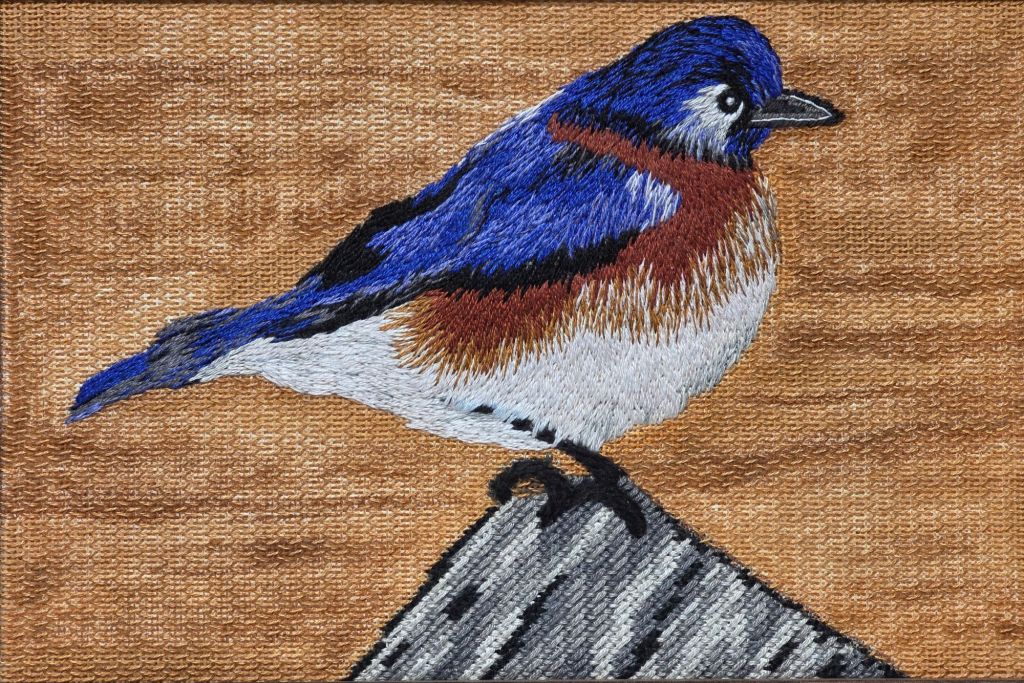
It flew off to the framer, Jim at Repenning Fine Arts in NJ, so it could head west to St. Louis for the ANG Exhibit at Seminar. That was the first of two exhibits he would enter before heading north for it’s permanent nest. I’m very happy with how it turned out!

It was in the Adaptation category in the exhibit. No ribbon but good scores and good feedback from the Judge in the critique:
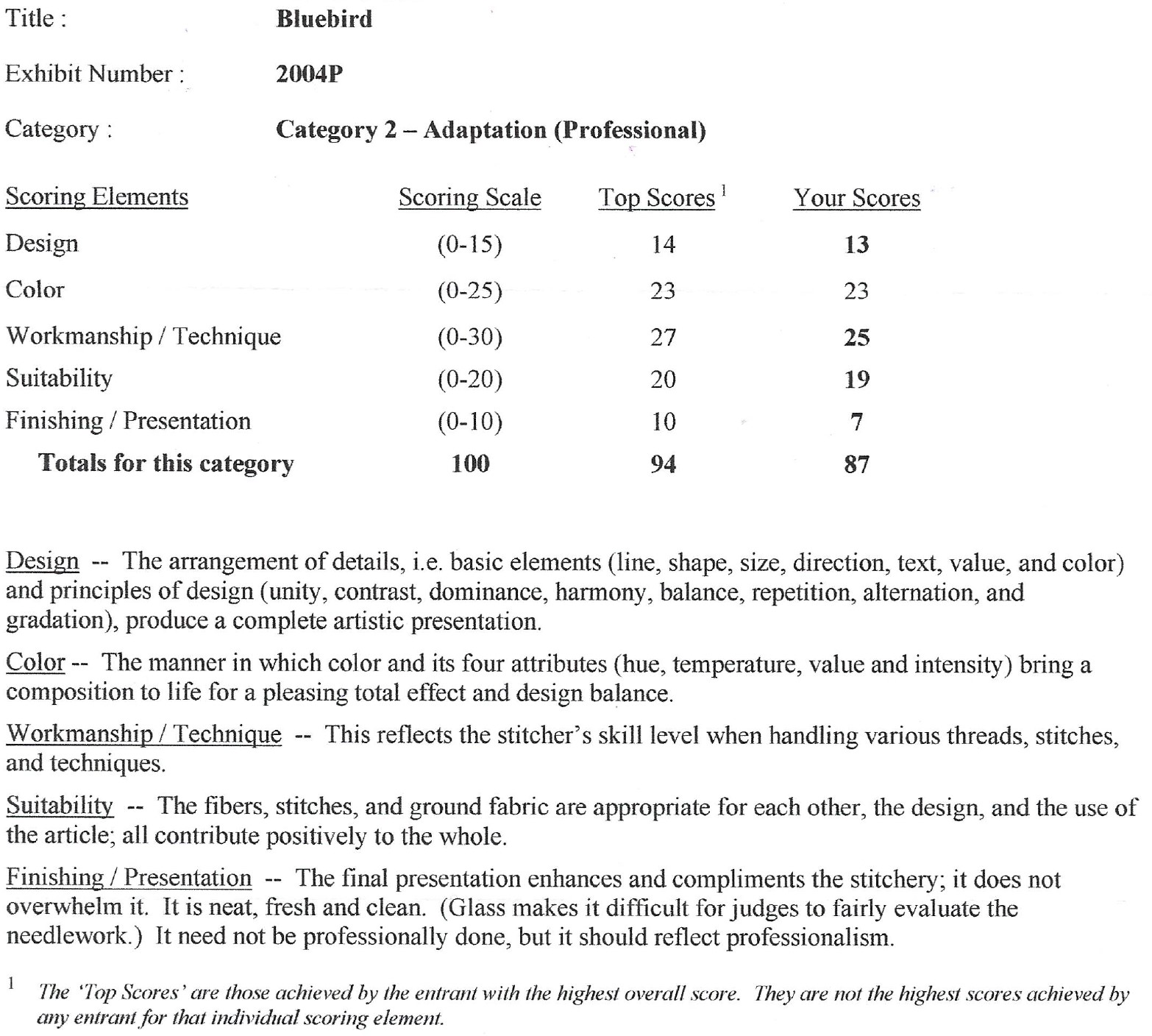
• Ordinarily some of my comments would have been about the line of the back of the bluebird could have been smoother. But then I realized that your depiction was truer to what had been painted, which is more important. Bluebirds may not be as dark of a blue as your sister-in-law painted him but we felt that you wanted to replicate her painting as much as possible in tribute.
• Your threadpainting was successful in transitioning from the darkest of colors to white. In the front of the breast, the transition was a bit more abrupt than on the side (middle) of the bird.
• Your threadpainting of the blue feathers was successful in the way you added the nuances of the different colors in those feathers. The success of the stitching of the feathers is in following the line of flow of the feathers from the breast to the tail. The line of stitches in the breast area follows the flow from the top of the breast to the lower part.
• Transitioning from the breast area to the midway area was not as smooth as it was from midway to the back area. The flow of the line of stitches truly followed the line of the body when going from the middle to the tail. Slanting some of the rusty brown stitches a bit in the middle areas would help a viewer to see a better flow.
• Using an open stitch allowed the shades of the background to come through in a much better way than if you had completely covered the ground fabric with stitching.
• Looking at the overall presentation of your piece, the bluebird might have been happier with a bit more space above his head. Adding some more background above the bird and less rock below would have helped. A less heavy frame would also have improved the presence of the bird.
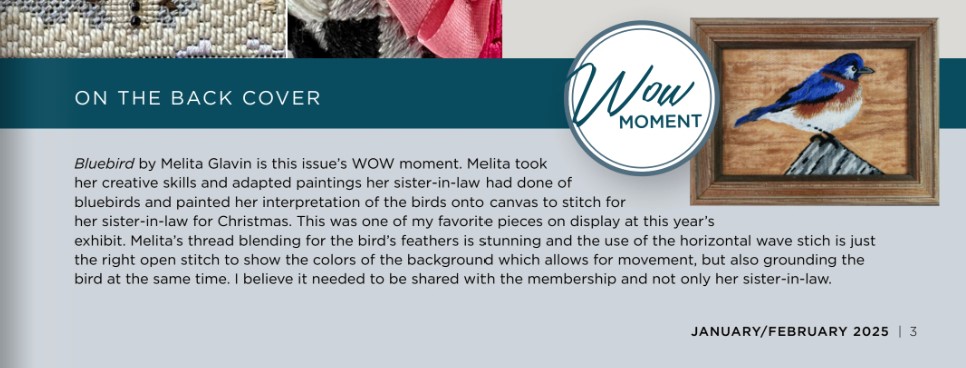
It was really special that Patty, the editor of NeedlePointers, has Bluebird as the WOW Moment & displayed it on the back cover page of the January/February 2025 issue! Here’s what she had to say about it:
Many thanks to Linda M who gave me her copy of the magazine so that I can present Sher with the issue. I want to keep a copy of the issue myself.
The piece was going to go to Sher for Christmas 2024, but I decided to send it south for the winter to the 2025 Woodlawn Needlework Exhibit where it earned Honorable Mention in Adaptation in Surface Embroidery category. It should not have been reclassified from Canvaswork to Surface Embroidery, but the Judges said it wasn’t them. There were 3 judges listed in the Woodlawn booklet and I had their contact information. Apparently, there is a committee that takes in the pieces, and it must have been them. I didn’t pursue it further.

Here’s the piece, ribbon, and pin from Patty..

We visited Sher for her birthday in May 2025. She was blown away and I can finally post this saga! Here we both are with our gifted bluebirds. Neither Lady nor DeeDee seem impressed.

 Melitastitches4fun's Blog