Filed under: Books in My Library, Needlepoint Books, Stitchery Under Southern Skies by Mary Anderson and Debbie Deem
I know I read several of Debbie Deem’s article s from old issues of ANG Needle Pointers for an Archives article on design. This booklet, Stitchery Under Southern Skies by Mary Anderson and Debbie Deem, must have been mentioned but I can’t remember why. Again, I found it online a few months ago, Bill put it away when it arrived, and I forgot about it.

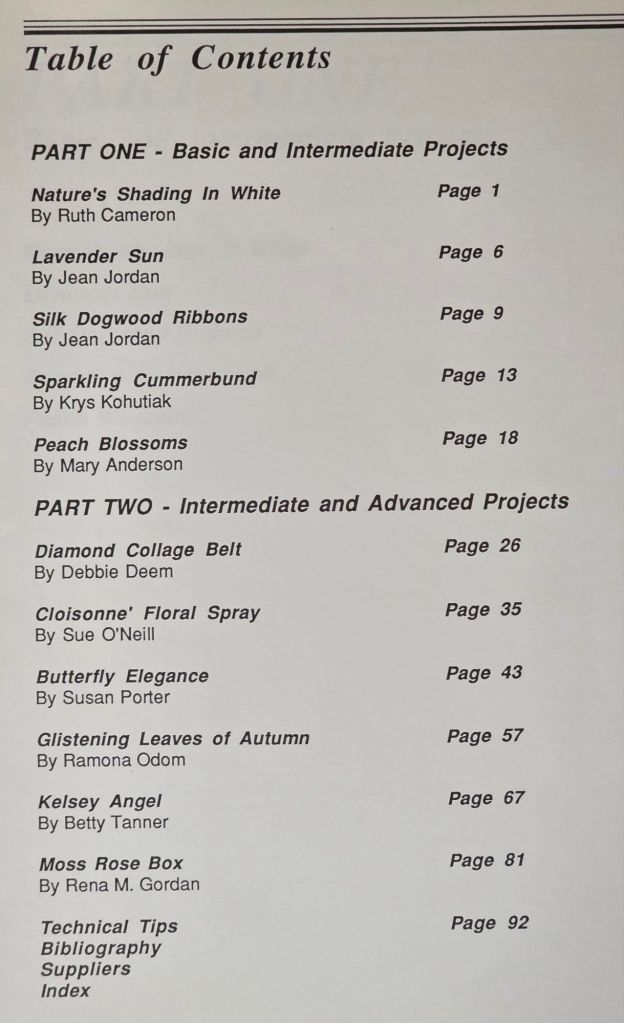
It’s technically not a “needlepoint book” as you can see from the Table of Contents because it has 11 projects. But, I gleaned some interesting things from it. Ruth Cameron explains how to use one color of stranded threads to create depth and contrast. Mary Anderson diagrams Smyrna Cross Variations. Susan Porter created an interesting Mosaic Border with a Running Stitch Accent. That’s what popped out on the first pass through the booklet.
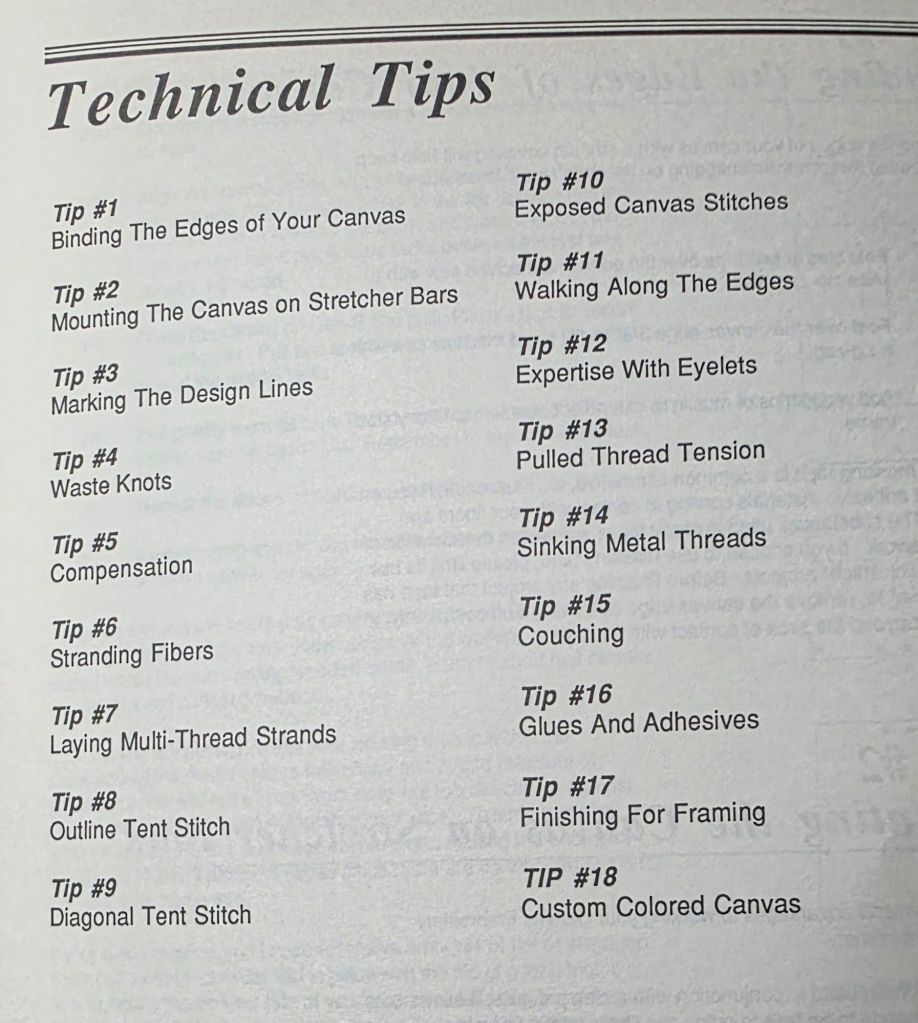
It ends with 18 tips. One was using a #16 or #13 needle to make eyelet holes consistent. And, the couching procedures are interesting. Couching over a thread is common enough but into the sides and down the center of a thread offers some variety.
Filed under: Books in My Library, Needlepoint Books, Traditional Silk and Metal Thread Techniques on Canvas by Jane Zimmerman
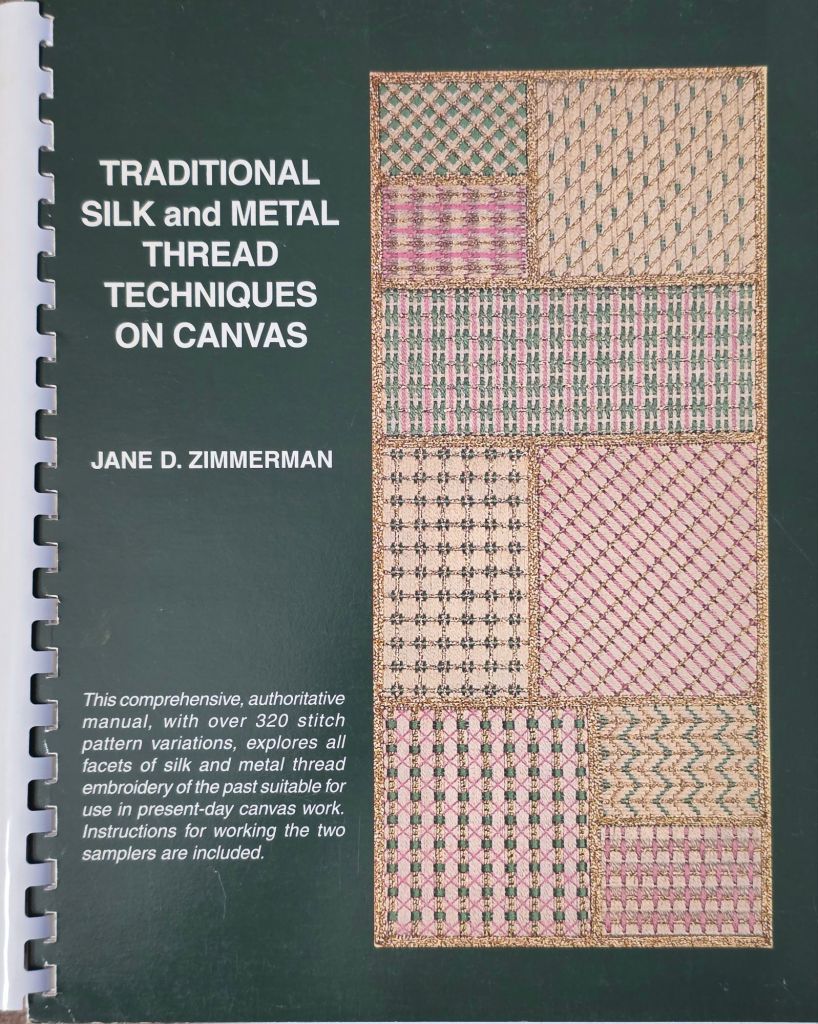
As the title implies, Jane Zimmerman discusses Traditional Silk and Metal Thread Techniques on Canvas.
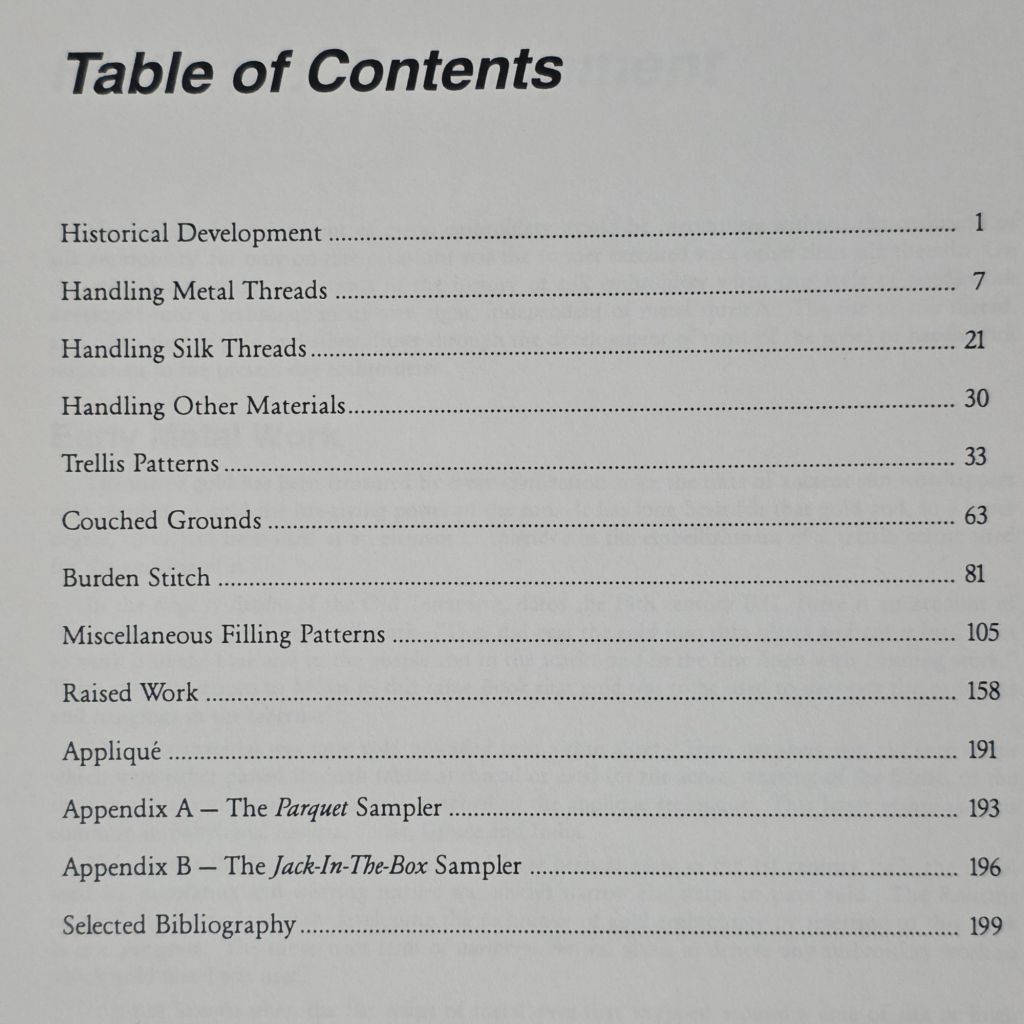
I don’t do much goldwork but this goes over enough to answer any questions I might have for that technique.
Even better, Jane provides hundreds of stitch patterns that can be used with any combination of threads. In fact, the 2 projects indicate that Kreinik can be substituted for the gold threads. But, I do have a box of leftover gold threads which I would love to play with but not now since I still have a few more 2025 goals to work on.
Filed under: Books in My Library, Exploring Pattern in Stitches by Mary Shipp, Needlepoint Books
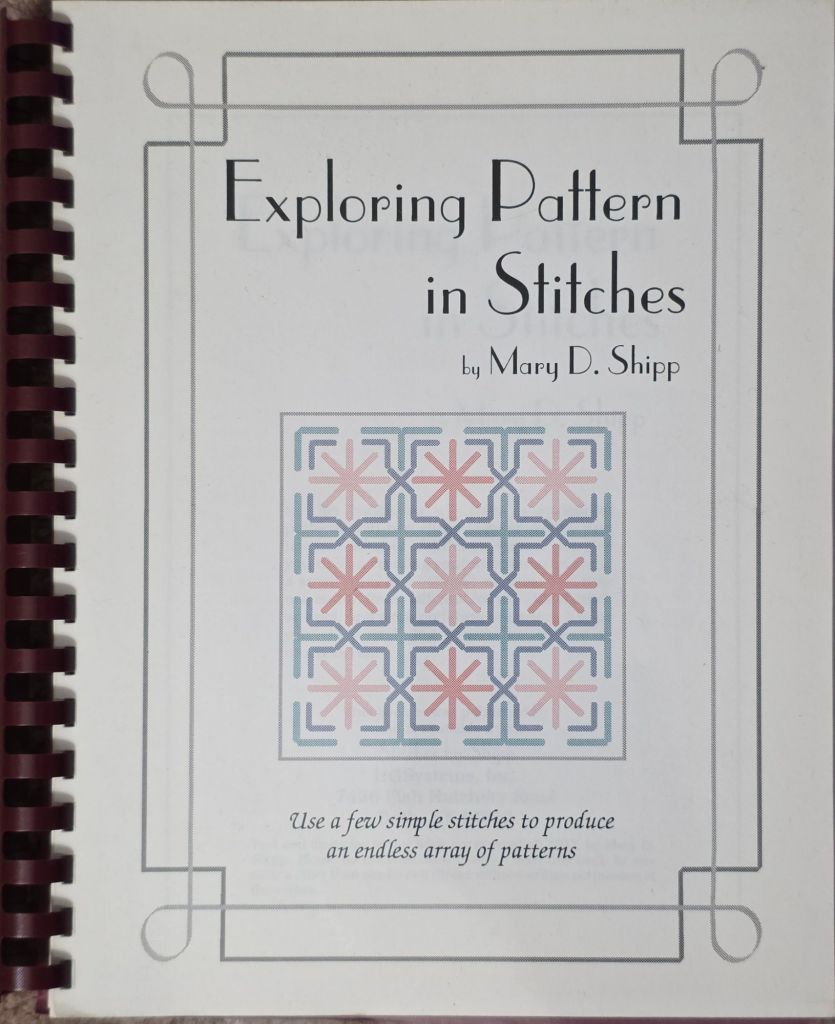
One of the books in Nanette Costa’s library was from one of my favorite teachers, Mary Shipp. It’s Exploring Pattern in Stitches which is a very interesting topic. I took two of my first three Correspondence Courses from Mary on Color and Design.
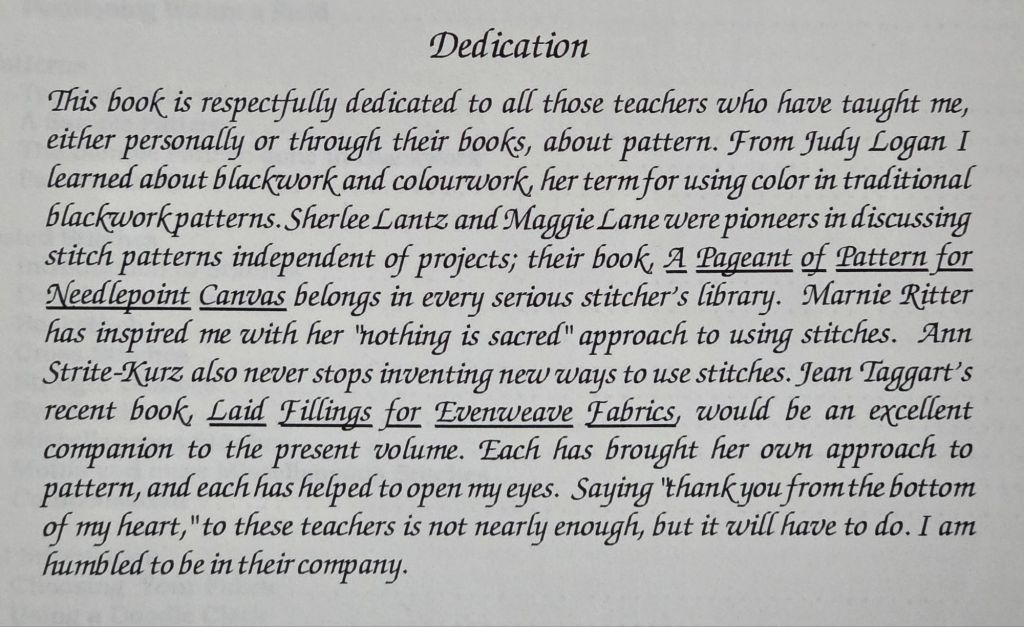
Mary grabbed me right from the beginning with her dedication by citing teachers she learned from. No big surprise that I have both the books she references.
In the introduction, Mary says she enjoys the process and does not need the product. That is probably why a number of my projects are completed but not finished. It may also account for why I have multiple projects started.
She provides a variety of patterns but gives tips on modifying them and creating your own. Any threads will work. Any color combination can be employed but color options are discussed including a review of The One-Three-Five Rule.
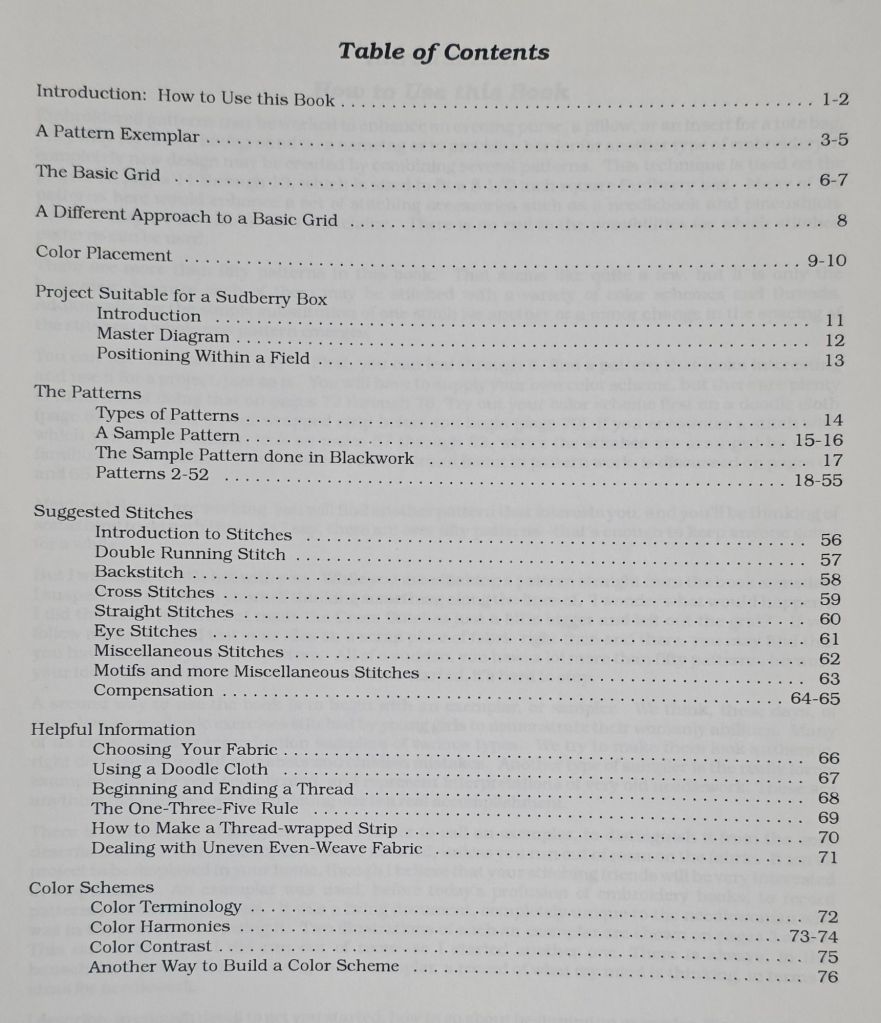
The coolest thing about the pattern project Mary includes is that beyond the Master Diagram marking off 5 areas, “you are on your own” for choosing patterns and colors. There is lots to read before tackling it (in 2026). Very exciting!!
Filed under: Books in My Library, Needlepoint Books, Quick Stitch Variations and More Quick Stitch Reference by Custom House of Needle Arts
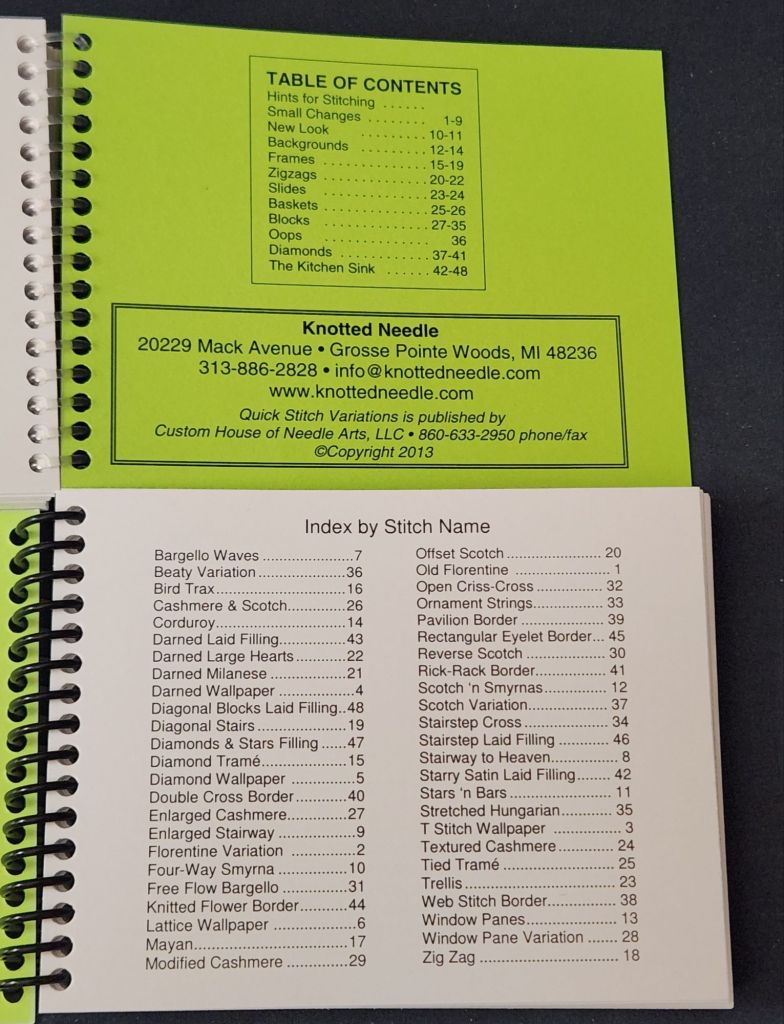
Quick Stitch Variations and More Quick Stitch Reference by Custom House of Needle Arts allows the ordering store to put their logo on the cover. Nice feature. It might make a nice Anniversary gift for chapters to give to their members (@ was $20 retail price).
The top one has a Table of Contents and the bottom one has a Stitch Index. Each stitch has text about where to use it and thread options. They are 5.5″ wide and 4″ tall.

Filed under: Books in My Library, Needlepoint Books, Transformative Stitching: Needlework on the Diagonal by Dawn Donnelly
Dawn Donnelly was selling Transformative Stitching: Needlework on the Diagonal at Merchandise Night.
It’s got a ring binder, so pages open and a flexible but hard plastic cover to withstand wear and tear. It’s my favorite size, 5.5″ wide and 8.5″ tall.

The Table of Contents also serves as an Index. I didn’t photgraph the entire TOC since it’s 3 pages long.
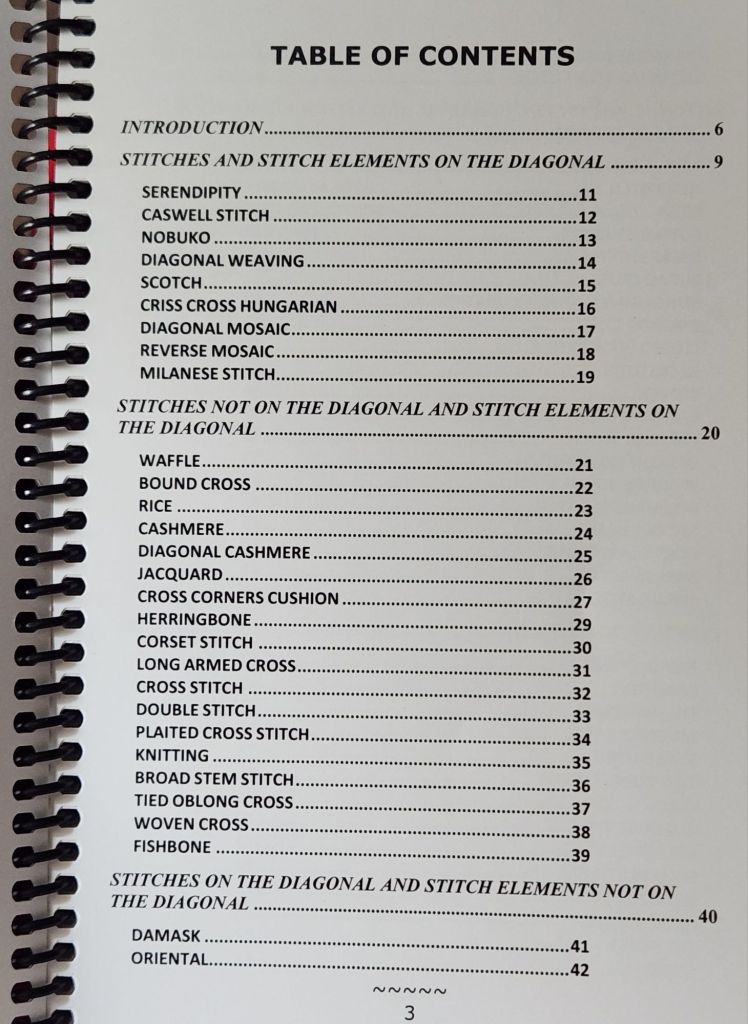
You can order it at https://www.threadupdd.com/merchandise-for-sale. What Dawn doesn’t say on her website is that she’ll share a link to a pdf so you can use it anywhere. I found several great stitches to use on my Project Runway piece.
Filed under: Books in My Library, Mary's Whimsical Small Stitches by Mary Legallet, Needlepoint Books
Mary’s Whimsical Small Stitches, Volume 4 is the book I picked up at Stitching Fox earlier this week.
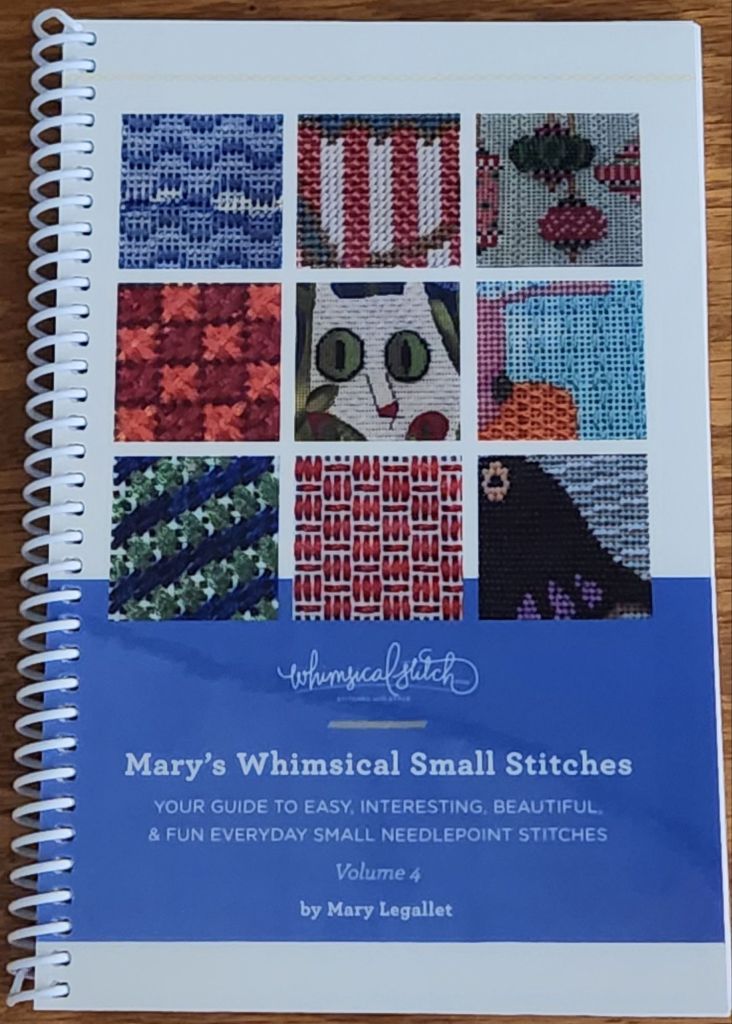
It has my favorite features: The stitch diagrams are easy to follow. It’s a small book at 6″ x 8.5″ with hard plastic covers on front and back but has rings, so pages flip and stay open.
It has a new feature. QR codes for stitched samples. Scan and the link takes you to her Instagram account for photos ofthestitch in action.
As the title states, these are stitch suggestions for small spaces. There is an excellent discussion of various issues under Stitch Planning 101.
Here’s the TOC:
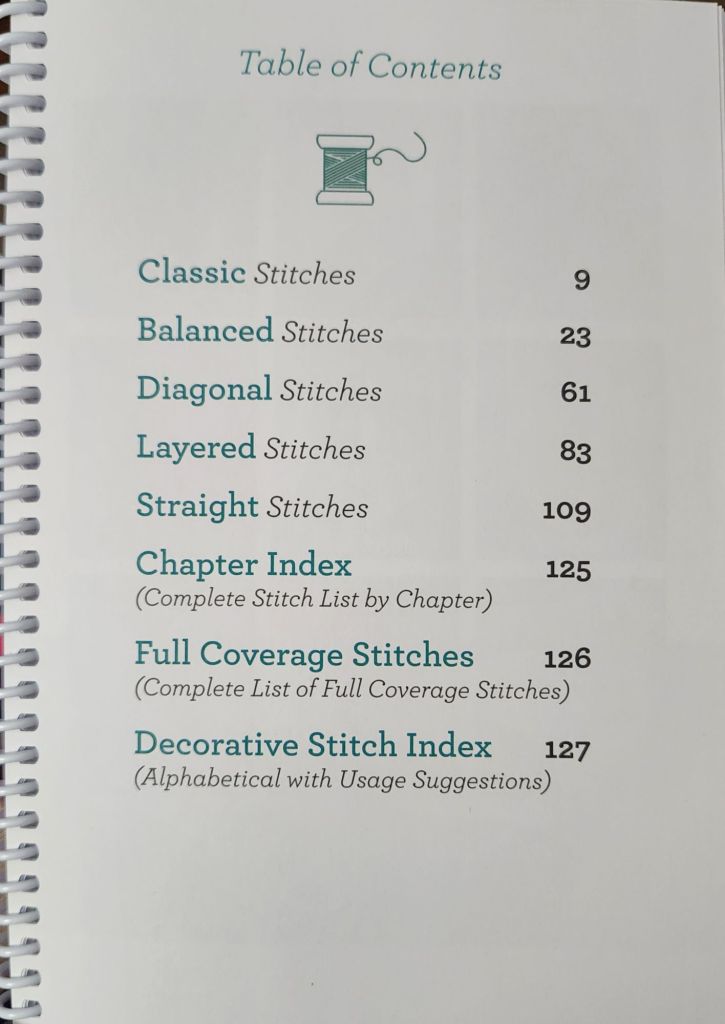
The Decorative Stitch Index is a wonderful feature.

This book should get a lot of use.
Filed under: Architectural Stitches by June McKnight, Books in My Library, Decorative Backgrounds by June McKnight, More Backgrounds by June McKnight, Needlepoint Books, Plants and Animals by June McKnight, Shading and Thread Blending Techniques by June McKnight
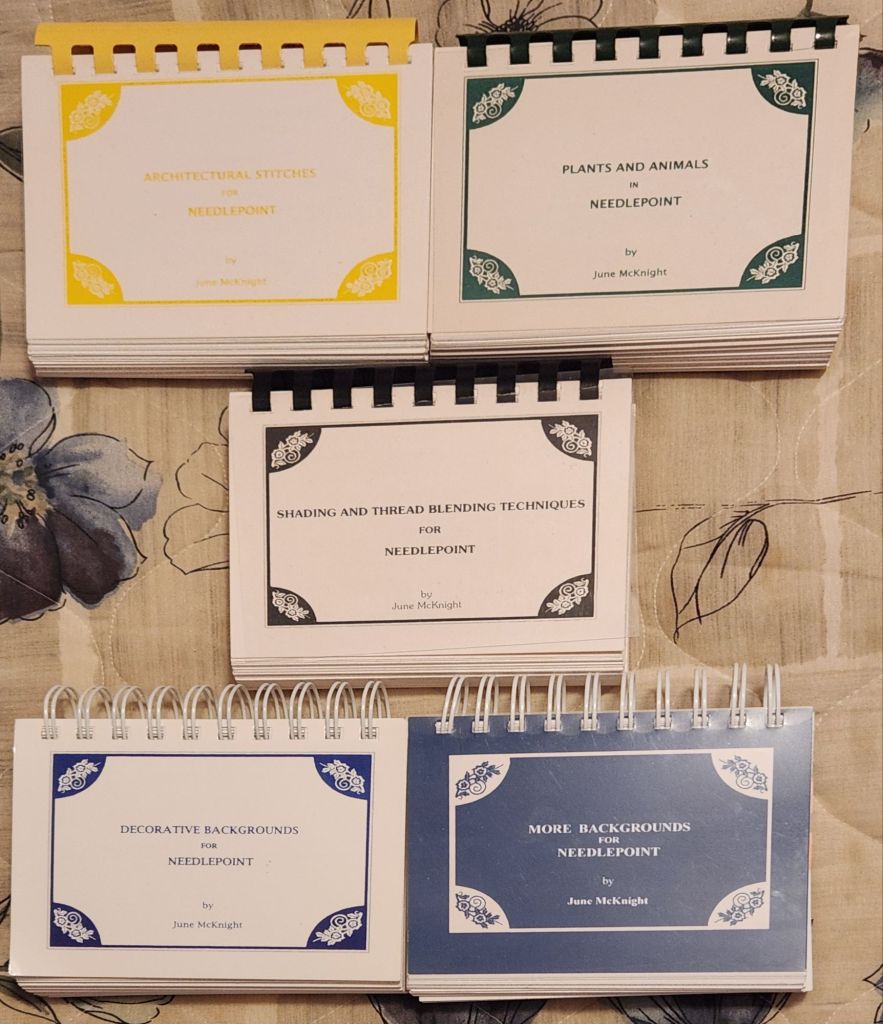
Most of my needlepoint booklets are 8.5″ wide x 11″ or 5.5″ wide x 8.5″ high. But these by June McKnight are 5.5″ wide by 4″ high, and they are thick at 1.25″ with heavy weight pages printed on one side only.
June McKnight has quite a few books of which I have these 5:
Architectural Stitches: Foundations, walls, masonry, windows, doors, roofs, and fretwork.
Plants and Animals: Foilage, flowers, garden structures, and animals.
Shading and Thread Blending Techniques: Precise thread blending, random thread blending, tweeding, twilling, twiddling, shading with dynamic threads, and decorative stitches. It’s my favorite book of the ones I own.
Decorative Backgrounds: In addition to the Ten Commandments of Backgrounds, there are basketweave and continental variations, fast and easy, delicate, trellis stitches, Florentine backgrounds, pattern darning & blackwork, pulled lace, and bold.
More Backgrounds: Covers lace, satin, stripes, wallpaper, chenille (patterns combined with FrenchKnots), and darning.
Filed under: Books in My Library, Embellishments for Canvas by Mary Lou Helgesen, Needlepoint Books, New Twists on Needlework Embellishment by Howren and Robertson
Two new books joined my library for Christmas. As you can see, they are focusing on embellishment for painted canvases.
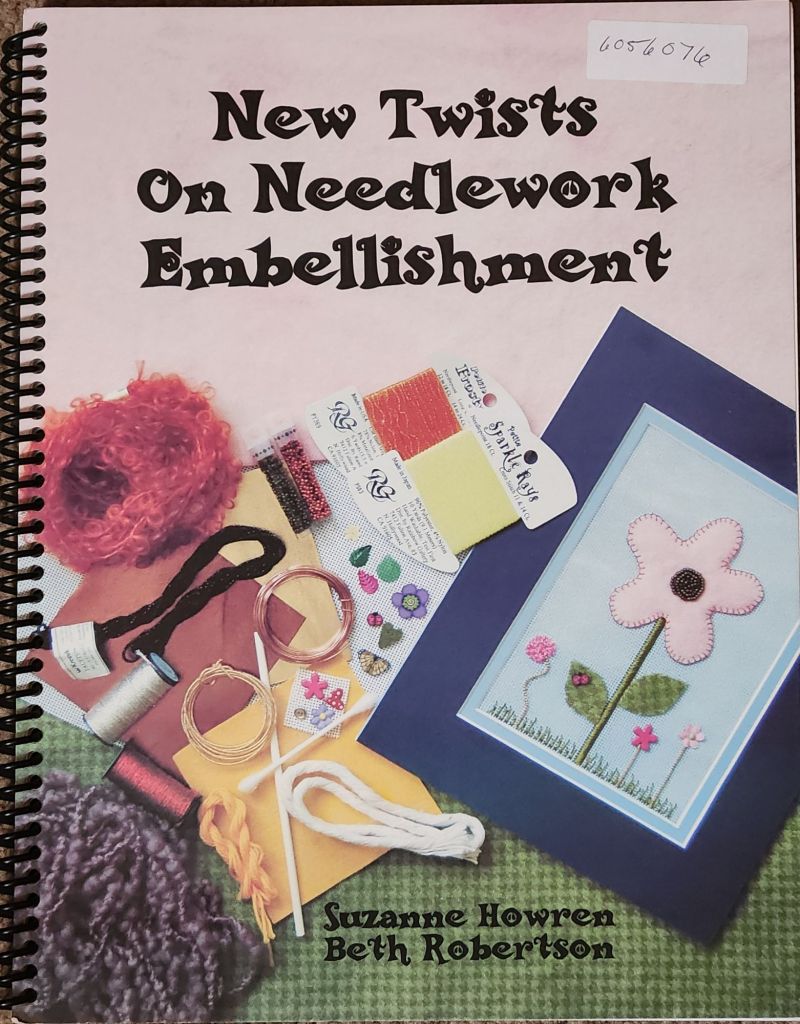
New Twists on Needlework Embellishment by Howren and Robertson is well indexed. Ruching a variety of threads is discussed, although what they call ruched ribbon is more of gathered ribbon like that done in All That Shimmers.

Embellishments for Canvas by Mary Lou Helgesen is primarily for nativity figures but has an interesting use for a wide ribbon. Jacqui talked about ribbons at the New Jersey Needle Artists Chapter meeting this week and supplied us with several ribbons, including the wide ribbon in our kit. There is also a canvas pattern that turns corners, which should be fun to try.


Here’s the photo of the ribbon suggestions in the booklet. I couldn’t figure out how to weave around the French Knots on the wide ribbon or where I would use it, but couching ribbons would be easier to incorporate into a piece. I played a little with the other ribbons supplied by NJNA.

Filed under: Books in My Library, Needlepoint and Beyond 27 Lessons in Advanced Canvas Work by Edith Anderson, Needlepoint Books

In a previous post, I pointed out a chapter in Needlepoint and Beyond 27 Lessons in Advanced Canvas Work by Edith Anderson Feisner entitled Variations in which she describes varying a stitch by size, by direction, by proportion, and by combination. In fact, she stitched a small landscape in all white using all variations of only cross stitch.
Since I am working on attaching stones, shells, and various objects, I read the chapter on Stones, Beads, and Found Objects. In addition to detached buttonhole which Dawn Donnelly discussed in her class at the ANG Seminar, Treasures from the Great Lakes, needleweaving is also described to hold a shell.
In the Texture chapter, Edith ranks 25 stitches in 6 categories from smoothest (basketweave) to roughest (Turkey).
The book covers a lot:

Filed under: Books in My Library, Desert Island Stitches, Volume 1 - Ideas for Small Spaces, Desert Island Stitches, Volume 2 - Ideas for Creative Borders, Needlepoint Books, Painted Canvas Embellishment: An Idea Book by Carol Lake and Michael Boren
These books by Carole H Lake and Michael Boren are intended to aid stitchers of painted canvases. But, they are stitch books, making them relevant and useful for selecting stitches for any project.
Painted Canvas Embellishment: An Idea Book
There is an excellent 5-page introduction of general thoughts, including choosing threads and stitches.
The pages on thread characteristics are not exciting, but I have skimmed them at least once. I underlined “chainette” in 8 places (2 are noted as discontinued – maybe more than that by now). It would make a good reference if you’re threading up an old project that calls for discontinued threads so you know better what to substitute.
Stitches cover faces, fur, clothing, foliage, snow, wings (good for my butterfly that I’m working on but not posting about until the big reveal for my ANG Main Line Stitchers chapter), stars, motifs, small areas, medium areas, very large areas, backgrounds, borders, lines, shading, combinations, and beading.
Desert Island Stitches, Volume 1 – Ideas for Small Spaces
It covers tent stitches in the first 2 pages. Can you think of 12 patterns? They did! Then, they go into diagonal stitches, oblique stitches, straight stitches, and cross stitches.
Desert Island Stitches, Volume 2 – Ideas for Creative Borders
These borders are arranged in 6 sections: continuous borders, mitered corners, center miters, log cabin borders, corner motif borders, and center motif borders. I love the reminder to combine several narrow borders to make a wider border. That makes me think of Autumn 3-Ways by Toni Gerdes and 5 Vases with Curly Bamboo by Sharon G.

 Melitastitches4fun's Blog