Filed under: Books in My Library, Embroidery Books, Embroidery by Kathleen Whyte
Design in Embroidery by Kathleen Whyte


There are some color photos but mostly black and white ones.
This is not a stitch dictionary, although several stitches are discussed. Exercises are suggested to experiment with threads, stitches, colors, and textures.
This is more embroidery related, but canvaswork and drawn work are discussed.
Kathleen focuses on elements of a design with the most examples of free-form abstract pieces. The design on the cover is the most appealing one to me.
Filed under: Books in My Library, Embroidery Books, Making Needlecraft Landscapes by Mary Carroll, That’s Not Needlepoint (It’s Inspired Art Created with Your Needle), which is by dede Ogden
Neither of these are “stitch books” because they are focused on creating projects, but both show you how to apply stitches to create a realistic design.

Making Needlecraft Landscapes by Mary Carroll has 32 landscapes, and stitches are provided to make them. The color photos, diagrams, and detailed description of stitch placement are great.
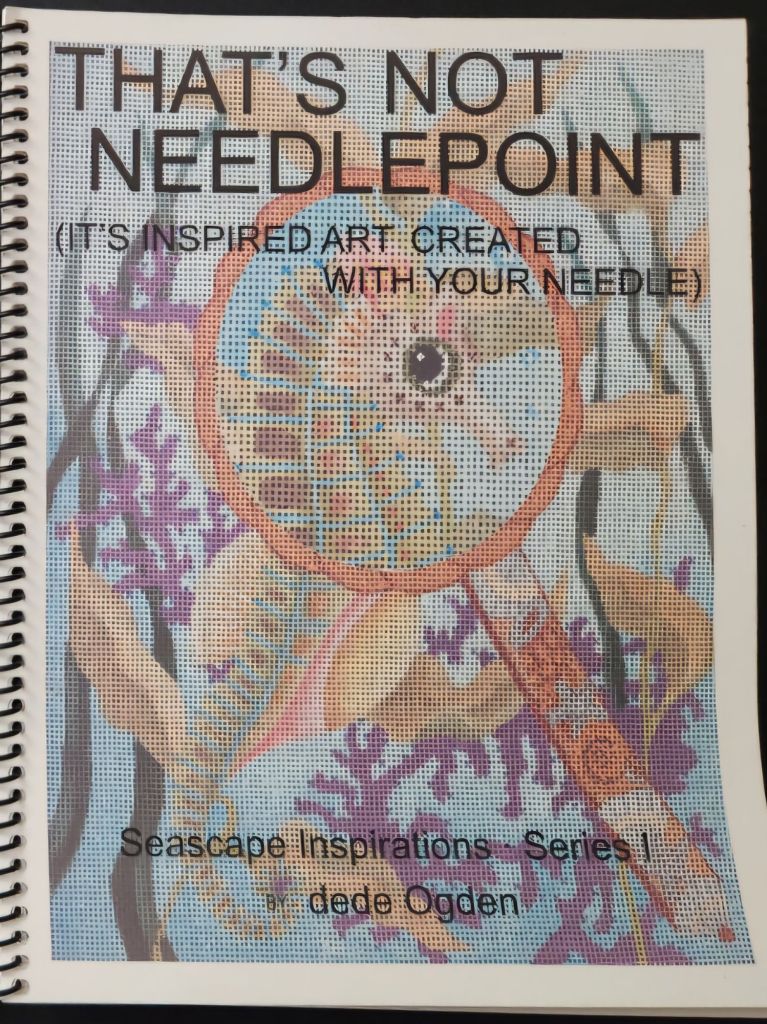
I did post previously about the other booklet, That’s Not Needlepoint (It’s Inspired Art Created with Your Needle), which is by dede Ogden (2011) and represented by Fleur de Paris, Inc. It’s not intended to be complete charts or diagrams to finish the various painted canvases but to offer suggestions for types of elements found in seascapes. The first canvas discussed is Seahorse Spyglass 18073 and is still available (and so is a stitch guide by Tony Minieri). Other canvases discussed are still available from a variety of sources including Undersea Fish 1373, Glass Aquarium Tropicals Green Fish 18015, Glass Aquarium Tropicals Blue Fish 18034, Undersea Garden 1378, Seahorse Pillow 18056, and Enchanted Mermaid Dream 18050.
The Casalgudi stitch is discussed, although I can’t understand where it’s executed. The photos could be better. And, without padding, it’s probably better called a wrapped stem stitch. The Railway Stitch makes a good background stitch. Sue has an interesting Bead Cup Stitch and shows how to expand an overlapping cross stitch to fit fluctuations in the width of seaweed.
Filed under: Books in My Library, Needlepoint and Beyond 27 Lessons in Advanced Canvas Work by Edith Anderson, Needlepoint Books

In a previous post, I pointed out a chapter in Needlepoint and Beyond 27 Lessons in Advanced Canvas Work by Edith Anderson Feisner entitled Variations in which she describes varying a stitch by size, by direction, by proportion, and by combination. In fact, she stitched a small landscape in all white using all variations of only cross stitch.
Since I am working on attaching stones, shells, and various objects, I read the chapter on Stones, Beads, and Found Objects. In addition to detached buttonhole which Dawn Donnelly discussed in her class at the ANG Seminar, Treasures from the Great Lakes, needleweaving is also described to hold a shell.
In the Texture chapter, Edith ranks 25 stitches in 6 categories from smoothest (basketweave) to roughest (Turkey).
The book covers a lot:

Filed under: Books in My Library, Desert Island Stitches, Volume 1 - Ideas for Small Spaces, Desert Island Stitches, Volume 2 - Ideas for Creative Borders, Needlepoint Books, Painted Canvas Embellishment: An Idea Book by Carol Lake and Michael Boren
These books by Carole H Lake and Michael Boren are intended to aid stitchers of painted canvases. But, they are stitch books, making them relevant and useful for selecting stitches for any project.
Painted Canvas Embellishment: An Idea Book
There is an excellent 5-page introduction of general thoughts, including choosing threads and stitches.
The pages on thread characteristics are not exciting, but I have skimmed them at least once. I underlined “chainette” in 8 places (2 are noted as discontinued – maybe more than that by now). It would make a good reference if you’re threading up an old project that calls for discontinued threads so you know better what to substitute.
Stitches cover faces, fur, clothing, foliage, snow, wings (good for my butterfly that I’m working on but not posting about until the big reveal for my ANG Main Line Stitchers chapter), stars, motifs, small areas, medium areas, very large areas, backgrounds, borders, lines, shading, combinations, and beading.
Desert Island Stitches, Volume 1 – Ideas for Small Spaces
It covers tent stitches in the first 2 pages. Can you think of 12 patterns? They did! Then, they go into diagonal stitches, oblique stitches, straight stitches, and cross stitches.
Desert Island Stitches, Volume 2 – Ideas for Creative Borders
These borders are arranged in 6 sections: continuous borders, mitered corners, center miters, log cabin borders, corner motif borders, and center motif borders. I love the reminder to combine several narrow borders to make a wider border. That makes me think of Autumn 3-Ways by Toni Gerdes and 5 Vases with Curly Bamboo by Sharon G.

Filed under: Books in My Library, Embroidered Landscapes by Helen M Stevens, Embroidery Books
I’ve been asked by my Needlework and Fiber Guild of Media to talk about selecting stitches for needlepoint next month in 30 minutes or less!
Having worked on landscape stitches for Gail Stafford’s class and now her Tar River Trail, I will share them and several canvas books that list stitches by effect rendered (fur, buildings, flowers, etc).
I also have this book, Embroidered Landscapes by Helen M Stevens who shares her masterclass in landscape through 5 major projects with templates, color charts, and detailed explanations of design elements.

These designs employ mostly linear stitches, including stem and straight stitches. The filling stitches look linear to me but are called opus plumarium or feather work.
For these designs, it’s less about the stitches and more about perspective. In the photo on the cover, you can see elements in the close, middle, and far distances.
Shading plays a big part with each design using between 19 and 26 threads. In 3 of the designs, between one-third and half the threads are in the yellow and green family.
The use of contrasting threads is employed by using shiny threads to add vibracy up close and threads with duller texture to recede.
Stranded cottons, stranded and twisted silks, Japanese floss silk, fine floss silk, and spun (fine twisted) silk threads are suggested.
An example of varying thread types was using twisted cotton for grass, a plied silk for a glossy river, and a very fine untwisted silk floss for the sky.
I am disappointed that actual threads used in the designs are not provided. Only the colors are suggested in the color coded design map. It would have been helpful.
These are best worked on a smooth, evenweave fabric that does not stretch. Suitable fabrics include cotton, polyester cotton (Percale), and linen. Although she suggests evenweave, she says, “As a general rule, if the weave is open enough to be used for counted thread embroidery, it will be too wide for us!”
One of the scenes resembles the perspective that I have designed for the second design from Debbie Rowley’s class. I did so want to get started on that, but I do really want to finish Tar River Trail before the seminar. Then, I’ll want to finish those pieces (3 classes)! Oh my. Got to get my head out of this book and back to stitching!
Filed under: Books in My Library, Needlepoint Books, The Canvas Embroidery Notebook by Mindy English & a Book Mix-up!
I ordered The Canvas Embroidery Notebook by Mindy English from an Ebay site and was sent Backgrounds, The Finishing Touch by Ann Strite-Kurz instead!
After one look inside Ann’s book, I was happy with the mistake. Wow. I only paged through it, but the amount of information in this book is considerable. It will take quite a while to go through it all. I am excited to see the photos on the CD. Some photos I recall from Ann’ Diaper Pattern and Potpourri of Pattern Encore books, but much is different.
It made me think to look at Ann’s website again to see what other books she has. I already had her Potpourri of Pattern Encore when I started the Master Craftsman program. That’s when I got her Diaper Pattern and Applique books to expand my knowledge of those areas before tackling those steps. All her books have been so thorough. I also obtained Stitch Variations and Mutations, Parts 1 and 2 and Stitch Refinement for Canvas Embroidery (which replaces the older book, The Science of Canvas Embroidery). I could use 6 more weeks of winter to read these books!
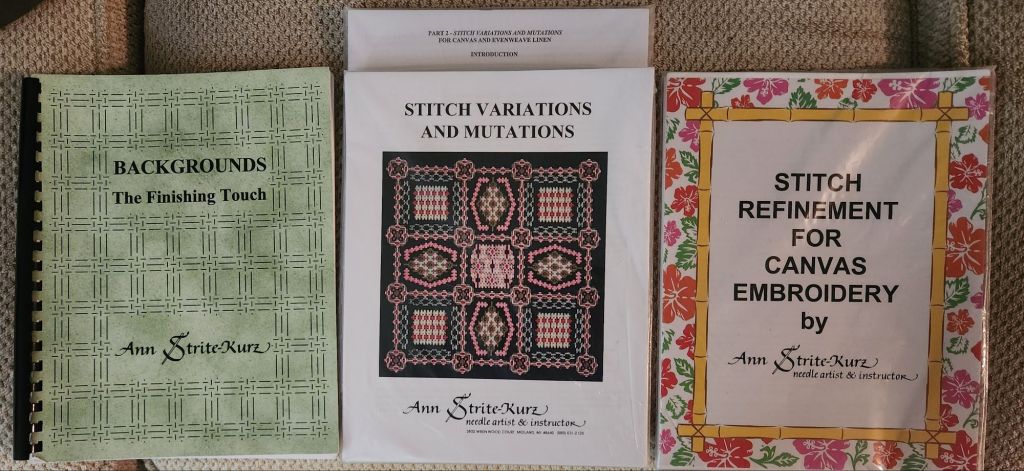
Since I keep books organized by author on my blog, I have updated my original post on Ann’s books: https://melitastitches4fun.com/2022/02/25/books-in-my-library-canvas-applique-diaper-patterns-and-potpoutti-of-pattern-encore-by-ann-strite-kurz/
I did find Mindy’s book from AbeBooks, who got the order correct. Not only is this an excellent reference for 20 stitches but also for manipulating those stitches for increased creativity. It was written in 1986 (the fifth revision) but is just as relevant today. The pages are numbered within each chapter, and the index refers you to pages within the chapter, but you have to find the start of each chapter. It’s not my favorite pagination. But otherwise, it’s just what I expected.
There are 26 variations of the Mosaic Stitch. But then there is more variation under Diagonal Mosaic Stitch. The patterns under Mosaic Family combine Mosaic, Scotch, Milanese, and Cashmere. Wow! Both the creativity and time it took to put this together is amazing.
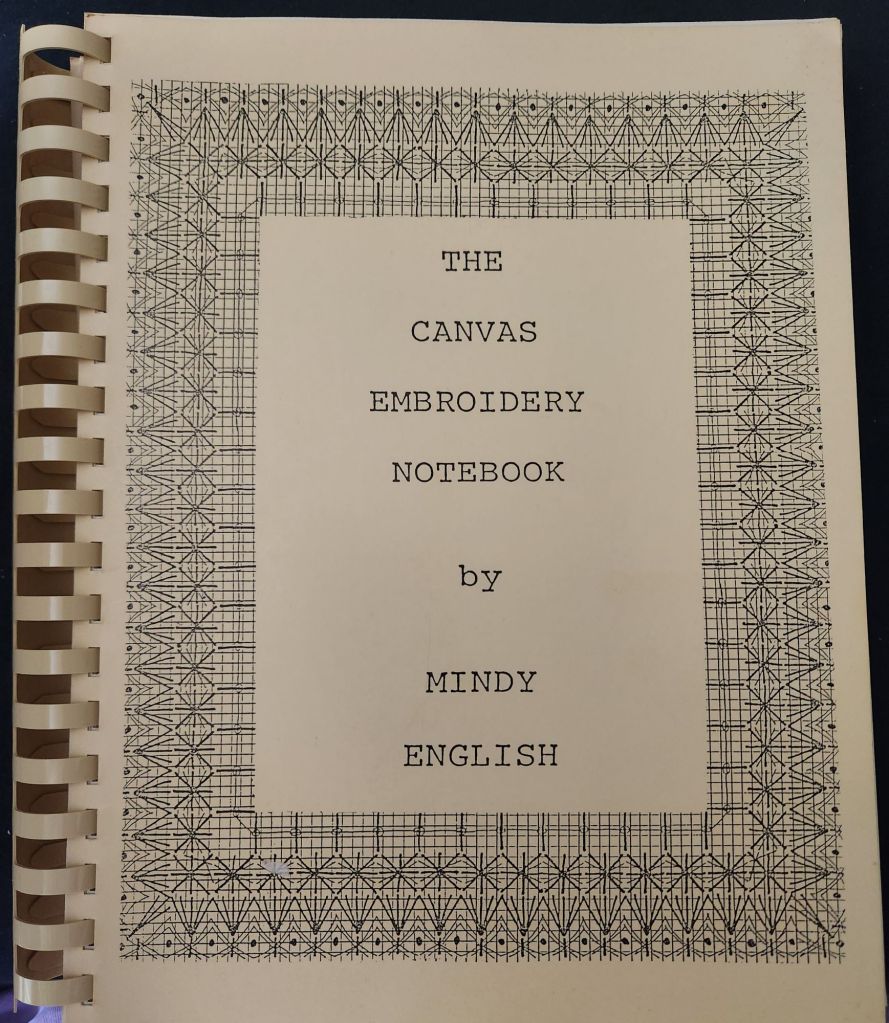
Both Ann and Mindy explore stitch variations. It’ll be interesting to see how each approaches the issue.
Since I now have two of Mindy’s books, one is going to Meghan, a younger member of my ANG Main Line Stitchers chapter who has been very engaged in needlepoint since joining our chapter. You can see her owl in the September/October 2023 issue of Needle Pointers along with Lori’s and Patrick’s owls under Chapter News. All 3 are great. Watch for something more from Meghan later this year in the magazine!
Filed under: 120 Alphabets by Leisure Arts, 365 Alphabets: Cross Stitch All Through The Year by Kooler Design Studio, Alphabet Books, Alphabets Galore: 136 Alphabets by Leisure Arts, Books in My Library, Clown Alphabet by Just CrossStitch, Plain & Fancy Alphabets by Better Homes and Gardens
The ANG NJ Needle Artists chapter is doing Chottie’s Plaid for a name tag. Last night, Cathryn discussed how to fit names onto the available space. It dawned on me that I never compiled a list of my alphabet books.
My print pamphlets/books include (in no particular order):
Plain & Fancy Alphabets by Better Homes and Gardens

Clown Alphabet by Just CrossStitch

365 Alphabets: Cross Stitch All Through The Year by Kooler Design Studio

Alphabets Galore: 136 Alphabets by Leisure Arts

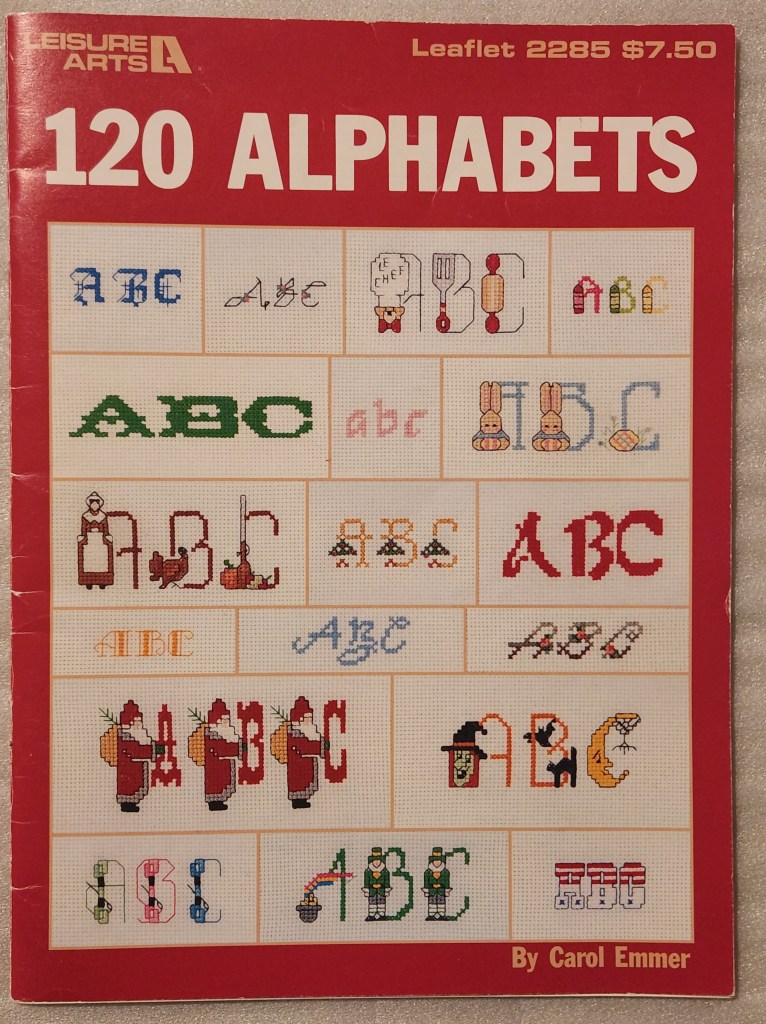
120 Alphabets by Leisure Arts
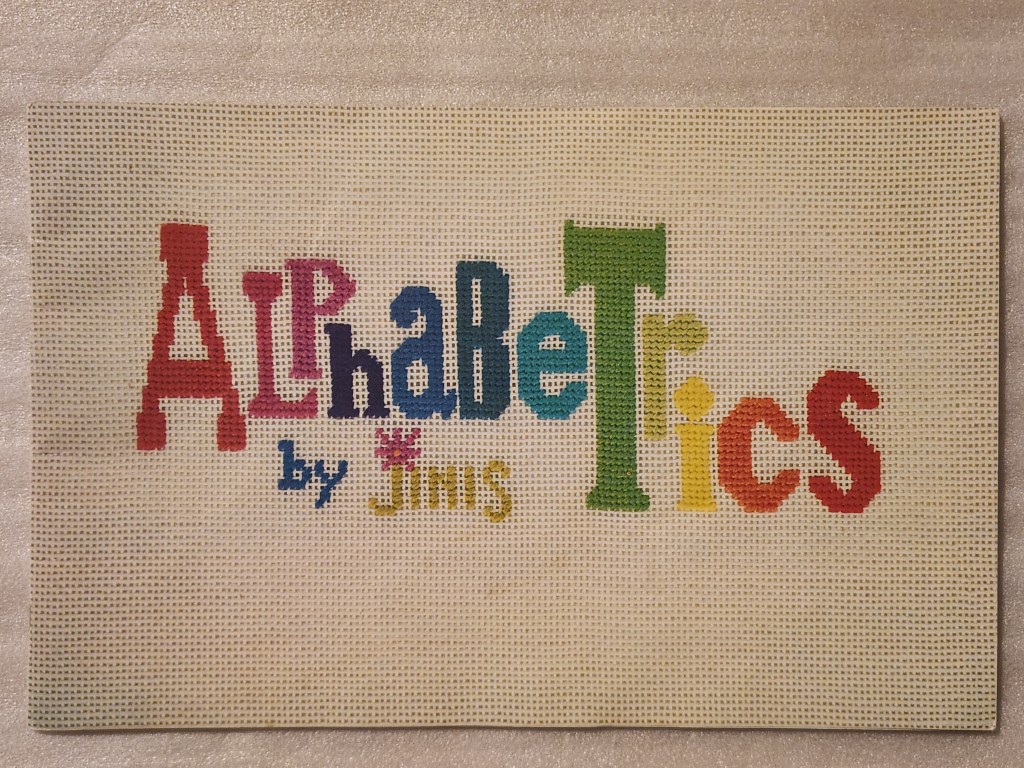
Alphabetrics by Jinis
Online resource include:
https://lordlibidan.com/53-free-cross-stitch-alphabets/ Here’s an example (arranged by height up to 16 stitches high):

And, ANG members can access this one:
Leslie’s Italic Alphabet by Dianne’s Designs from Nametag with Bright Fish, by Leslie Barnes, in the 1999 July issue of Needle Pointers magazine (https://online.fliphtml5.com/bjsk/bzza/).
Brenda C left a comment below with more wonderful resources but I wanted to pull them up into the posting in case I forget they are there or others don’t read the comments. The rest are from Brenda who is, as always, very helpful and generous!
These also from Needle Pointer’s are by Tink Boord-Dill (who wrote many alphabet books which are available on Etsy at https://tinkbd.com/ and a Google search will find a few other books; a review of 6 books is in the 2006 03 March issue and 4 books in the 2018 05 May issue – alphabets are always in style):
- 2005 07 July issue for Asian and Pressed Out 18 or Negative Space
- 2005 09 September issue for Hebrew 16
- 2005 11 November issue for Typo Script 20 and Gallery 19 Serif
- 2006 01 January issue Diamond Tilt 20 and Bucket 16
In the 2013 03 March issue of Needle Pointers has 5 different alphabets from Sandra M R, an ANG certified Senior Master Teacher.
In the 2019 03 March issue of Needle Pointers Kathleen B shared her design, Lower Case Alphabet Sampler.
Janet Perry also has some wonderful alphabets on her blog: Nuts about Needlepoint.
I got this tip to add: If you want the words/letters to be legible on name tags, stick to simple, large fonts. Many of those you find in books are better for monograms than names.
Filed under: Books in My Library, Needlepoint 101 by Ruth Dilts, Needlepoint Books
Previously, I reported on Needlepoint 202 by Ruth Dilts which is A Guide to 12 Different Techniques with Illustrations for Embellishment of the Painted Canvas.
Of course that book led me on a quest for Needlepoint 101. Well, I found it!
Needlepoint 101 Guide to Painted Canvases is also by Ruth Dilts. This book (from 2005) provides a list of 21 stitchs and a stitch effect guide (beards, bushes, clouds, etc) and provides stitch guides for another 12 painted canvases of which I easily found 4 are still available (online google search) including: Puma Coaster by Kathy Schenkel, Lady Bug by JP Needlepoint, and Cowboy Santa by Needle Graphics.
Even without having the canvas, this book suggests stitches for components of lots of canvases such as clothing, flowers, pots, sky, tree, hair, stonework, paving, and more.
Each stitch has a brief description and list of suggested uses and where the stitch was used in the 12 canvases. Excellent cross referencing.
I just read the article Bookshelf by Elizabeth Bozievich in the Jan/Feb issue of Needlepoint Now and most of her favorite needlepoint books are the smaller 5″ x 8″ ones. This one is a small one too. Hopefully, she enjoys her retirement from owning and editing the magazine. I look forward to future articles from her. And, best of luck to Andrea Santiamo, the new owner and editor of Needlepoint Now.

Filed under: Books in My Library, Father B's 21st Century Book of Stitches, Needlepoint Books, Sharon G's Simply Essential Needlepoint Stitch Explanations
These two books are grouped together simply because the author’s name is identified in the title.
Father B’s 21st Century Book of Stitches is by The Reverend Robert E Blackburn, Jr. I have the Sixth Edition from 2000. He passed away in 2000 but I didn’t know that and thought I was meeting him at a class held by Orna Willis at her studio. It turned out to be a different Father B! An excellent stitcher, a fellow Duquesne alumni, and we still keep in touch. What are the odds of two Father B stitchers?
Back to the book. There are 353 stitches some of which Father B created himself. So, many are unique to this book and interesting. He had a needlepoint shop in the basement of his church with threads, canvases, and books. He published articles Needle Pointers, Needlepoint Today (I don’t know that one), and Needlepoint Now. He also designed – many published through Rainbow Gallery and some can still be found online at eBay or Etsy (google Father B needlepoint designs).
The organization of the book is a bit odd. There are chapters but the headings are difficult to find (all uppercase letters as are the stitch names in the same font size). They are as follows: The Outline Stitches-pg 1, The Gobelin Stitches-pg 12, The Slanted Gobelin-pg 47, The Brick Stitches-pg 88, The Hungarian Stitches-pg 115, The Scotch Stitches-pg 135, The Cross Stitches-pg 150, The Star Stitches-pg 203, The Eyelet Stitches-pg 208, Miscellaneous Stitches-pg 239 including what he calls Filler Stitches-pg 268 (mostly open background stitches), The Border Stitches-pg 300, Oriental Diaper Patterns-pg 331, and Miscellaneous Stitches II-pg 344.
Within each chapter, stitches are usually listed alphabetically and the Index at the end has all stitches listed alphabetically. But so many are names that I do not recognize that I have to go through them. I am hoping that by identifying the type of stitches in each chapter that will make it easier to find a stitch type. He talks about each stitch sometimes suggesting a thread type or how many colors to use. Most stitch paths are not numbered but he often discusses how to work the stitch.
I have not seen the new Father B book by Suzanne Howren but Janet Perry reviews it (https://nuts-about-needlepoint.com/a-father-b-sampler-book-review/) and it sounds good.
Sharon G’s Simply Essential Needlepoint Stitch Explanations (SENSE) was published in 2010 and was intended to be the first in a series but I have not seen more. It is interesting that the organization is totally different from many stitch books. “SENSE” has 3 sections: Stitches with very low texture and minimal pattern, Stitches with medium texture and no diagonal flow, and Stitches with a well-defined diagonal flow.
Sharon G was a painter of needlepoint canvases and probably enjoyed and encouraged the use of lighter coverage so the artist’s paint could shine through. That’s actually one of the reasons why I haven’t done a lot of painted canvases. Why spend that much money for a beautiful canvas just to cover it completely with thread!?! So, I was happy that I had the opportunity to take a class with Sharon G for her canvas, 5 Vases with Curly Bamboo. She suggested some wonderful stitches and threads. I’m also happy that Linda and Beth stitched up the canvas a couple of years ago using other stitch guides. It was great to have the comradery of others stitching the same piece and see the variety of stitches in the 3 approaches. It was the subject of an article in Needle Pointers (Jan/Feb 2021) and all 3 were included during our virtual online exhibit (https://youtu.be/Ley3vbrjE4s). This piece now has center stage in my living room.
Sharon G also has a small paragraph discussing the stitch. I do like non-directional background stitches and just learned that the T-Stitch was named after Tish Holland who was one of two original partners in Sundance Designs. Did you know that T stitch which is worked on the vertical or horizontal intersections will change the texture due to the weave? One will be heavier and one lighter. The vertical intersections are higher and will be a heavier texture and horizontal stitches lie lower and will be slightly less texture.
Both books are small 5.5″ x 8.5″ but Sharon’s only has 68 stitches. I created my own index when I read through the book once before by writing down what stitches were recommended for different types of areas. She has stitches for backgrounds, buildings, Christmas, clothes, faces, feathers, fish, fur, grass, moon, quilt, roof, sky, snow, street, sun, upholstery, and a wall.

Filed under: Books in My Library, Borderlines by Jean Hilton, Light 'n Lacy by Jean Hilton, Needlepoint Books, Needlepoint Stitches by Jean Hilton, Stimulating Stitches by Jean Hilton
The books by Jean Hilton are presented in order of publication.
Jean experiments with stitches in Needlepoint Stitches (1988) right from the start with the same size Jessica but by shifting just the 1-2 stitch, she creates a small medium and large opening. Mind blowing and that’s just page 2! She explores the Amadeus stitch patterns, Jessicas, Walneto, Elongated Smyrnas, Rhodes, Sprats Heads, Waffles, and a bunch of miscellaneous ones (Bowtie, Mistake stitch, Mistake pinwheel, Helen’s Lace, Hesitation stitch, Hungarian Hearts, wrapped coils, cross and tuck, double tied, Ashland stitch, offset Scotch, tied Mosaic variation, a huge star and superimposed waffle, diagonal weaving, short Mosaic, and spatula). Her wrapped sheaf fit well in my Lady Sybil design. It’ll look better when I stitch it correctly too. I stitched it last night incorrectly, just ripped it out, and will get it correct tonight! That’s why I was writing this post – to find that error.
After using Stimulating Stitches (1992) for years, I just saw the Table of Contents divides the stitches into “motifs where all stitches go over previous ones” and “motifs where the stitches slide under” in all uppercase letters. In just three years, Jean “discovered” variations of stitches discussed in Needlepoint Stitches and revisits Jessicas, wrapped sheaf, Amadeus, and Waffles. Jean gets into crescents, exotic crescents, Fleur-De-Lis crescents, Sprats Heads, Plaited Rays, and Double Fans. I was able to learn how to make them fit the space I had in my Lady Sybil design.
In Borderlines (1994), Jean teaches you how turn a corner. There are borders within borders, narrow borders, dividing borders, straight borders, curving borders, heart borders, diagonal borders, and miscellaneous borders. Her imagination and ability to create these combinations is astounding. And, she describes how she developed them. There is a pattern of squares with 9 empty canvas threads and another with octagons and squares both of which looks like they would be fun to play with. One of her special corner treatments worked out perfectly for my Lady Sybil design although I nested 3 Jessicas. Speaking of Lady Sybil, that piece had something wrong with it and I ripped out a section and is now waiting for me to decide what to try next.
Jean Hilton’s Light ‘n Lacy is a booklet of 30 “Delicate Designs”, name tag designs, and an alphabet consisting of what else other than Smyrnas and Jessicas. This is from 1995 and I only recognize 2 of the 44 contributing stitchers. Reading this Introduction as with her other books is like having Jean sitting nearby talking right to you. These are not complicated designs using cross stitches, Smyrnas, crescents, eyelets, and Rhodes stitches. I got this more to see how she developed designs.

 Melitastitches4fun's Blog