Filed under: Embroidery Guild of America, Seminar 2023 - Boston, Understanding Color Relationships: Luster and Luminosity with Patricia Goaley
I did manage to finish the class assignment from Understanding Color Relationships: Luster and Luminosity with Patricia Goaley last night after dinner.
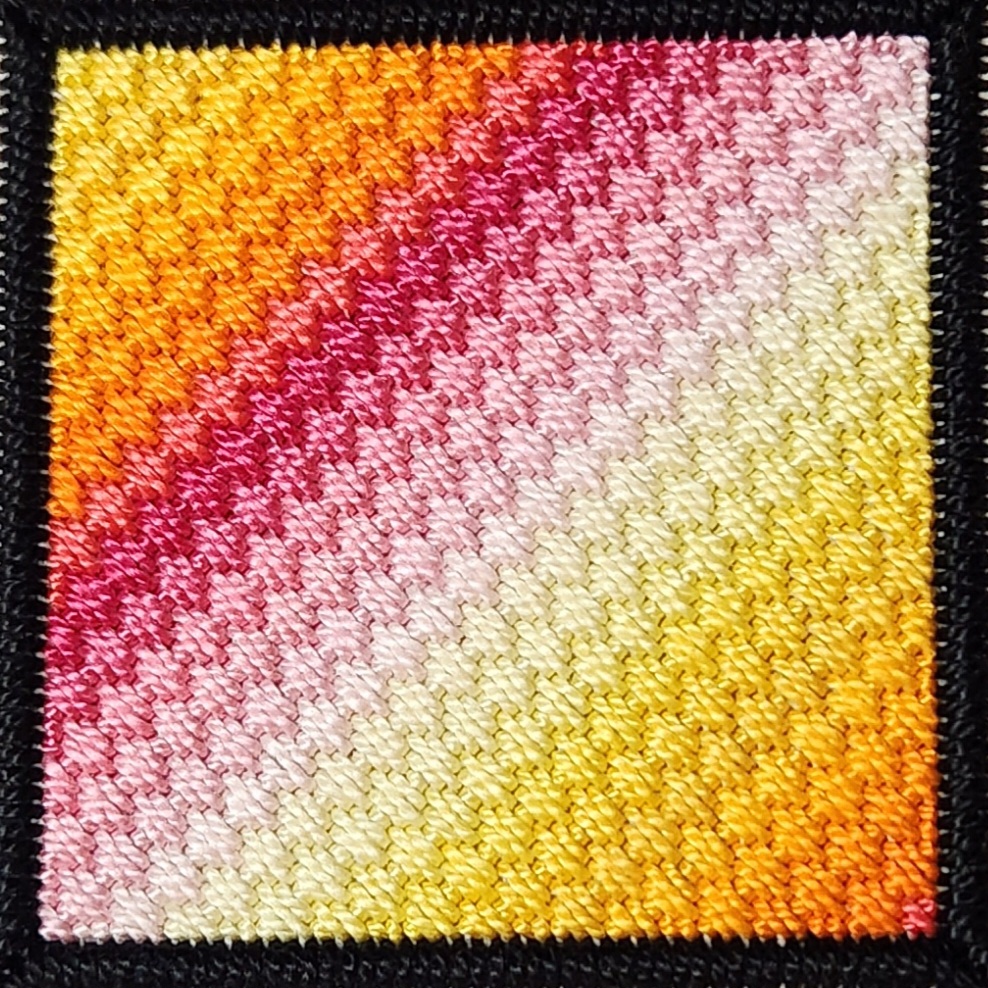
I have enough thread left. Perhaps I will make a companion piece for a pair of coasters.
Eventually, I will rework my tiny weaving project. First, I think I will finish the Pomegranate Heart while it’s fresh in my mind but not tonight. Even though I didn’t drive home, it was a long day. We enjoyed Boston and the Seminar but it’s nice to be home!
Filed under: Embroidery Guild of America, Pomegranate Heart by Melissa Sherbring, Seminar 2023 - Boston, Understanding Color Relationships: Luster and Luminosity with Patricia Goaley
My second class, a two-day class, was Understanding Color Relationships: Luster and Luminosity with Patricia Goaley.
Class description from EGA’s website: Using simple forms, we will experiment with advanced color relationships using various colors of number 8 pearl cotton and 18 count canvas and 28 count overdyed linen. This low stress class will play with luminosity and luster over 2 days. If you have overdyed linen that you are at a loss how to use, bring it and look at the future possibilities. There will be some choice in color chosen for fibers and foundation materials. Tricks will be discussed for improving overall appearance of your needlework and increasing the intensity of the color relationships.
I looked up the definition for luster. It is a gentle sheen or soft glow, especially that of a partly reflective surface. And, luminosity is the relative brightness of something.
Learning more about color and low stress sounded good!
In our first day, we made our own grayscale and hue color chart.
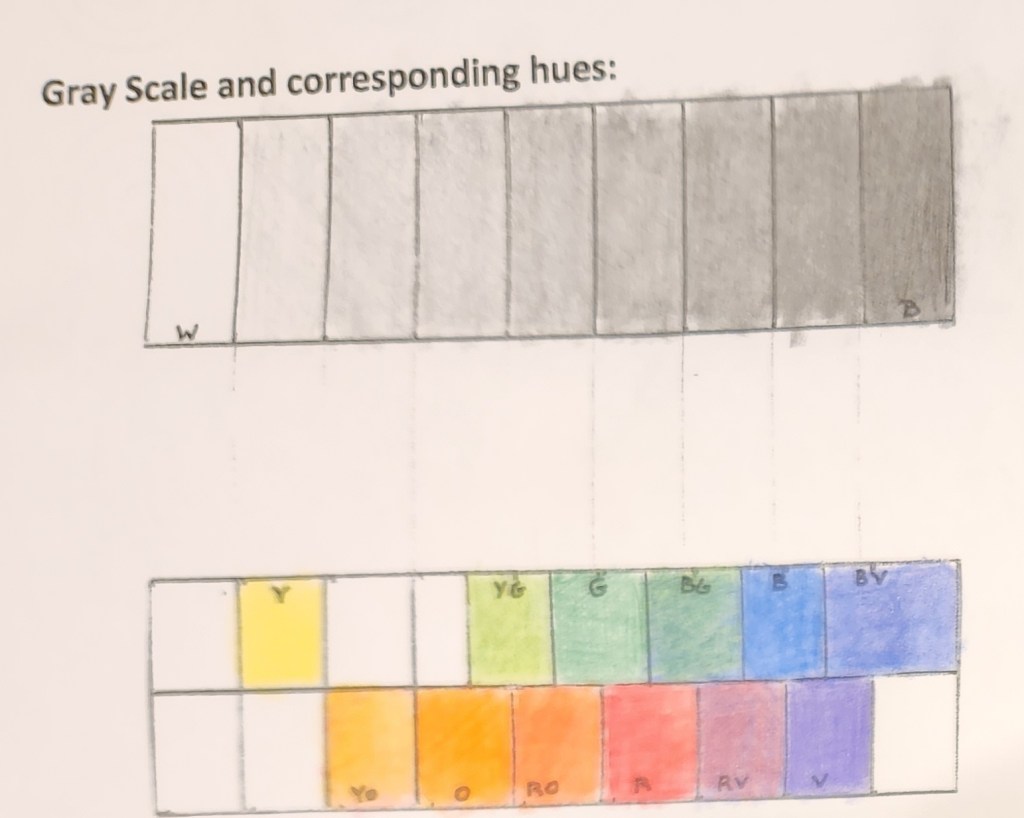
We added value with color (red example below) and density of stitches (green example below).

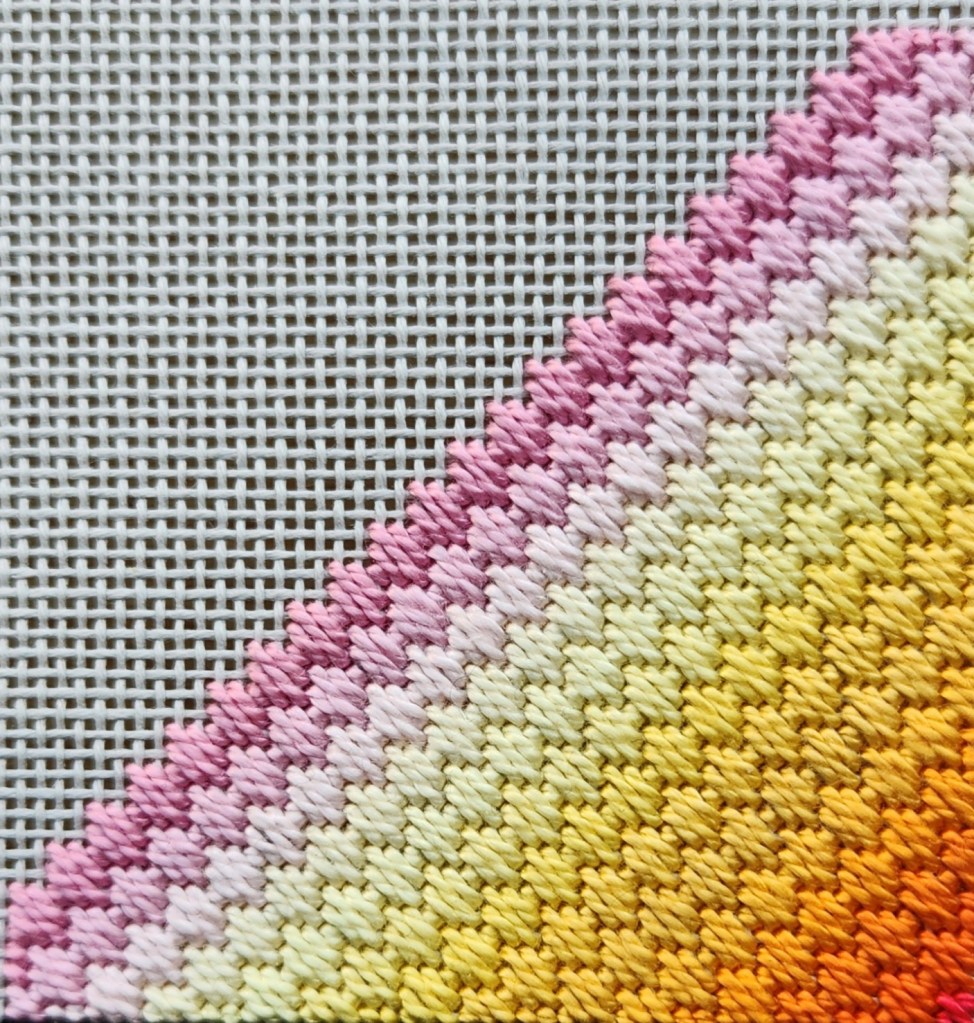
Then, we stitched to watch the interaction of color as you add each color.

The luminosity is created with the lightest values and the luster will appear as reflected light becoming more evident when a significant value difference is incorporated. Because I am working on the gray canvas, I added a black border to make it pop (after dinner and a delicious Espresso Martini). This isn’t fully stitched yet. Does the bottom one look a little washed out compared to the one with the back border?

Thanks to the other students who pitched in to distribute Day 2 class materials. Lots of stuff!

These were my morning paintings – masterpieces! We went from black and white to color. We had QTips and paint brushes to play with. I could have done this all afternoon.


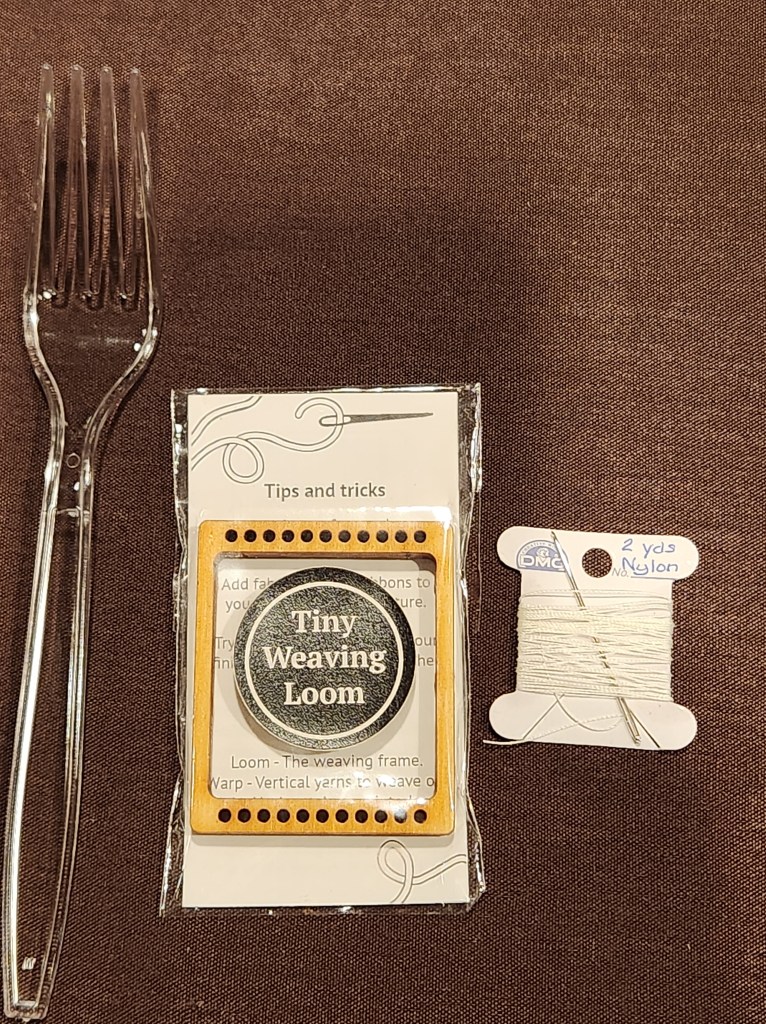
But, it was time to move onto weaving. Look at this teeny, tiny loom! The fork was used to push down the threads.
This was my afternoon’s weaving project. At one point, Pat mentioned that you can stitch on the weave you produce. So, I am going to trash this and restart it. My tension got tighter in the middle which is the same thing that happened to me with the larger loom.

Working on linen as described in the class description would have been nice but getting to weave again was fun and let me learn that Surface embroidery could be combined with weaving. A fun mixed media project. I’m thinking about what to do!
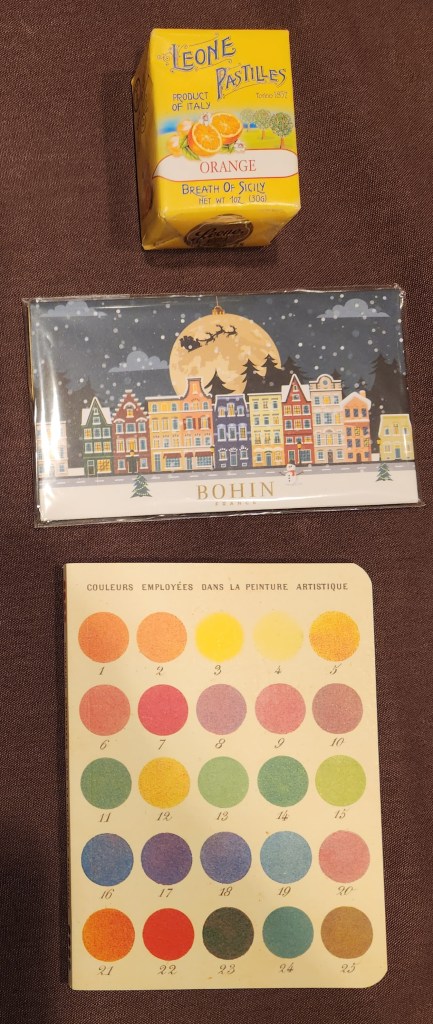
Pat gave me an entirely unexpected gift bag for being Class Angel. The Bohin needlecase has 40 different needles in a variety of sizes. Orange is my favorite flavor of hard candy. And, can always use a notebook.
 Melitastitches4fun's Blog
Filed under: ANG New Jersey Needle Artists Chapter, Embroidery Guild of America, General comments, Ruby Razzle Dazzle by Ann Strite-Kurz, Seminar 2023 - Boston, Threads, Understanding Color Relationships: Luster and Luminosity with Patricia Goaley
I’ve got a lot of small stuff to finish. I decided to get back into the swing of it with new coasters for us.
For Bill’s coaster (on the left), I folded over along the edges and tacked them into place with invisible thread. Details on how I stitched the 4 corners differently are at: https://melitastitches4fun.com/2024/03/02/manipulating-overdyed-threads/
For mine (on the right), I folded over along the edges and practiced the buttonhole stitch. I used black DMC Perle #8 and could have used #5 because some canvas is showing through. The design is from a class on Color and Luminosity with Pat Goaley during the EGA Seminar in Boston (more on that at https://melitastitches4fun.com/2023/09/03/ega-seminar-class-2-understanding-color-relationships-luster-and-luminosity-with-patricia-goaley/).
For both, I glued black ultrasuede on the bottom using Aleene’s Fabric Adhesive.
Next up is a blue sample from Razzle Dazzle by Ann Strite-Kurz that I made into a bookmark. More on this at: https://melitastitches4fun.com/2024/02/16/ruby-razzle-dazzle-by-ann-strite-kurz/
I used black DMC Perle #5 this time to make the buttonhole edging across 3 canvas threads. It has less white showing. I didn’t fold back the edges to make it a thinner, lighter finished piece (compared to the coasters that have the edges folded over). Then, I cut very slowly, carefully, and close to the stitching without cutting the threads. Here’s the back before covering it with a dark blue ultrasuede.
Again, I glued a piece of ultrasuede to the back (Aleene’s). I placed the glue all along the edges so that the glue touched only the DMC Perle buttonhole stitching. The width of three canvas threads accommodated a nice amount of glue.
It’s thin enough for a bookmark. A pretty one too!