Filed under: Books in My Library, Needlepoint Books, Stitchery Under Southern Skies by Mary Anderson and Debbie Deem
I know I read several of Debbie Deem’s article s from old issues of ANG Needle Pointers for an Archives article on design. This booklet, Stitchery Under Southern Skies by Mary Anderson and Debbie Deem, must have been mentioned but I can’t remember why. Again, I found it online a few months ago, Bill put it away when it arrived, and I forgot about it.

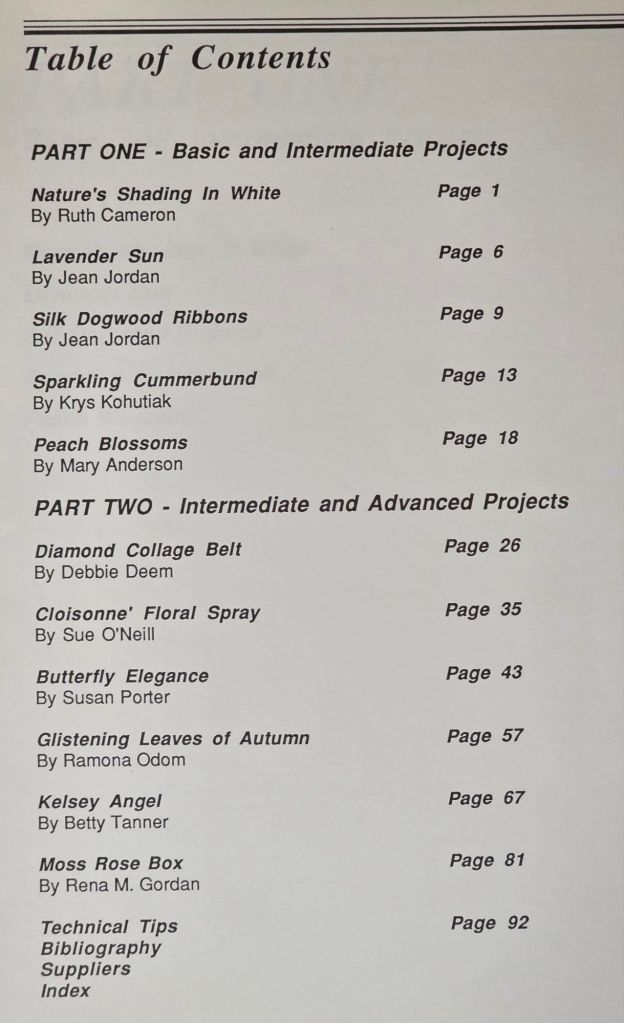
It’s technically not a “needlepoint book” as you can see from the Table of Contents because it has 11 projects. But, I gleaned some interesting things from it. Ruth Cameron explains how to use one color of stranded threads to create depth and contrast. Mary Anderson diagrams Smyrna Cross Variations. Susan Porter created an interesting Mosaic Border with a Running Stitch Accent. That’s what popped out on the first pass through the booklet.
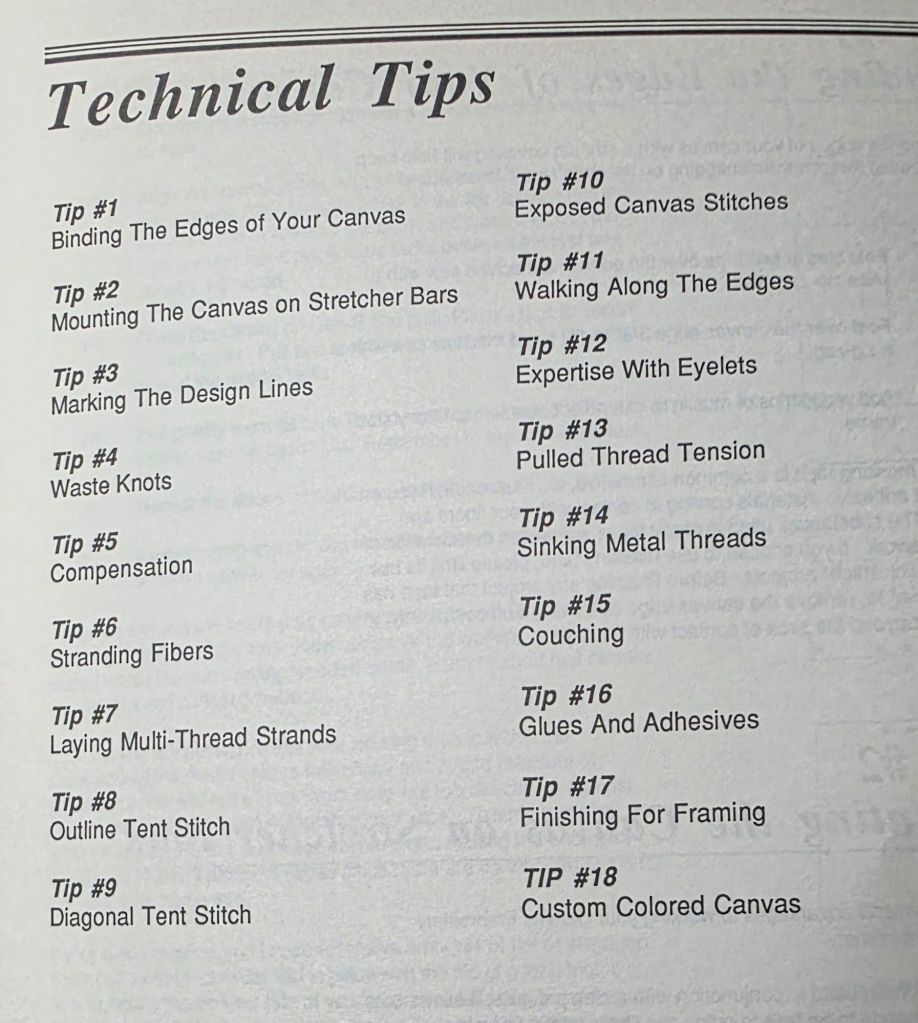
It ends with 18 tips. One was using a #16 or #13 needle to make eyelet holes consistent. And, the couching procedures are interesting. Couching over a thread is common enough but into the sides and down the center of a thread offers some variety.
Filed under: Books in My Library, Needlepoint Books, Traditional Silk and Metal Thread Techniques on Canvas by Jane Zimmerman
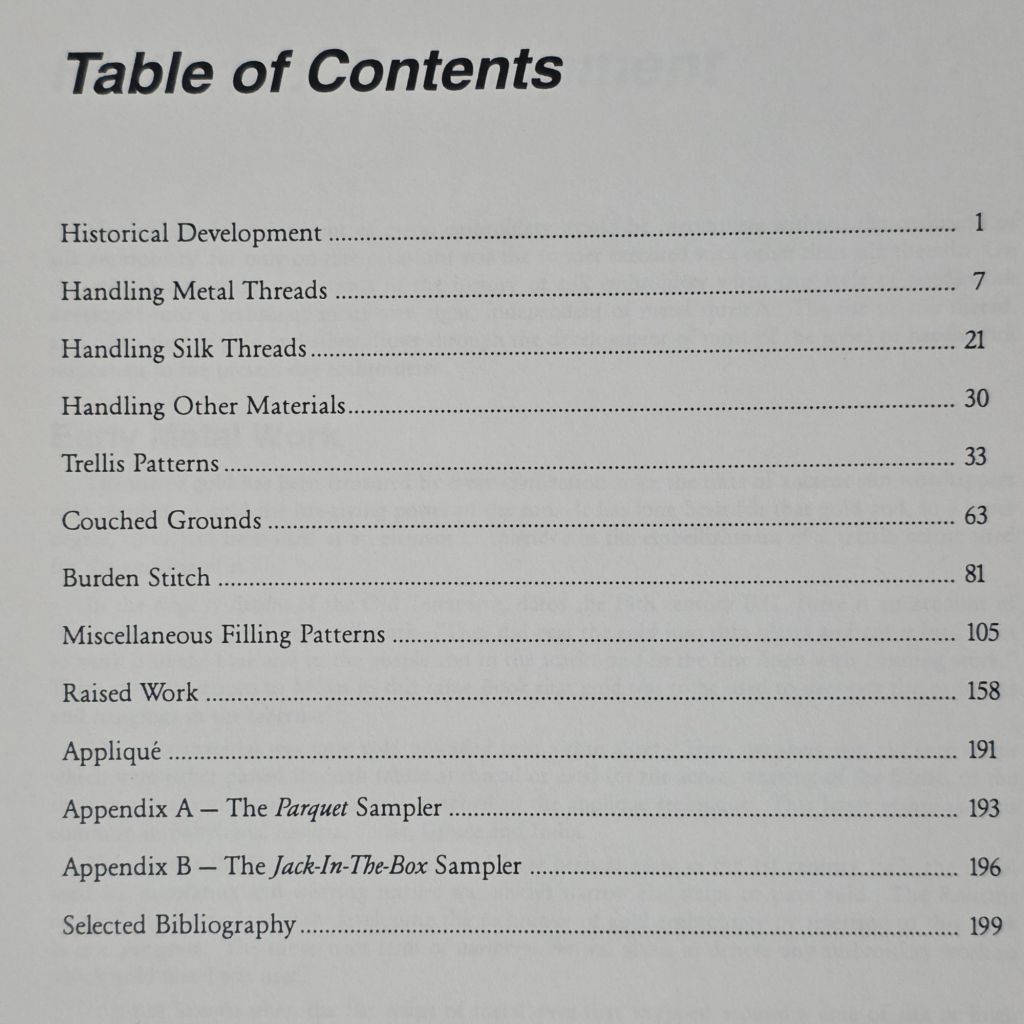
As the title implies, Jane Zimmerman discusses Traditional Silk and Metal Thread Techniques on Canvas.
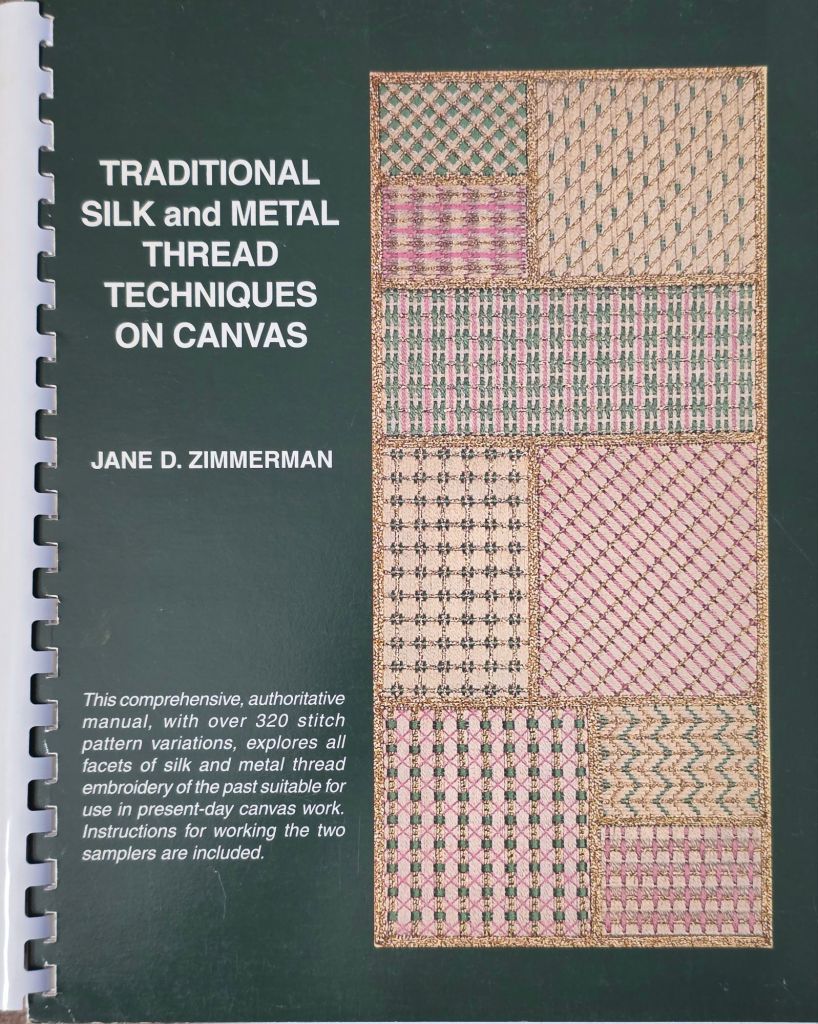
I don’t do much goldwork but this goes over enough to answer any questions I might have for that technique.
Even better, Jane provides hundreds of stitch patterns that can be used with any combination of threads. In fact, the 2 projects indicate that Kreinik can be substituted for the gold threads. But, I do have a box of leftover gold threads which I would love to play with but not now since I still have a few more 2025 goals to work on.
Filed under: Books in My Library, Exploring Pattern in Stitches by Mary Shipp, Needlepoint Books
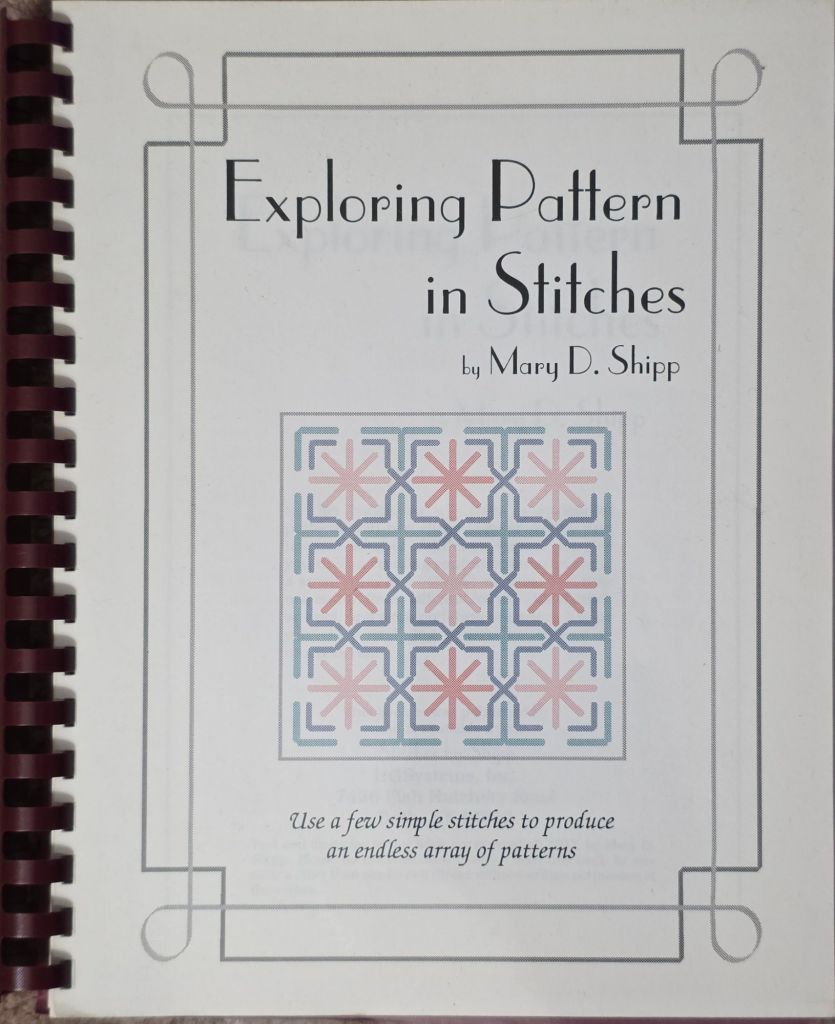
One of the books in Nanette Costa’s library was from one of my favorite teachers, Mary Shipp. It’s Exploring Pattern in Stitches which is a very interesting topic. I took two of my first three Correspondence Courses from Mary on Color and Design.
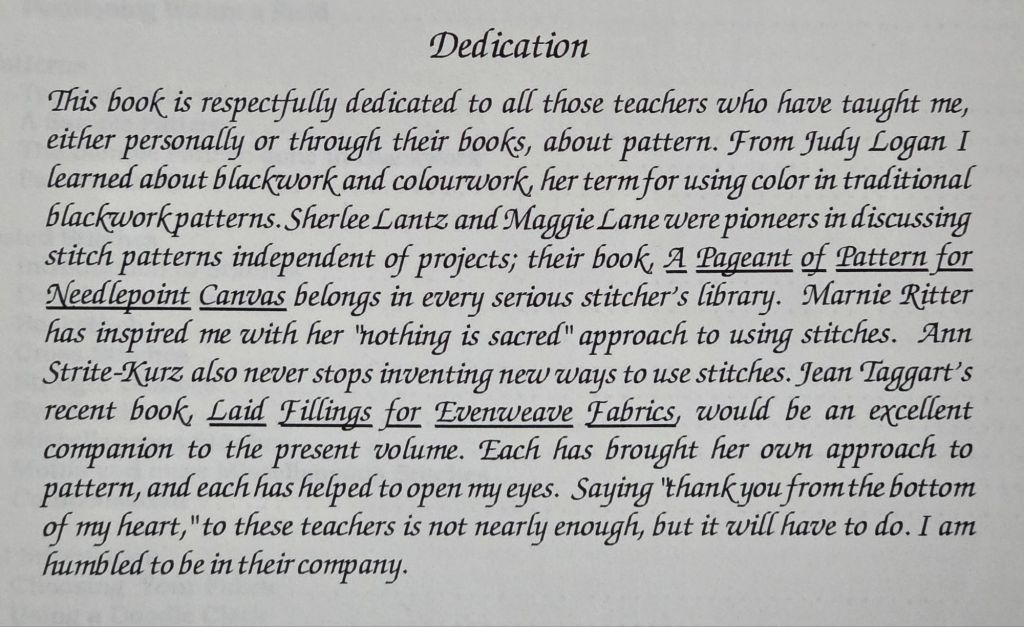
Mary grabbed me right from the beginning with her dedication by citing teachers she learned from. No big surprise that I have both the books she references.
In the introduction, Mary says she enjoys the process and does not need the product. That is probably why a number of my projects are completed but not finished. It may also account for why I have multiple projects started.
She provides a variety of patterns but gives tips on modifying them and creating your own. Any threads will work. Any color combination can be employed but color options are discussed including a review of The One-Three-Five Rule.
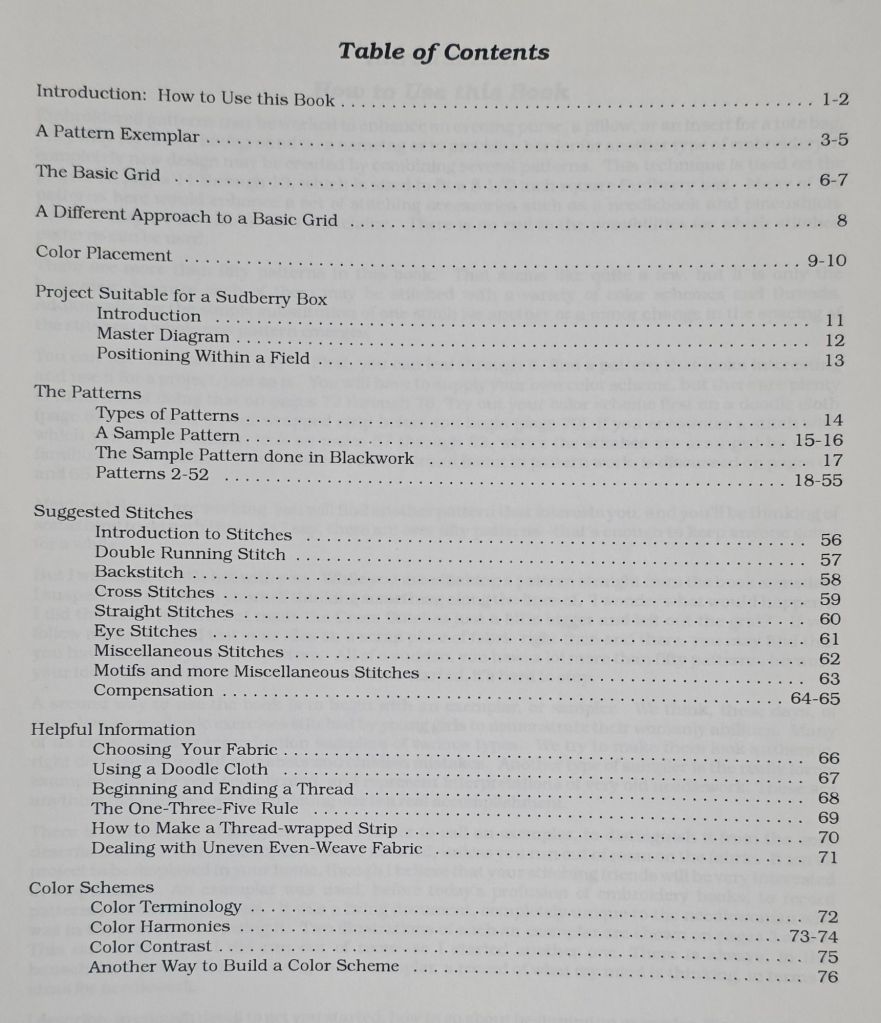
The coolest thing about the pattern project Mary includes is that beyond the Master Diagram marking off 5 areas, “you are on your own” for choosing patterns and colors. There is lots to read before tackling it (in 2026). Very exciting!!
Filed under: Bargello Antics by Dorothy Kaestner, Bargello Books, Books in My Library
Bargello Antics by Dorothy Kaestner, 1979


I especially like several designs for their use of bargello or cross-stitch as the center focal point placed within a satin stitch square or diamond which is surrounded by a wide bargello border. That’s been a thing in several books from this period.
The movement of a pinwheel is always intriguing to me. But there is way too much movement in one pattern in the book or perhaps it’s the asymmetrical aspect of it that really bothers me.
That’s the last of my bargello “books”. I have several project booklets written by Liz Morrow which are fantastic and still available thanks to her forethought, planning, and daughter-in-law. Liz’s amazing designs live on at https://www.lizartneedlepoint.com/bargello-designs.html#/
Filed under: Bargello Books, Books in My Library, Free-Form Bargello by Gigs Stevens
Free-Form Bargello by Gigs Stevens, 1977


31 color plates are included. Very abstract like the cover.
I absolutely the turtle! There is a stitched turtle in the book but not this one. But, it doesn’t look like bargello. The book takes an odd turn. I wonder if Gigs knew about Zentangle because the designs towards the end of the book remind of that style. These seem easily adaptable to embroidery but would work on Congress Cloth because of the extra details you can do as opposed to 18 count monocanvas.
Filed under: Bargello Books, Bargello Sampler by Nancy Noland Kurten, Books in My Library
Bargello Sampler by Nancy Noland Kurten, 1975.

No Table of Contents because it is a complete project rather than a stitch dictionary.
The booklet has hand drawn stitches as opposed to those created on a computer. Very easy key to follow for each pattern.
Nancy explains bargello concepts and takes you through setting up the sampler, selecting colors, and large easy to read diagrams for each of the stitch patterns (described generally and then specically for the sampler).
I particularly like how she incorporates a rose Medallion in the upper left corner. That makes several books that have showcased a design with a bargello pattern.

Four Way Bargello by Dorothy Kaestner, 1974 is on the EGA Bibliography for EGA Master Craftsman Canvas, Step 4. I don’t have a book cover for this one. It’s a hardcover red book.
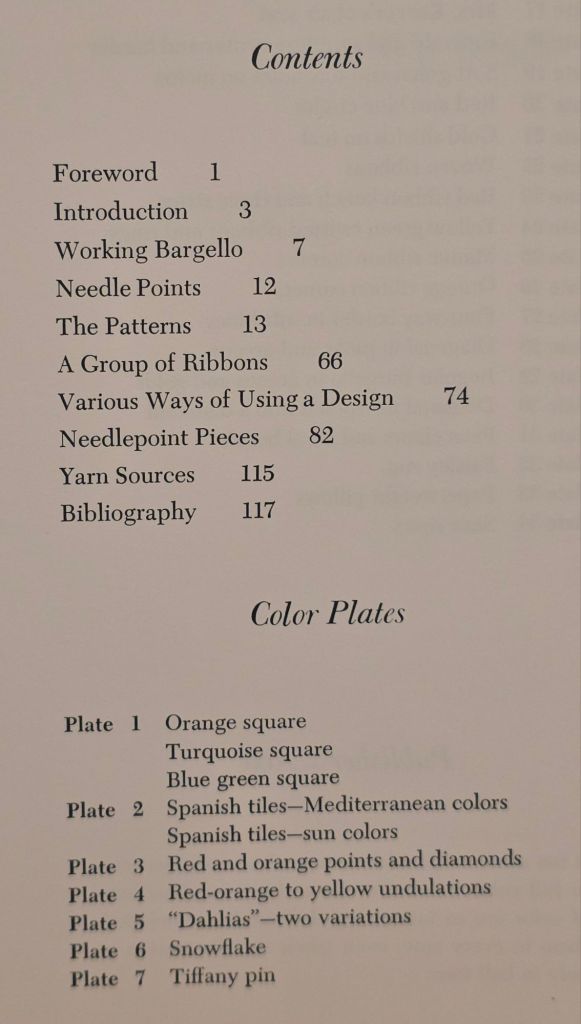
There are a total of 32 color plates, diagrams for 2 sizes of Alphabets and 1 set of numbers, and 2 flower motifs that would be stitched in basketweave for the center of medallions. Leaf stitch is incorporated into one design and one pattern forms a circle.
The ribbon patterns are great and I would love time to play with the ribbon and ring patterns. I used the corner ribbon pattern on pages 110-111 for the outer border in my Bargello Bowls (https://melitastitches4fun.com/2021/04/22/canvas-master-craftsman-program-step-4/).
Filed under: Bargello - A Pattern Book by Golden Hands, Bargello Books, Books in My Library
Bargello – A Pattern Book by Golden Hands, 1972


The 3-D boxes and hearts are the 2 patterns I like.
The canopy bed-hanging and caftans are way over the top but I like the design wrapped around a trash can. There are finishing instructions for a hairband, belts, bags, seats, stools, and even slippers.
Filed under: Bargello Books, Books in My Library, Florentine Embroidery by Barbara Snook
Florentine Embroidery by Barbara Snook, 1967
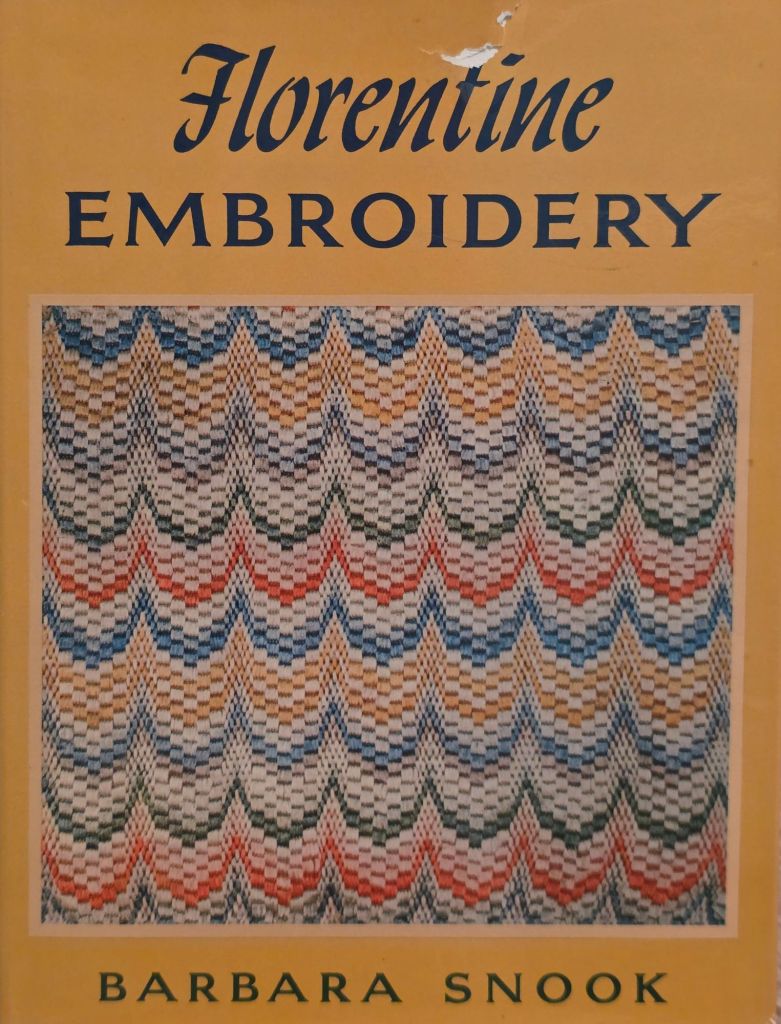
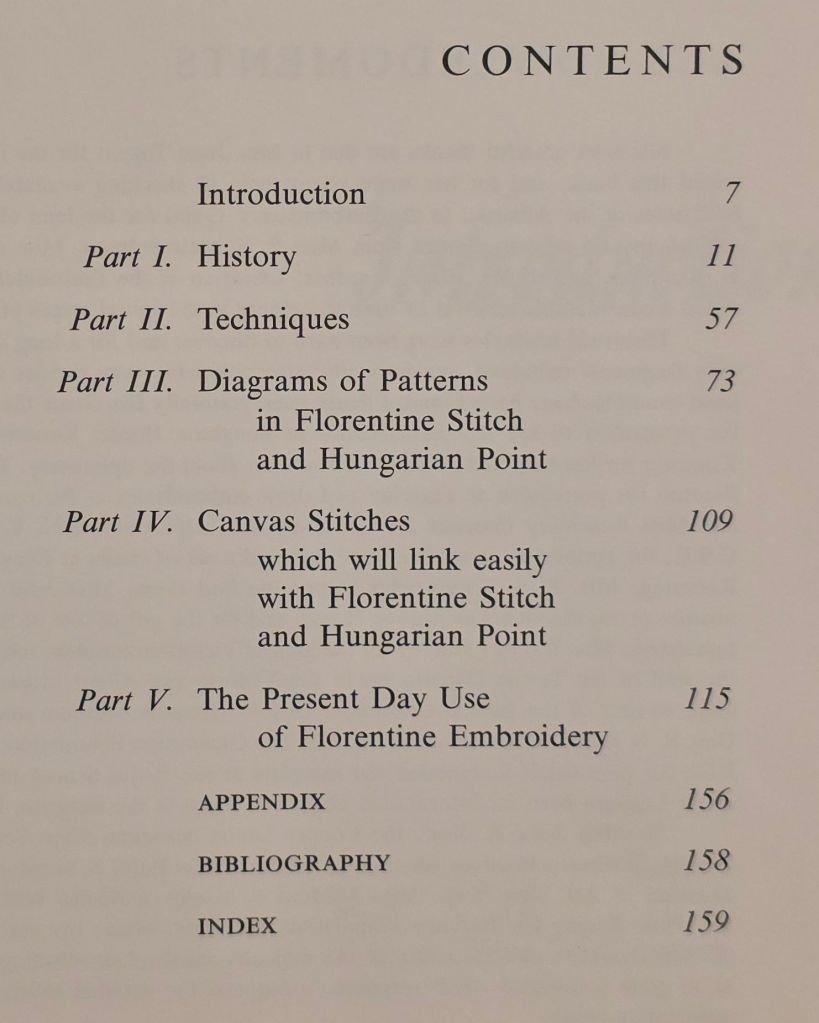
Lots of diagrams of some great patterns. I’m just not a fan of the cross-stitch type of diagrams. I do like seeing the bargello patterns combined with other canvas stitches.
Barbara’s other book, The Craft of Florentine Embroidery, also from 1967, is on the Bibliography from EGA’s Step 4 Master Craftsman (but I don’t have it).
Filed under: Bargello - Florentine Canvas Work by Elsa S Williams, Bargello Books, Books in My Library
Bargello Florentine Canvas Work by Elsa S Williams, 1967


This book is on the EGA Bibliography for Master Craftsman Canvaswork, Step 4.
There are no diagrams but the photos are clear enough to follow. Color combinations are included for each pattern although they are easily changed because you use shades of various colors. This book has a floral medallion done in basketweave in the center of a bargello pattern. That is a great idea.
 Melitastitches4fun's Blog