Filed under: Easter Eggs
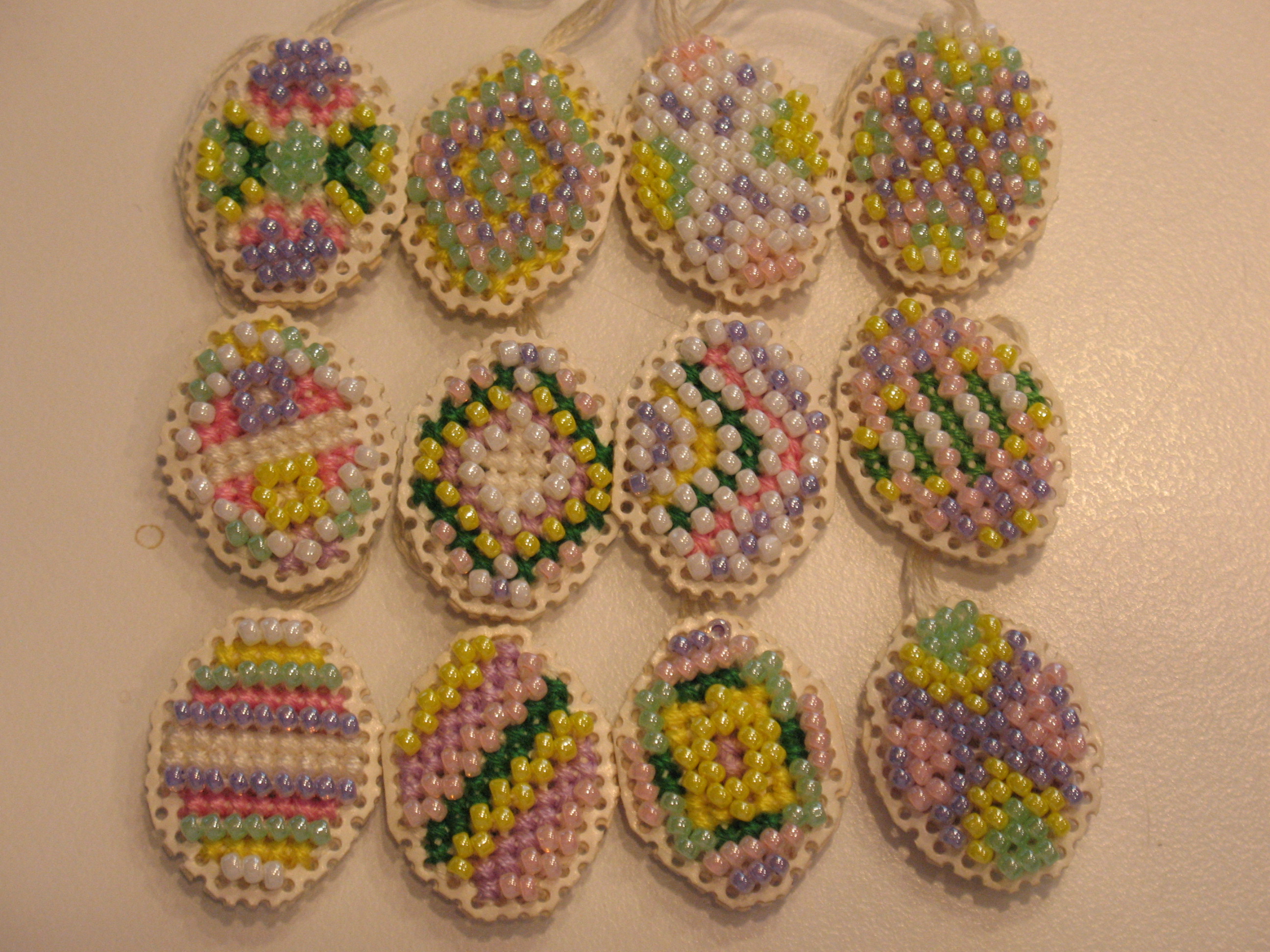
There are a dozen eggs made using DMC floss and Mill Hill Beads on perforated paper (all purchased at AC Moore) for my Easter egg tree (from the Lillian Vernon catalogue years ago). These were done before any ANG classes. I used regular graph paper to chart out the designs (which I still have & found in my pile). The tricky part was cutting each small egg exactly the same so that I could sew them back to back after I was done. The front design did not match the back. Now that I think about it, perhaps I could have stitched the beads first on one side & then on the second side. It must be possible but that actually doesn’t sound easy either. I didn’t do a whole bunch with beads but managed to gather a stash of them!


Filed under: Sculptured Knot Garden
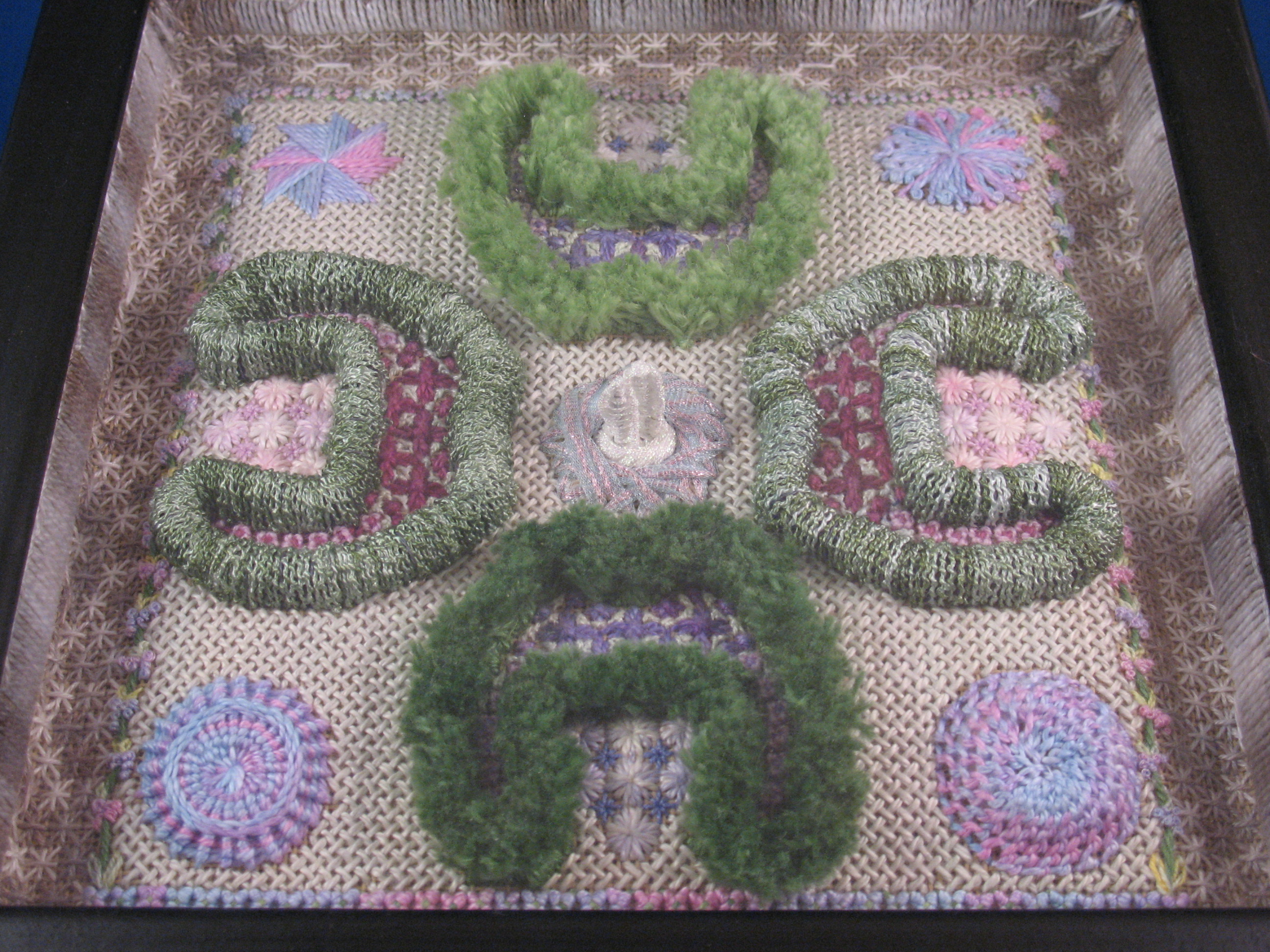
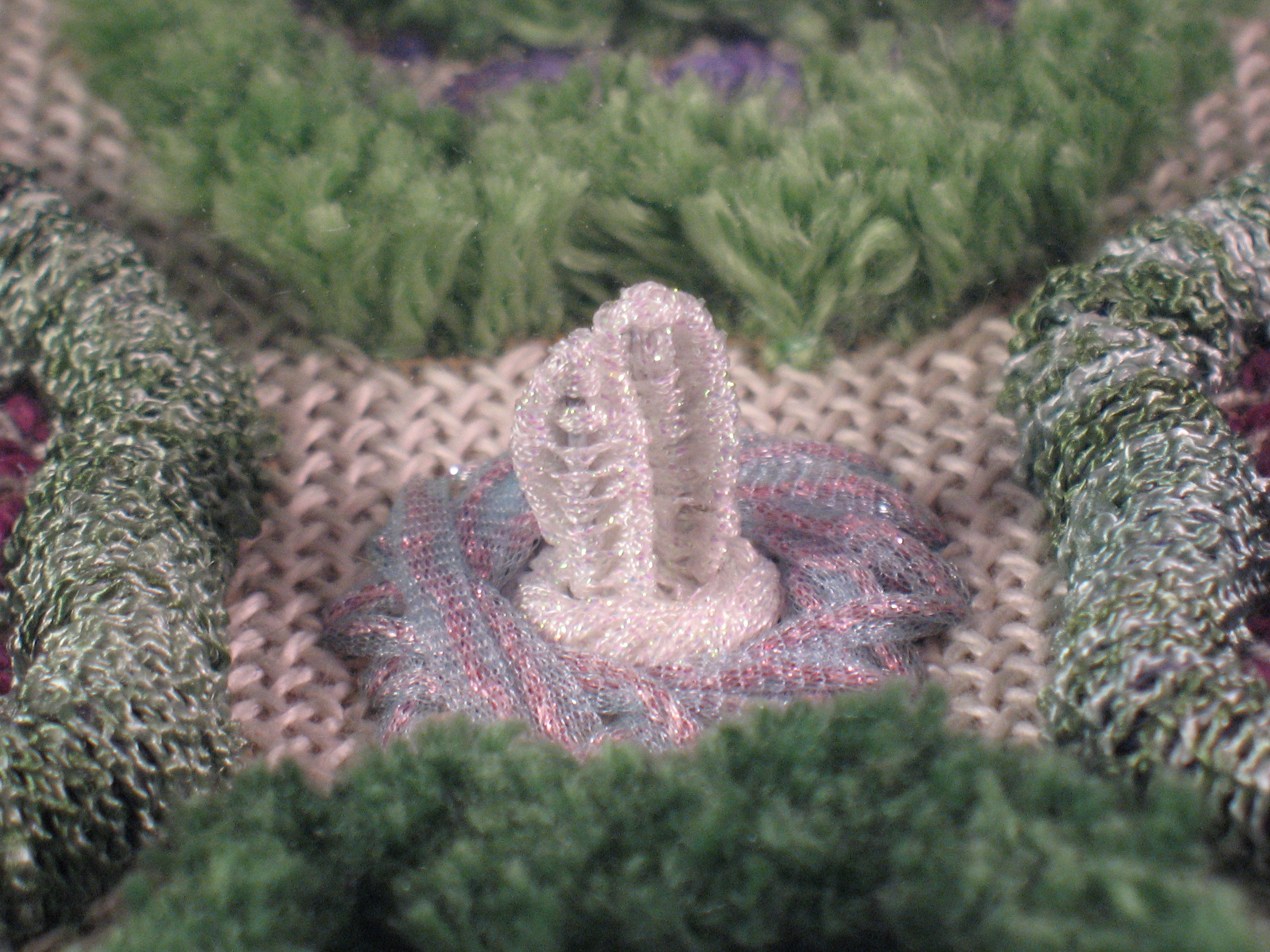
This garden has depth & variety that a larger garden (8” x 8”) can accommodate. There is even a water fountain. By adding some padding in several areas underneath stitches, I have added contour to the topography. Last year, one of our members offered suggestions for basic garden designs & stitches that work well in a garden. And, as you can image, no 2 were alike. I’m not a big French Knot fan but I worked some in along the inner border & used Raised & Palenstra Knots in order to call it a “Knot” Garden.
I had to place the finished piece inside a shadow box because I was afraid of dust. NOT that my friend & co-worker, Roya, who I gave it to as a gift upon completion, is a bad housekeeper!! We all get dust. Anyway, the shadowbox was quite an ordeal. When I realized the cardboard sides would show, I added straight stitches along the sides to cover them. Then, I had to tack down the piece to the cardboard so it would lay flat along the bottom – the fountain JUST fit – only slightly touching the glass. Once I had it fully attached to the cardboard & bent the sides fully, it puckered more than I had expected! Well, that just added a little more to the contour of the topography!
In this garden, I used the following stitches:
Outer border: Triangle
Inner North & South borders (top & bottom): Raised Knots with Colonial Knot centers
Inner East & West border (sides): Lazy Daisy, Straight Stitch, & French Knots (for simple flower design)
Large corner areas (listed in a clockwise manner starting at the NE corner or 1 pm):
- French Knot on a Stick
- Detached Buttonhole with a few layers of felt padding
- Web Stitch Wrapped with 2 rows of Rosette Stitch
- Milanese Pinwheel
North & South horseshoes: Turkey Work (I used a thread that expanded in volume beyond my expectation and covered the flowers of the inner portion of the horseshoe. Since I wasn’t going to rip it out, I had to cinch them together using a matching floss near the surface where it wouldn’t show. I learned that Turkey Work isn’t my favorite stitch & using floss would have been a better choice.)
East & West horseshoes: I don’t know if what I did has a name but necessity is the mother of invention & I sure didn’t want to do anymore Turkey Work. So, I took a chunk of a flexible cloth hair band & stitched up & over it using an overdyed bouclé.
Outer area between arms of horseshoes: Ringed Daisies
Inner area between arms of horseshoes: Raised Knots with Colonial Knot centers
Inner center area of horseshoes: Tied Windmills & Knots to fill in the spaces
Center portion: Jessica inside Walneto
Fountain: Needleweaving (over a stiff wire which had been bent in half & placed up through the canvas before stitching)
Ground covering: Not sure of the name of this stitch. If anyone recognizes, please let me know. Thanks in advance. Sharon (ANG Yahoo group member in St. Charles, MO) suggested T-stitch which I found in Stitches To Go by Suzanne Howren & Beth Robertson. But this stitch is longer. So, I flipped through that book again & found it. It’s called Woven. Thanks Sharon for getting me to the right book!!
Stitch books used:
- The Needlepoint Book by Jo Ippolito Christensen
- Stitches To Go by Suzanne Howren and Beth Robertson
- Stitch Sampler by Lucinda Ganderton
- Elegant Stitches by Judith Baker Montano
- Sculptured Needlepoint Stitchery by Ella Projansky
Filed under: Pruned Knot Garden
I love this frame. It was a fleamarket find. And, I’ve made 3 attempts to fill it.
Which of the 3 attempts do you prefer for the frame – or should I keep trying?
Looking forward to your input – in the form of a comment as I can’t figure out how to post a poll.

First, I attempted this abstract design trying to match the colors using diamond eyelet & tied windmill:

Then, I was practicing with various stitches & thought this garden would be better but it ended looking a little overgrown to me:
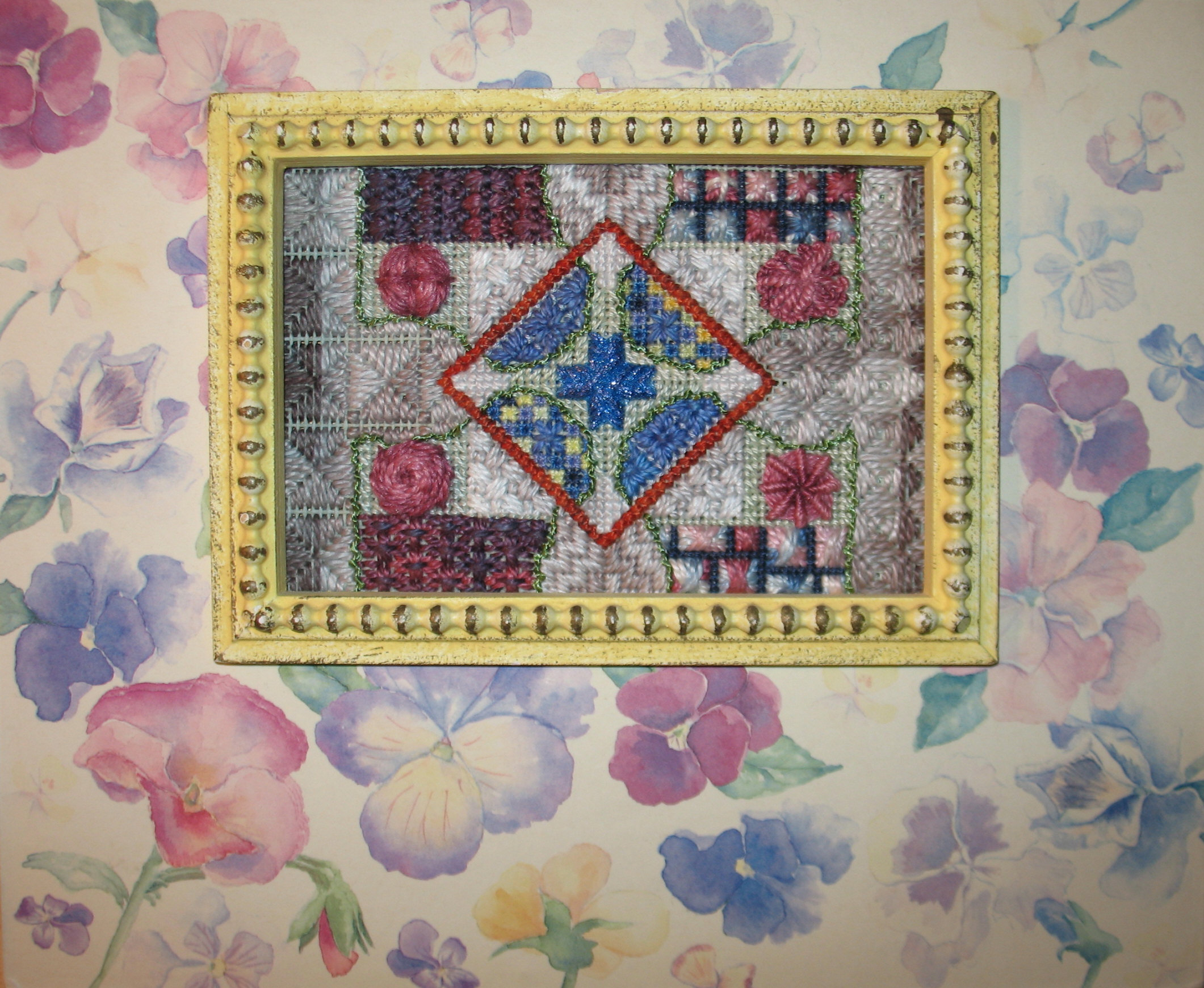
So, I redid the piece to tone down or pruned the variety stitches from that of the previous piece:

Filed under: Pruned Knot Garden
I got my garden under control! Only 5 stitches were trimmed from my 4&1/2” x 3” area but the difference in stitches made for a cleaner garden:
Far left & right walkway: Alternating Cashmere
Outer rectangular portion (listed in a clockwise manner starting at high noon):
- Byzantine
- Triple Leviathan
- Tied Windmills
- Ringed Daisies
- Double Crossed Diamond
Corners of inner square portion: Couched Boucle (dark green) & Criss Cross Hungarian (grey/brown over-dye)
Inner diamond portions: Inner: Woven Cross filled in with Squared Palestrina Knot, Raised Knot, Colonial Knot & French Knot (nice variety of knotted stitches)
Inner diamond border: Upright Crosses
Center portion: Walneto surrounded by tent
Divide walkway from planted areas: Couched Boucle (light green)

Stitch books used:
- The Needlepoint Book by Jo Ippolito Christensen
- Stitches To Go by Suzanne Howren and Beth Robertson
- Stitch Sampler by Lucinda Ganderton
- Elegant Stitches by Judith Baker Montano
Filed under: Overgrown Knot Garden
Last year our chapter worked on a knot garden. Before I tackled the large garden, I practiced in a 4&1/2” x 3” area. My garden became a little overgrown with stitches! I fit all these stitches into that small space:
Far left walkway: Alternating Hungarian Diamond
Far right walkway: Triangle
Outer rectangular portion (listed in a clockwise manner starting at high noon):
- Byzantine
- Double Leviathan
- French Knot on Stick
- Spider Stitch
- Rhodes
- Byzantine
- Cameo
- Belly Button
- Wound Cross
- Shell & Cross
Corners of inner square portion: Criss Cross Hungarian
Inner diamond portion (listed in a clockwise manner starting at 1 pm):
- Algerian Eye with Palenstra
- Diamond Eyelet Variation
- Smyrna Cross
- Double Crossed Diamond
Inner diamond portion is filled in with Cross-stitch (white) & Mosaic (light green)
Center portion: Walneto

I liked some elements but not others. I knew I could do better!
Stitch books used:
- The Needlepoint Book by Jo Ippolito Christensen
- Stitches To Go by Suzanne Howren and Beth Robertson
- Stitch Sampler by Lucinda Ganderton
- Elegant Stitches by Judith Baker Montano
After finding this Framecraft ceramic mauve bowl with gilded metal lid (on sale), I went into my jewelry stash (from flea markets) & found the rose from a necklace that I could sew onto the lid for a handle. Then, I created a simple design for the lid from my stash. It is a smaller variation of the Pavillion Steps from The Needlepoint Book by Jo Ippolito Christensen. And, the 3 colors I used (mauve, pink, & gold) are placed differently than in the diagram but as Jo wrote, 3 colors are essential to obtain a 3-dimensional effect. The little bit of gold Kreinik (#4 very fine) used in the pattern complimented the rose handle & the metal lid without overpowering the small lid. It now holds some small miscellaneous needlepoint aides & an eraser which gets a lot of use!

Filed under: 9-step Value Scale
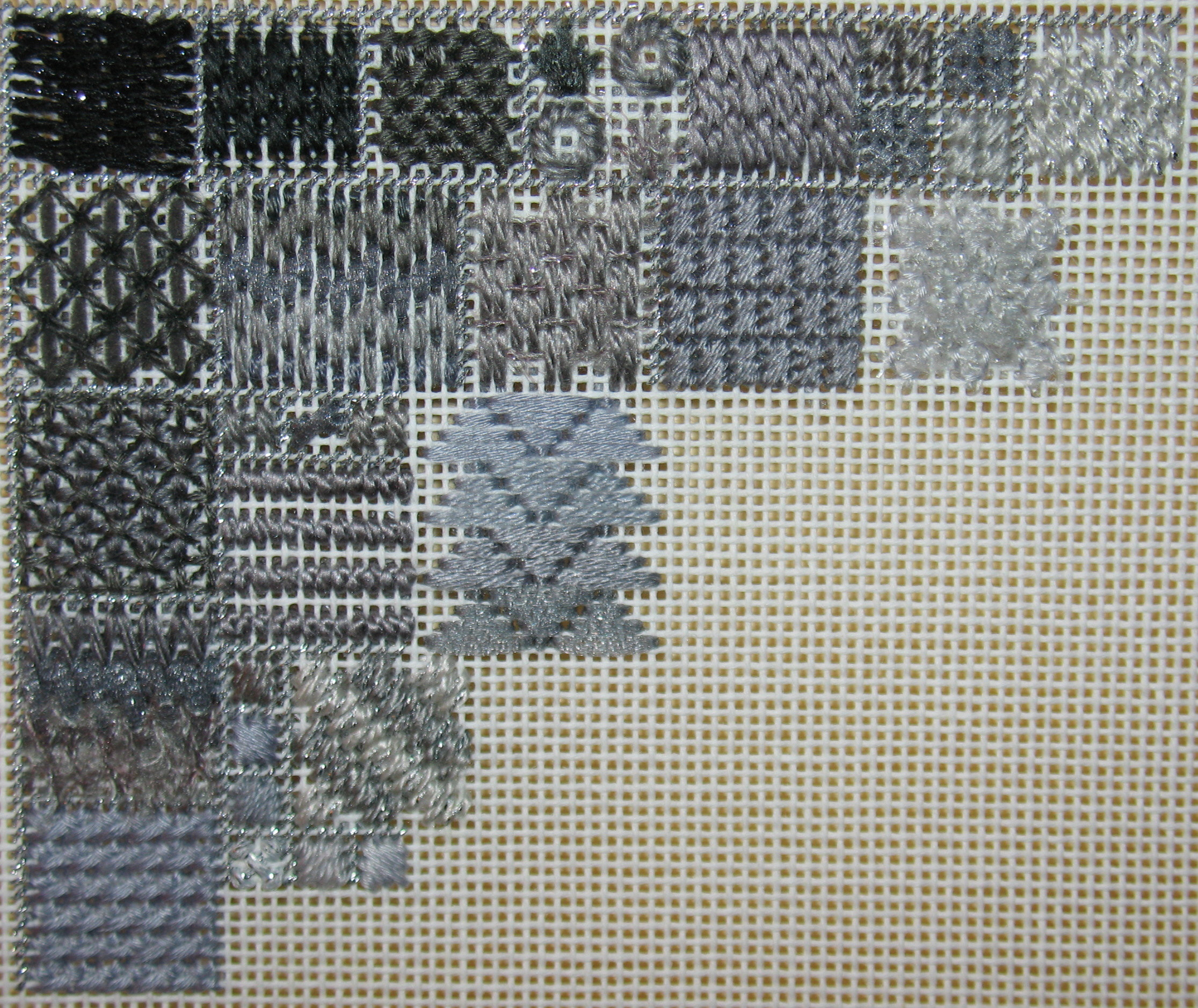
9-step Value Scale Threads:
9 – Black (DMC floss #310): Vineyard Silk S538*, Trio T12, Petite Very Velvet, V601, Fuzzy Stuff FZ02, DMC Floche 310
8 – Gray (DMC floss 3799): Trio T40*, Petite Very Velvet, V616
7 – Gray (DMC floss 413): Trio T207*, Trio T208, Fuzzy Stuff FZ19*, Splendor S1118*
6 – Gray (DMC floss 317): Trio T57*, Trio T103*, Flair 610*, Silk & Ivory 57*, Splendor S889
5 – Gray (DMC floss 414): Vineyard Silk C106*, Planet Earth Dusk*, Fuzzy Stuff FZ01*
4 – Gray (DMC floss 318): Vineyard Silk S536*, Flair 593*, Impressions 1072*, DMC Floche 318*, Splendor S891
3 – Gray (DMC floss 415): Trio T58*, Impressions 1046*, Vineyard Silk S535*, Fuzzy Stuff FZ36*, Snow 09* Silver*, DMC Floche 415*
2 – Gray (DMC floss 762): Trio T113, Vineyard Silk S539*, DMC Floche 762*
1 – White (DMC floss blanc): Trio T02, Fuzzy Stuff FZ15, DMC Floche blanc*, DMC Perle #8 blanc
*Indicates thread was used in some part of the pictured needlework.
Some threads I placed in a particular value could be debated (but I had to place them somewhere).
Filed under: 9-step Value Scale
I wanted to utilize the 9-step gray scale that I learned about in Mary Shipp’s design class. And, I wanted to practice with stitches from Stitches For Effect/Stitches To Go by Suzanne Howren & Beth Robertson. But, I did not get the effect of dark (upper left) to light (moving down & to the right). And, the stitch selection didn’t help. I think this is an example of trying to do too much in one piece. I forgot about the One-Three-Five Rule from Mary’s lessons. Next time, I’ll eliminate either many of the stitches I selected or many of the thread types I selected or both!
And, you may have guessed, that’s why I am using shades of gray in ANG SOTM 2010 Mystery project – I have quite a large stash now!
Filed under: Thread Play
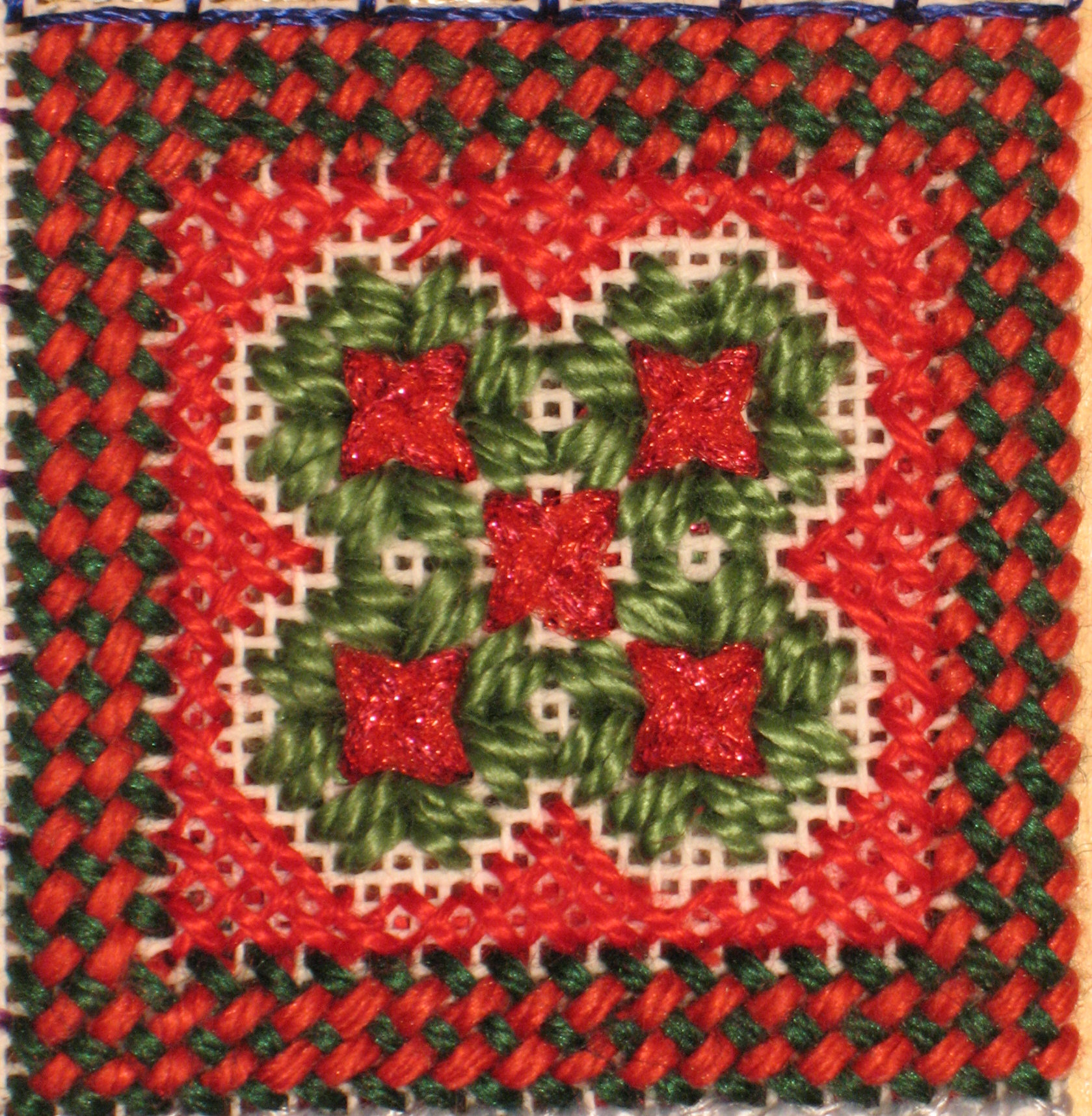
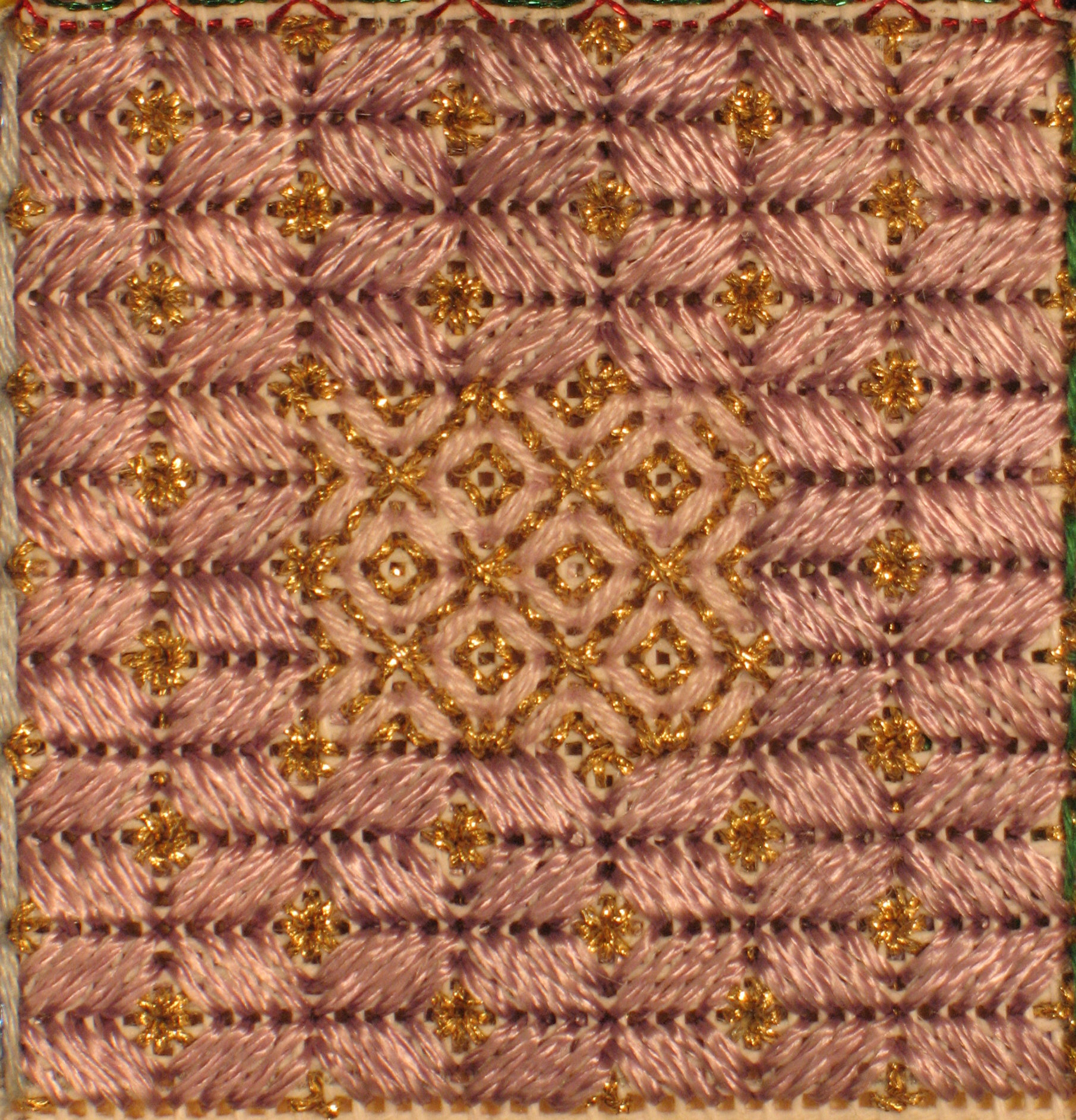
You won’t be surprised when I tell you I took Mary Shipp’s ‘Understanding Color’ class – that was in May 2005. When I created this piece, “Thread Play” for one of the lessons, she said I gave her “quite a shock”. Tasked to experiment with various effects that you can get with various threads, I prepared 25 samples. I’ve included close-up pictures of 2 of my favorites.

After Mary Shipp’s Understanding Design class, I created this color wheel despite her comment that available threads are not available for a full 24 hue color wheel. Next time, I’ll do a 12 hue color wheel.

My DMC floss color #s are listed below.
Note: * indicate those of mine which differed from Mary’s suggestions.
Legend: yellow (y), green (g), blue (b), violet (v), red (r), orange (o).
y: 973*
y-g-y: 907
y-g: 906*
g-y-g: 701
g: 700*
g-b-g 991
b-g 3765
b-g-b: 517*
b: 825*
b-v-b: 797*
b-v: 796*
v-b-v: 791*
v: 333*
v-r-v: 550*
r-v: 327*
r-v-r: 3685*
r: 666*
r-o-r: 606*
r-o: 608*
o-r-o: 740*
o: 970*
o-y-o: 740*
o-y: 742*
y-o-y: 972*
 Melitastitches4fun's Blog