Filed under: ANG Main Line Stitchers Chapter, Razzle Dazzle by Ann Strite-Kurz
Ribbon 3 of Razzle Dazzle by Ann Strite-Kurz is taller than the first 2 ribbons and has 5 steps!
Step 1 with long rows of Trame was easy and done quickly. Step 2 was the exact opposite. Small Ray stitches and lots of them made for slow going. It took multiple sessions to complete Step 2 of just one ribbon and there are 4 on each colorway. Steps 3 and 5 were easy enough. The blackwork in Step 4 was slow going too but it is worth the effort for the lacy effect.
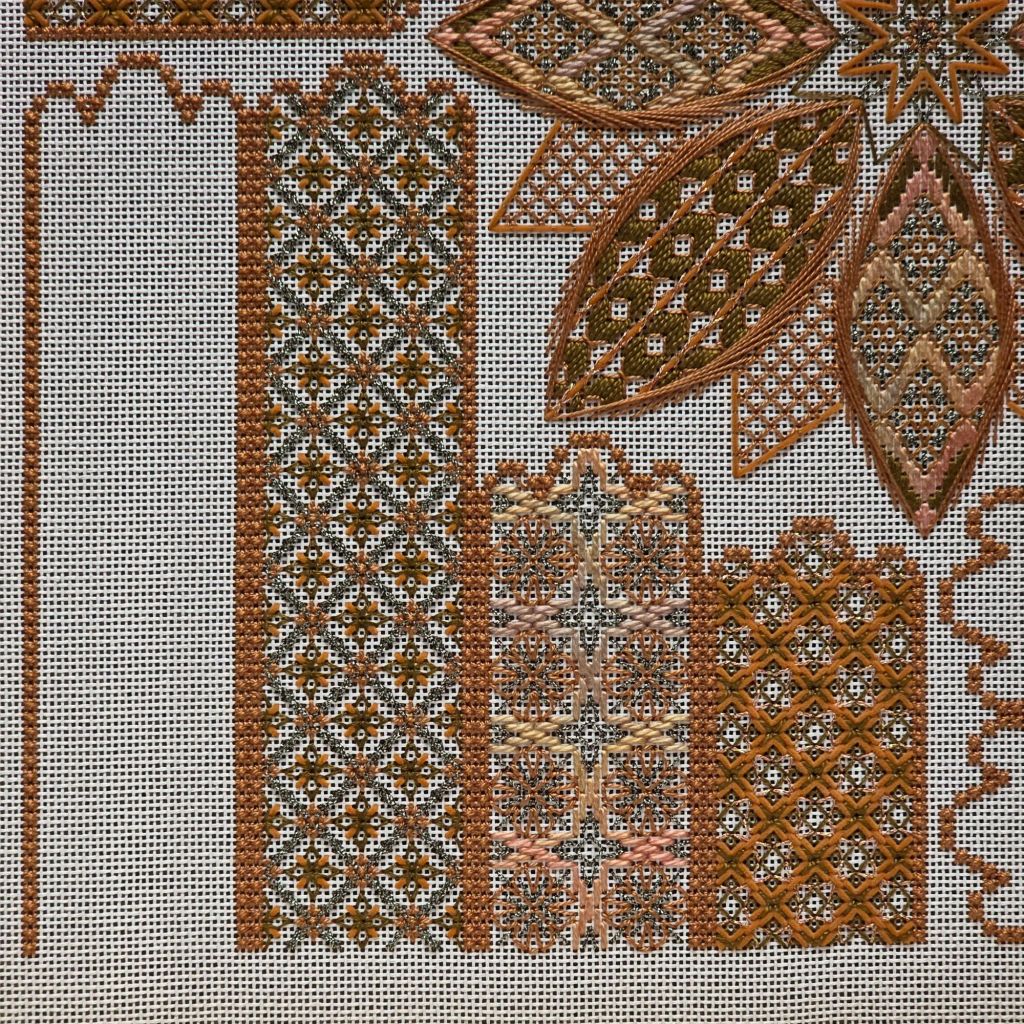
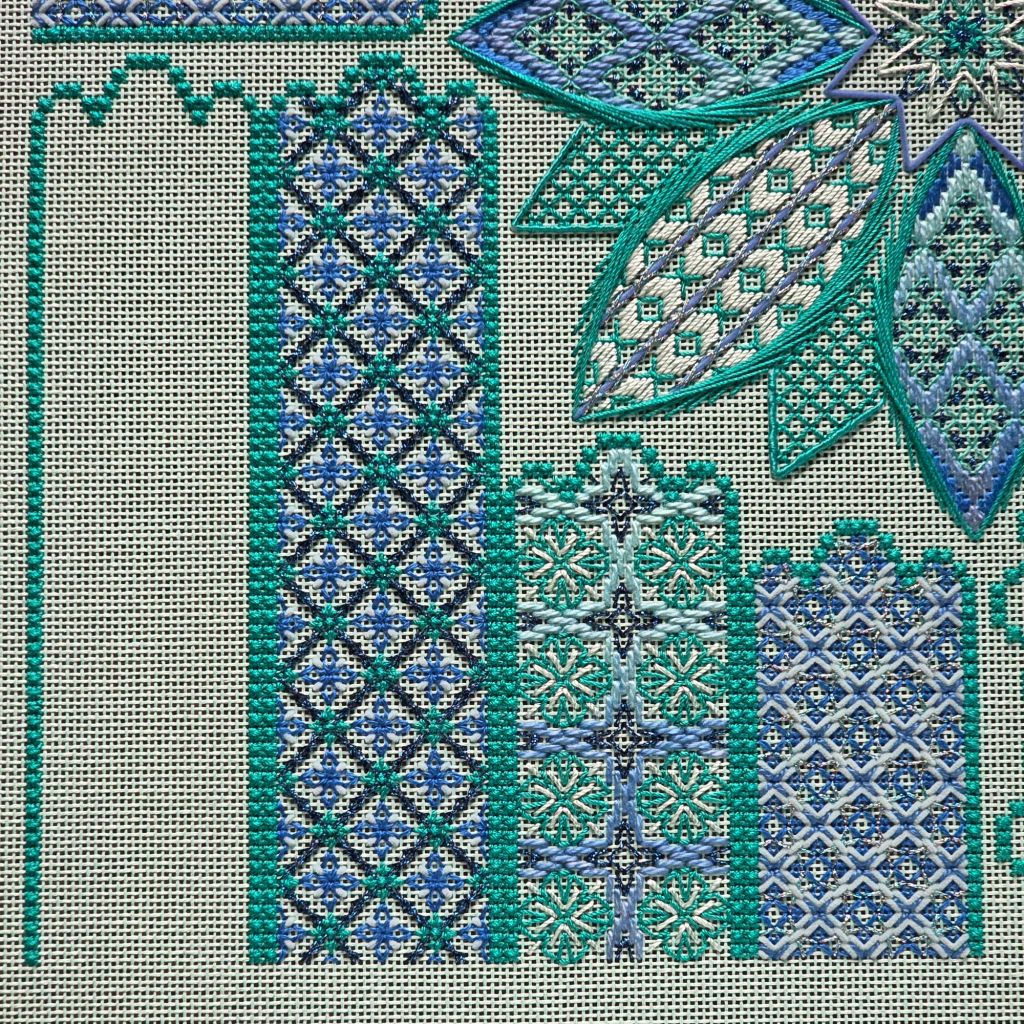
I didn’t get all four Ribbon 3 areas done before our ANG Main Line Stitchers chapter meeting (Monday night) but I am over half done on each colorway. Linda M knew folks would need extra time for this project and that’s why we’ll start our next counted project in March. January and February will be Zoom lectures.
Filed under: ANG Main Line Stitchers Chapter, L O V E, by Raymond Crawford
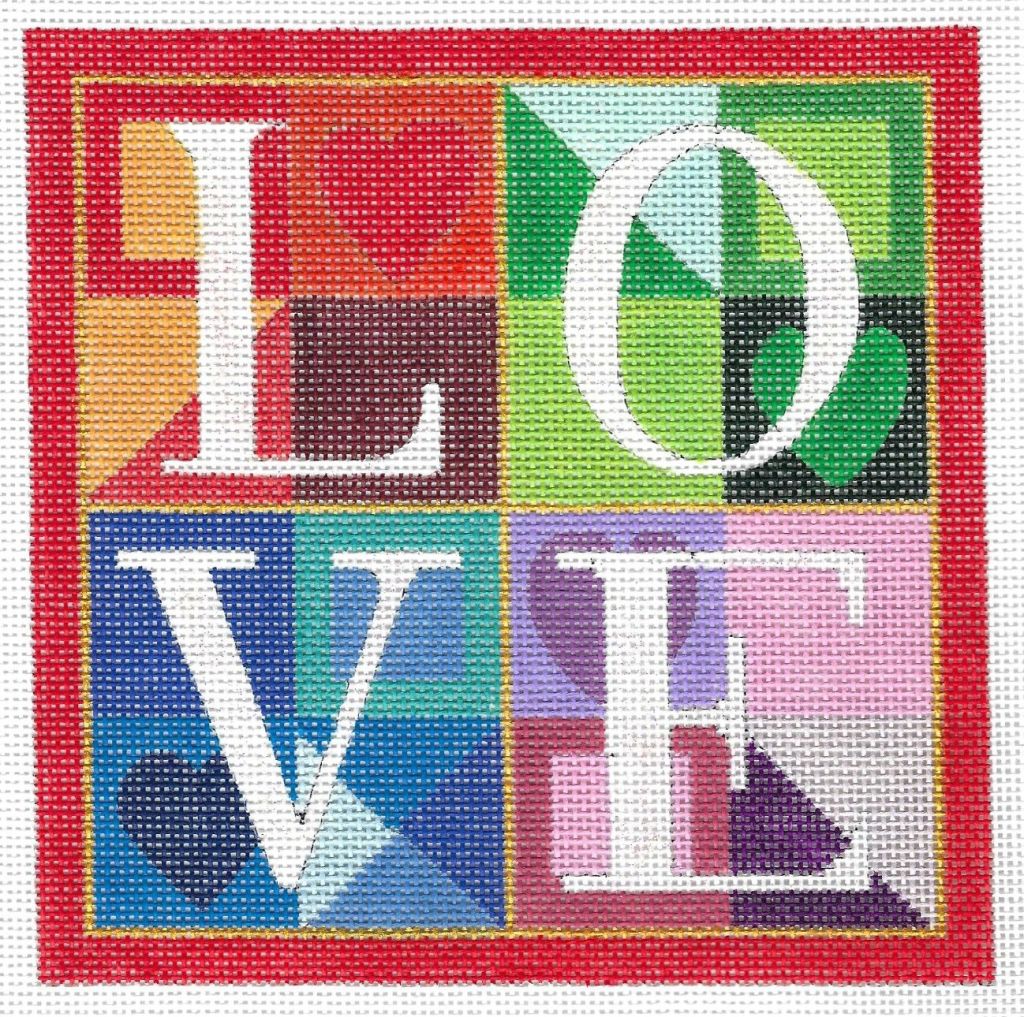
In anticipation of Colors of Praise letters (we ordered 17 letters and expect it’ll take months to get them painted), we will discuss my painted canvas, LOVE, that has lots of small spaces at our next few ANG Main Line Stitchers chapter meetings. It’s a Raymond Crawford canvas (HO-196).
I have these four needlepoint books that focus on small stitches:
• SuZy’s Small Stitches by SuZy Murphy
• Quick Stitch Variations by Custom of Needle Arts LLC (for local needlepoint stores to sell)
• Mary’s Whimsical Small Stitches, Volume 4 by Mary Legallet
• Desert Island Stitches, Volume 1 Ideas for Small Spaces by Carole Lake and Michael Boren
I’m almost afraid to ask (and tempt me)! What can you add to those?
Filed under: ANG Main Line Stitchers Chapter, Razzle Dazzle by Ann Strite-Kurz
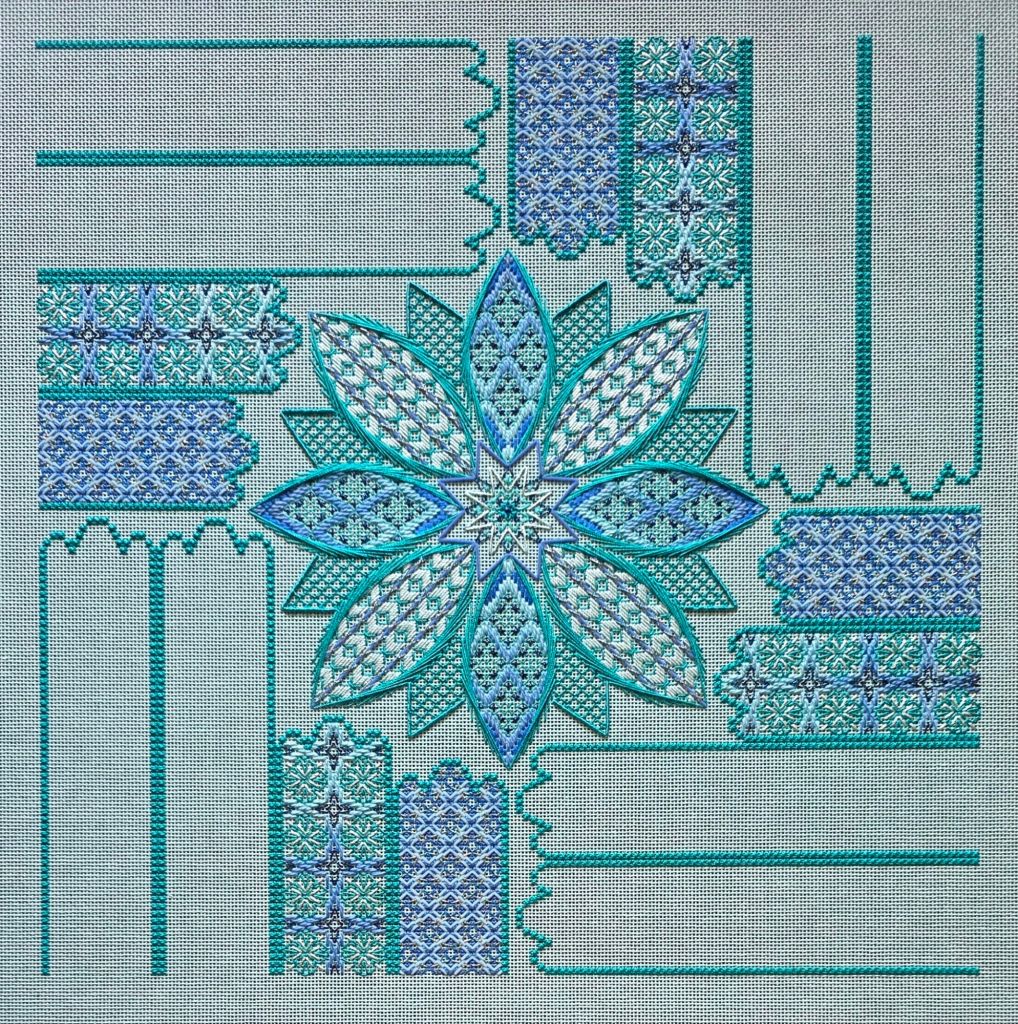
The second ribbon of Razzle Dazzle by Ann Strite-Kurz is done now in both colorways. Phew!
Several observations . . .
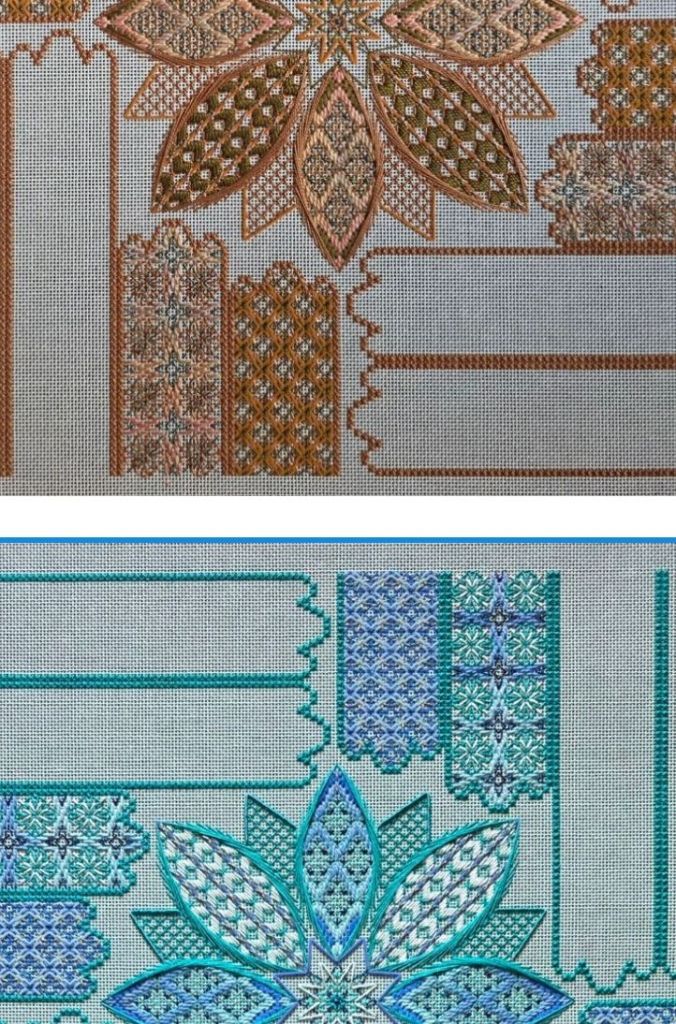
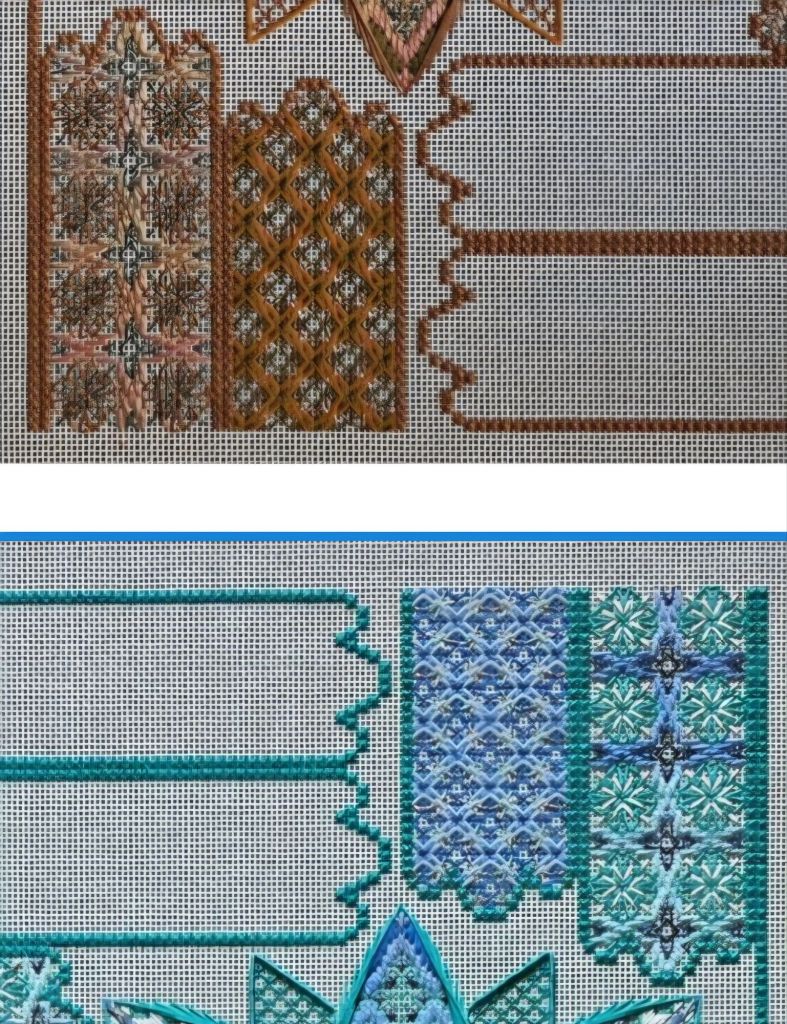
There is a more obvious color variation in the overdyed thread for the teal colorway than the fall version. So, I color matched the Watercolours Mediterranean 068 placing the darker area on the outer edge moving to a lighter color near the center. It definitely makes a visual difference. I love the symmetry. The fall version has symmetry within each of the 4 ribbons but not necessarily across all 4 ribbons and you can’t see any difference.
Only someone very familiar with the design might see that the fall colorway used 3 threads and the teal used 4 threads. I wanted to pull in the Aquamarine Trebizond TRA701 used in the center diagonal areas of the teal colorway.
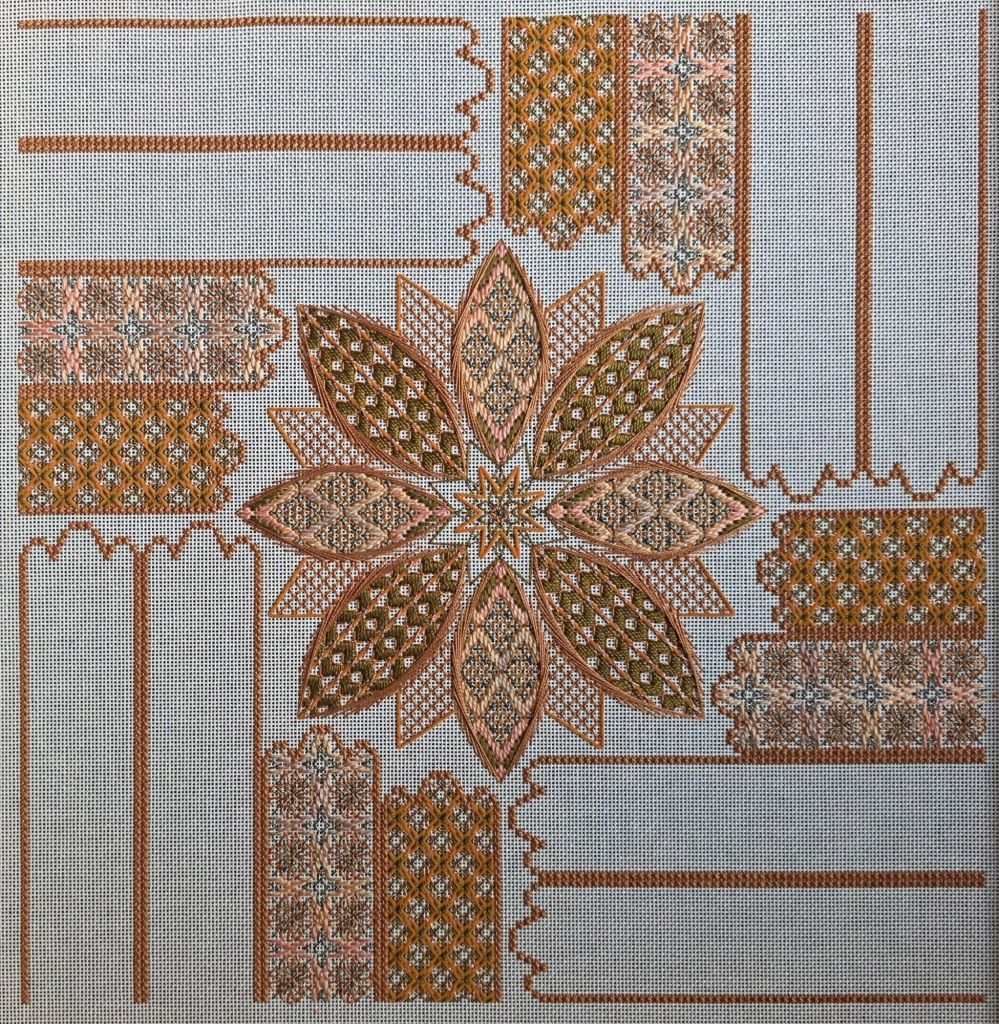
Here’s a close up.
Even closer. I love looking at these because they look so different.
What will Ribbon 3 bring? I will wait for our ANG Main Line Stitchers chapter meeting on September 14. I have other pieces needing my attention!
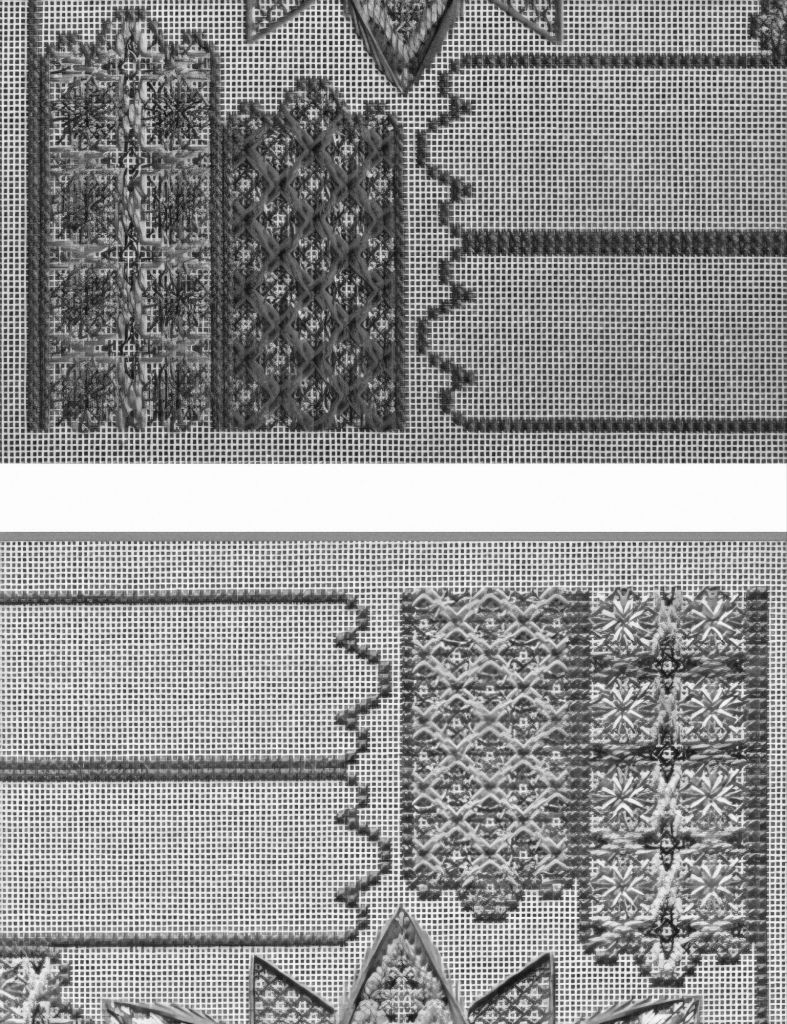
I am adding a black and white to see the impact of value. Thanks Diane for giving me the idea to share this too. So different.
Filed under: ANG Main Line Stitchers Chapter, Razzle Dazzle by Ann Strite-Kurz
I am caught up with Ribbon 1 of Razzle Dazzle by Ann Strite-Kurz in both the fall and teal colorways. Each of the first 3 steps became quite easy after doing them 14 more times.
Step 4 did get easier and I didn’t have to do the double running technique. I worked it similarly to the way as Ann diagrammed it but worked it on the opposite diagonal path.
It’s quite apparent that I am selecting different values of thread colors between the fall and teal versions. It’s quite interesting to see these develop.
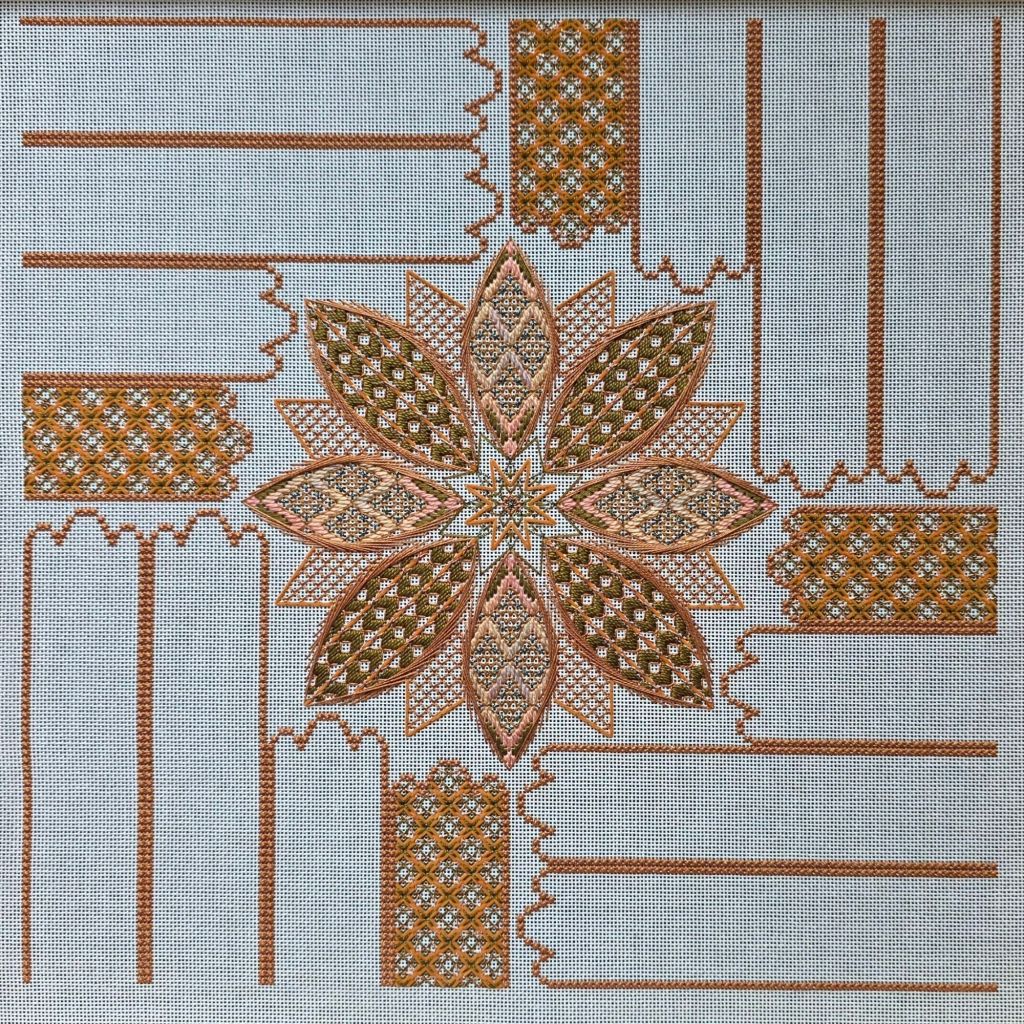
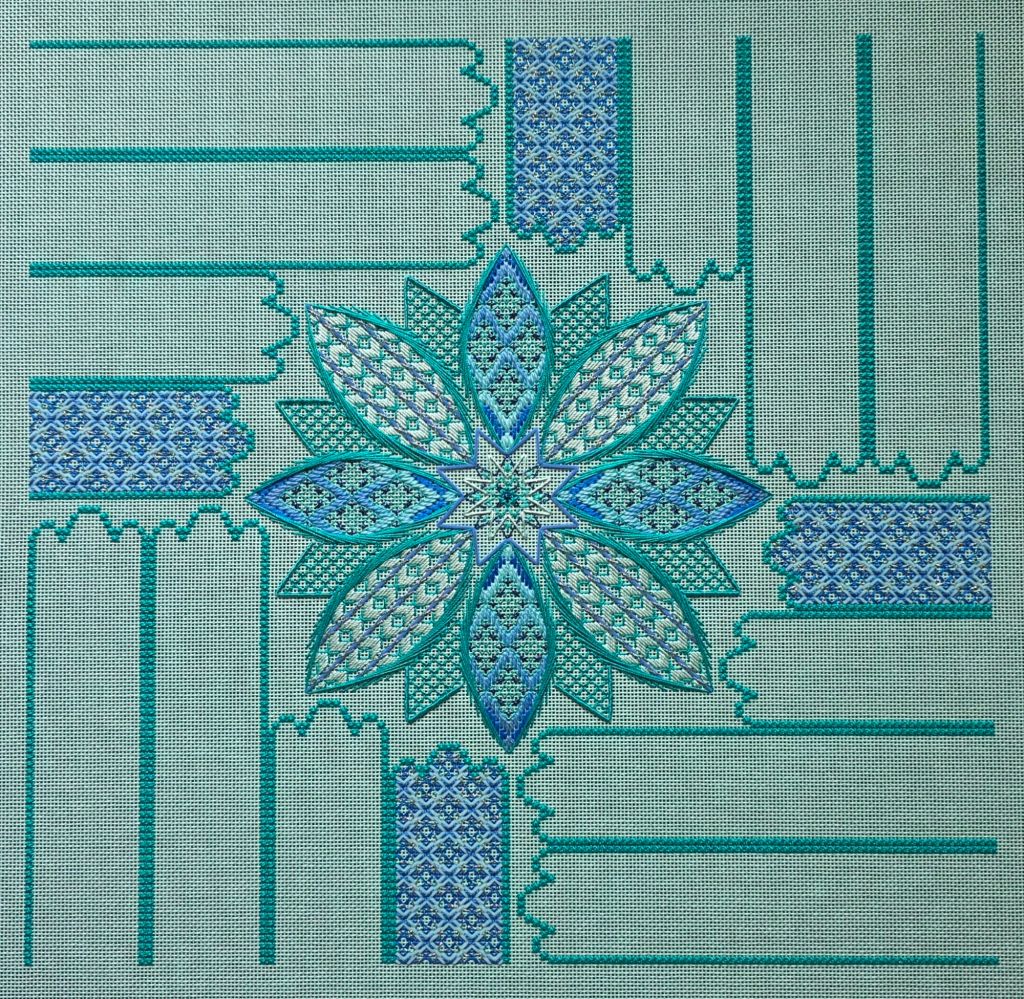
There is plenty of time to work on Ribbon 2 before our next ANG Main Line Stitchers chapter meeting on September 14. But, I will not be taking these to Stitch-in tomorrow since they are too big.
Filed under: ANG Main Line Stitchers Chapter, Razzle Dazzle by Ann Strite-Kurz
Due to being at ANG Seminar and working on an article for the Timeless Treasures from the Archives in Needle Pointers, I am behind on Razzle Dazzle. Linda M is talking about Ribbon 2 tonight.
There are 4 steps in Ribbon 1 and each step takes a good amount of time 45 minutes to an hour. I rarely time my stitching but I was curious. Do you keep track of stitching time?
The paths for Steps 1 and 2 were easy to remember and stitch. Step 3 path was tougher to remember and I periodically looked at the instructions but they made sense. Step 4 is the toughest and I switched to a double running technique that she also discusses because it took less thinking for me! I have plenty (6) more opportunities to give the original path another try.
Initially, I was going to do each Step across both colorways before moving to the next step. However, repeating the first step 8 times got a tad boring although I felt like I was moving efficiently.
I was only able to finish one of four Ribbon 1 areas in each colorway before our Monday meeting leaving some catch up work to do on Ribbon 1 and all of Ribbon 2 to work on before next month.
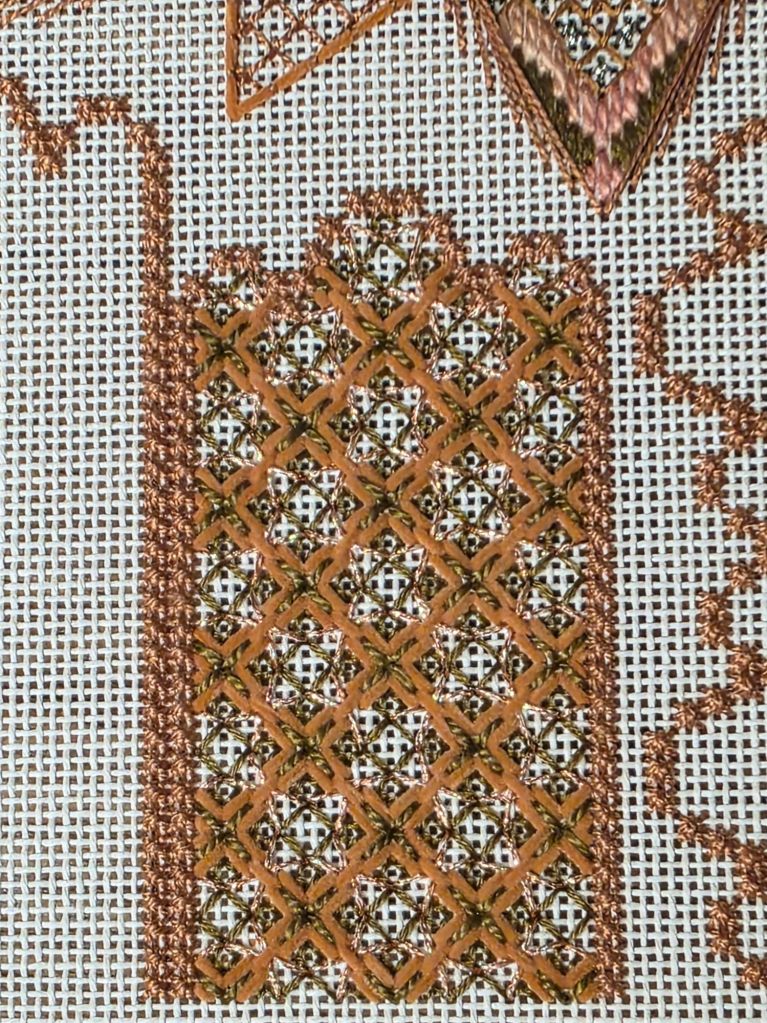
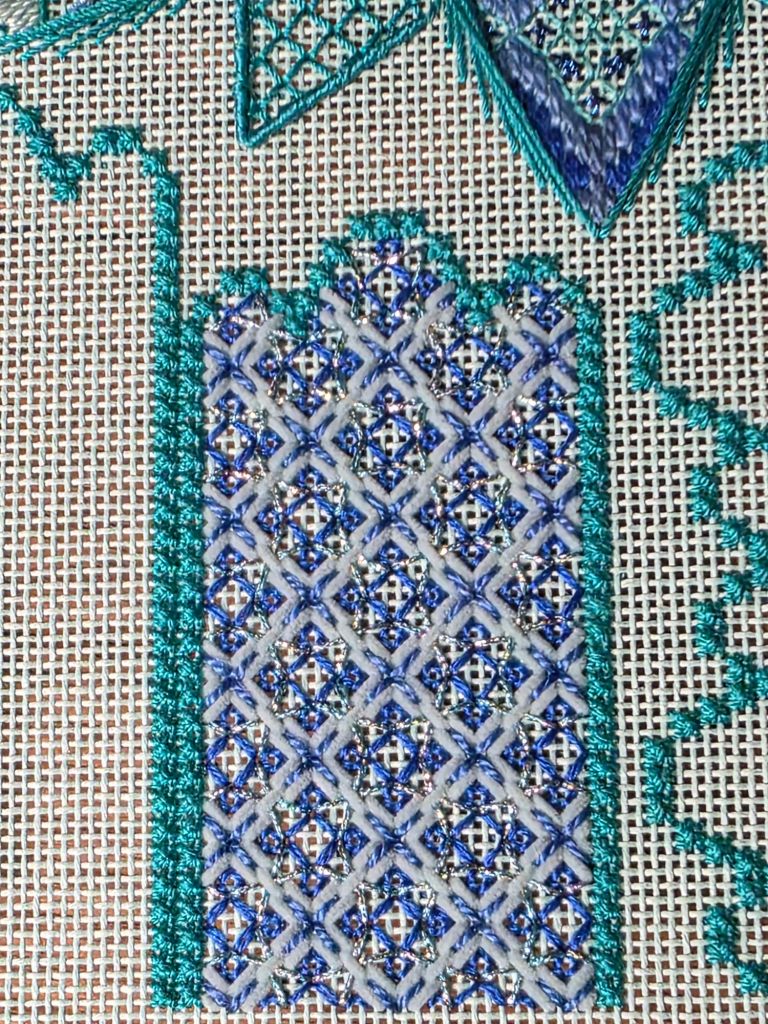
It looks lacy to me.
Filed under: ANG Main Line Stitchers Chapter, Razzle Dazzle by Ann Strite-Kurz
When I work with needlepoint up close, I forget to look at it from a distance. So, I really didn’t think the Petite Very Velvet V662 was so light that it wasn’t going to be seen from afar. But, when I set it down for the night, I realized the star points between the ovals were practically invisible against the canvas.
There wasn’t a darker Petite Very Velvet that matched the Elegance that I had been using. So, I decided to match it to a Trebizond that I seperated and ironed. I learned from Kay Stanis while taking her Nautilus class that Trebizond is not meant to be taken apart but the three plies of flat silk can be separated. Then, I carefully wrapped the Petite Very Velvet with one strand.
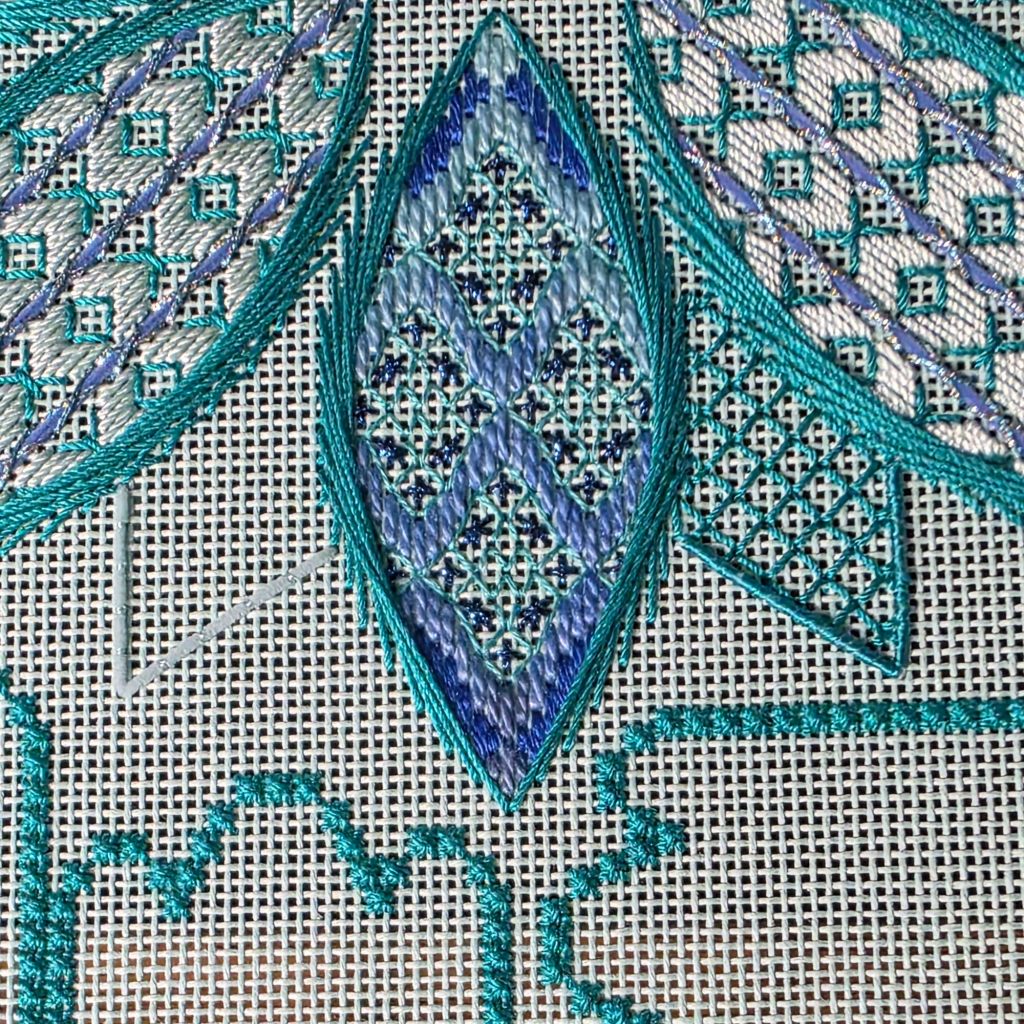
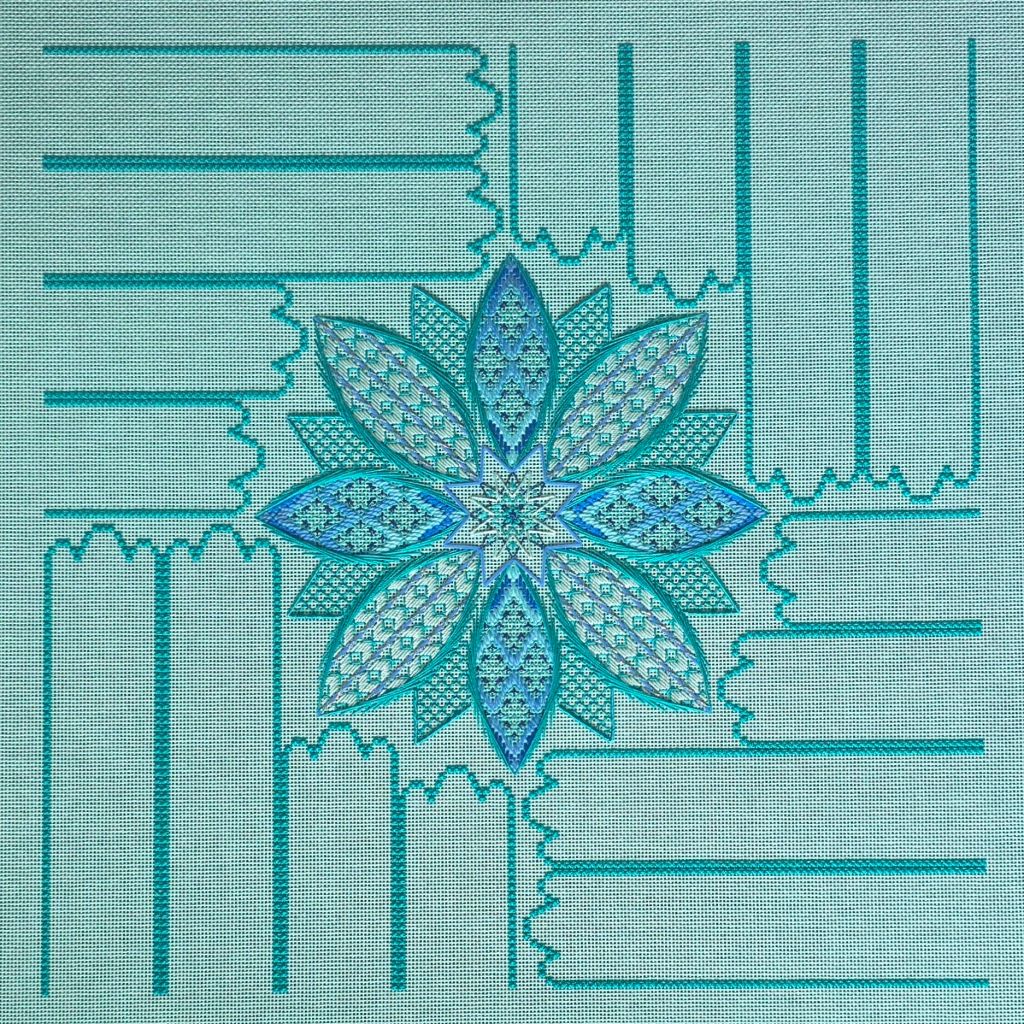
It turned out great. Tedious but you can see it!
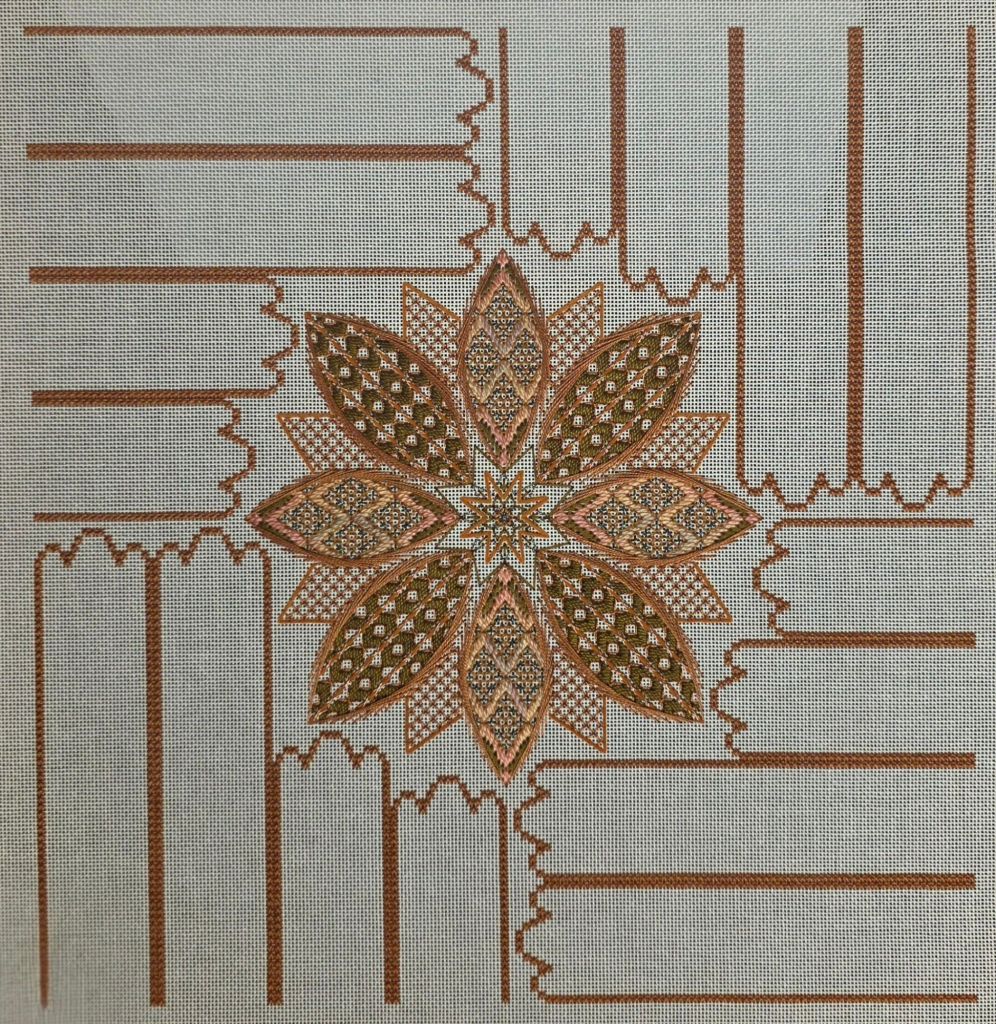
And, here is the autumnal colorway. Looks good too. This Petite Very Velvet was dark enough.
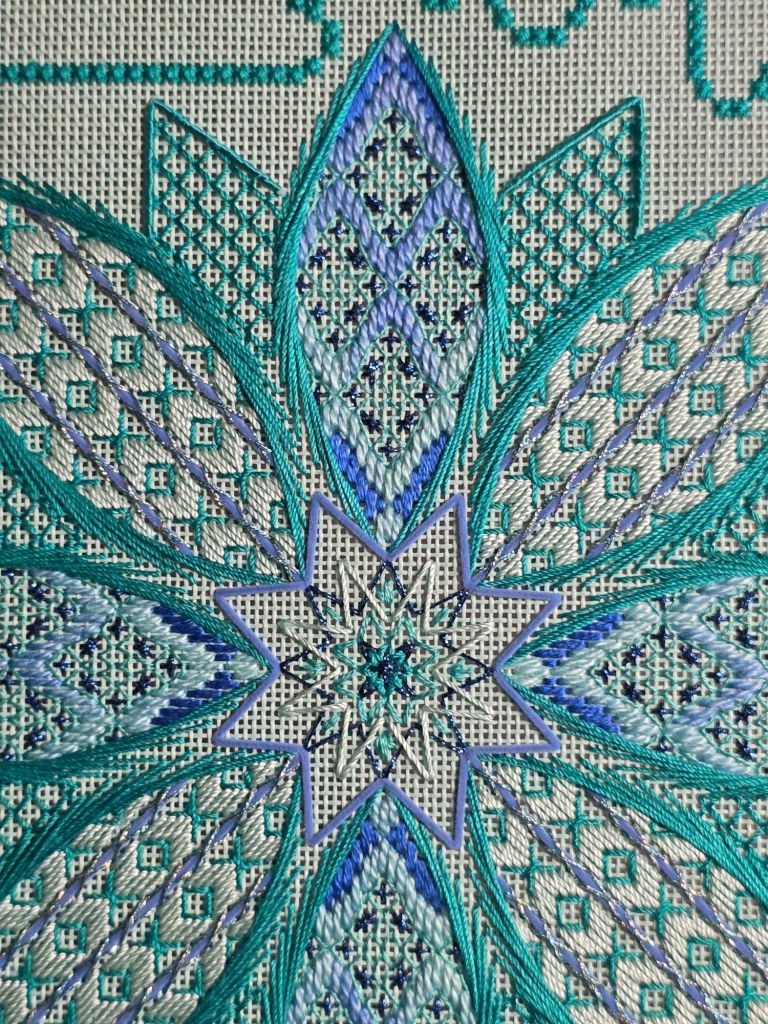
Here are close-up photos of the center. I switched around colors in the Teal version but not in the Autumnal version.
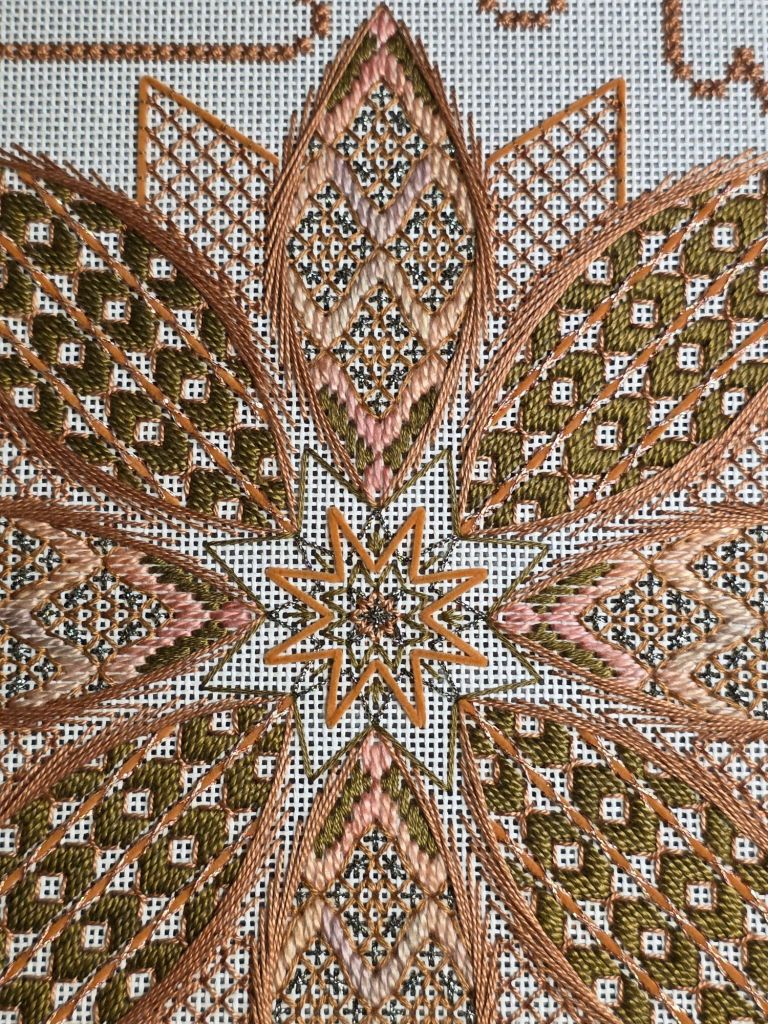
We got insights from Linda at our ANG Main Line Stitchers chapter meeting on this past Monday night for the smallest of the ribbons. Looking forward to seeing these develop.
Filed under: ANG Main Line Stitchers Chapter, Razzle Dazzle by Ann Strite-Kurz
If you work with Watercolours often enough, you should come to realize that when you unwind the skein, the color flow can look different than how it is packaged. I shouldn’t have been but was surprised to see one span of light teal portion and the rest was all the blue. So, I found the repeating pattern of color and cut a long enough length to move from light teal in the center moving towards blue for the outer edges. Very pretty. But, I didn’t realize the full impact of the Watercolours until I went to pull threads for Area 2 of Razzle Dazzle by Ann Strite-Kurz.
Initially, I picked up Petite Very Velvet (V660, a blue) but based on Ann’s color scheme it should be the teal color. So, I selected V662 Green Aqua at our ANG Main Line Stitchers May Monday meeting. I was thinking of staying with silk but there isn’t the correct blue in Grandeur (a silk #5 pearl). So, I went home to regroup. In my stash there was a full skein of DMC #5 Pearl 517, a blue cotton. That’s when I realized that the Watercolours caused the first four petals to be more blue than teal and I need to make the diagonal petals more teal. I had inadvertently inverted (partially) the colorway. So, back to my stash and into the teal drawer. What should appear but a lovely spool of Trebizond, a silk, in a lovely aquamarine (TRA701). I only had the one spool until stopping at Nimble Needle in NJ for another 2 spools. Problems solved!
One of Ann’s comments after giving us guidance on selecting colors for her design is, “Beyond this, anything goes, so have fun playing with threads.” That part is easy! In studying various versions of the design I’ve seen online, they can and do vary. So, as long the colors look good together, it should be fine. In a recent email with her, Ann said she believes a dark canvas is better because it creates a negative space better than the lighter canvas colors. I can see that as well but working on the darker colors is tougher on my eyes and I will not stitch a third colorway.
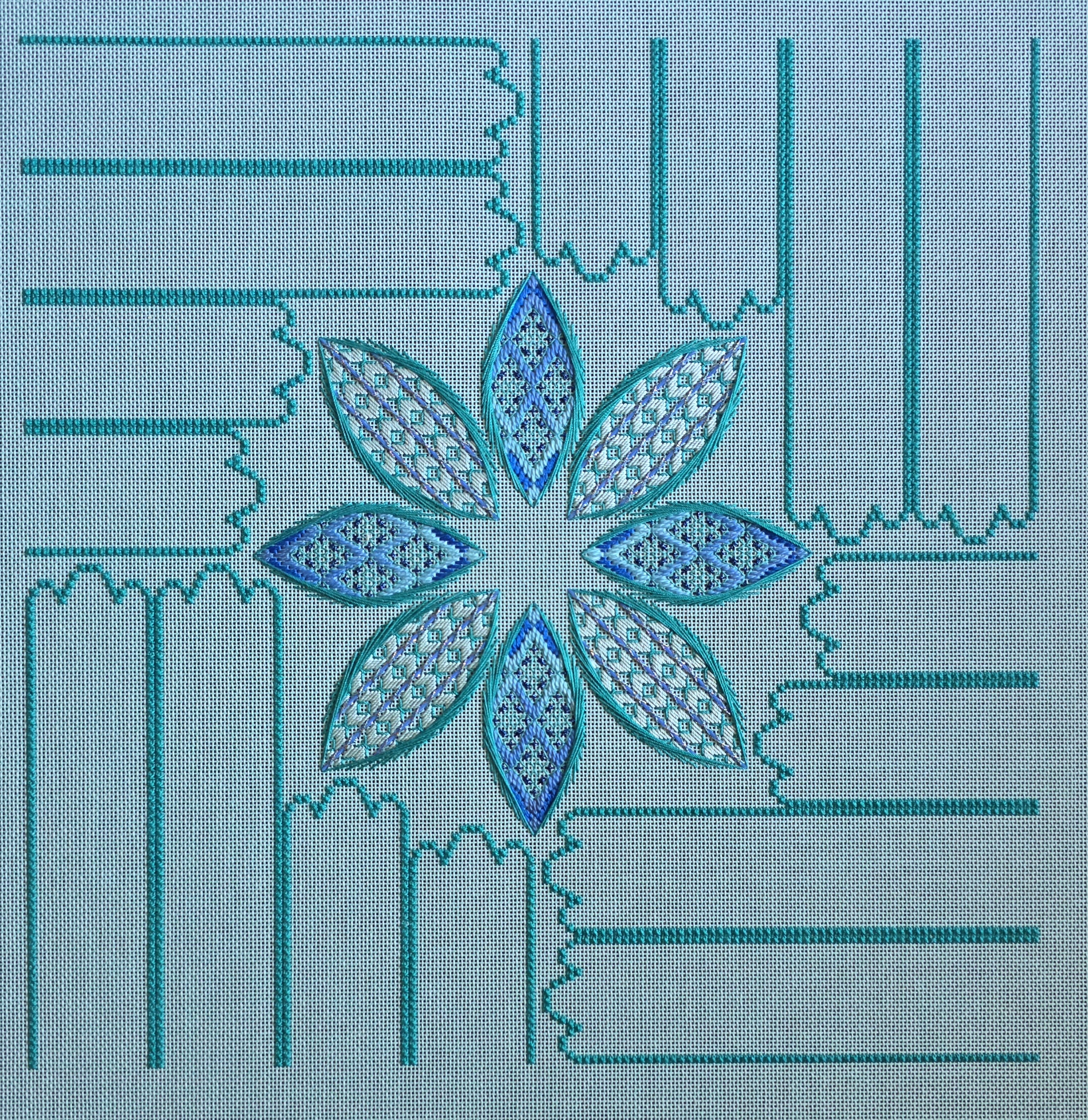
I did go back to do the Autumnal colorway and as you can see the diagonal ovals are stitched in an overall darker value than you see in the diagonal ovals of the Aquamarine colorway. Ann is correct in that it is fun to see these develop.
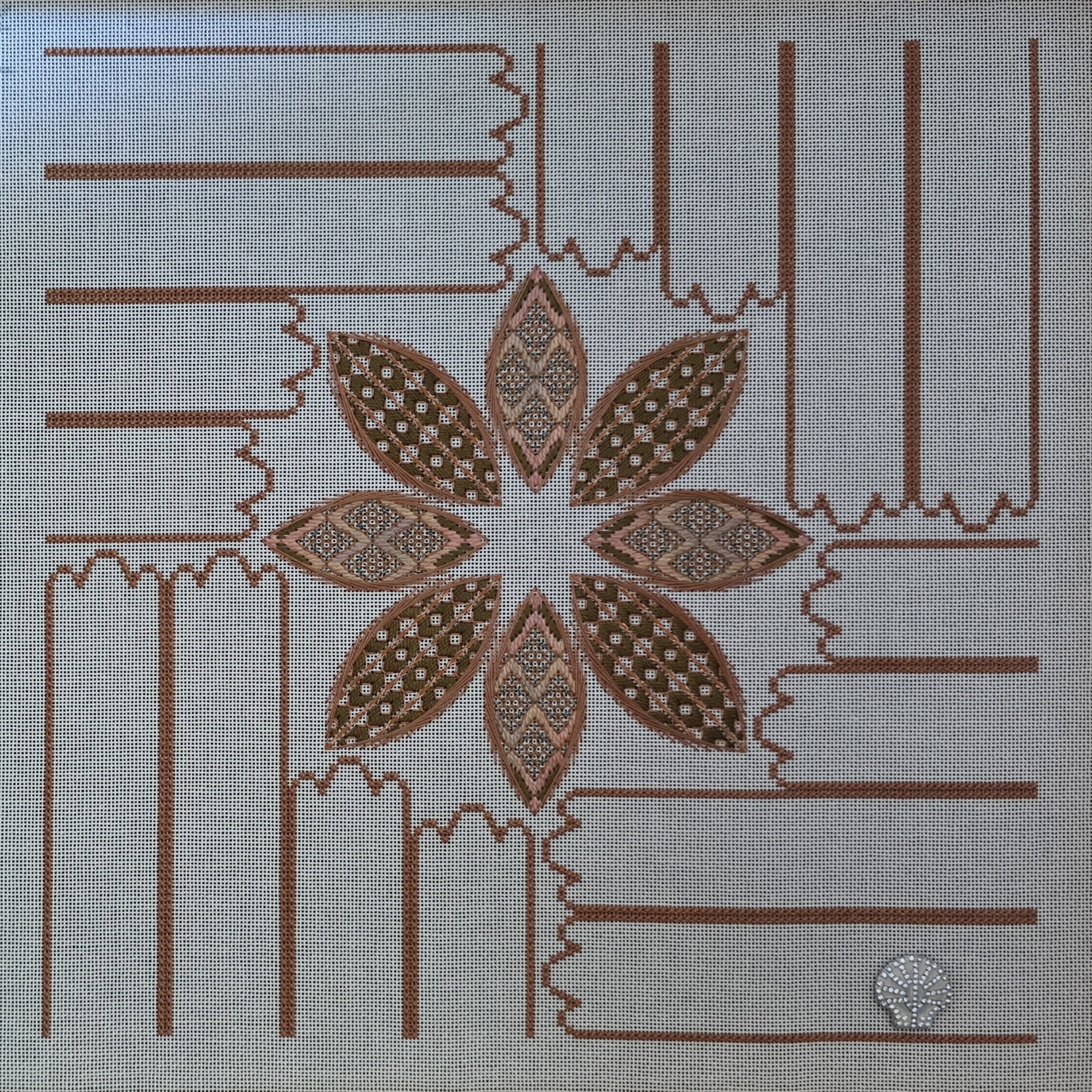
Next up (at tomorrow night’s June meeting) will be filling in the center and tips around the ovals. While that will be pretty, I am really looking forward to getting to the ribbons and I have enough thread to go in whatever direction moves me.
Filed under: ANG Main Line Stitchers Chapter, Razzle Dazzle by Ann Strite-Kurz
The four center areas in Razzle Dazzle by Ann Strite-Kurz, Ribbon Borders are done. Nothing too difficult because she charted the blackwork. Except for the side trips on the sides, it never felt intuitive. I guess that’s something!
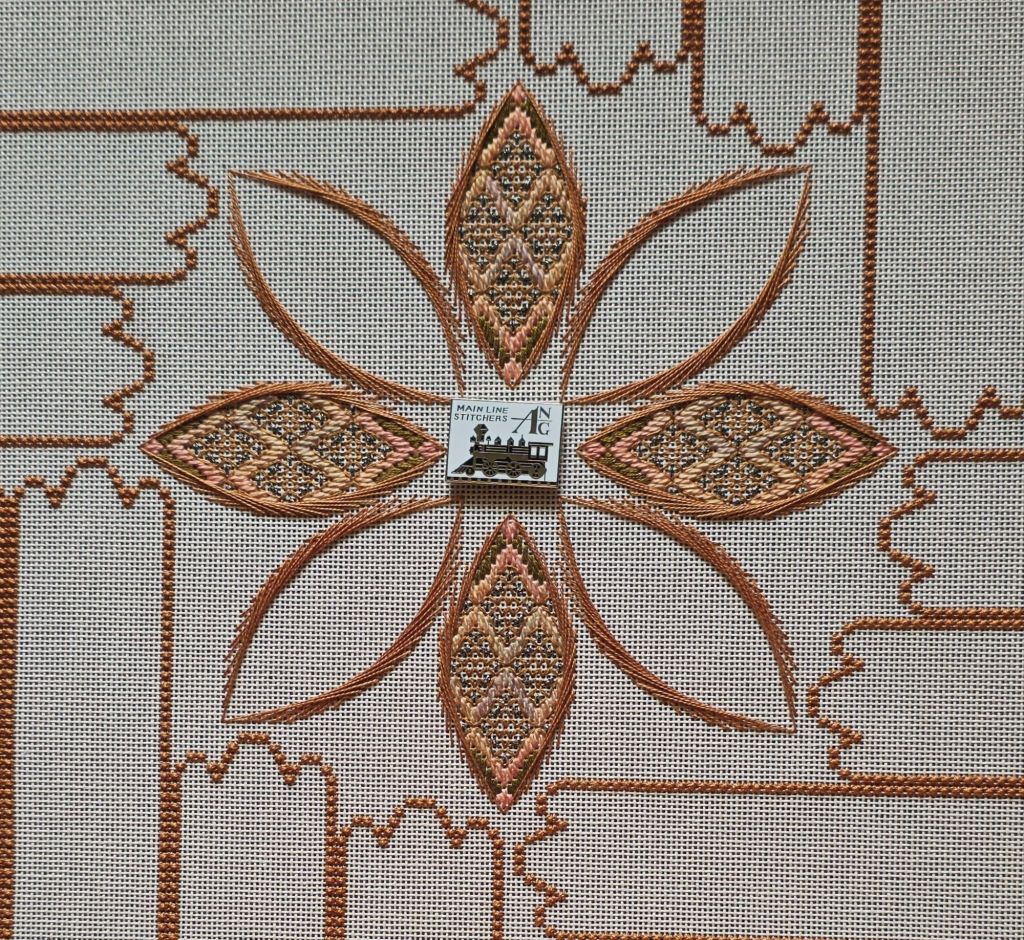
Ready for the next area. Or am I? The colorway isn’t popping for me. What is a stitcher to do!?!
I had recently found 2 pairs of 21″ bars in the basement. Thinking I might switch to another colorway and that I could shop for it at the last EGA Stitch-in at Fireside, I calculated how many cards of Elegance (a silk pearl #8) I would need in place of 2 balls of DMC Pearl cotton #8 (since Fireside doesn’t carry it). It turned out to be 9 cards but I thought it might be brighter and I wanted as much pop as I could get (so, worth the extra cost). Fireside’s website had indicated they didn’t have any colored 18 count canvas left. So, I didn’t think I’d be shopping for a new colorway and didn’t bring the instructions. However, when I arrived, they did have the aquamarine canvas that I wanted. So, I found Watercolours 068 Mediterranean that looked great with the canvas. There was a fantastic color available in Elegance E880 Teal and I found 2 colors of Kreinik #8 Braid (033 and 044). I couldn’t remember what other threads I needed except for Petite Very Velvet. More about that next time.
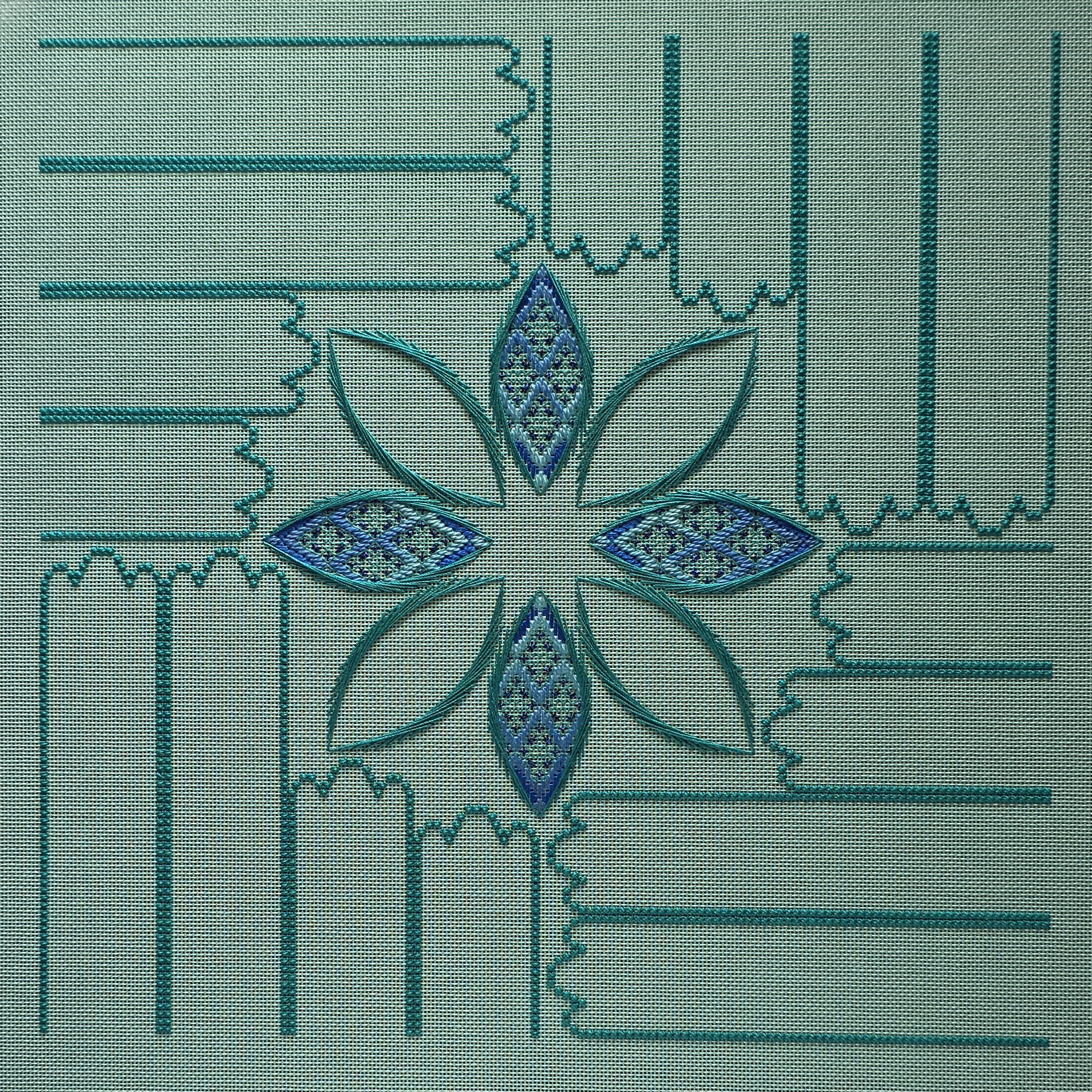
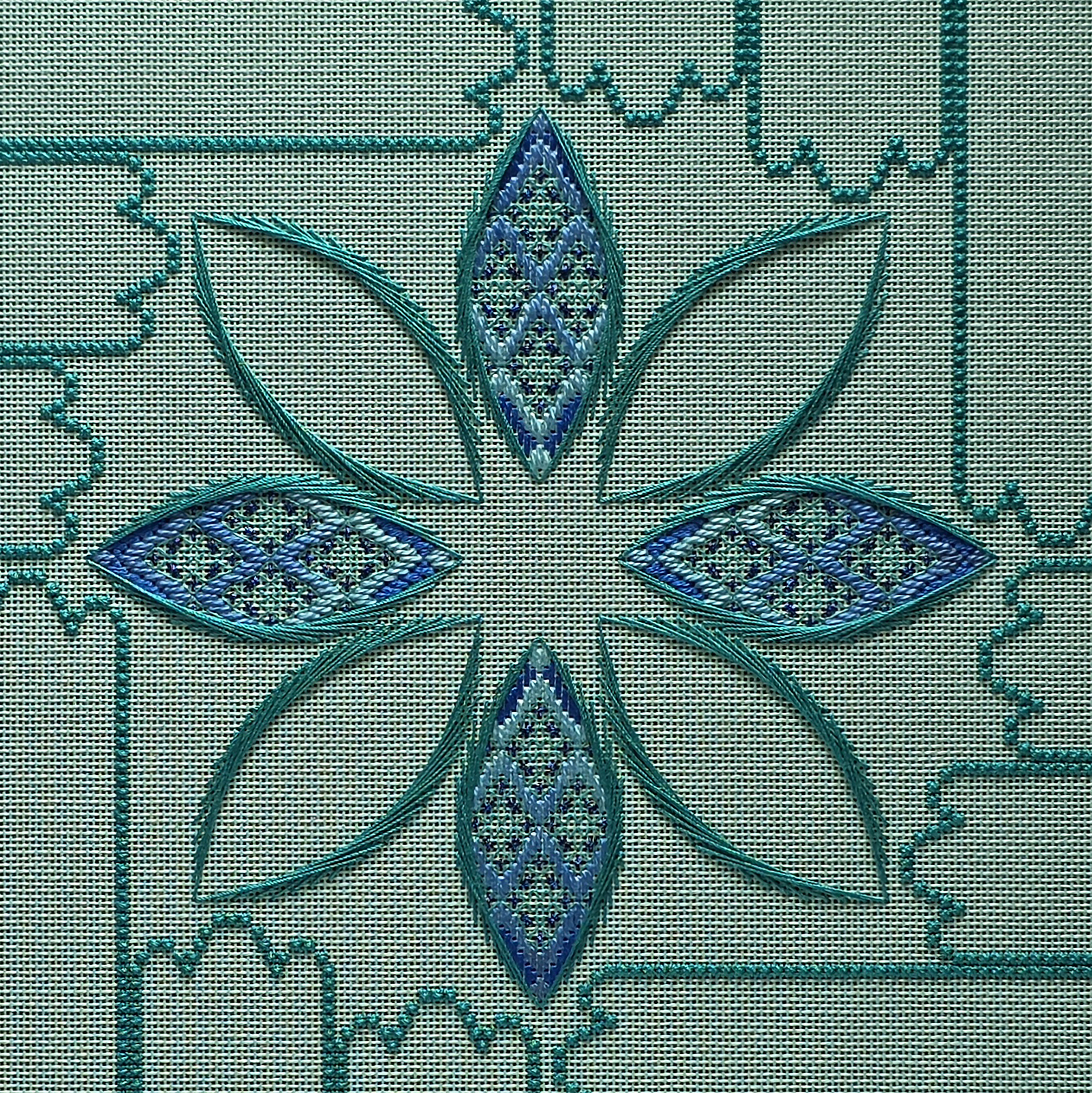
It was much easier stitching this the second time around. It took 10 days to get this done and I worked on 2 other projects to break up working on all those Smyrnas! I still needed to look at the blackwork diagram frequently. I’m very happy with this one. And I will continue with both colorways for now.
Filed under: ANG Main Line Stitchers Chapter, Razzle Dazzle by Ann Strite-Kurz
Thanks to the Masters weekend (golf), there was lots of time to stitch and it made the Smyrnas easier to get through.
All ready for the next area. Linda M from Main Line Stitchers has finished hers ahead of us in order to walk us through the project over the next few months. The upright interior portion of the center area is the topic of tonight’s meeting along with progress 6 members have made on Songbirds, a painted canvas (each is different). Of course, we’ll have Show & Tell.
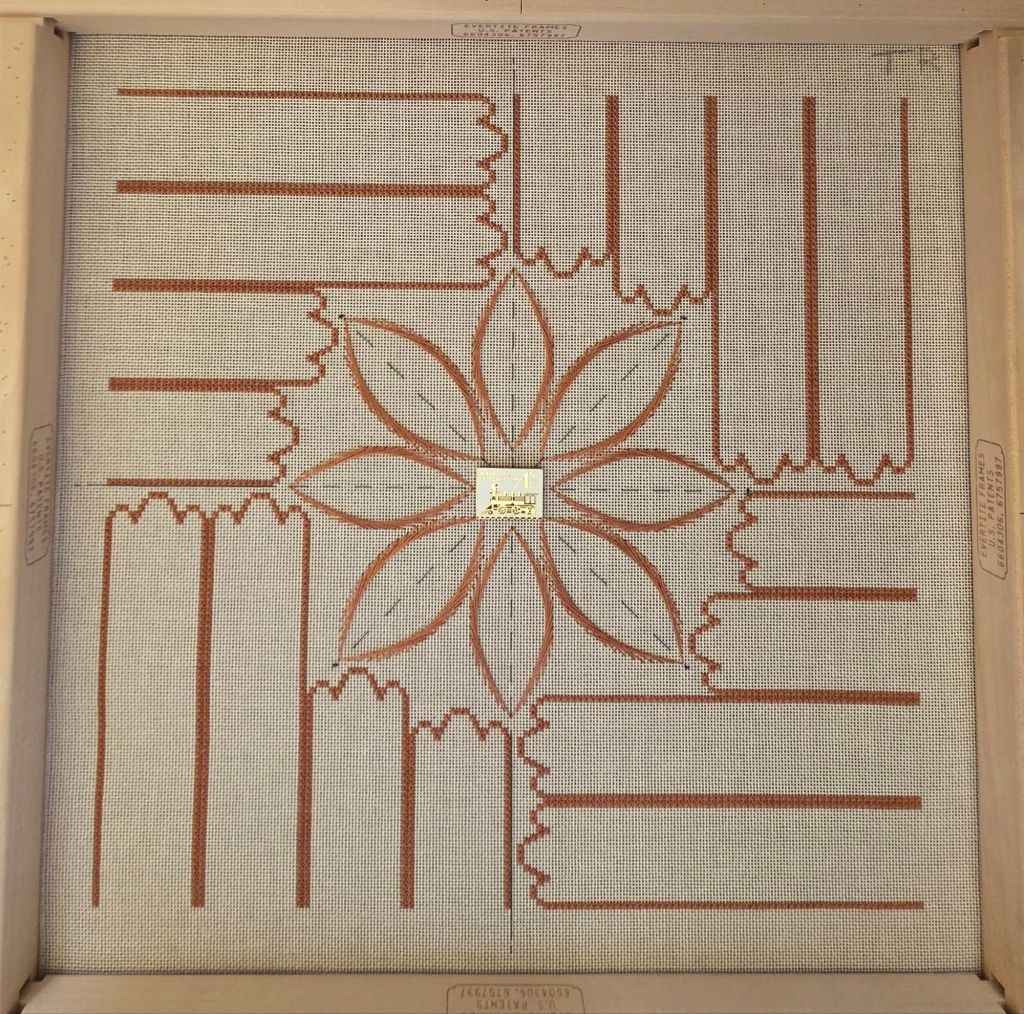
Filed under: ANG Main Line Stitchers Chapter, Razzle Dazzle by Ann Strite-Kurz
In the ribbon borders of Razzle Dazzle by Ann Strite-Kurz, there are 277 Smyrnas in each of 4 quadrants for a total of 1,108. So, here is the first quadrant done.
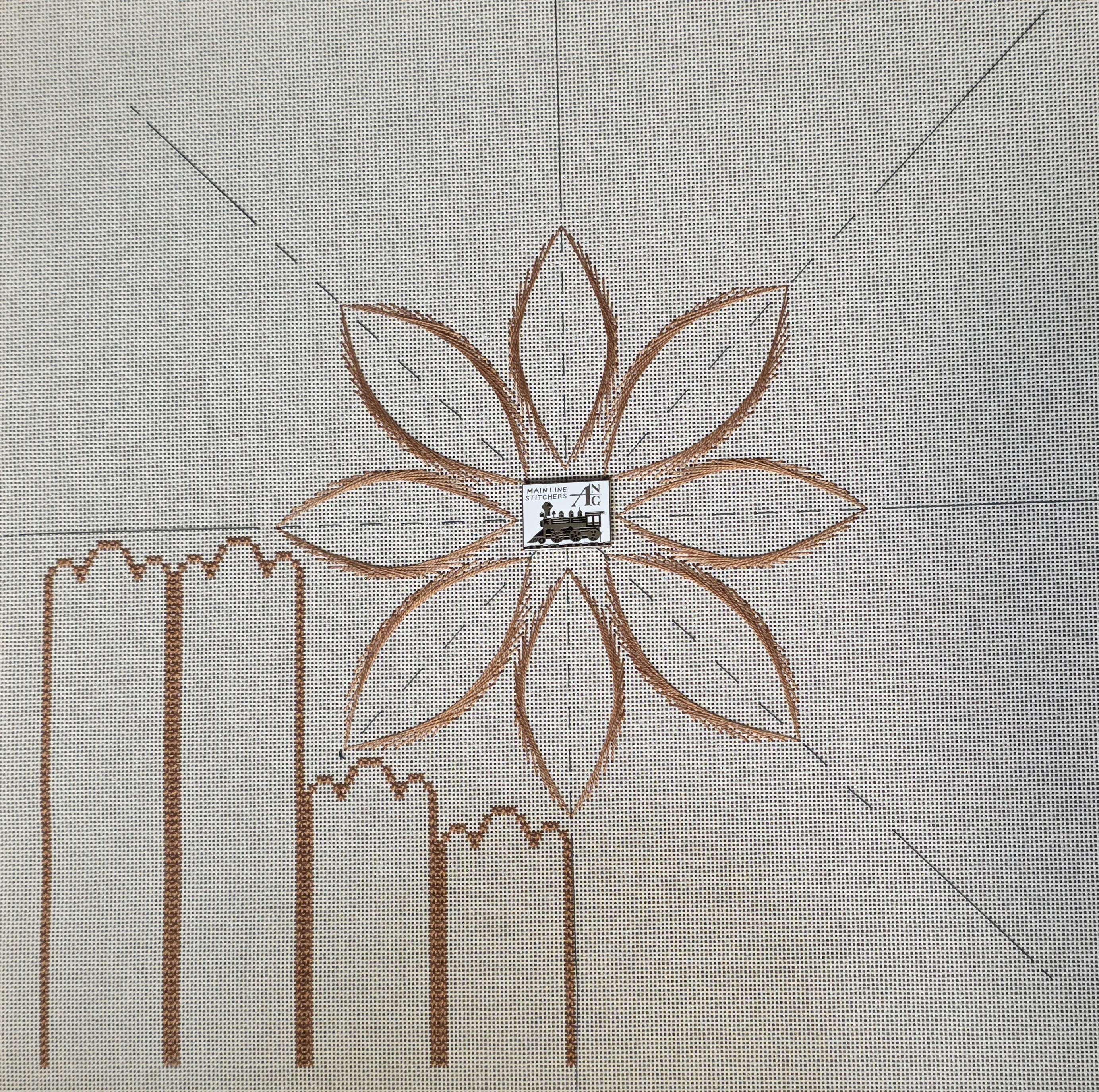
The tops edges requires some thought but the rows do not. So, I’ll have to break it up by other projects because it is too monotonous once you get to the straight rows. Hopefully, these will be done in advance of our April Monday meeting with ANG Main Line Stitchers on the 13th.

