Santa is back from the Fireside Stitchery finisher. I’m so ho, ho, ho, happy with it! As it turns out, I picked him up exactly 6 months before Christmas. I have to leave him out for a little while & enjoy it. I’m so glad Kelly suggested I add a few rows of white around the edge.

And the back is great too.

Ho, Ho, Ho, Santa’s done & ready to go on a trip – not to the North Pole – just to the finisher! That was a fun project & not difficult. More than enough materials were provided. And, the directions were clear.
Thanks to Kelly for telling me to stitch a few rows around the piece before taking to the finisher. I see now Kelly said 2 rows but I did 4-5 – sure hope that isn’t too many. I love the fur on the hat!

Santa is looking good – go ahead & pull on the beard or mustache! 
Just the hat band left to go (excluding the four rows needed all around the piece for finishers to work with).
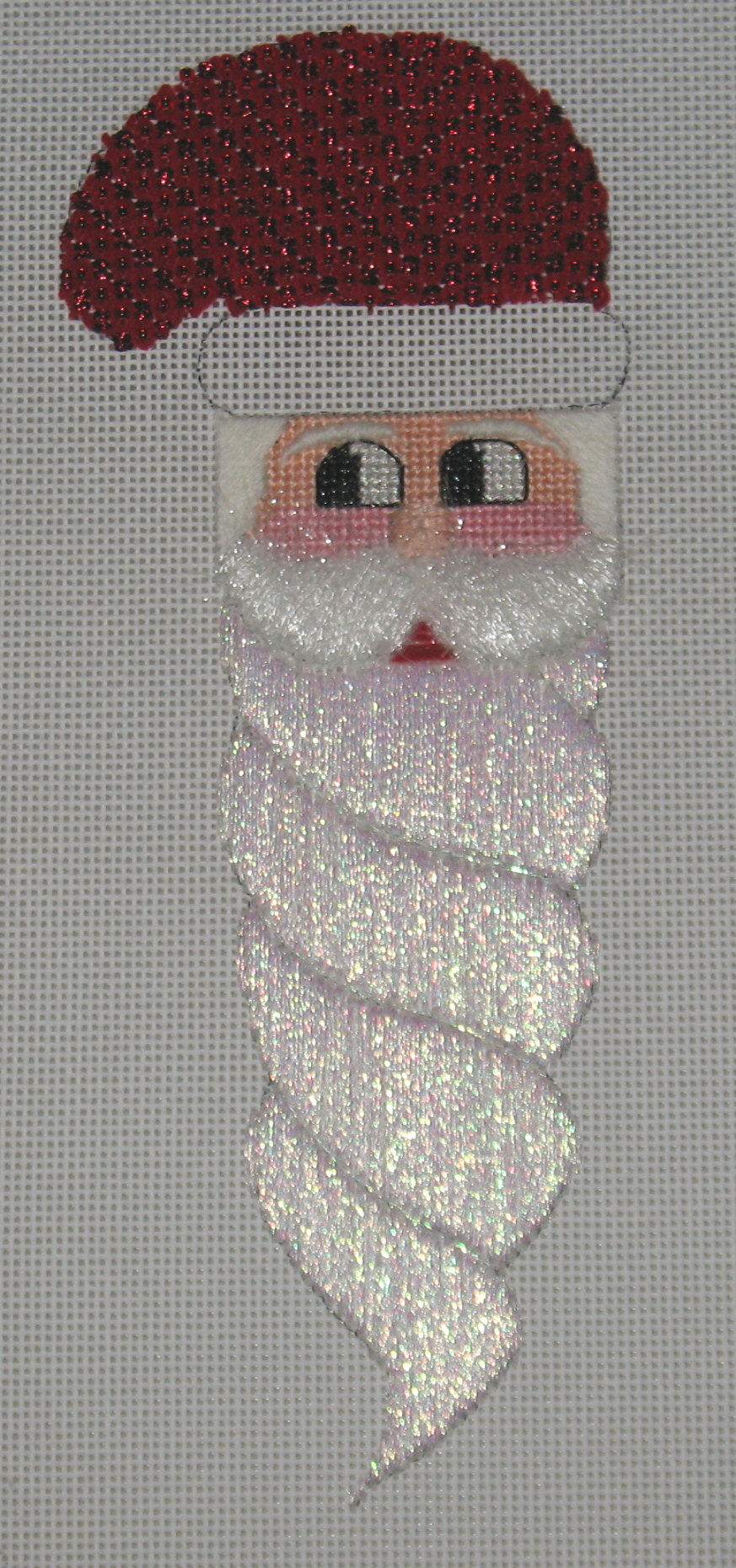
Santa gets his full face & a red-hot hat this weekend! Even though I had spring fever from going to the Philadelphia Flower Show, I got a lot done – mostly Sunday because my feet needed the rest after walking the convention center. It sure felt like spring even with the chill in the air on Saturday. Wonderful weekend!
The Tied Oblong Cross Stitch on the Diagonal for his hat was tough to get the hang of & compensate. So, I did have to concentrate but it looks great. The hat has a very rich & full look with the Petite Very Velvet for the crosses, Kreinik Ribbon for the ties, & Sundance Beads.
I’m really happy with my sky even though Monet’s palette had more yellow in the clouds than these. When I selected the overdyed thread, Crescent Colours Frosty (120485), it really looked blue & yellow. But, when it separated to fewer threads, the colors diffused.
I had used thread blending and thread shading techniques before but after seeing how Lois Kershner combined thread blending with thread shading (as described in ‘Landscapes: Design & Stitching Techniques’) for her ‘Pajaro Dunes’, I knew I’d found my sky. I removed the few rows of Irregular Running as Giant Parisian variation in favor of the Horizontal Brick Stitch. The technique for thread shading works with most stitches but not with the running type of stitch.
I subdivided the portions of the sky into 6 levels of color in the sky. One skein had slightly darker blue portions (skein #1) than the other (skein #2). So, I cut out the portions that were dark blue from skein #1, light blue from skein #2, and light yellow from either skein.
Section 1 – 3 threads of dark blue
Section 2 – 2 threads of dark blue, 1 thread of light blue
Section 3 – 1 thread of dark blue, 2 threads of light blue
Section 4 – 3 threads of light yellow
Section 5 – 2 threads of light yellow, 1 thread of light blue
Section 6 – 2 threads of light blue, 1 thread of light yellow
I had bought 2 skeins of the floss (each 5 yards) – plenty – so I thought! Well, I ended up with just five 6-inch yellow pieces and one 6-inch light blue piece. That was close!!

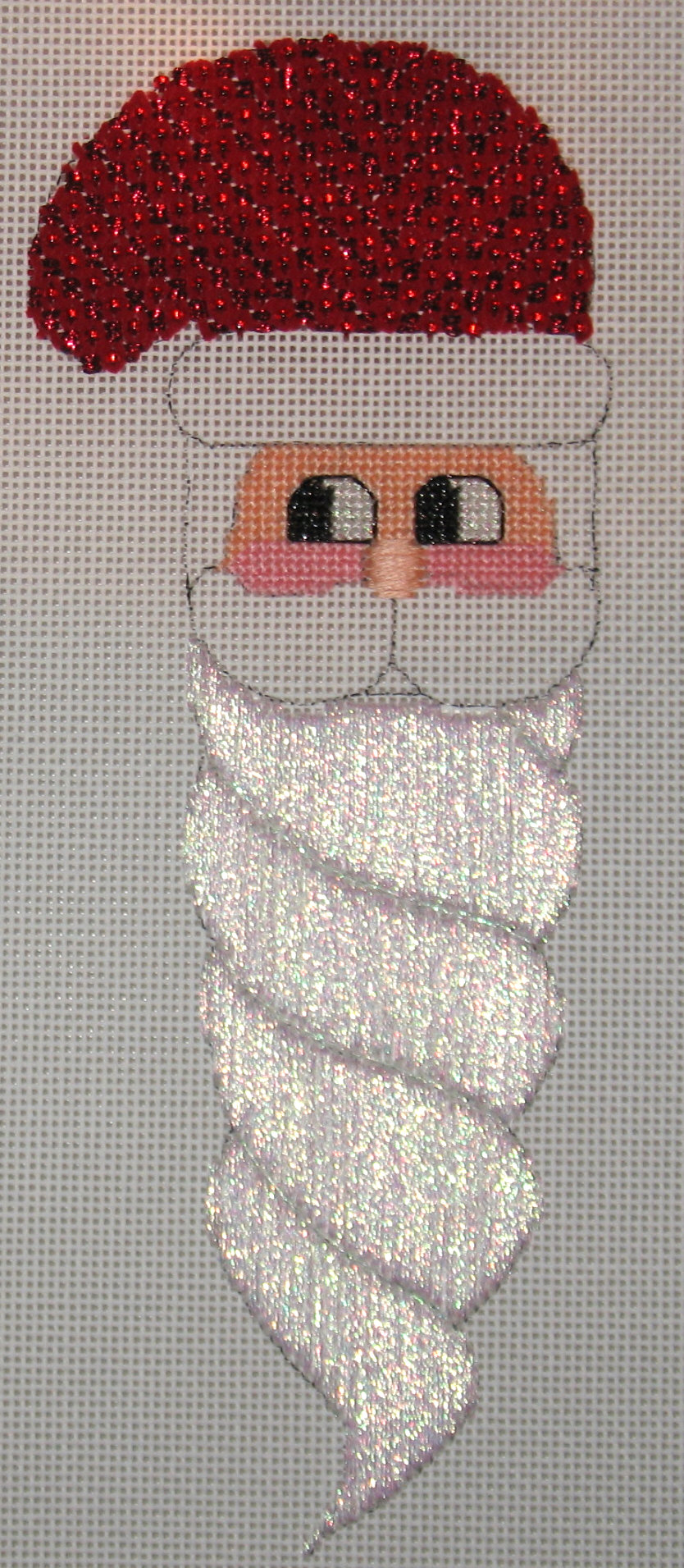
Whenever I go to see Santa at the mall, I always look at his beard – to me that makes all the difference. It’s got to be white & full just like this one! I wonder if my finishing Santa’s beard this tonight is causing the upcoming snow event?
I took the Metallic Ribbon Floss, stripped 2 thin strands, layed, & couched them between the segments of the beard. Perhaps I pulled too tight but I could see holes and/or some of the sketch & they are covered up now.

Filed under: ANG Seminar 2010, Melita's Adaptations, Monet's Poppy Field, Poppy Field
I can’t remember where or when I fell in love with Monet’s Poppy Field in a Hollow near Giverny (1885). But, I am convinced some day I’ll capture it in needlepoint. No, it won’t be Monet’s Poppy Field, it’ll be my interpretation of it. But hopefully, it’ll be something I can gaze upon & feel it take me to a patch of that long grass.

My first attempt was all about testing stitches. I really like the Whipped or Laced Running Stitch (Elegant Stitches by Judith Baker Montano) for the light blue on the right. I didn’t care for it as much for the 2 greens to the left of that area. I also liked the stitch Serendipity used in the top blue-green portion for the distant tree line & Rococo for the dark green bushes in the middle (both are from Stitches To Go by Suzanne Howren & Beth Robertson). It’s size is 4&1/2″ x 4&1/2″ & too square.

The quest continued for stitches in my second attempt. I had it in my mind that a large stitch pattern base would work for the poppies & then thought random french & colonial knots would make the flowers on the field appear random but it became too dense. I did like the Knotted Stitch on the upper left & a similar stitch with less slope for the area to the left of the center dark green bushes called Diagonal Roumanian. Then, I created a variation of Kennan for the area left of the center dark green bushes. These stitches came from Stitches To Go by Suzanne Howren & Beth Robertson. It’s size is 4″ x 4&1/2″.

I felt pretty good about stitches & decided in this attempt I better test some colors & threads. To combat the density of the poppy field, I switched to a thinner thread. It was better but it wasn’t right – it seemed flat & lifeless. So, I put it away for a long time deciding further experience was needed before I could improve the piece. It’s size is still 4″ x 4&1/2″.

Always on the look out for new threads, I tried a variety of threads. I also tried some different stitches. I liked this version much better, especially the poppy field because I used various shades. David McCaskill’s suggestion to use a canvas with the blue tint to it improved the piece as well because areas show through, depending on the stitch/thread. While I saw improvement, I wasn’t sure where to go next & decided to put it away – again. It’s size is 4&1/2″ x 4&1/2″.
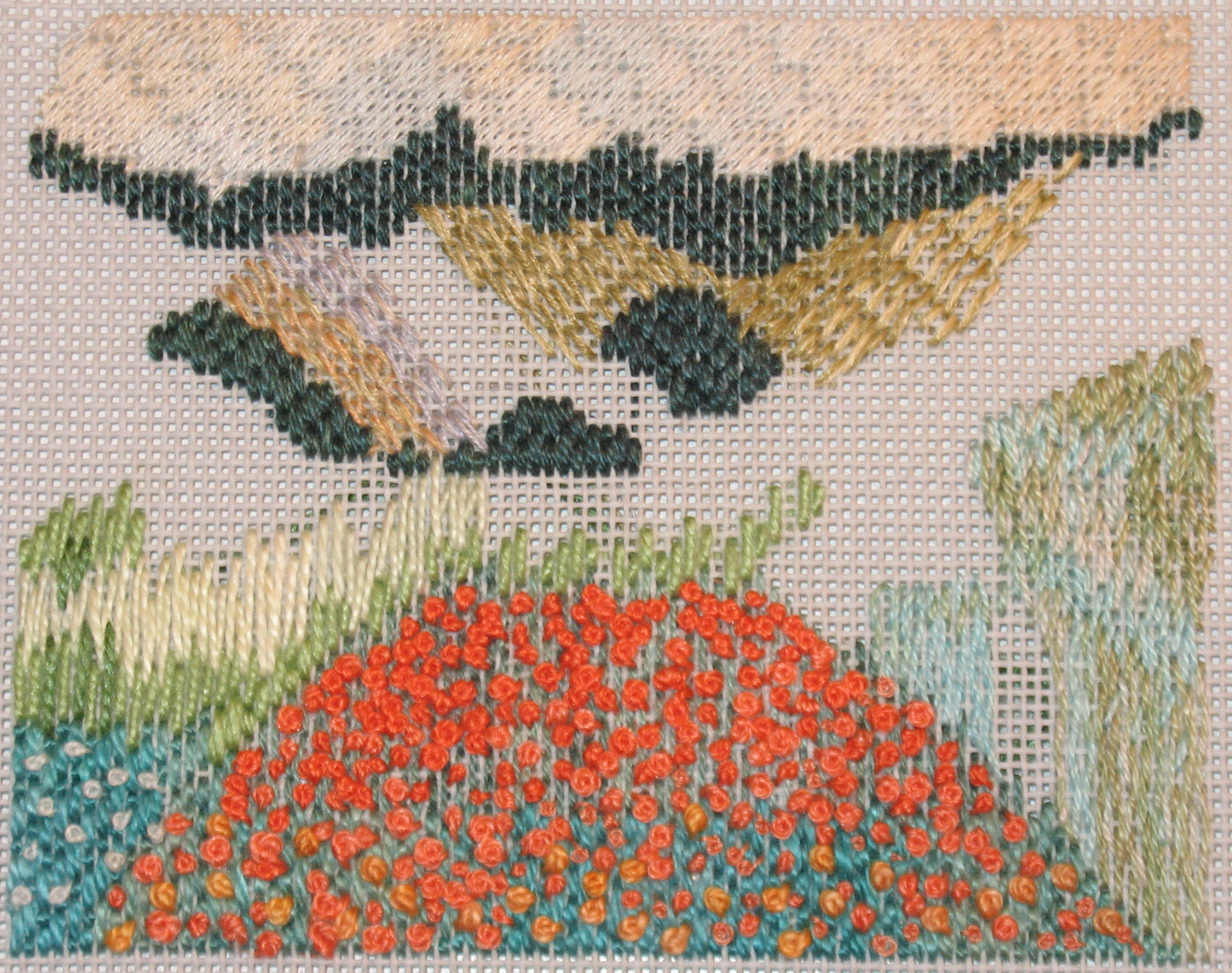
Then, I saw the class teaching design & stitching techniques for landscapes advertised for the 2010 ANG Seminar taught by Lois Kershner. I wasn’t familiar with her work but could tell by the description of the class it’d be perfect for me to help figure out my poppy field. So, I attended my first seminar. Now, I am armed with knowledge from her class as taught by Pat Rusch. Will my fifth attempt be my last? It is full size (8″ x 9&1/2″) still on blue canvas. As you can see, I didn’t get much stitched during class because I was studying the techniques in the book and reconsidering threads & stitches – again! Wish me luck!!

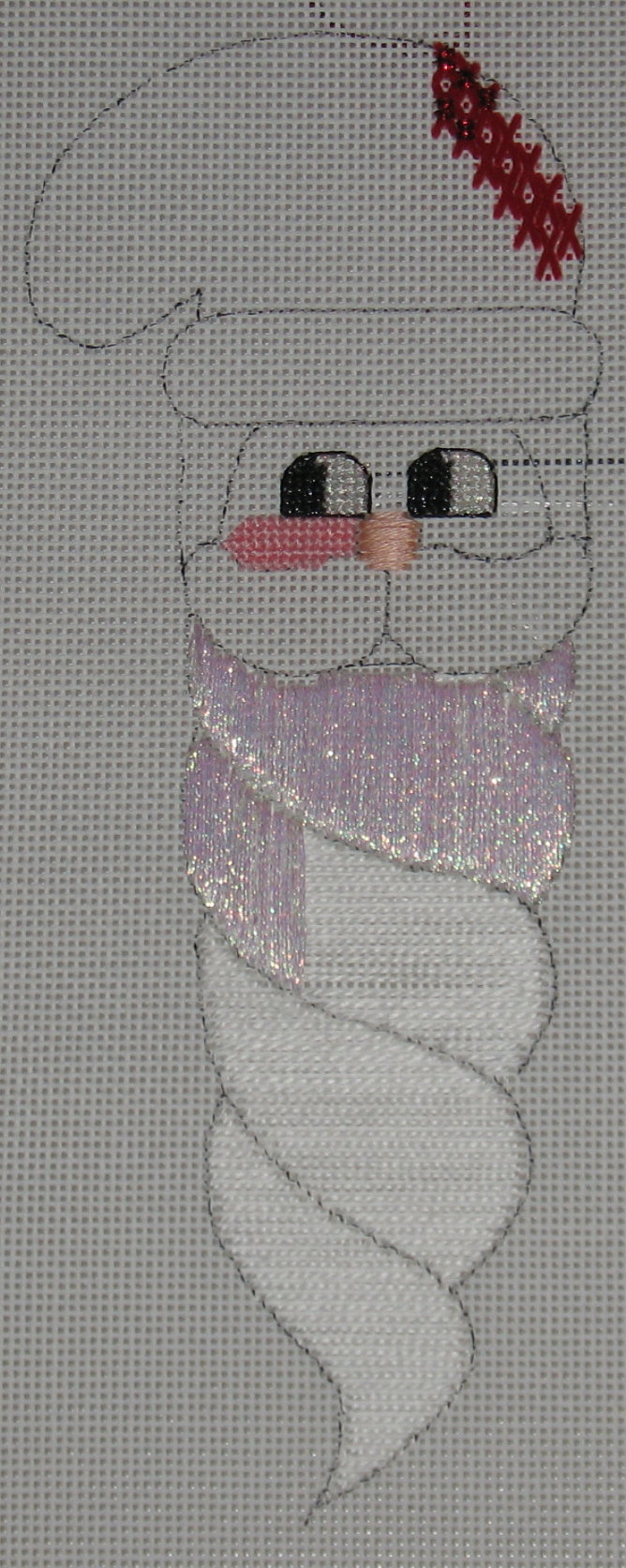
At the ANG Seminar in October 2010, I took this half-day class taught by Janet Zickler Casey called Santacicle. I love icicles & Santas – so, I gravitated to this project.
There isn’t a lot of stitching that I could get done in 1/2 day. Yet, Janet discussed how to stitch all the sections – so, it moved at quite a rapid pace. Some of the beard was done during class & then worked on when I first returned from class. Since then, I got distracted on other projects. There are some new threads for me to work with such as Metallic Ribbon Floss which is what I’m using now to cover the Perle Cotton on the beard . . .
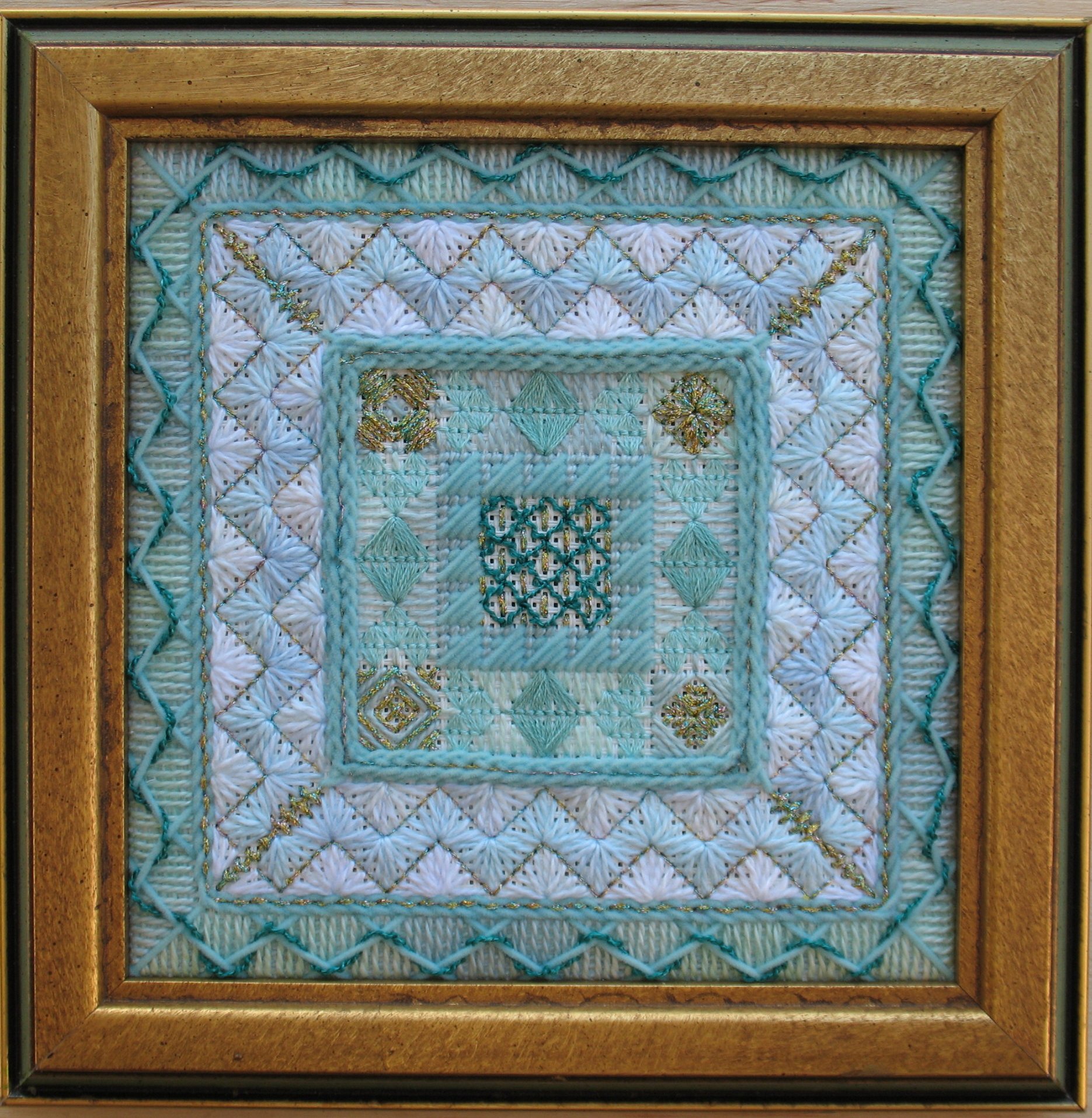
“Points of Tranquility” in 3 color families were entered in the 2010 ANG Seminar in the original design category. My artist’s statement follows:
When I was given a lovely blue and gold square frame, I decided to design a piece of needlepoint for it. I like to be challenged and felt I had learned enough from recent geometric designs we had done as part of ANG Main Line Chapter projects to make the attempt.
Because the square frame has an inner portion of thin royal blue and gold strips, then a wider blue strip, and lastly a gold strip, I wanted to create that same ‘frame within a frame’ effect in the design area and keep the piece symmetrical. I found enough triangular-shaped stitch patterns that squared up nicely and didn’t require much compensation. Although I had to stitch no larger than the opening for the frame, I didn’t plan everything out in advance. For example, the Triangular Ray band, had a diagonal gap that filled in nicely by the Pearl stitch, with its small triangle portions, and really added to the effect of depth. The Raised Lattice Band for the outermost band could be as wide as needed. It all seemed to fit into place as I progressed.
I couldn’t think of anything other than, ‘Trianguality’, for a name but I knew it wasn’t good. So, I solicited input from the wonderful women who help take care of my mother. And, I just fell in love with Kathy’s suggestion, “Points of Tranquility”. Thanks again Kathy!
When I showed off my finished piece at our end-of-year dinner and my fellow Chapter members asked “Who’s design is that!?!”, I was thrilled. Then, I was flattered when they actually wanted to stitch it as a project. From my scribbled notes, I wrote my first stitch guide using just Adobe Acrobat. And, to make sure I was writing everything down, I stitched a second one in another color family. Then, when we stitched it in the fall, I did another in a third color. So, I distinguish each “Points of Tranquility” by adding “in the Sky” for the blue piece, “on the Earth” for the brown piece, and “in the Sea” for the aqua green piece.
Thanks for the frame Dottie & for many tranquil visits to your Pocono home!
“Points of Tranquility” scored the lowest (73% of total and 19% lower than the top score in the category). But, this was my first attempt at a geometric design and not surprised that they had issues. The comments get quite technical but key issues were around values chosen and confusion about the focal point. I’m still struggling with seeing different focal points in each piece. Apparently, in the blue, there are 2 focal points – one within the navy/metallic area and the other the true center; in the brown, it is the area enclosed with the brown metallic; in the green, it is the true center. I’ll keep studying them! One of the elements I liked the best was the outer border. I just love how it was described, “Your wrapped stitches for the outer borders are an effective and inspired selection. It is effective, provides a variation in texture and loft to the pieces and lends itself to the utilization of subtlety while still providing weight for balance of the piece.” I said it before and I’ll say it again, I really appreciate the thoughtful and thoroughness of each critique.


Madam Carina was entered in the 2010 ANG Seminar. I was really pleased that she scored just 1 point lower than “Beautiful Ohio” in each area: design, color, workmanship/technique, suitability, and finishing. They were both adaptations but Madam Carina used a variety of stitches. My artist’s statement follows:
This mysterious woman appeared at my hair salon as a stained glass piece (original designer unknown). As I continued to be intrigued by her at my appointments, I decided she’d look striking in needlepoint. So, I took a photo and looked through my collection of pins for one to adorn her hat. But, as soon as I saw the pearl and gold pin, I knew it was ideal for her earring. I’d been designing needlepoint to showcase jewelry, mainly pins (which I call “Pinsations” and is designed so that the pin can be removed and worn).
I enlarged the photo using a xerox/printer until I determined a size appropriate for the pin to work as an earring. Then, I drew the design on the canvas and selected stitches as I progressed. I started with the jacket and chose stitches based on the angle of the particular piece of her jacket. For the collar of the jacket I decided to use the darkest portions of the overdyed thread to help bring that area out and I did some free-style weaving with threads that added some sparkle. Once I decided to couch the outline of the jacket and face, she came to life. If the pin were removed and worn, there is an Octagonal Rhodes stitched underneath the pin which serves to attach the pin and look like an earring.
Naming “MadamCarina” became the hardest part. I finally chose Madam because she is mysterious and Carina, a Danish short form of Catherine which is my sister-in-law’s name and the original owner of the pin!
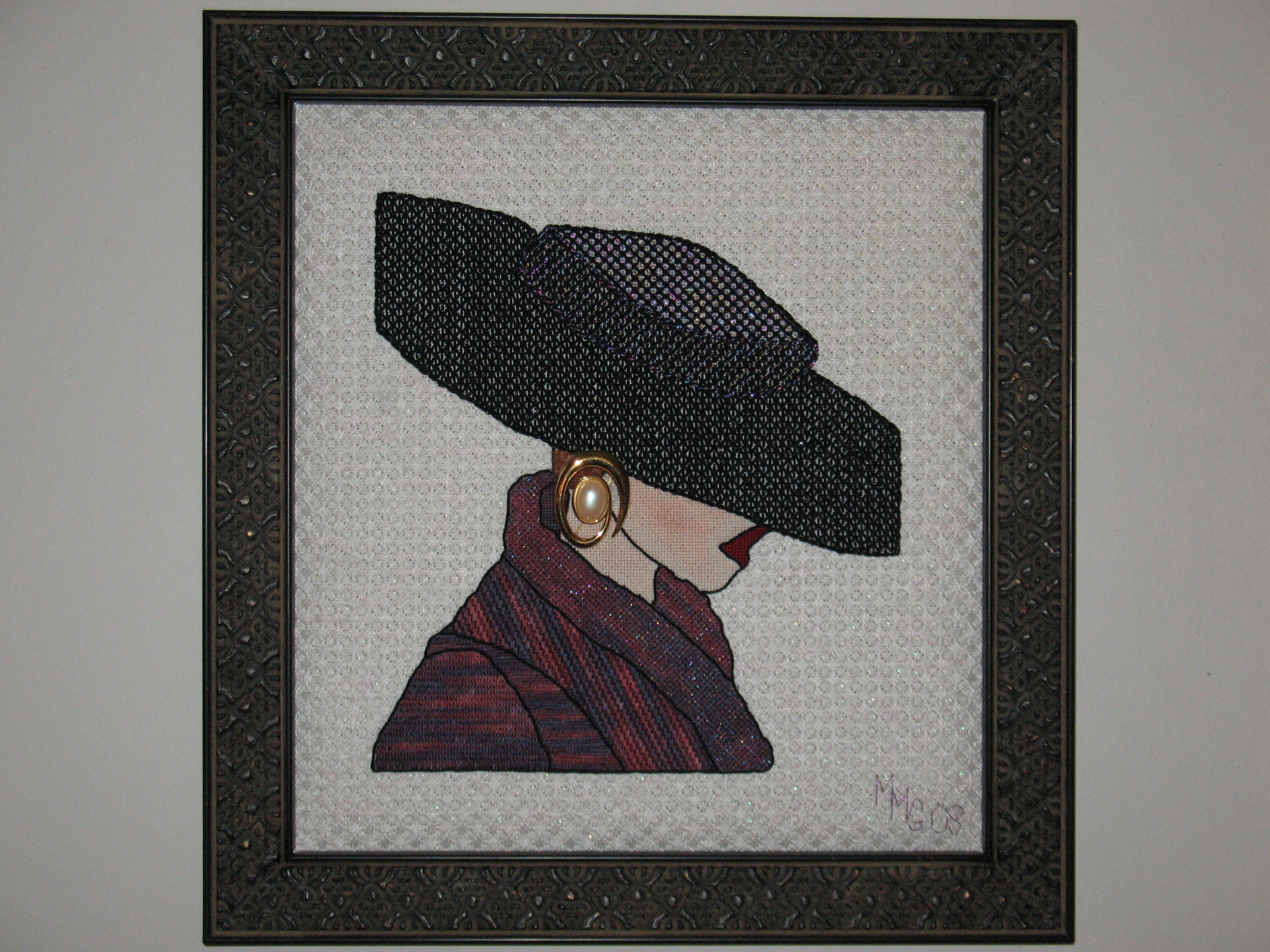
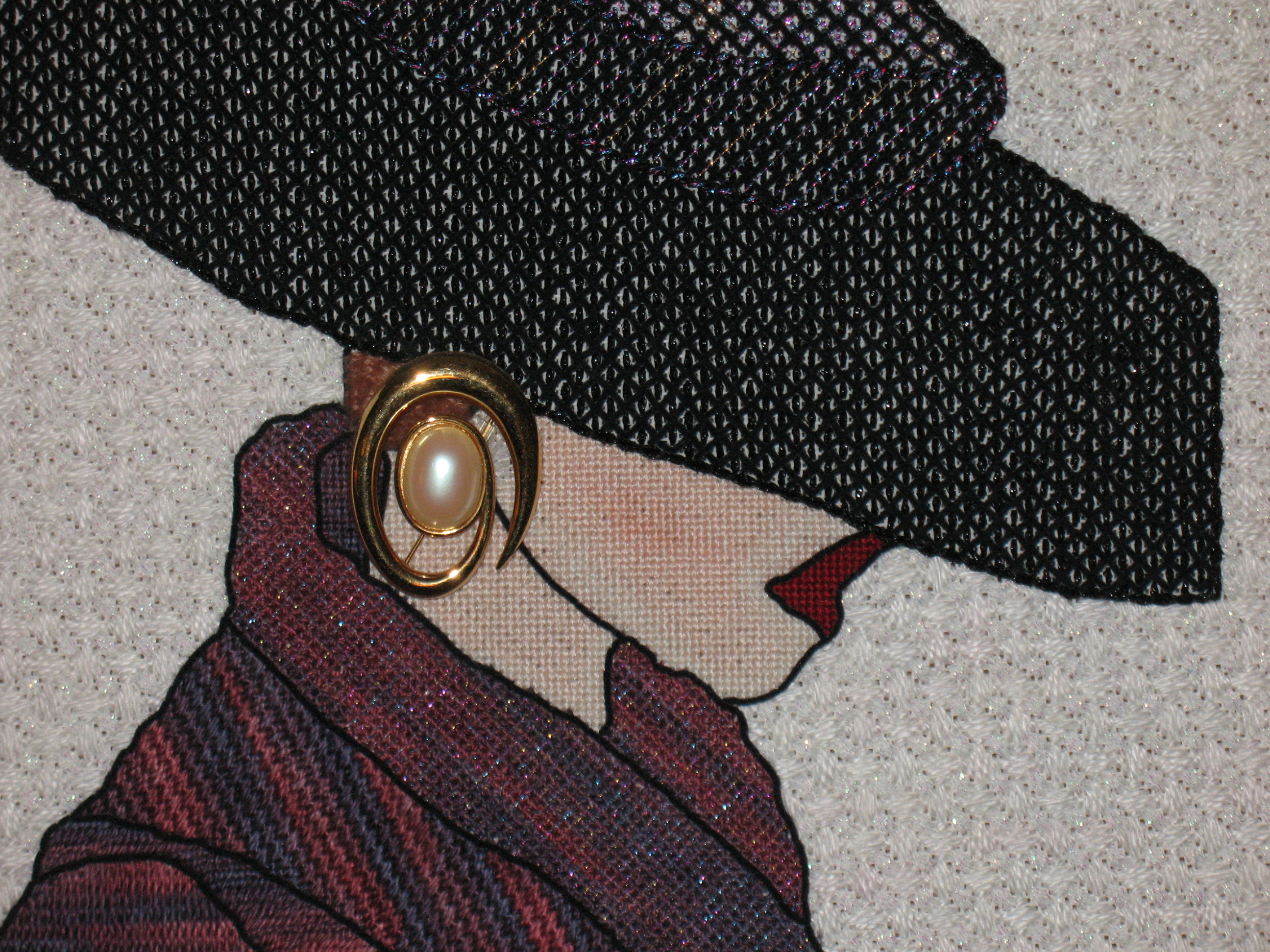
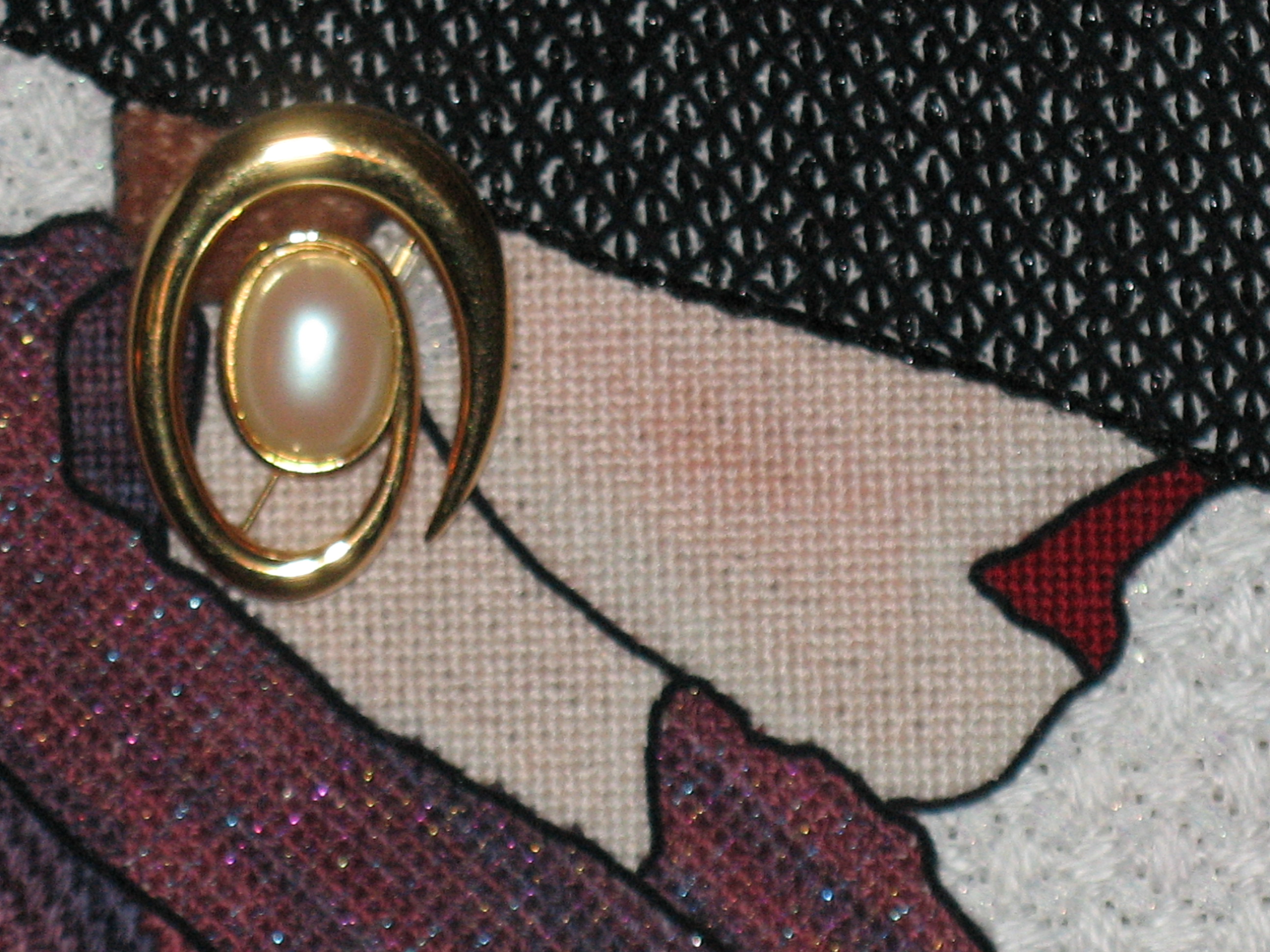
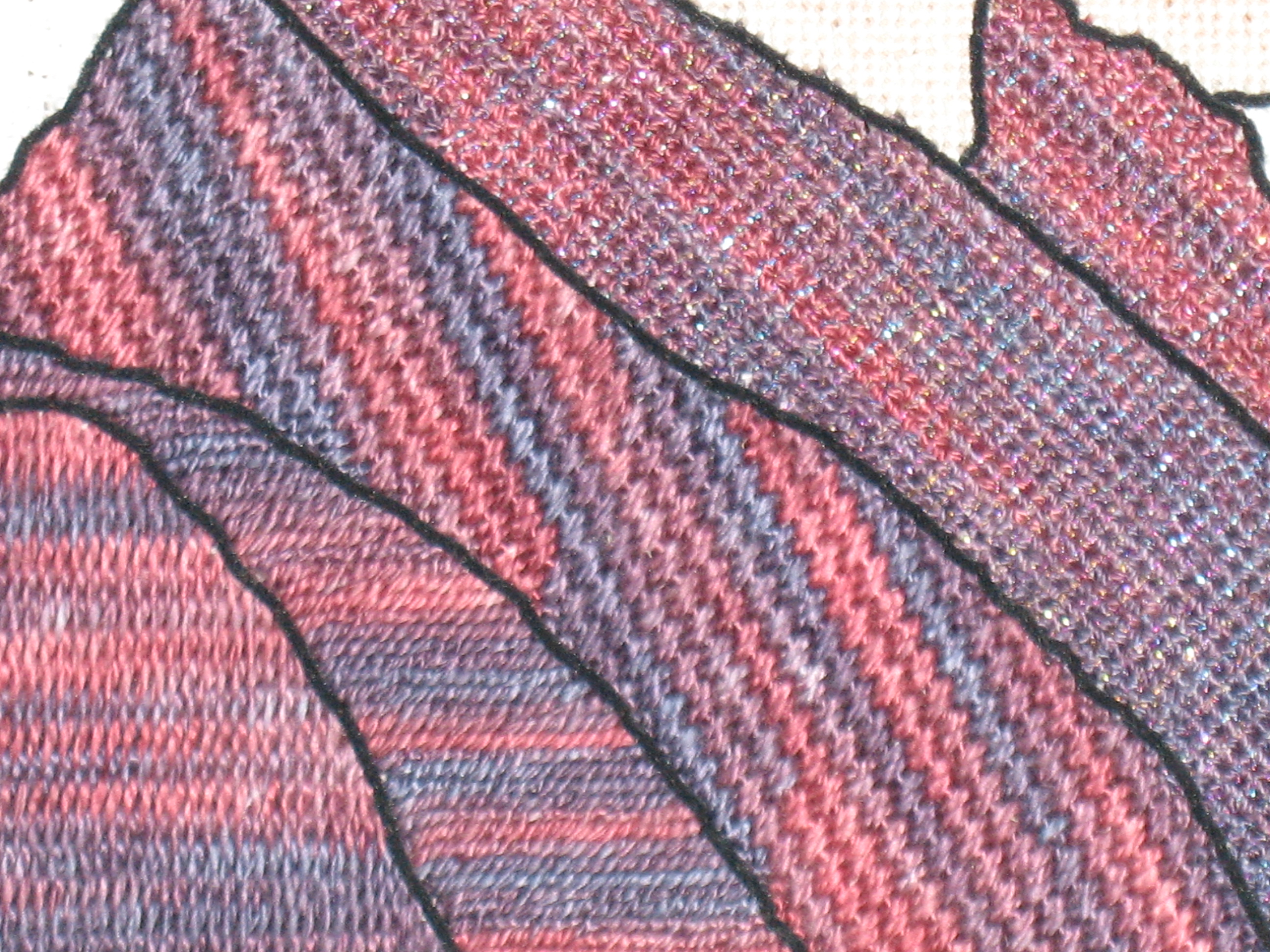
The parts of the coat include: interlocking gobelin (5×1 and 2×2) & diagonal cashmere. The collar is padded alternating continental & free-style weaving with Accentuate (275) to match Watercolours (090 Ruby). The outline of the coat is couched Petite Very Velvet. The face & lips are tent stitch. The hat is Alicia’s Lace Variation with the outline using threaded back. The earring (under the pin) is octagonal rhodes & the hair is turkey. The background is the palace pattern.
 Melitastitches4fun's Blog