Filed under: Embroidery Guild of America, Mid-Atlantic Region, Nature's Palette THaP - Catherine Jordan
Catherine Jordan led Nature’s Palette a few years ago at an EGA Mid-Atlantic Region meeting (https://melitastitches4fun.com/2022/09/17/thap-class-blackwork-on-natures-palette/). Catherine let us take extra leaves she had painted (acrylic paints). When I went to the two Guilds (I was so busy there are no pictures from either class), I had more fun painting the leaves than stitching them (https://melitastitches4fun.com/2022/11/02/painted-magnolia-leaves/). Catherine had given us a reversible blackwork pattern that was way above my pay grade.
Finally, I finished my second leaf which is just a grid and the third leaf has one small motif used in the first leaf.

It does make me happy to finish this. I glued (E6000) wooden dowels onto the back of each leaf and placed them in a vase for fall decor.

Filed under: Beaded Super Duo Tape Measure Cover Kit by Carole Ohl, Brandywine Chapter, Embroidery Guild of America, Mid-Atlantic Region, Zokins
The 3rd session of the 3rd quarter for my EGA Brandywine Guild meetings led by Kathy A and Karen S was well attended yesterday by about a dozen members many of us hanging out even after lunch.
Adding the cloth pages were easier than I expected especially when I focused on reading the directions! Amazing how well that helps. I prefer visual instructions but they work better when explained in text.

At least Joanne M and I prefer canvaswork more because getting precise lines in this free form stitching is nearly impossible. Others found the freedom enjoyable. What do you prefer?
Joanne M made a bucket drawstring kind of purse – really nice and the lines looked straight! Nancy G sized her cover to fit over her booklet of needles. Patrick B found a few fabrics with sayings for his. Others were still piecing theirs together. Everyone’s turning out different and it was fun to look at them all.
Kathy A talked about the related Sashiko embroidery and brought several books and tons of stencils. So, I transferred a couple of patterns with a borrowed a Sewline mechanical pencil with 5 different colors that can be used. Karen S has had her pencil quite awhile and I would need to buy each color pencil separately. But, after a discussion with Linda from Main Line Stitchers about the few quilt stores left in our area where Sewline products are likely to be found, she is giving me one of her extra Sewline air erasable fabric pens. I look forward to playing with that!
Here is my completed booklet ready to sew over my stencils. You can just about see this pattern but I can see it under my lamp. At least with the stencil, the stitching should be more precise.
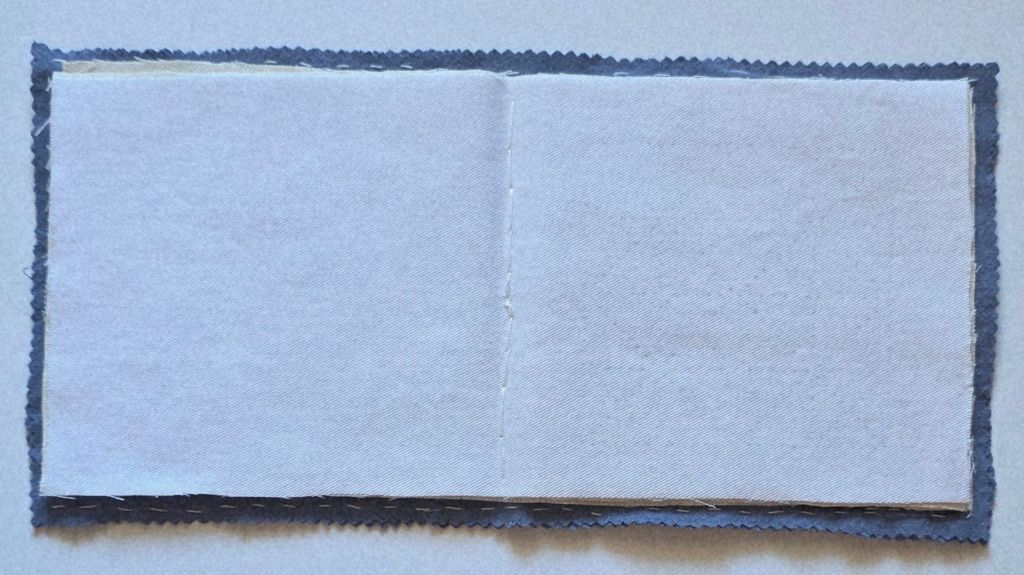
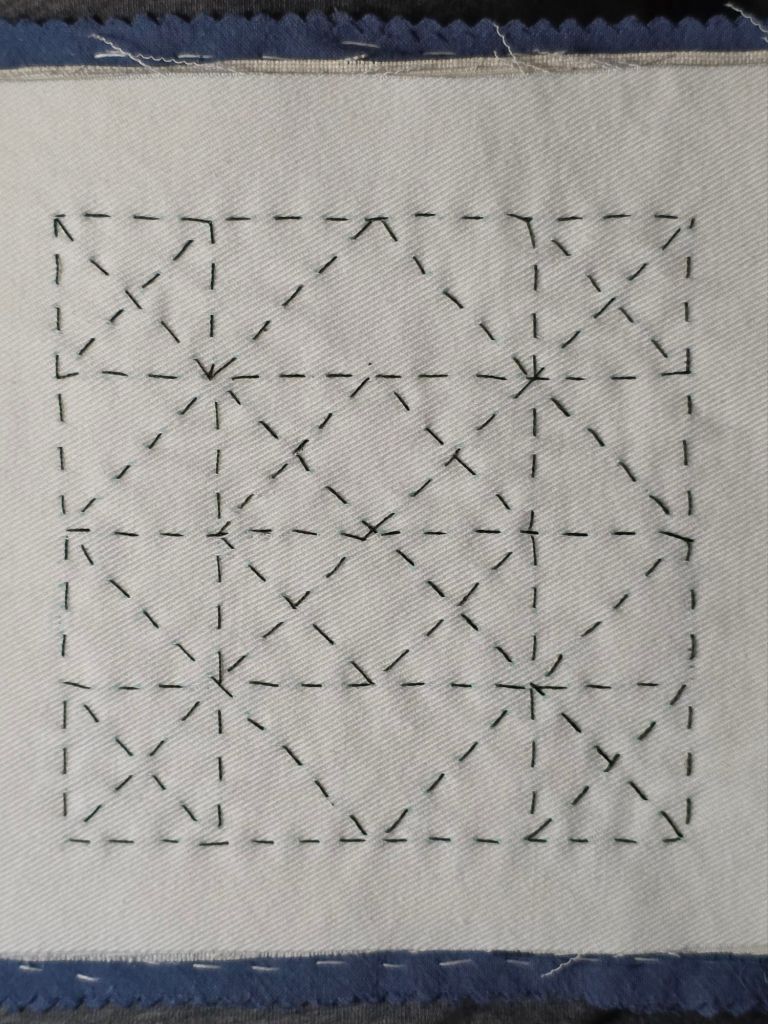
This pattern is easier to see. I’m thinking that I’ll add little motifs inside each scallop.

The running stitch with long Sashiko needles allows for faster stitching than the stabbing method of stitching but there is still room for improvement where threads come together at intersections. But, this is a doodle booklet. Also, I can’t say I love all those little fraying threads but it’s a doodle booklet. And, having the pages in a booklet makes stitching a little more logistically challenging. The pages could come out and get reattached but it’s a doodle booklet. Bottom line, it’s all good enough.
As usual, I come away with more to do! When we split up the gift baskets Sue won at the EGA MAR Regional Seminar in Gettysburg, I had expressed interest in this beaded Carole Ohl Tape Measure Cover kit but so had Kathy A. Well, this month she gave it to me because she found she already had one in her stash. So, now it’s in my stash! So pretty. I love how the beads fit precisely packed together. Hopefully, mine will look this good (when I get to it).

Filed under: Cardinal Ornament - Liz Kisielewski, Embroidery Guild of America, Mid-Atlantic Region
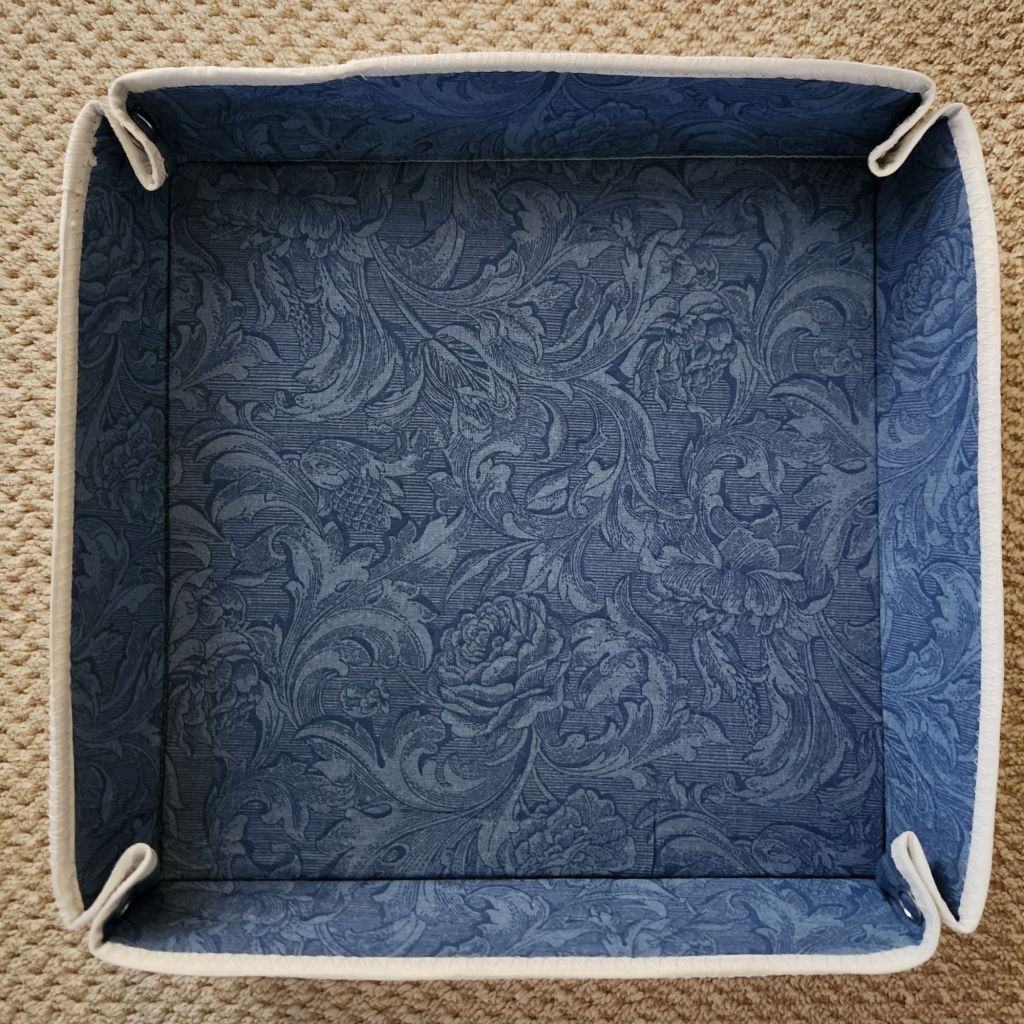
The EGA Mid-Atlantic Regional Spring Meeting occurred this past weekend in King of Prussia sponsored by the Philadelphia Chapter (no, I am not a member!). They did a lovely job. Teacup pincushion favors (one per table) were awarded to half of the class participants (two per table but not me). There were about 24-26 students. There were table favors, one per table of 6 people, at lunch (again not me). They handed out large carry bags and a snap tray to everyone.

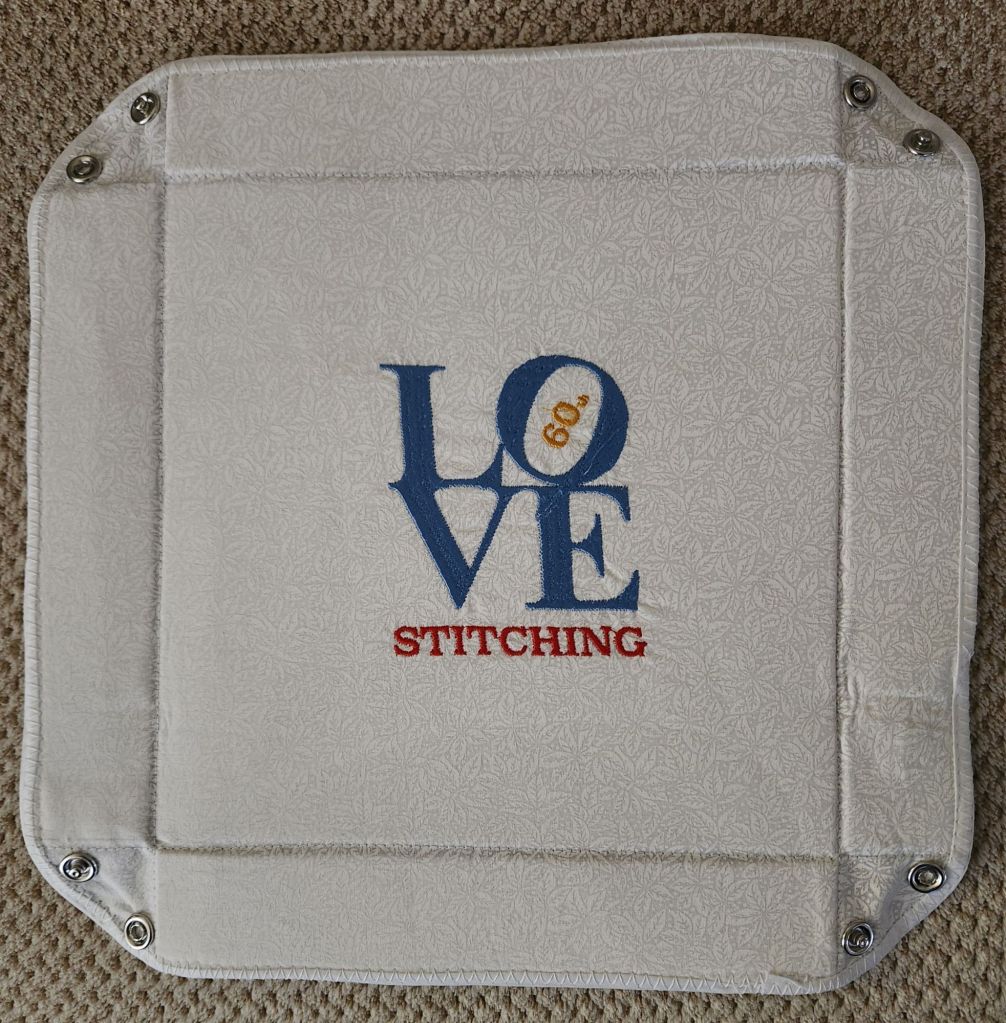
The Cardinal Ornament class was designed and led by Liz Kisielewski. It is 6.5″ x 4″ and made from wool felt (6 colors), floss (3 colors), and stuffing. You know how sometimes you just need the right person to show you how to do something. Well, I finally understand how to do the buttonhole stitch. I was always trying to work it left to right but on the top edge. Liz showed me working it left to right on the bottom edge. It works so much better for me!

This was a Take Home a Project (THaP) class which means most of the students are going back to their chapters as teachers for this project. Instructions are free to chapters to use. The kit materials are supposed to be $10 or less so it is an affordable price. My EGA Brandywine Chapter has a Board meeting on Tuesday (I am a co-VP for projects) and I wanted to have it done. I will teach it if they decide to do it.
The branch was done during class. I almost forgot to add the hanger but thanks to my neighbor for reminding me to add it and thanks to tweezers (and Linda for giving them to me), I was able to get it through an opening between 2 stitches. Phew!
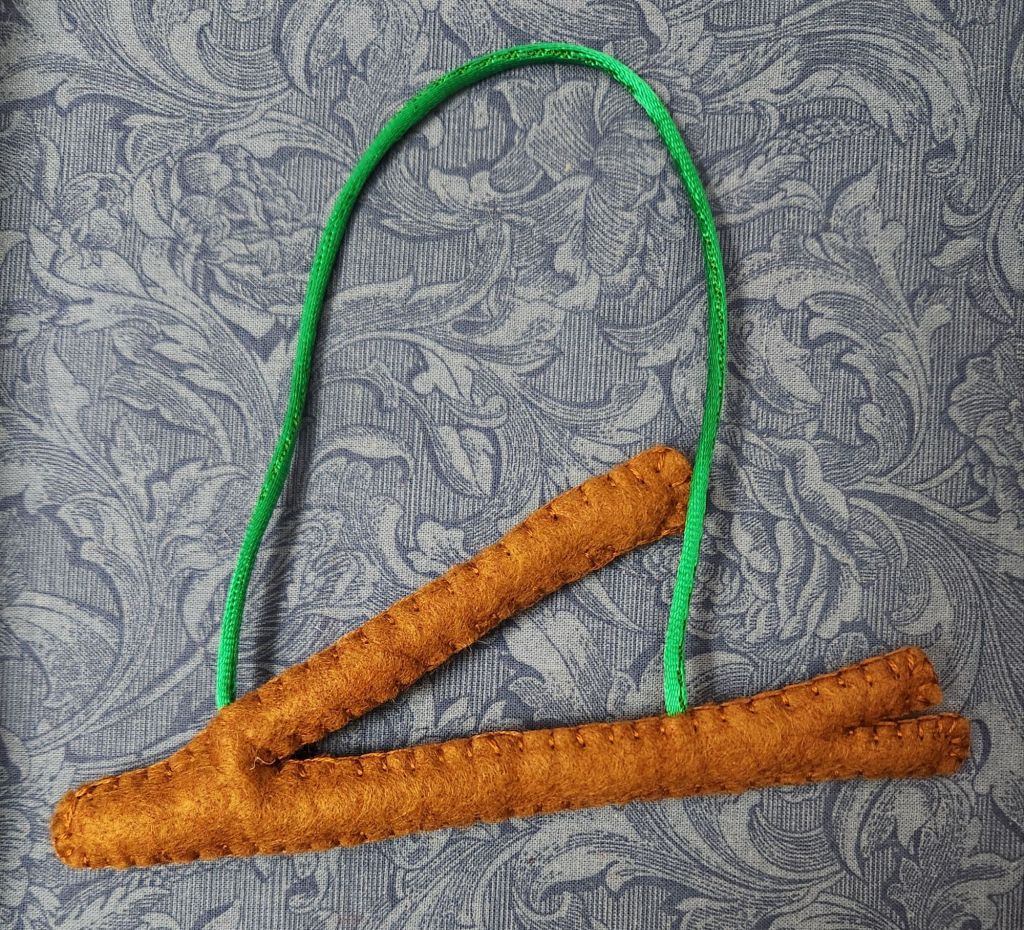
The Cardinal worked up quickly during a Phillies game later that day. Because there are only a few red stitches on the black felt, she didn’t have us switch threads. I used a black marker on those couple of stitches.

Sunday basketball allowed me to complete the ornament. I found a perfect bead for the eye. I couldn’t see the French knot that was on the demo bird because it was black on black. But, the bead has just a tad of light reflecting off it to be seen. It really wasn’t a difficult project. Needlepoint pieces take so long that doing something with more immediate gratification was fun. And, the 3D effect is much more apparent on this than on needlepoint. I won’t seek felt projects out, but it’s always fun to try something new.
I bet the gang on Tuesday night at the Needlework and Fiber Guild of Media will enjoy seeing this! The group meets at the Media Arts Council in Media, PA at 7 pm on the second Tuesday of the month.

Filed under: ANG Chapter Book Projects, Embroidery Guild of America, Needlepoint Shops, Nimble Needle, Overdyed Spools THaP, Petite Projects
My closest needlepoint store is Nimble Needle in NJ. Karen relocated to Merchantville a few years ago, making her a 20-minute drive for me. She has a great variety of everything, gives a 10% discount for ANG and EGA members, and always has the threads I need in stock. As if that isn’t good enough, I was even more thrilled when Karen showed me Overdyed Spools with her store name stitched where the spools originally would have been!
Patti, a customer and current President of EGA Colonial West NJ chapter, stitched it for Karen. Apparently, Patti has stitched a few of them as gifts. This is an EGA Petite Project, free to all members. It’s also a free project for ANG Chapters through the 2017 Chapter Project Book. One skein of Watercolours is used, and the thread is manipulated to create the color flow in the upper left and lower right corners.
It seems to be more popular with EGA than ANG, and I’ve seen several exhibited at Woodlawn (one of which was Patti’s with spools as seen in this 2022 post: https://melitastitches4fun.com/2022/03/31/woodlawn-needlework-exhibit-2022/). In this one, the spools have been replaced by a name tag and even made into a picture frame. Karen is going to attach it to a small project bag. I love it. Patti’s stitched another great one and Karen said I could post this!

Filed under: Crewel Stitches - Judy Jerow, Embroidery Guild of America, Mid-Atlantic Region
Back in May, I went to the EGA Mid-Atlantic Regional Spring meeting held in Wilkes-Barre, PA. I went up because the Take Home a Project (THaP) class was Stitching with Crewel Stitches with Judy Jerow, an expert in Crewel.
There really are 3 different greens, purples, and yellows Appleton wools but they are so close, the shading isn’t as evident as I expected. I had greens: 355, 354, 352; first 2 too close; purples: 103, 104, 105; first 2 too close (differences showed up the least of the 3 colors, probably because they are darker threads); yellows: 471, 472, 474; first 2 too close.
The stitching is done but this will not get “finished”. Nothing really wrong with it but can’t hang everything. I never came to like Appleton wool as I continued to stitch with it. Maintaining the twist is constantly required, it’s a hairy thread which looks messy to me, and the feel is rough. I was threading the correct end. More crewel work is not in my future. I’m also not comfortable working on a hoop – it feels awkward which would probably pass if I used it more often. Working on Twill Linen wasn’t easy because I pulled too hard (maybe?) which makes it pucker (I can flatten it in the hoop). Again, something that might not happen with practice.
I do want to use the Burden stitch and love her French Knots. The Raised Outline and Stem make great leaves. These stitches could all be done with different threads and on a different ground. It’s always fun to learn something new from a project and teacher. I throughly enjoyed Judy and her class.

Filed under: Crewel Stitches - Judy Jerow, Embroidery Guild of America, Mid-Atlantic Region
The EGA Mid-Atlantic Regional Spring meeting was held Saturday May 6 in Wilkes-Barre, PA. I went up on Friday because the Take Home a Project (THaP) class, Stitching with Crewel Stitches, with Judy Jerow started at 8:30 am. THaPs are geared towards chapter representatives returning to teach it to their chapter members. It’s my 2nd class as a student after teaching Overdyed Spools as a THaP in 2021.
Judy published Creative Crewel Embroidery: Traditions and Innovations. I don’t own the book but wanted to mention it because she is extremely knowledgeable and talented. One student had just gotten a copy of the book (used for a steal at a library sale-lucky lady-Donna!) and got it autographed.
With this design, we learned to use stitches other than long and short to shade a floral design. We learned how Judy makes chain, burden, French Knots, Coral Knots, stem, and outline stitches. She was frank and funny particularly when she said you can show me how you make these stitches but I’m here to show you how I make them. Then, you can do whatever you want!
I bought polyester Twill tape to wrap the inner hoop. There are 3 issues with the hoop (that I can live with for this project but a purist might find troublesome). 1. The hoop is plastic. Wood is preferred because they grip the ground fabric better and apparently don’t distort as easily. 2. The Twill tape is polyester. Natural cotton is preferred. The ground fabric can grab the cotton better keeping it stretched better. 3. The fabric is linen Twill and so wrapping the hoop wasn’t even necessary!

It was a 3-hour class that felt like half that long. The first stitches, chain (right sise in photo) and Coral Knot (left side of photo), weren’t worked on the hoop. And, I didn’t get to stitch the others. So, I didn’t use the hoop! I can’t stitch and listen. As I heard someone in class say, it’s not a race. With that said, this was my progress in class (except for the French Knots that I practiced on a napkin). There is no shading evident. But, there will be.

Cindy, one of my tablemates from Williamsburg, joined me at my table – nice to see her again. Several of the ladies let me know how much they and their chapter members have enjoyed Overdyed Spools.
Class was over in a flash. I learned how to start a thread and Judy even discussed her blocking method. I’m glad I got to get a lesson from her before she retires. She recently celebrated her 64th Wedding Anniversary!
Using 2 stranded wool is required to make it Crewel. This design and techniques are applicable to other threads but then is would be called Surface Embroidery. Good to know. Appleton wool is THE wool to use. And, I don’t care for it. It feels almost rough. We had 2 colorways to select from. One had pinks and the one I selected had yellows. We got 9 needles. Once I start shading, I’ll need them.

Filed under: Embroidery Guild of America, Mid-Atlantic Region, Nature's Palette THaP - Catherine Jordan
The 2022 fall Take Home a Project (THaP) class, Blackwork on Nature’s Palette by Catherine Jordan, was today across the bridge in Mt. Laurel, NJ.
It was a full class and my first attempts were not good. I’d only done one small square of Blackwork quite some time ago. I was getting nowhere and finally asked Catherine what was I doing wrong. It turns out I was trying to do this on the diagonal. So, I grabbed a new Magnolia leaf (she brought extras – I actually will do 3 of these). The second leaf went easier on the front but it is not reversible. The lady bug is a cute embellishment. I will try the diagonal one again and a reversible one.
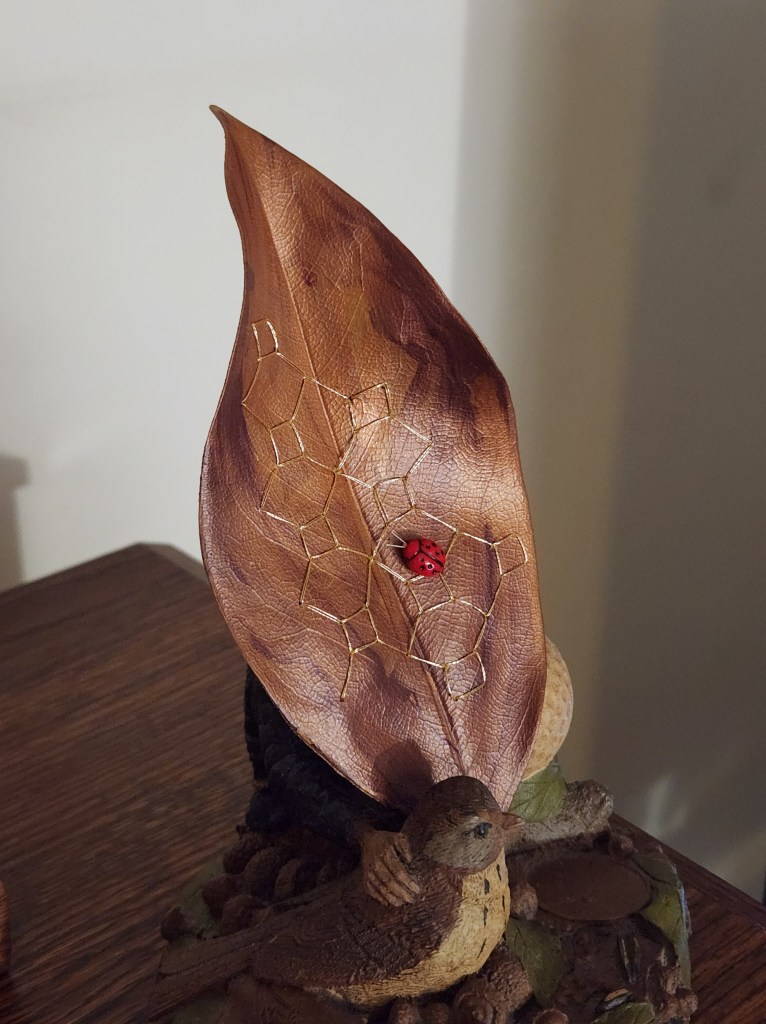
They were painted beautifully with acrylic paints. I grabbed about a half dozen green ones because I will offer to teach this to the Brandywine chapter. That’s the purpose of THaP. It’s like the ANG Chapter Project Book.
I taught the Overdyed Spools to the group last year and several of them commented on how their chapter members enjoyed it and several chapters have it scheduled for 2022 and 2023.
Filed under: Embroidery Guild of America, Mid-Atlantic Region, Overdyed Spools THaP, Petite Projects, Seminar 2022-NYC
Overdyed Spools was released today as an EGA Petite Project (https://egausa.org/new-petite-project-overdyed-spools/)! I taught it at the Mid-Atlantic Region (MAR) Fall meeting in October 2021 and since then, at least 6 chapters have or will be teaching it to members. I have been getting photos by text and email showing me another one finished periodically – so cool. A couple of people changed the stitch to have the color flow differently which was wonderful. And, the center changed to 3 larger geometric shapes – so original.
Then, thanks to Jana (dual member) from the EGA Great Lakes Region (GLR) for asking if that region could share the design with chapters. Since ANG has the project in the 2017 Chapter Project Book (still available), I figured that maybe EGA would be able to share it through their Petite Projects which are smaller projects also intended to be used by chapters and/or regions as scheduled programs. Since I created diagrams for the Petite Projects, Favorite Medallion #1 and Technique Basics, working with Carole and Harriet, I knew who to contact. And, it was quickly accepted.
This is my newest colorway which is the one I used for demonstration for class and finished afterwards. You may have seen it at the EGA Seminar in NYC this summer as a “Coming Soon” piece – it’s here now!
Filed under: Embroidery Guild of America, Mid-Atlantic Region, Overdyed Spools THaP
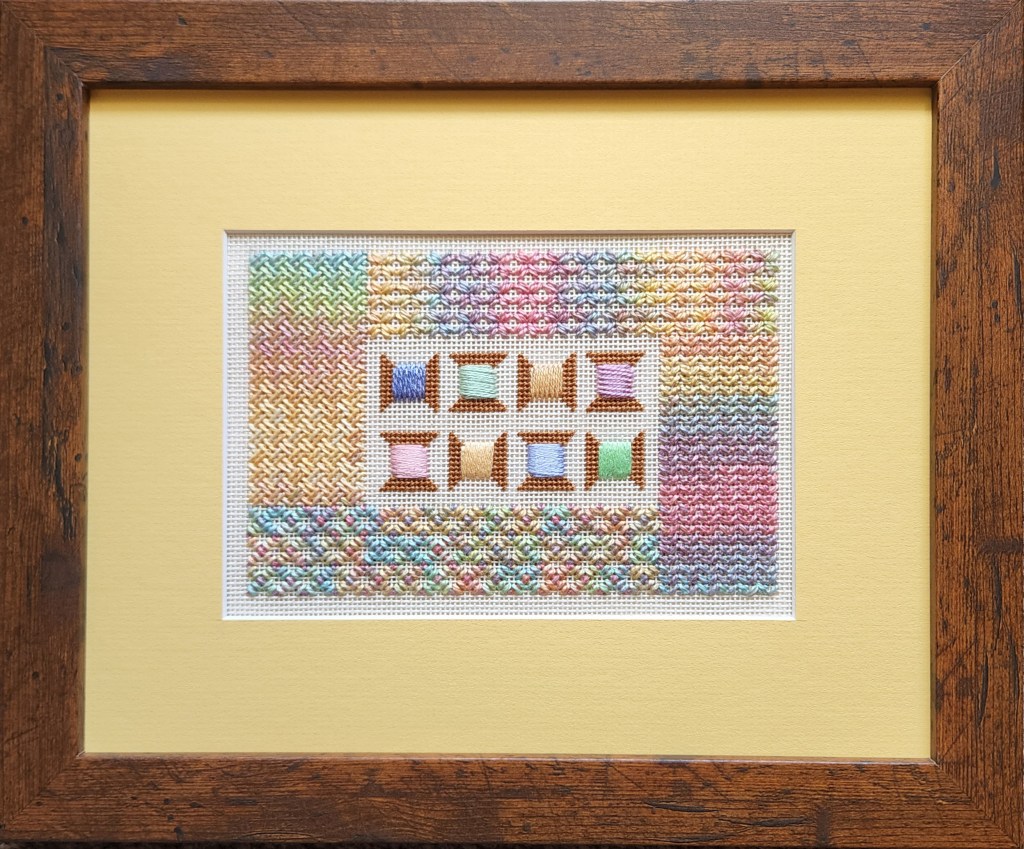
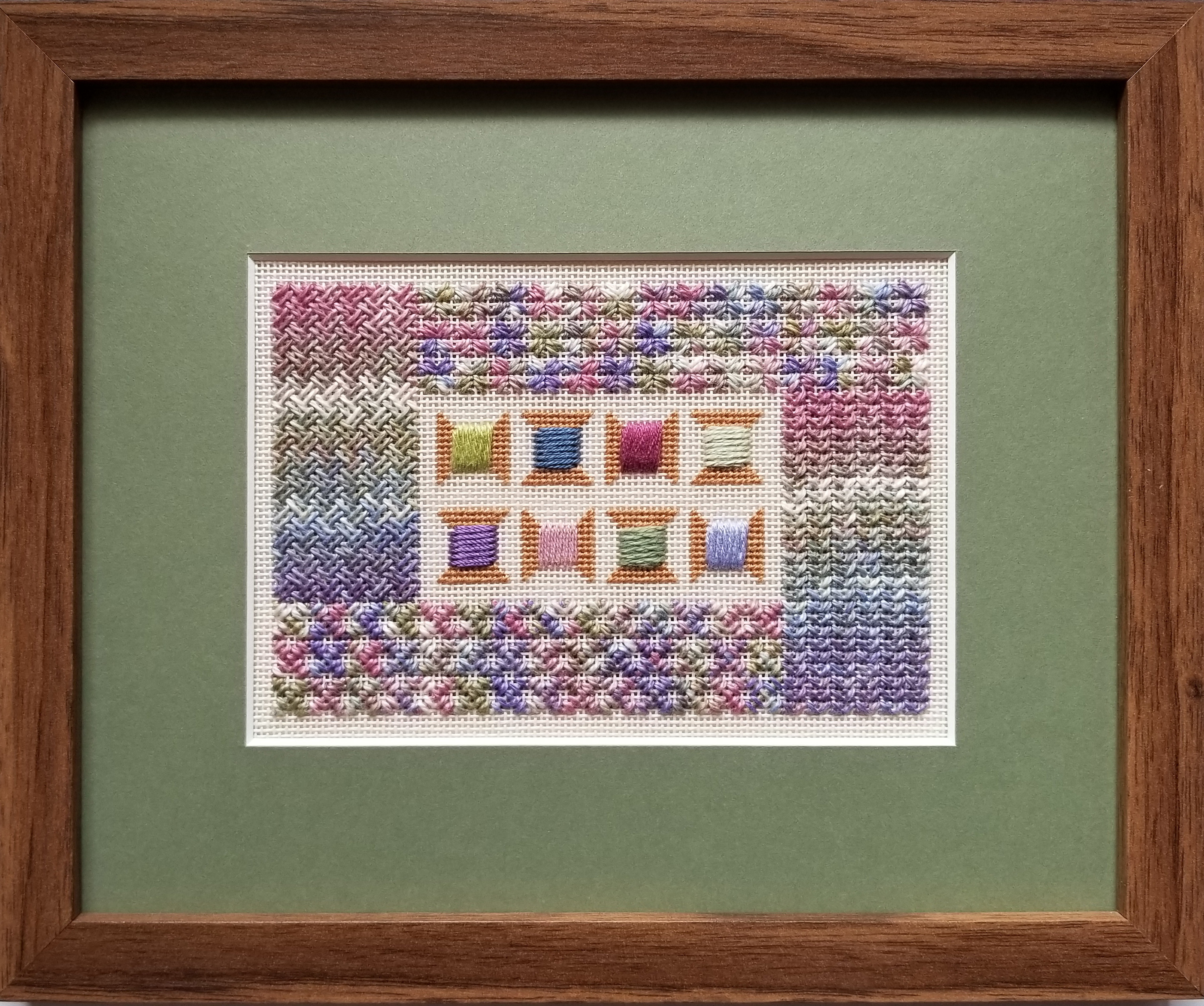
In October, I taught Overdyed Spools to 31 students at EGA’s Mid-Atlantic Regional meeting and a few have finished theirs. They are turning out great. It’s so much fun and rewarding to see what others do with it. Donna shared hers in progress and is experimenting with shifting the color change on the diagonal. Love it!
I got mine framed at Michael’s – same as where I got the previous one framed. I wanted them to go well together. I’m happy with how it turned out.
Filed under: Embroidery Guild of America, Mid-Atlantic Region, Overdyed Spools THaP
On Saturday October 16, I taught this to 31 students at EGA’s Mid-Atlantic Regional meeting. About half are going back to teach it to their chapters. It was a great experience.
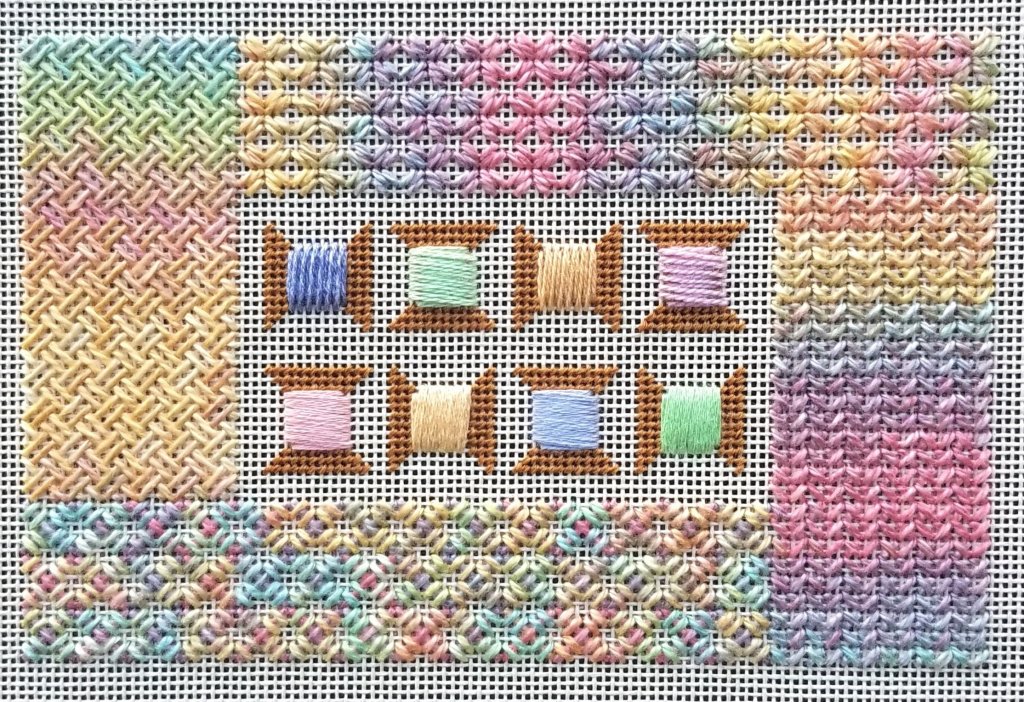
It’s not a complicated piece to stitch. The hardest part is finding the repeat of color within a skein. Some skeins work better than others. At least 2 people had to switch skeins. I brought a couple of extras and so did several people.
For this one, I am using Caron’s Watercolours Cantaloupe 079. The upper left area uses 11 strands before compensating but only 9 strands had color line up nicely on the horizontal. So, I had to run thread underneath until they lined up. And, I needed an extra strand for a couple of columns.
Since it is my third time stitching it, I tried something different than random in 2 of those sections. The top right has color matched threads moving left to right for 3 rows making vertical columns of matching colors. And, the bottom left area with the 6 x 6 Rice stitch has been stitched with the pink and light purple portions for the large crosses and the blue, green, and yellow portions used for the short over 2 diagonal stitches.
The bottom right area uses 6 strands for the vertical color arrangement and 3 strands for compensation. I think I used the designated compensation threads in the bottom left corner by accident. But, I managed to compensate the area with other threads.
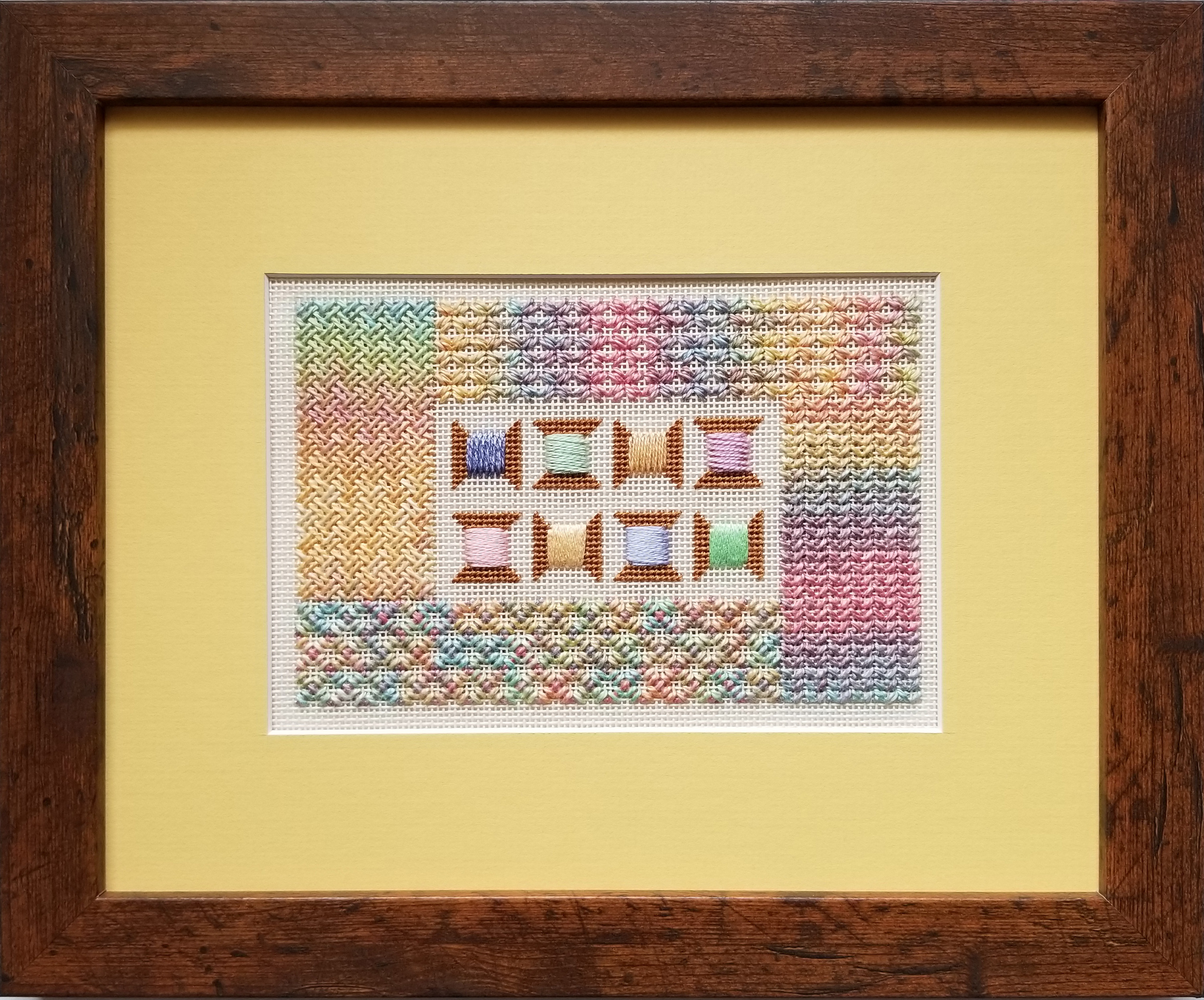
The spools are stitched with DMC Floche 434 which is the same as I used in the other two stitched pieces. There is one hand-dyed thread in the spools. Can you find it without reading ahead?
Lucille C, one of the people who was in the ANG Delaware Seashore chapter when I led the project for them, brought her stitched piece and mentioned that she had padded under the wraps or wrapped extra to get a more rounded effect. Good idea and I padded under all but one spool (upper left corner).
The thread wraps include from upper left to right: The Pure Palette Baroque Silk 1192 (very subtle color change for the hand-dyed thread – really tough to see the color change in the small sample; plies not separated), Madeira’s Burmilana 3893 (two stands laid), Caron’s Impressions 1106 (one strand), The Thread Gatherer’s Sheep’s Silk SPS125; one strand) and from bottom left to right: four strands laid for each color of Rainbow Gallery’s Splendor S994, S977, S932, S1058.
The Pure Palette appears to have 6 plies but I read on several websites that it is has 3. It can be used as it comes off the skein on larger count canvas (13 or 14) or separated into 3. So, I contacted the company and was told, “If you separate it all the way down to the six strands, it becomes more difficult to work with.” It is kind of like Splendor which is a 12-strand skein. Initially it separates into 3 groups of 4 plies but is intended to be separated further into 4 strands. However, Pure Palette should remain in 3 groups of 2 plies.
I revised the text some based on feedback from the organizer of THaP and people can now see another stitched example. One of the messages that I hope I made clear is that one should feel free to experiment with the threads and have fun!
 Melitastitches4fun's Blog