Filed under: Embroidery Guild of America, Mid-Atlantic Region, Nature's Palette THaP - Catherine Jordan
The 2022 fall Take Home a Project (THaP) class, Blackwork on Nature’s Palette by Catherine Jordan, was today across the bridge in Mt. Laurel, NJ.
It was a full class and my first attempts were not good. I’d only done one small square of Blackwork quite some time ago. I was getting nowhere and finally asked Catherine what was I doing wrong. It turns out I was trying to do this on the diagonal. So, I grabbed a new Magnolia leaf (she brought extras – I actually will do 3 of these). The second leaf went easier on the front but it is not reversible. The lady bug is a cute embellishment. I will try the diagonal one again and a reversible one.
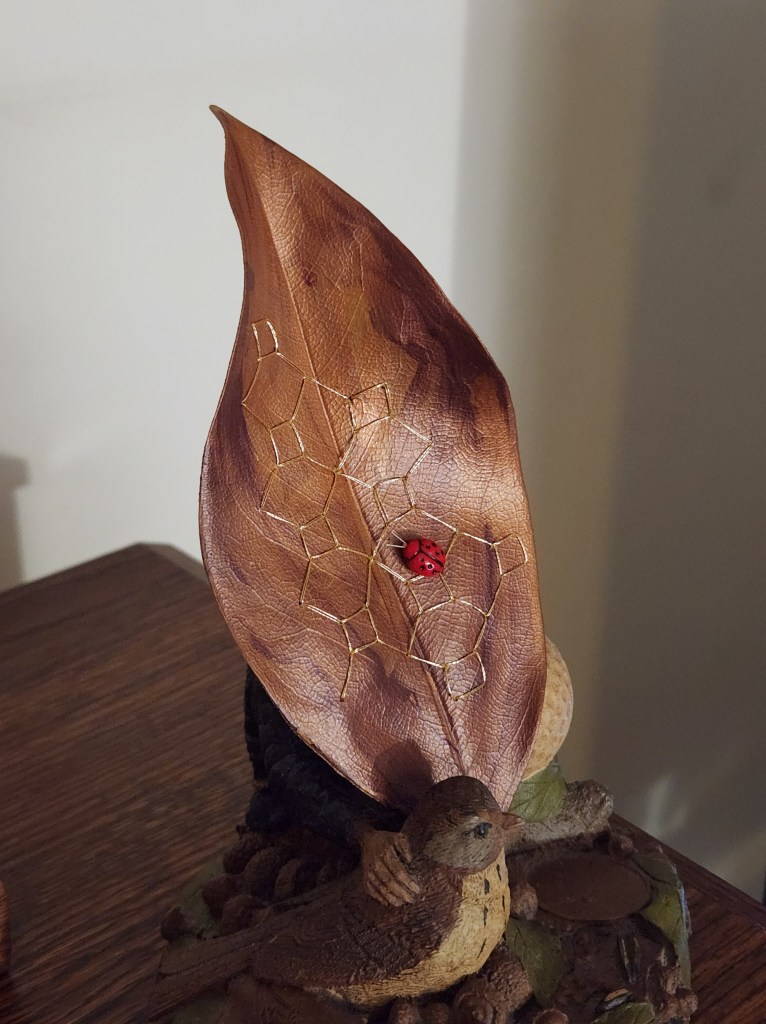
They were painted beautifully with acrylic paints. I grabbed about a half dozen green ones because I will offer to teach this to the Brandywine chapter. That’s the purpose of THaP. It’s like the ANG Chapter Project Book.
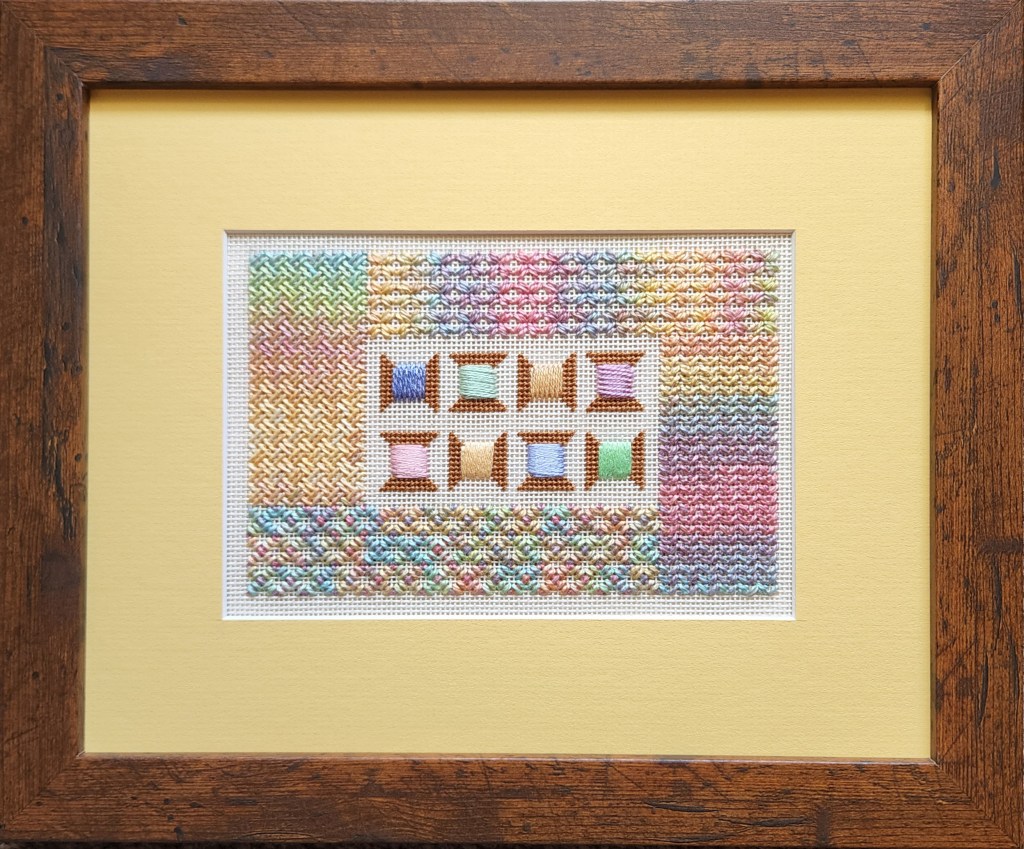
I taught the Overdyed Spools to the group last year and several of them commented on how their chapter members enjoyed it and several chapters have it scheduled for 2022 and 2023.
Filed under: Embroidery Guild of America, Mid-Atlantic Region, Overdyed Spools THaP, Petite Projects, Seminar 2022-NYC
Overdyed Spools was released today as an EGA Petite Project (https://egausa.org/new-petite-project-overdyed-spools/)! I taught it at the Mid-Atlantic Region (MAR) Fall meeting in October 2021 and since then, at least 6 chapters have or will be teaching it to members. I have been getting photos by text and email showing me another one finished periodically – so cool. A couple of people changed the stitch to have the color flow differently which was wonderful. And, the center changed to 3 larger geometric shapes – so original.
Then, thanks to Jana (dual member) from the EGA Great Lakes Region (GLR) for asking if that region could share the design with chapters. Since ANG has the project in the 2017 Chapter Project Book (still available), I figured that maybe EGA would be able to share it through their Petite Projects which are smaller projects also intended to be used by chapters and/or regions as scheduled programs. Since I created diagrams for the Petite Projects, Favorite Medallion #1 and Technique Basics, working with Carole and Harriet, I knew who to contact. And, it was quickly accepted.
This is my newest colorway which is the one I used for demonstration for class and finished afterwards. You may have seen it at the EGA Seminar in NYC this summer as a “Coming Soon” piece – it’s here now!
Filed under: Canvas Master Craftsman Program, Embroidery Guild of America, Seminar 2022-NYC, Step 5
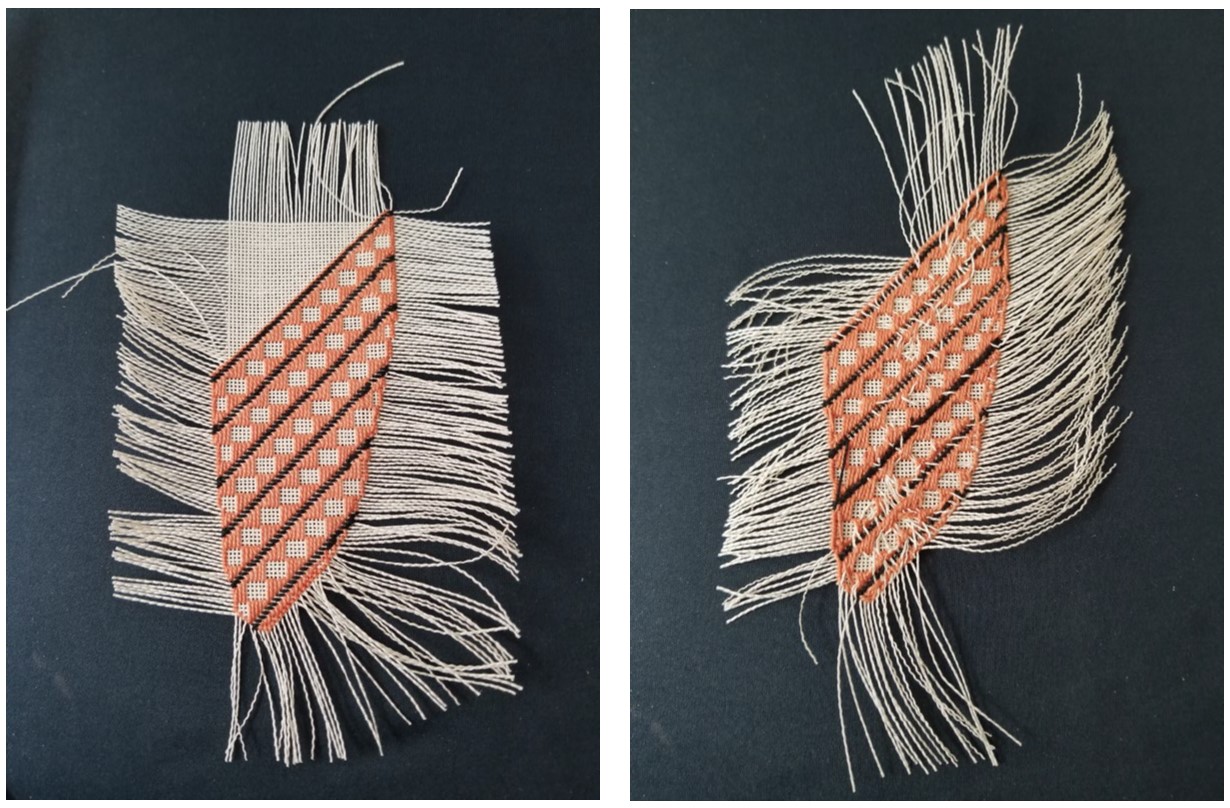
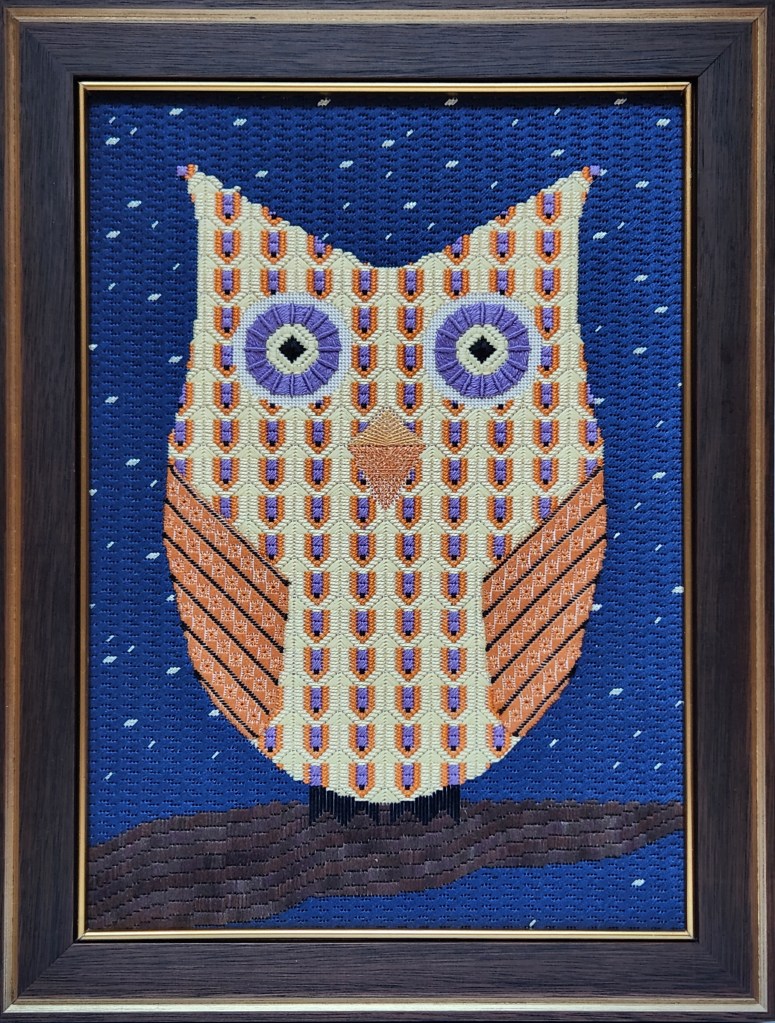
Step 5 of the EGA Master Craftsman Canvas 3 had to include 2 appliques (canvas to canvas and at least one had to be irregularly shaped). It had to be 10″ x 14″.
The wings were stitched on 24 count Congress Cloth and applied to 18 count canvas. These are the practice wings. In a nutshell, Step 1 is to pull threads out to the stitched piece (in progress in left photo). Step 2 buries some threads on the back of the applique (right photo). The rest of the threads are pulled to the back and buried in the surrounding stitched area. It is time consuming.
I started this piece shortly after seeing the article Tale of Two Stitchers in the Needle Pointers magazine (Mar/Apr 2021) regarding 2 painted canvases of owls “Who Gives a Hoot”. At first I was going to make the round eyes the applique until I realized that a circle is not irregular! So, I switched to making the wings the appliques which actually made better sense since they should be in front of the body anyway. I would have padded it but the instructions didn’t say you could but it is allowed. They have changed their instructions to clearly state that padding is allowed.
I had to practice the technique and actually stitched 5 wings trying to get this right. That’s why this step took an extra 6 months. But, the piece passed with distinction. So, it was worth it. Bill likes owls, knew I had worked on it a lot, and thought Night Owl deserved to be framed. So, it was framed before going on display at EGA National Seminar from August 24-28, 2022 in New York City.
I’m glad I waited to post this until I got it back so I could take a new photo. Before my photography class:
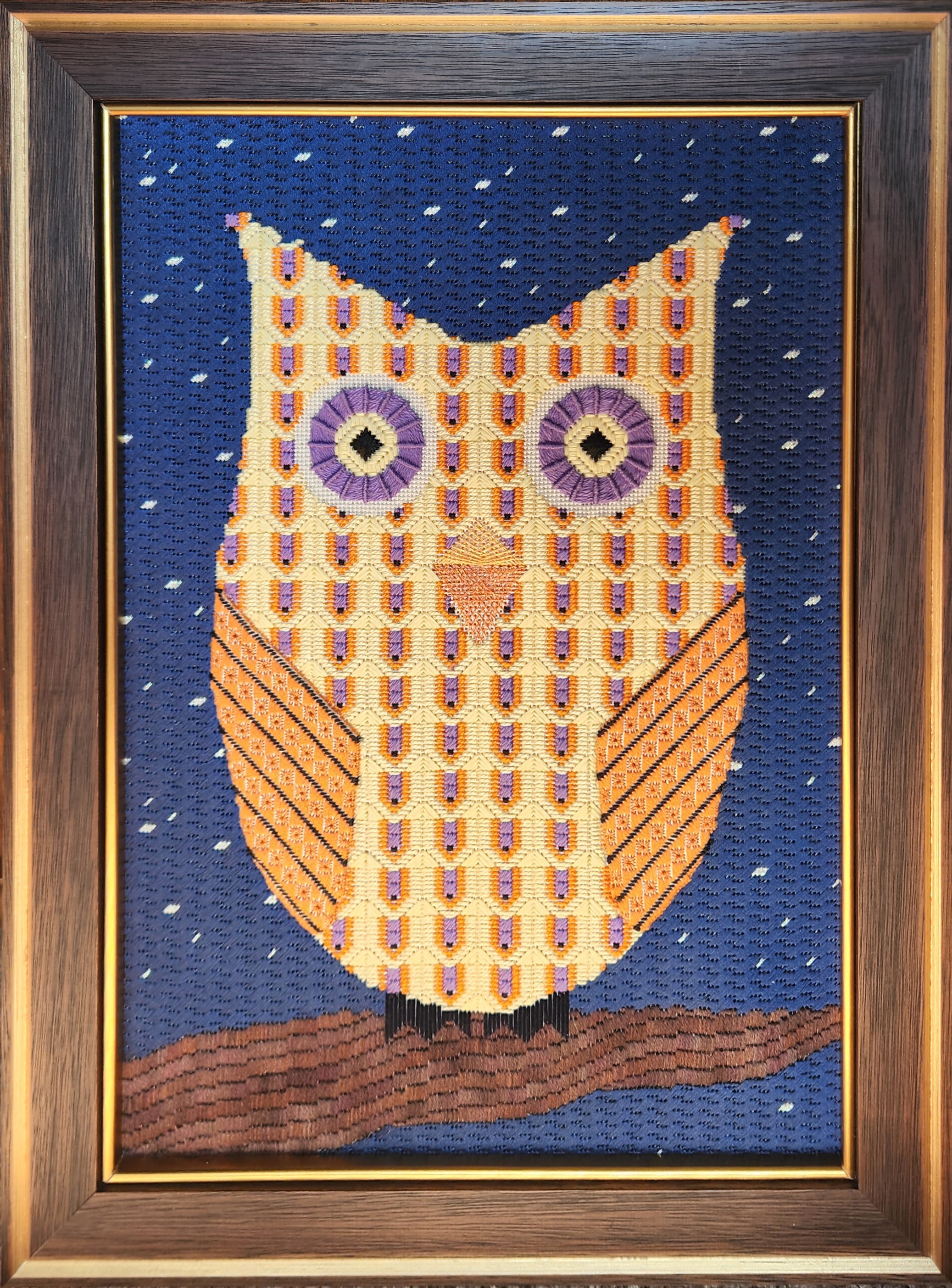
After class:
Filed under: Embroidery Guild of America, Mid-Atlantic Region, Overdyed Spools THaP
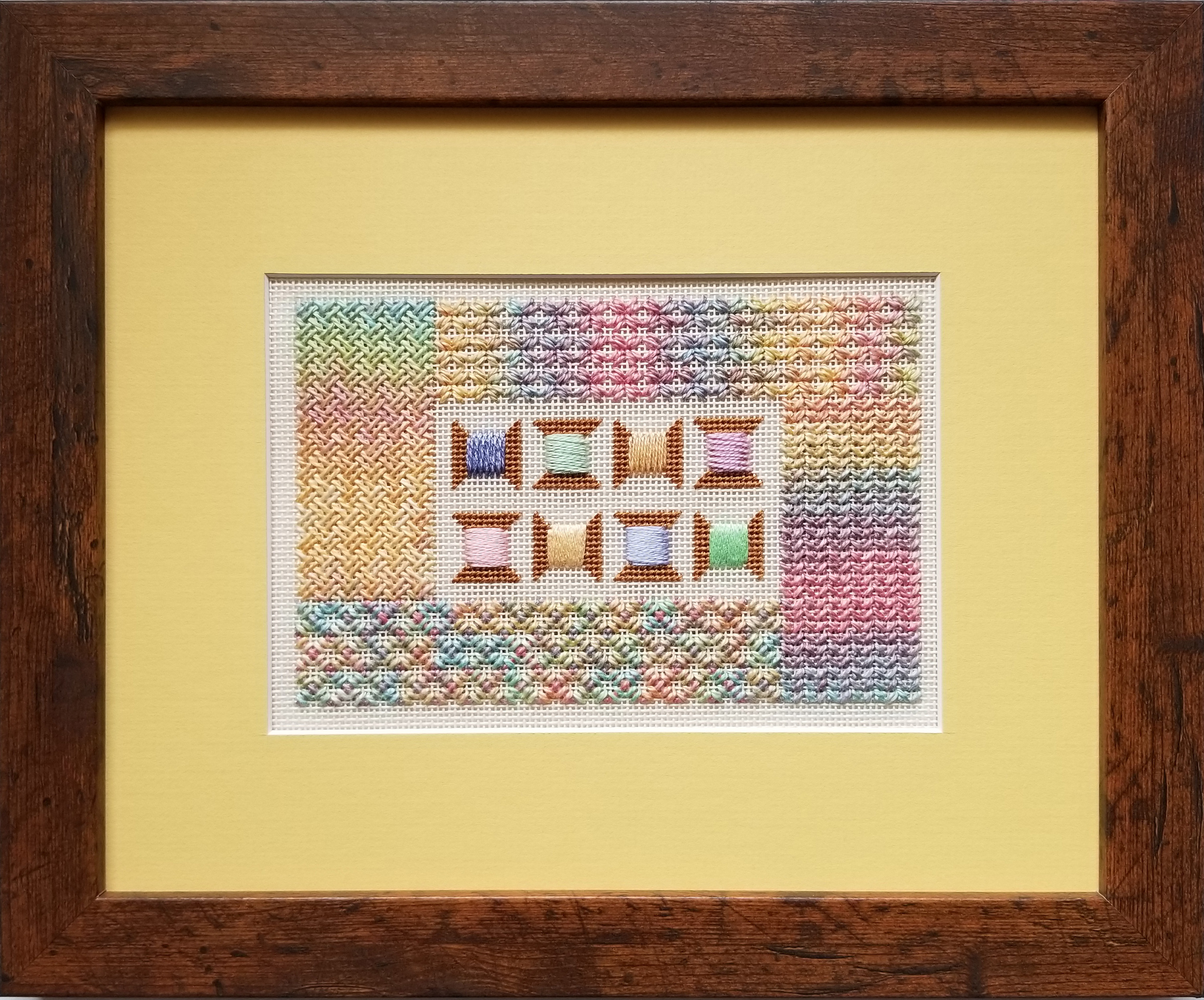
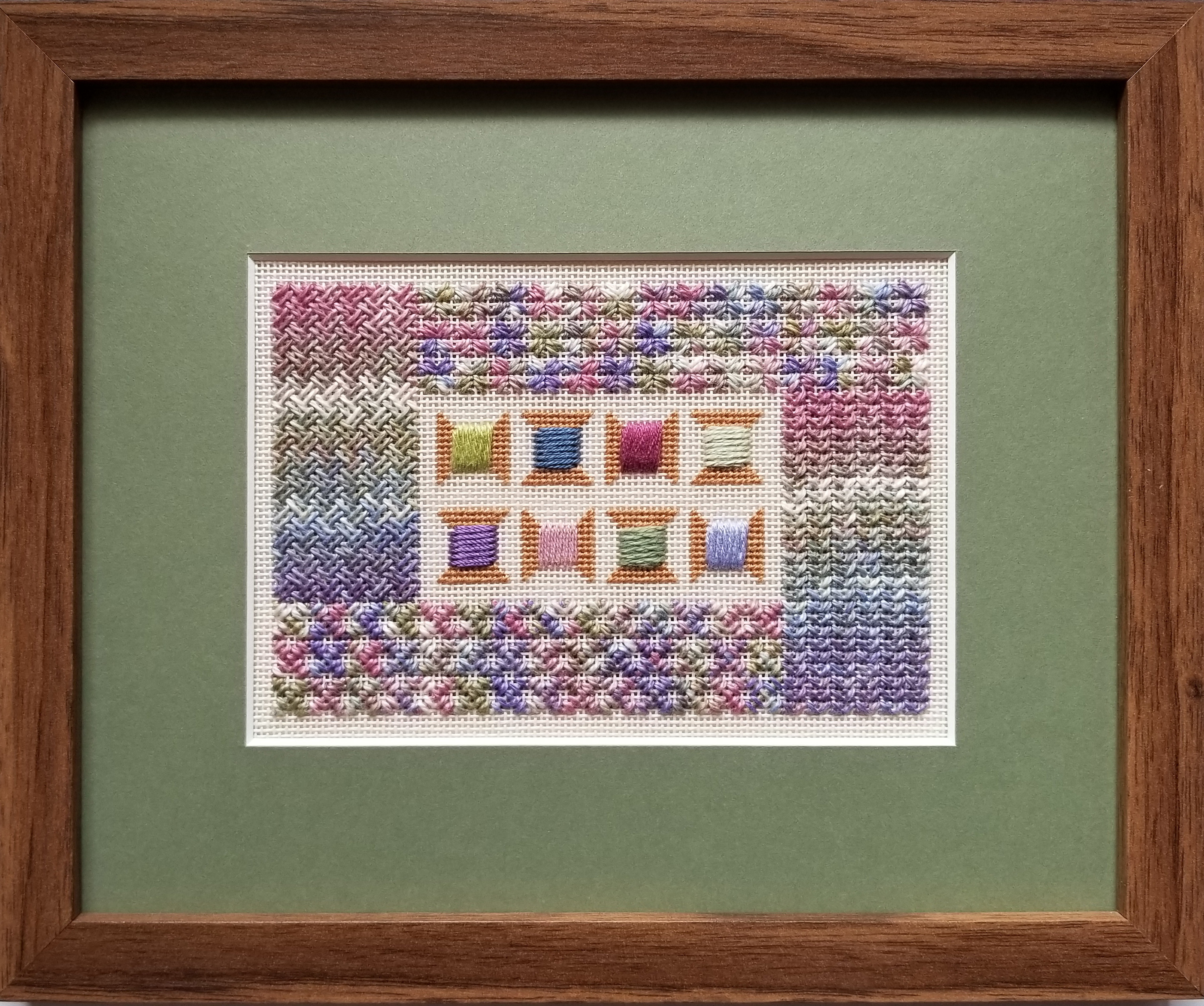
In October, I taught Overdyed Spools to 31 students at EGA’s Mid-Atlantic Regional meeting and a few have finished theirs. They are turning out great. It’s so much fun and rewarding to see what others do with it. Donna shared hers in progress and is experimenting with shifting the color change on the diagonal. Love it!
I got mine framed at Michael’s – same as where I got the previous one framed. I wanted them to go well together. I’m happy with how it turned out.
Filed under: Embroidery Guild of America, Mid-Atlantic Region, Overdyed Spools THaP
On Saturday October 16, I taught this to 31 students at EGA’s Mid-Atlantic Regional meeting. About half are going back to teach it to their chapters. It was a great experience.
It’s not a complicated piece to stitch. The hardest part is finding the repeat of color within a skein. Some skeins work better than others. At least 2 people had to switch skeins. I brought a couple of extras and so did several people.
For this one, I am using Caron’s Watercolours Cantaloupe 079. The upper left area uses 11 strands before compensating but only 9 strands had color line up nicely on the horizontal. So, I had to run thread underneath until they lined up. And, I needed an extra strand for a couple of columns.
Since it is my third time stitching it, I tried something different than random in 2 of those sections. The top right has color matched threads moving left to right for 3 rows making vertical columns of matching colors. And, the bottom left area with the 6 x 6 Rice stitch has been stitched with the pink and light purple portions for the large crosses and the blue, green, and yellow portions used for the short over 2 diagonal stitches.
The bottom right area uses 6 strands for the vertical color arrangement and 3 strands for compensation. I think I used the designated compensation threads in the bottom left corner by accident. But, I managed to compensate the area with other threads.
The spools are stitched with DMC Floche 434 which is the same as I used in the other two stitched pieces. There is one hand-dyed thread in the spools. Can you find it without reading ahead?
Lucille C, one of the people who was in the ANG Delaware Seashore chapter when I led the project for them, brought her stitched piece and mentioned that she had padded under the wraps or wrapped extra to get a more rounded effect. Good idea and I padded under all but one spool (upper left corner).
The thread wraps include from upper left to right: The Pure Palette Baroque Silk 1192 (very subtle color change for the hand-dyed thread – really tough to see the color change in the small sample; plies not separated), Madeira’s Burmilana 3893 (two stands laid), Caron’s Impressions 1106 (one strand), The Thread Gatherer’s Sheep’s Silk SPS125; one strand) and from bottom left to right: four strands laid for each color of Rainbow Gallery’s Splendor S994, S977, S932, S1058.
The Pure Palette appears to have 6 plies but I read on several websites that it is has 3. It can be used as it comes off the skein on larger count canvas (13 or 14) or separated into 3. So, I contacted the company and was told, “If you separate it all the way down to the six strands, it becomes more difficult to work with.” It is kind of like Splendor which is a 12-strand skein. Initially it separates into 3 groups of 4 plies but is intended to be separated further into 4 strands. However, Pure Palette should remain in 3 groups of 2 plies.
I revised the text some based on feedback from the organizer of THaP and people can now see another stitched example. One of the messages that I hope I made clear is that one should feel free to experiment with the threads and have fun!
Filed under: Embroidery Guild of America, Mid-Atlantic Region, Overdyed Spools THaP
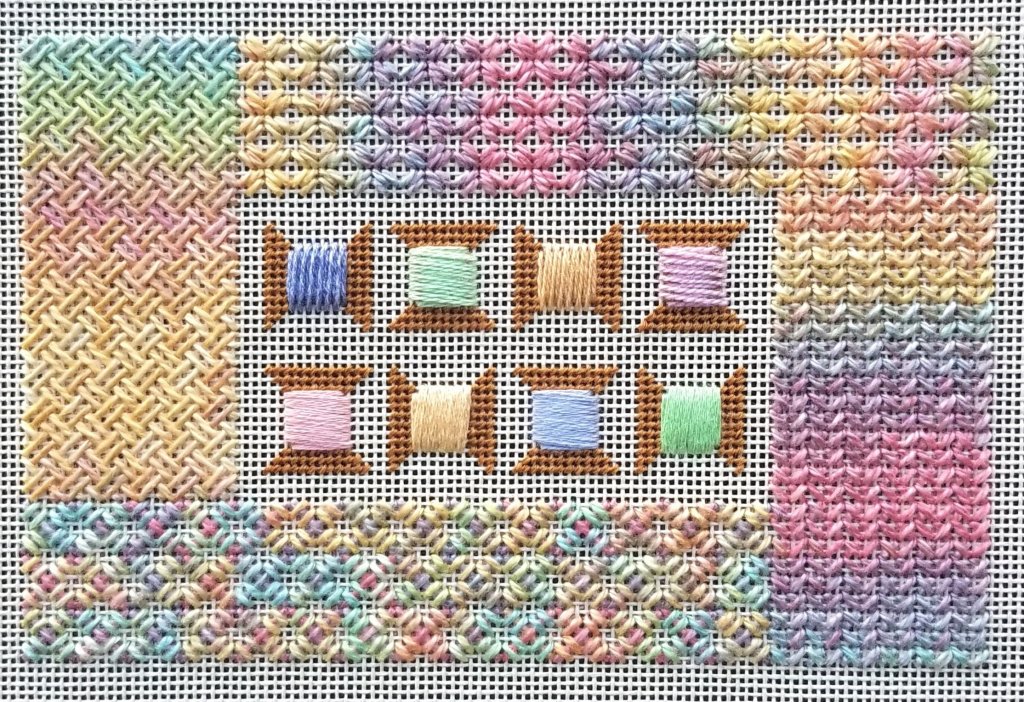
Today’s 3-hour class at EGA’s Mid-Atlantic Regional meeting was fun and challenging. There were 31 students – larger than anything I’ve done on the chapter level. Everyone was wonderful.
The piece labeled original was done for a purse for my sister in 2015 and the second for the ANG 2017 Chapter Project Book.
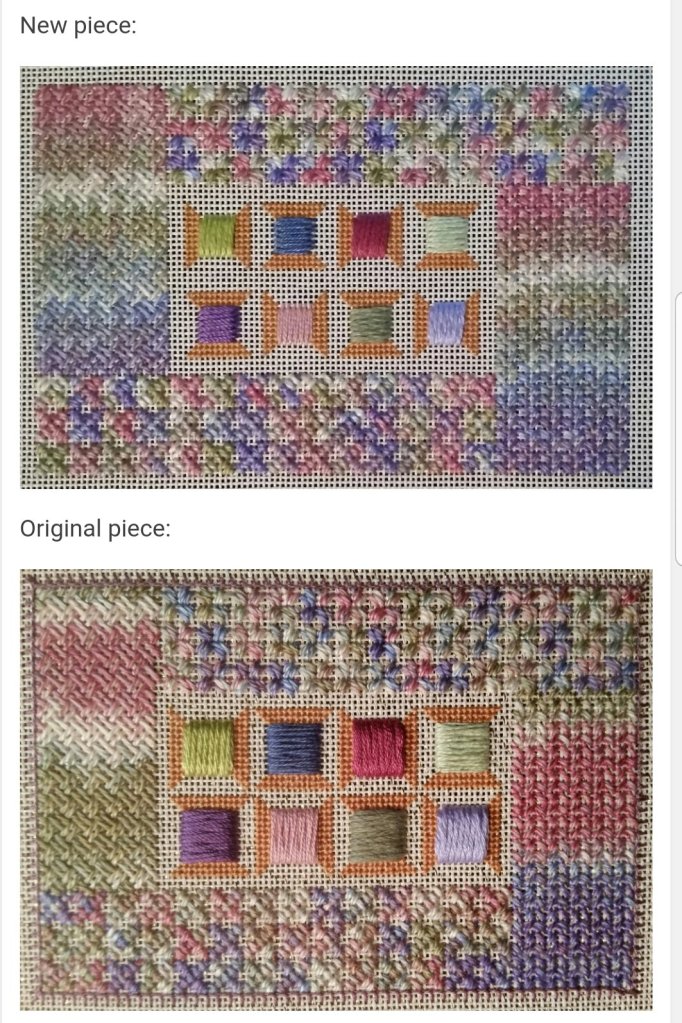
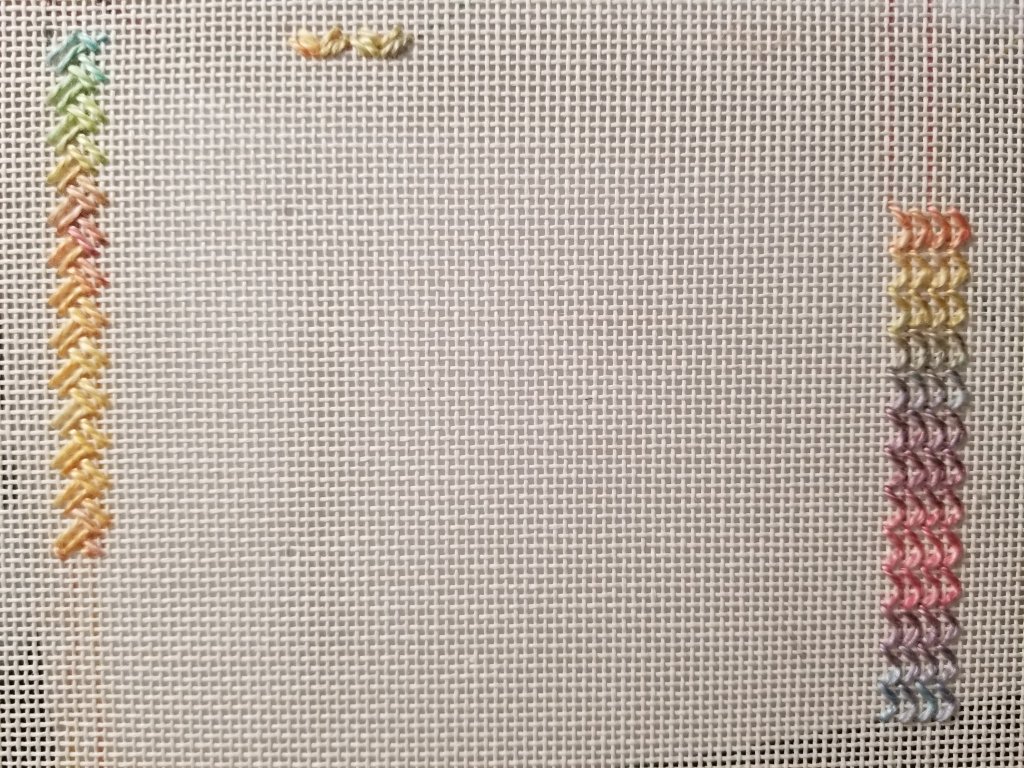
I started stitching it for the third time in order to refresh myself. It is intended to be a small project where many (about 20) of the students then go back and teach it to their own chapter. The main idea is to manipulate an overdyed thread in 2 areas to create a striped effect and place color randomly in the other 2 areas. I shared other pieces where I manipulated overdyed, demonstrated a quilter’s knot, and how to find the repeating color sequence.
I sent this photo out to get people excited. After class, the best comment I heard was, “I’ll never look at overdyed threads the same again.” That’s wonderful to hear and fun to open up possibilities for people.
Filed under: ANG Chapter Book Projects, Embroidery Guild of America, Flutterby by Kurdy Biggs, Rings on Her Fingers with Kay Stanis, Seminar 2021-Chicago
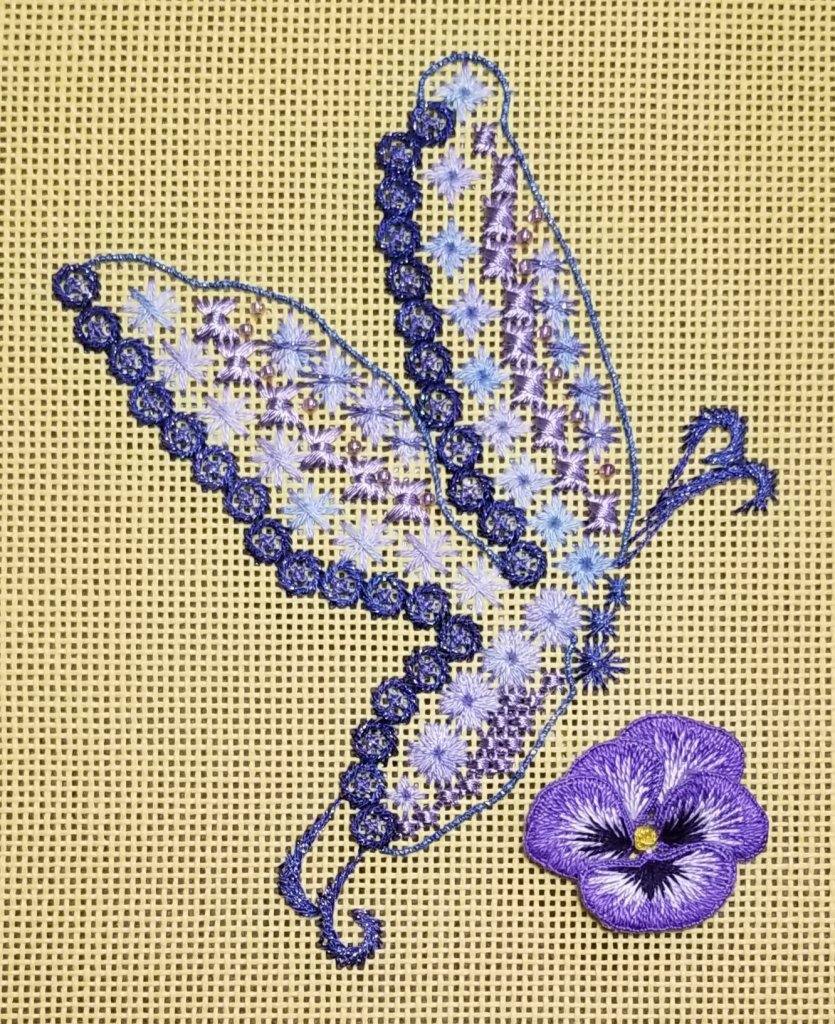
I wanted to showcase the Mauve Pansy that I stitched for the EGA class Rings on Her Fingers designed by Allison Cole and taught by Kay Stanis. Rather than making it into a ring, I selected Flutterby designed by Kurdy Biggs for ANG’s 2017 Chapter Project Book so that the butterfly would be flying around the pansy.
I switched the canvas color and threads from lilac to yellow and blue. My stash came through nicely with threads including Waterlilies 017 Blue Lavender (instead of Gloriana), ThreadworX 710161 (which was a little heavier than Kreinik #4 but worked well), Kreinik Petite Facets 014, Neon Ray’s N98 (rather than Panache which I had in the correct color but hated working with it), Silk Lame Braid Petite SP174 (instead of Treasure Braid), and Sundance Beads Size 11 Color 356.
Then, I enlarged a couple of holes, put the wires through the holes, and whip stitched them to hold in place. Lastly, the 6 strand Colonial Knot was added and covered up the little bit of wires that was showing in the center.
It may take a while to get it finished but it will be done as a stand up on an acrylic stand. My other Seminar piece, Annette’s Bouquet, is at the framers and will also take a while because the frame is temporarily out of stock. But, I am not in a rush for that either. I find it very gratifying to have finished both Seminar pieces.
Filed under: Annette's Bouquet with Deborah Mitek, Embroidery Guild of America, Seminar 2021-Chicago
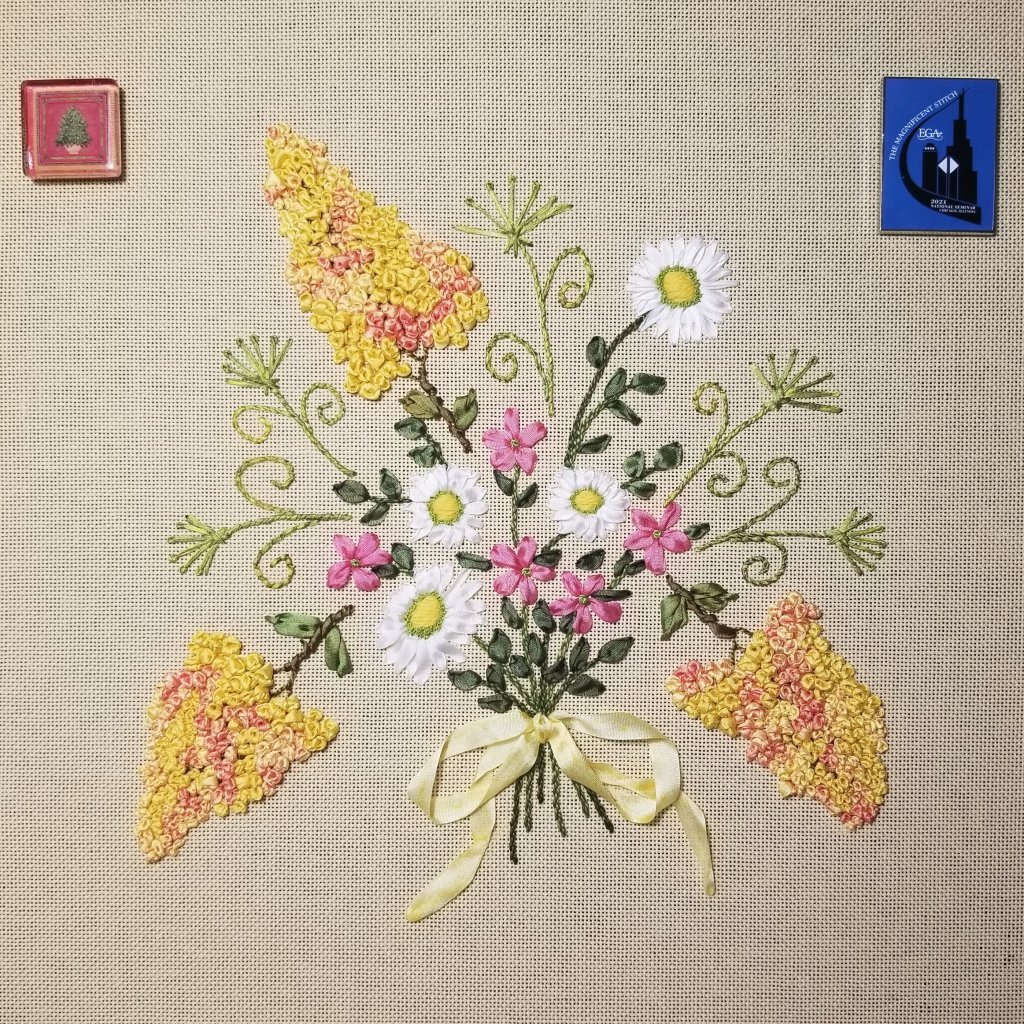
The lilacs were the most fun flowers of Annette’s Bouquet (EGA Seminar class from Deborah Mitek) perhaps because they are French and Colonial Knots which I am more comfortable with than the other ribbon techniques.
These were also interesting because of the foundation consists of Fly stitches to raise the knots. I added extra Fly stitches than indicated in the instructions for the center top one because my line started out wonky but I had plenty of thread. By the second and third lilac, my Fly stitches lined up. You probably can’t see it but I poked a needle into the Congress Cloth to make the general shape.
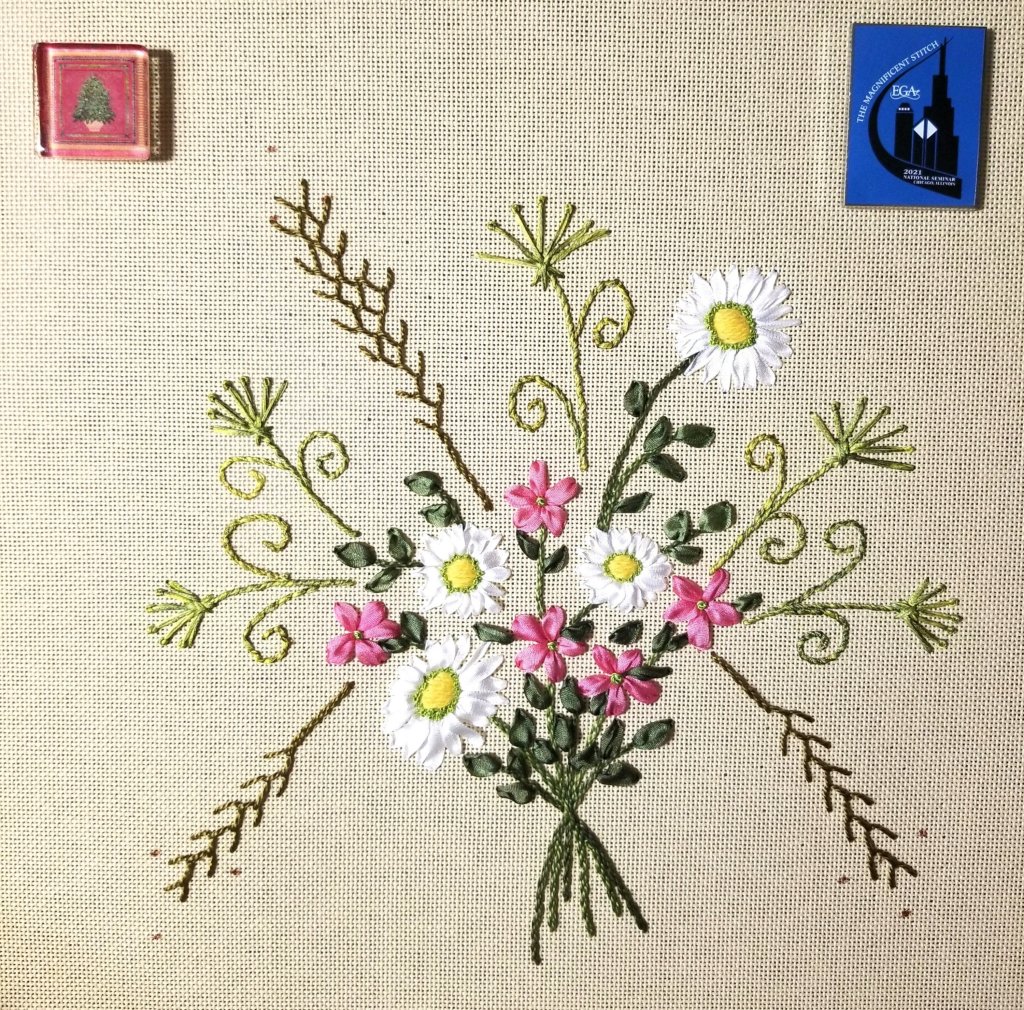
Wrapping the lower stem stitches lightly adding twists and links with ribbon sounds easy. It took several attempts to get the first one (center top) and then when I finished it off, it almost looked better on the back. So, I tried until I was happy. Good thing I had plenty of ribbon. The second of the wraps worked great on the first attempt (bottom right). Then, I struggled with the third (bottom left). Wow.
You know that it took me 35 minutes to cut 4 skeins of ribbons for the lilacs (two were 5 yards and two were 5.5 yards). I know it was 35 minutes because dinner was cooking! The way it was cut yielded 4 threads of each color for the 3 flowers. That’s a lot of ribbon!
I saved ironing and separating them to get a good variety of overdyed thread in each set of three for the next day when I was ready to stitch.
The center top was my first one. It’s more dense than was probably intended but I kept putting my needle through thread which pulled the knots tighter than I wanted. Finally, I flipped the canvas and worked them up so the thread wasn’t in the path of where I was stitching. It’s a big lilac (compared to the teacher’s model but no two pieces would ever be the same anyway) which used 11 of the 12 threads one 7 mm strand left over). The shape is good, there is movement of color within the flower, and there is depth because some are tighter to the canvas. I am happy with my first lilac.
My second lilac was the bottom left. And, it too has a good shape, color movement, and depth. It is smaller. I had 3 strands of 4 mm ribbon left over (two solid and one overdyed).
The third (bottom right) is about the same size as the other one on the bottom and all aspects just as good. I had 3 strands of solid yellow ribbon left over (two 4 mm and one 7 mm).
Three lilacs took 3 days. But, I stayed up late to finish the lilac leaves and bow.
There are 6 lilac leaves using 7 mm ribbon in a Lazy Daisy and they were tricky. A little twist, a little luck, and a couple of tries finally got them in place.
The final step was the bow. Easier than the leaves because you twist, preview, and tack. I am very happy with the bow and the whole piece!!
FYI: I allowed my Surface Pro to get down to 22% (took about 3 hours of use) and then connected it to the charger. It took 1 hour and 20 minutes to fully charge my computer (I kept using it during the charging) and was left with 15% on the charger. So, that’s definitely adequate for my needs in chapter meetings and classes.
Filed under: Annette's Bouquet with Deborah Mitek, Embroidery Guild of America, Seminar 2021-Chicago
Given a little quiet time and my comfy stitching chair, I was able to finish the wild greenery (pistol stitch and wrapped backstitch), stems, the 3 remaining daisies, the 5 Periwinkle flowers, and the leaves. I left my 2 practice ones in the bottom right corner to show the difference.
One of the biggest tips from Deborah was to enlarge the holes for the tips of the petals (away from the center) before stitching them to ensure you like the shape of the flower before stitching it.
That leaves (pun) just the 3 large Lilacs and the bow.

Filed under: Embroidery Guild of America, Rings on Her Fingers with Kay Stanis, Seminar 2021-Chicago
Kay Stanis filled in excellently for Allison Cole for Rings on Her Fingers at the EGA Seminar.
Kay shared that she prefers wooden hoops and even then suggests wrapping the inner hoop with twill which she brought and let us have some. It let’s the fabric hold better in the hoop.
In order to finish this piece, I needed new sharp scissors with the rounded tip in order to cut right up to the edge of each petal. I loved my gingher scissors that I’ve been using a long time. But, when I happened to mention that I needed a new pair of scissors to be sure they were sharp enough, I was told that Kai scissors are fantastic. So, I ordered them and am ready to cut! Nervous to cut that close to the stitching but I am going to do it.

The Kai scissors 4″ have a slight curve at the tip and are very sharp to cut with and have extremely sharp pointy tips. They are so light to hold – much lighter than the gingher scissors but those are all metal and these have the black plastic finger holes (very comfortable fitting). It wasn’t as bad as I expected. I did practice cutting on the practice petal and then kept going. It looks great! Once I am ready to attach it to the canvas, I will finish the assembly process and add the yellow center. I ordered the black Congress Cloth for the butterfly. Nobody around here has it. But, I will start gathering threads for Flutterby by Kurdy Biggs (in the ANG Chapter Project Book – two of us in Main Line Stitchers chapter signed up for it).


