Filed under: ANG Delaware's Seashore Chapter, Stitches in Sterling by Nancy Cucci
The beaded center of Stitches in Sterling by Nancy Cucci is done in just 12 years and 5 months! It was not nearly as intimidating as it was when I started it.
That’s a lot of beads in a small area. Very fun. The 40ss Swarovski Crystal jewel was the last to go on. It took some effort to get the prongs of the ring mount through the stitching far enough to bend them inwards to hold the bead securely and not have the stone jiggle.
We’ll be visiting Jim at Repenning Fine Art for framing sometime soon.

Filed under: A Spring Sampler, Brandywine Chapter, Embroidery Guild of America
I had a Stitch-in Tuesday with my EGA Brandywine Chapter members. Patrick has been stitching on this project with regularity, and it’s coming along nicely.
I can’t remember when I stitched Bands 5 and 17, but all Tuesday, I kept looking at them, thinking something wasn’t right. It wasn’t until I got home and finishing up the now bottom Band 18 that I realized I had used the wrong thread for Bands 5 (second from top) and 17 (second from bottom).

It really pays to start and end your threads carefully enough to be able to rip out without disrupting the adjoining area.

And, here are Bands 5 and 17 looking much better. Agreed?

Filed under: ANG New Jersey Needle Artists Chapter, Tumbling Stripes by Marilyn Owen
I ditched the threads I’d gathered for Tumbling Stripes in favor of DMC cotton floss. The first batch just didn’t look right to me when I went back to start the project, Tumbling Stripes by Marilyn Owen.
My floss has a better selection of light, medium, and dark yellows and blues. So, I matched the yellow Petite Sparkle Rays to 445, 307, and 444, and the blue Silk Lame Braid to 800, 797, and 820. I included yellow because Jacqui, who is leading this for the ANG New Jersey Needle Artists chapter, has a Zoom talk, Why You Need Yellow in Your Life, which we enjoyed a while ago.
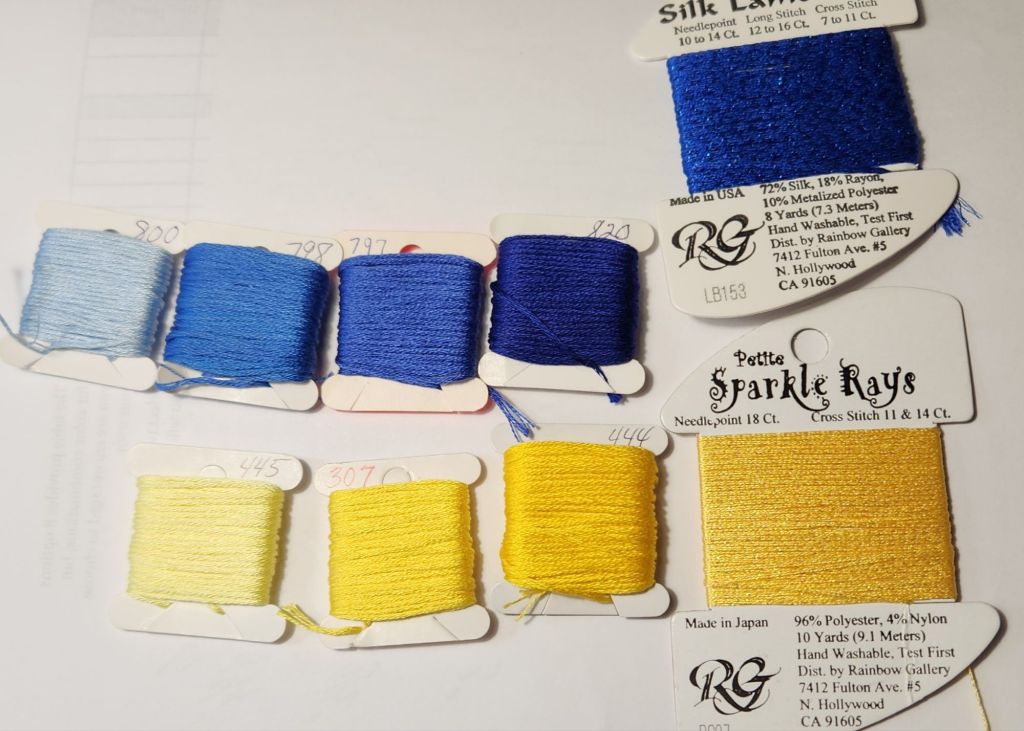
Our assignment this month was to select threads and baste. Well, I don’t like basting. So, I stitched the blank faces of the cubes first. They are actually the last step before the borders, but they line up with the stripes. Since I am doing this as an ornament, I will have to round it out after the stripes are all completed with the same light yellow thread.
Because I am stitching on Congress Cloth, I am using one less strand than suggested for 18 count canvas. I am all ready for February’s meeting next Wednesday night (thanks, Cathryn for reading my blog and letting me know about the date change for February; I even updated the NJNA website but not my calendar).

Filed under: ANG New Jersey Needle Artists Chapter, Ruby Razzle Dazzle by Ann Strite-Kurz
A few years ago, quite a few members of the ANG New Jersey Needle Artists Chapter (NJNA) stitched Ruby Razzle Dazzle by Ann Strite-Kurz. They came up with some great colorways (https://njneedleartists.org/njna-workshops/sotm/2015-sotm-ruby-razzle-dazzle/).
I have had these instructions for a year or so. After reading Ann’s books and seeing Diane’s completed piece at the NJNA Holiday Luncheon in January, I decided to try the patterns. But I can’t commit to doing the whole piece – maybe sometime.
By choosing the shortest ribbon to work first as a stand-alone piece, I was able to test the waters. Ann explains her thought process and logic for stitch paths, which is much more detailed than in other counted designs. It’s like taking a design class from her.
I completely understood and followed the logic of the shifting direction of Smyrna stitches because I went into that in my Crescent Journey design.
Ann describes how she developed the variation for this diamond lattice from a Scotch Stitch. Then, she explained how she placed the pattern. Wow! This may be too much information for some stitchers, but I think it is fantastic and brings together the concepts described in her books.
However, her recommended path and pivot concept to conceal the traveling path on the lattice reminds me that I did not do well in organic chemistry whenever I had to go from one compound to another in over 10 steps. Seeing 5 or so steps was my limit. No threads show through. I never would have thought of her efficient stitch path.

While the sequence for filling in the units made sense, Ann made it sound like it could be done in 2 paths, but I needed 3. My threads weren’t long enough anyway. Still no threads showing through, though, which is good.
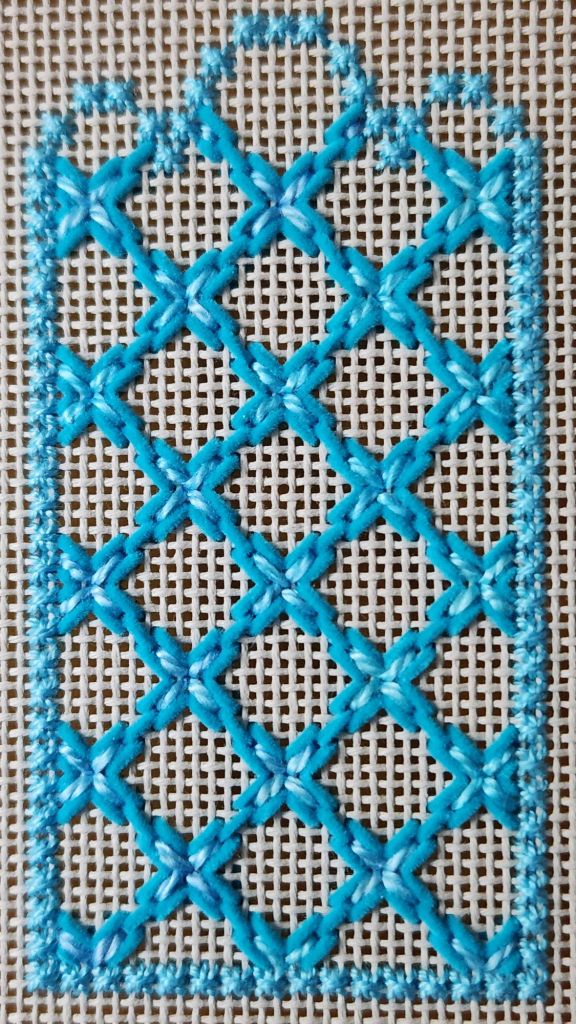
The blackwork pattern used 2 strands and was easy enough to follow. My canvas is pewter a light blue gray, but since this is such an open pattern, a more colorful canvas might be better.

The last step is also a blackwork pattern used a double running technique, which also made sense to me.

I used some different theads than recommended, such as Pearl #12 for the Smyrna stitches, because none of the Pearl #8 in my stash was the right color. I had a Petite Very Velvet. I went with one strand of Watercolours instead of a Pearl #5 and two strands of Weeks Dye Werks instead of 2 strands of DMC Floss.
I wonder what the next band will be doing?
Filed under: Explore and Design with Debbie Rowley, Other People's Designs
Thanks to Marilyn O, I signed up for Explore and Design with Debbie Rowley.
As of now, there are still 6 openings (of 20 max) for her inaugural class on this topic. There will be 6 weekly Zoom classes between March 14 and April 18, and I have no conflicts!
Interested in joining the fun? Registration ends February 25 or when the openings are filled. Read all about it at https://debbeesdesigns.com/product/explore-and-design/
This is a collage of some of her designs on the cover of her booklet, and the bee sits on a green magnet. Very nice!

Filed under: Books in My Library, Needlepoint Books, The Canvas Embroidery Notebook by Mindy English & a Book Mix-up!
I ordered The Canvas Embroidery Notebook by Mindy English from an Ebay site and was sent Backgrounds, The Finishing Touch by Ann Strite-Kurz instead!
After one look inside Ann’s book, I was happy with the mistake. Wow. I only paged through it, but the amount of information in this book is considerable. It will take quite a while to go through it all. I am excited to see the photos on the CD. Some photos I recall from Ann’ Diaper Pattern and Potpourri of Pattern Encore books, but much is different.
It made me think to look at Ann’s website again to see what other books she has. I already had her Potpourri of Pattern Encore when I started the Master Craftsman program. That’s when I got her Diaper Pattern and Applique books to expand my knowledge of those areas before tackling those steps. All her books have been so thorough. I also obtained Stitch Variations and Mutations, Parts 1 and 2 and Stitch Refinement for Canvas Embroidery (which replaces the older book, The Science of Canvas Embroidery). I could use 6 more weeks of winter to read these books!
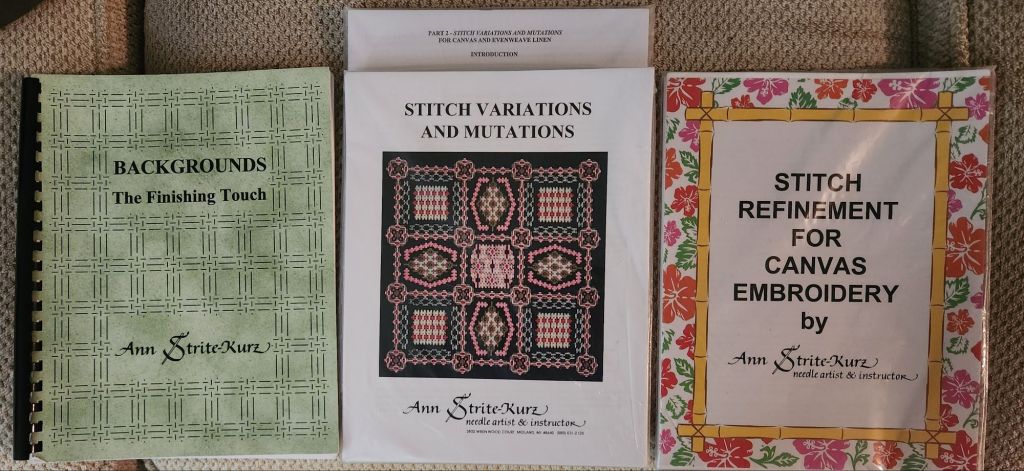
Since I keep books organized by author on my blog, I have updated my original post on Ann’s books: https://melitastitches4fun.com/2022/02/25/books-in-my-library-canvas-applique-diaper-patterns-and-potpoutti-of-pattern-encore-by-ann-strite-kurz/
I did find Mindy’s book from AbeBooks, who got the order correct. Not only is this an excellent reference for 20 stitches but also for manipulating those stitches for increased creativity. It was written in 1986 (the fifth revision) but is just as relevant today. The pages are numbered within each chapter, and the index refers you to pages within the chapter, but you have to find the start of each chapter. It’s not my favorite pagination. But otherwise, it’s just what I expected.
There are 26 variations of the Mosaic Stitch. But then there is more variation under Diagonal Mosaic Stitch. The patterns under Mosaic Family combine Mosaic, Scotch, Milanese, and Cashmere. Wow! Both the creativity and time it took to put this together is amazing.
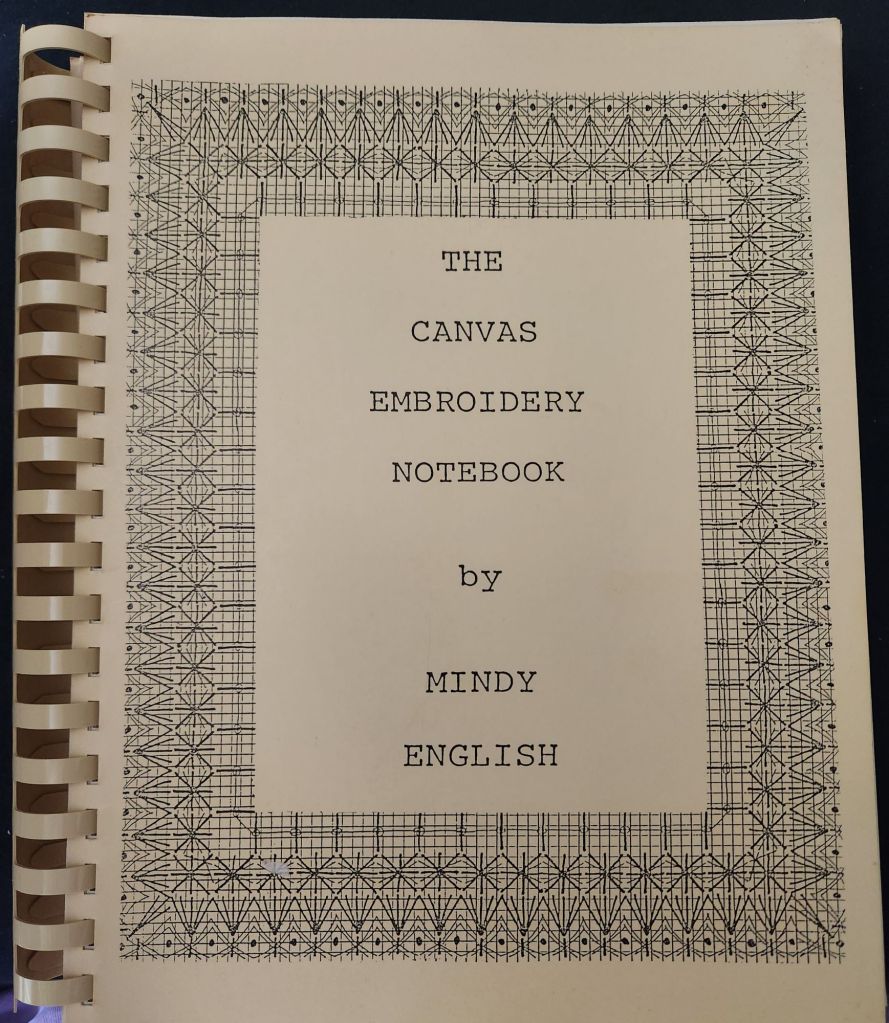
Both Ann and Mindy explore stitch variations. It’ll be interesting to see how each approaches the issue.
Since I now have two of Mindy’s books, one is going to Meghan, a younger member of my ANG Main Line Stitchers chapter who has been very engaged in needlepoint since joining our chapter. You can see her owl in the September/October 2023 issue of Needle Pointers along with Lori’s and Patrick’s owls under Chapter News. All 3 are great. Watch for something more from Meghan later this year in the magazine!
Filed under: ANG Delaware's Seashore Chapter, Stitches in Sterling by Nancy Cucci
I began Stitches in Sterling by Nancy Cucci in September 2011 when I did the pre-work (silver Kreinik grid) for a class in Rehoboth Beach, DE, with the ANG DE Seashore Chapter. I enjoyed the class. Lori, Patrick, Betsy, and I (all from ANG Main Line Stitchers chapter) took the class. During the 2 days, we got a lot done. I didn’t get more done until now.

I had taken the piece off the bars and kept it flat. It looks like I used First Aid tape on the edges. That has held up fine without discoloration. Can you believe that I had 11″ bars put together already and waiting for a project? Now, a little over 12 years later, I begin again!
We did not get to each area in the beaded center and only did 3 areas in the background. Nancy has excellent diagrams with easy to read keys. And, I took great notes. She has tips in an addendum for those not present in class that will probably be handy. I will work on the background first. There are only a few threads, including Pearl cotton #8, floss, Kreinik braids (#8 & #12), and Kreinik 1/16 ribbon.
The background had mostly darning patterns and I needed the grid to anchor threads. Only one area is completely covered, so the silver sparkle from the canvas shows through.
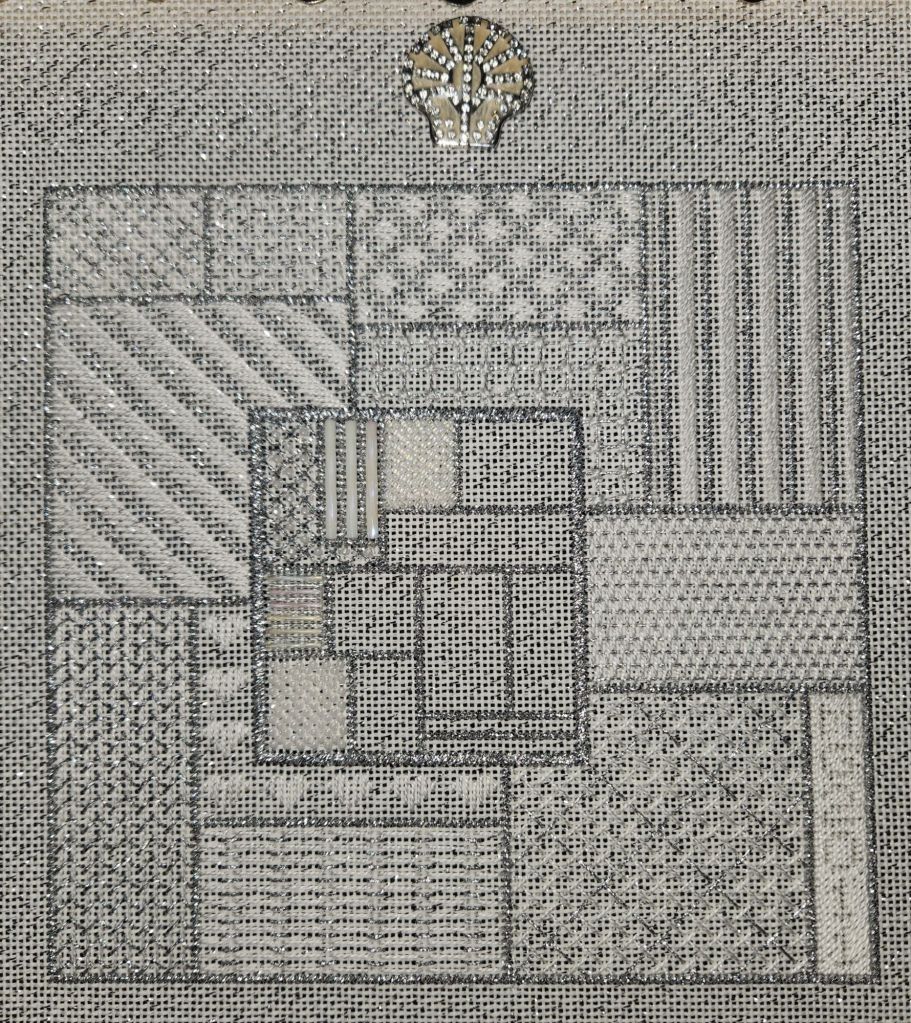
The photo includes my needle minder, which is silver and a seashell for the ANG DE Seashore Chapter, who sponsored the class.
Filed under: ANG Central Jersey Chapter, General comments, Needles, Sashiko Mini Sampler Kit by Miniature Rhino
Before I started a new project, I decided to put away all the threads that I had been throwing in a grocery store bag for quite some time! I’m very glad that’s done. There is more stuff to clean up (and will probably wind up with more threads to put away), but I am making progress.
One of the items that I came across was this Sashiko Mini Sampler Kit by Miniature Rhino. It was in the welcome gift bag from the Central Jersey Chapter (CJC). It’s a recent addition to my stash, but it looked like it’d work up quickly once I get started and rather than find a place to store it, I decided to stitch it. There were no instructions. So, I watched a couple of YouTube videos on Sashiko. There are books too.
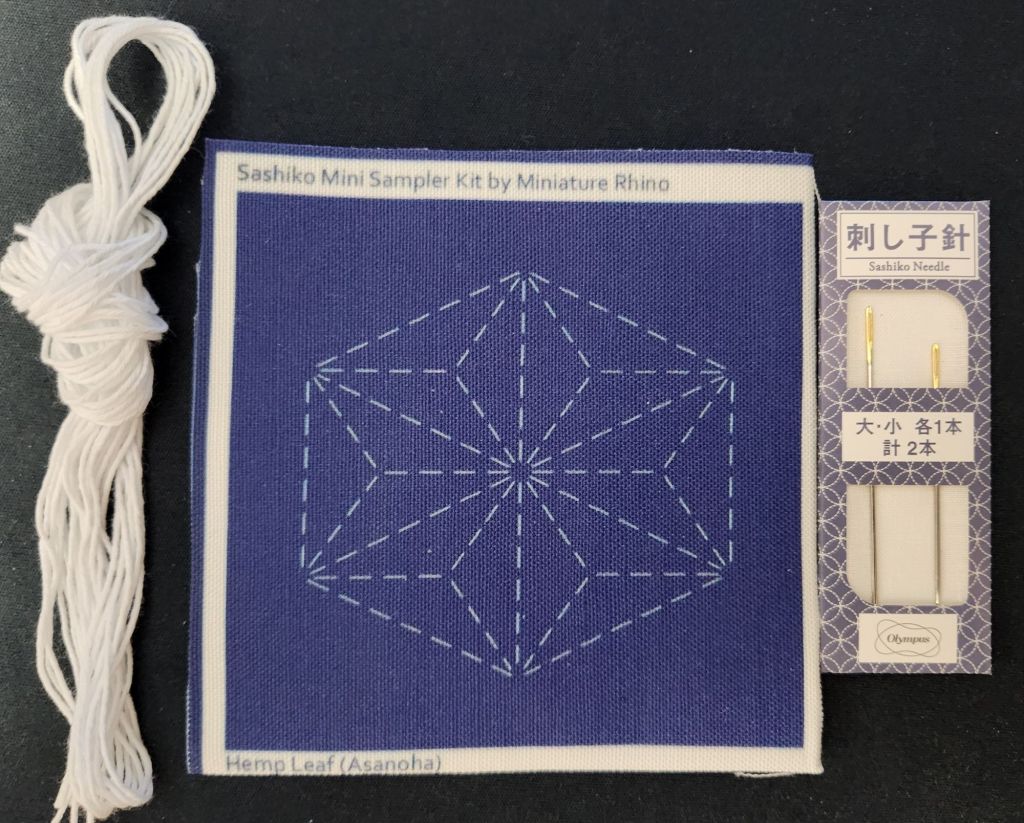
The thread gets used as supplied. I tried to separate it into 3 strands because it looked too thick, but it shred. Then, I checked with Jacqui C, who had taught an EGA online course a couple of years ago. It’s the right thread and is to be used as supplied. Jacqui thought DMC Perle #12 might work better for this fabric. The ANG NJNA and CJC Chapters are lucky to have Jacqui in both chapters.
The needles are sharp with a decent size eye. I am excited to use another type of needle. These are longer with a sharp point because Sashiko is done in hand, and generally speaking, you try and scoop a few stitches at a time. I don’t have a palm pad or thimble making multiple stitches difficult. So, I scooped one stitch at a time, mostly keeping the needle on the top as I stitched. The other option is to go with the poke and stab method. This is not a forgiving fabric. So, be sure of where your needle goes.
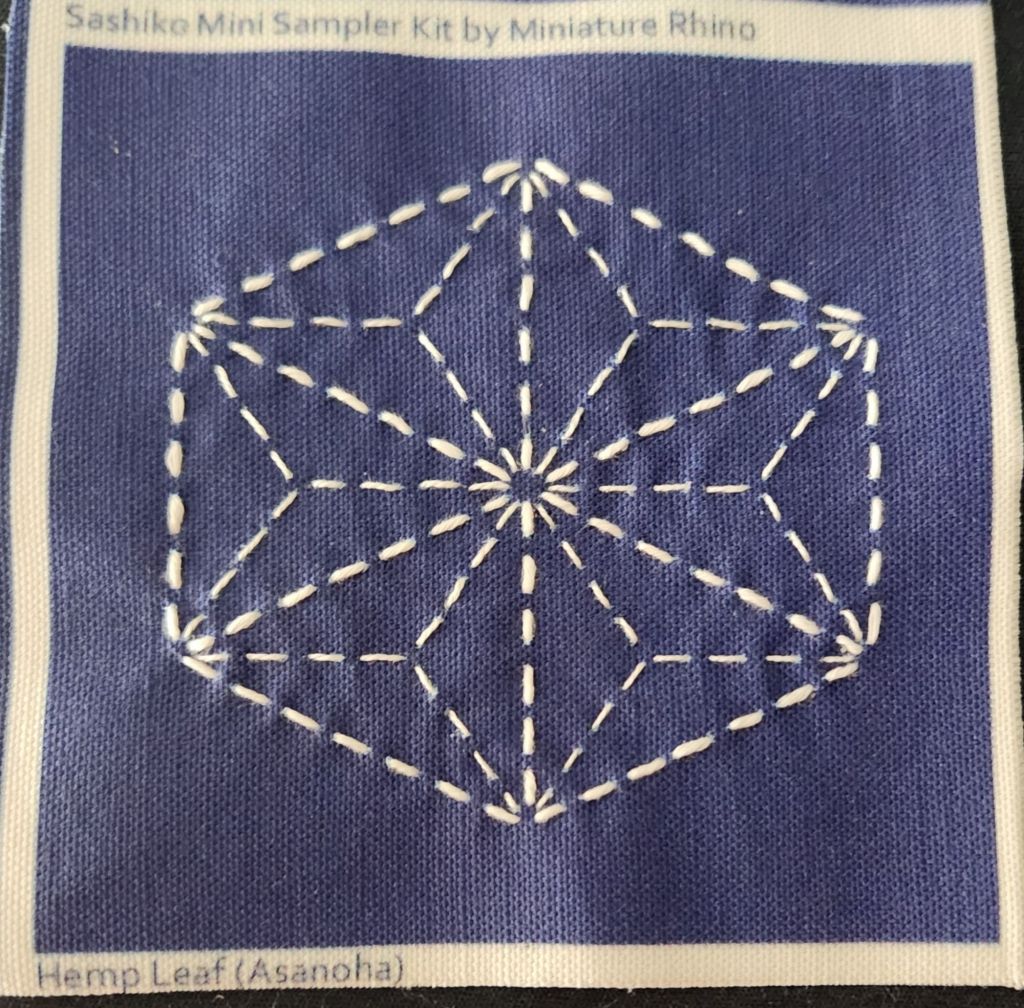
I decided to try both threads, the supplied thread, and DMC Perle #12. The #12 Perle was thinner, and I could scoop 3 stitches. But, the poke and stab method is more accurate. It probably takes practice to get accurate with the scoop method.
This will make a good Show and Tell piece for the February 13th meeting of the Needlework and Textile Guild of Media. It is from 7-8:30 pm at the Media Arts Council in Media, PA. I did a little reading on its origin. According to wiki, “Sashiko (刺し子, lit. ‘little stabs’) is a type of traditional Japanese embroidery or stitching used for the decorative and/or functional reinforcement of cloth and clothing.”
I have no functional use for this piece, so I need to find a decorative use. According to the meaning of Japanese patterns at Polina Couture (.com), “Literally, Asanoha (麻の葉) means “hemp leaves”. This star or hexagon motif evokes this hardy plant, which grows straight and fast. And so it symbolizes a good growth, vigor and resistance. And by extension, it augurs prosperity.” I went down a rabbit hole online and learned, “Hemp is defined as any part of the cannabis sativa plant with no more than 0.3% of tetrahydrocannabinol (THC), the mind-altering substance in marijuana.”
None of that helped me decide what to do with this. Hopefully, a use will reveal itself!
Our ANG Main Line Stitchers chapter’s first Stitch-in for 2024 was Saturday. We had a nice turnout with 9 people in person and one on Zoom for a couple of hours. We lucked out with the weather-mild and sunny!
Beth brought her framed Southwestern Pots. It was really framed beautifully. She’ll bring it to our March meeting when Kristen will bring hers too. I helped Beth get back on track with A Spring Sampler. Lori and Patrick are coming along nicely with theirs.
I worked on the borders for Imperial Topaz by Sue Reed. I did change 3 strands of Splendor to 1 strand of Silk Lame Braid Petite so I could see more of the Kreinik Braid that stretches corner to corner. And, I skipped the small upright stitches over 2 to see more of the Braid.
I finished the border Monday but got sidetracked and forgot to post this. I’m very happy with how this turned out. Thanks again to Linda for leading us through the project and picking threads which is key to getting the motifs to show.
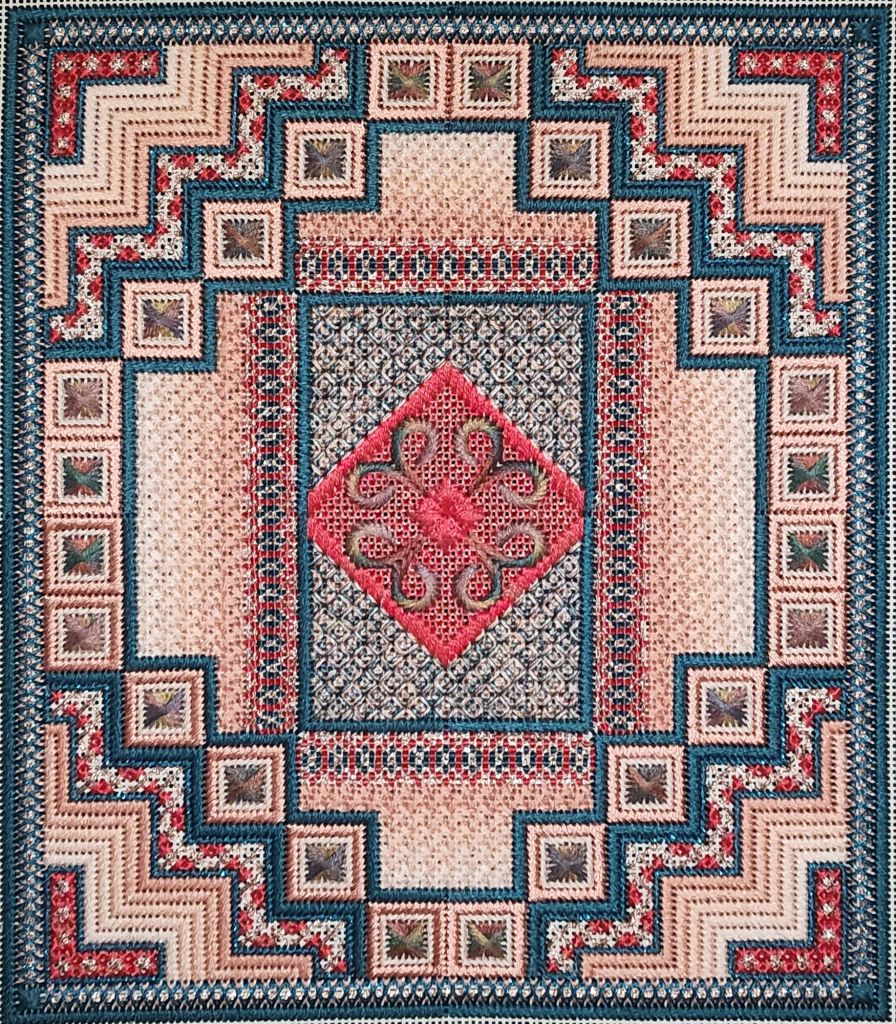
As a reminder, Needlepoint Now sells reprints, which are available for $3 at https://www.needlepointnow.com/product-category/project-reprints/.
Note: Gifted canvas to friends, Mona and Kirk. It goes with the color scheme in their living room! Glad it found a home.
 Melitastitches4fun's Blog