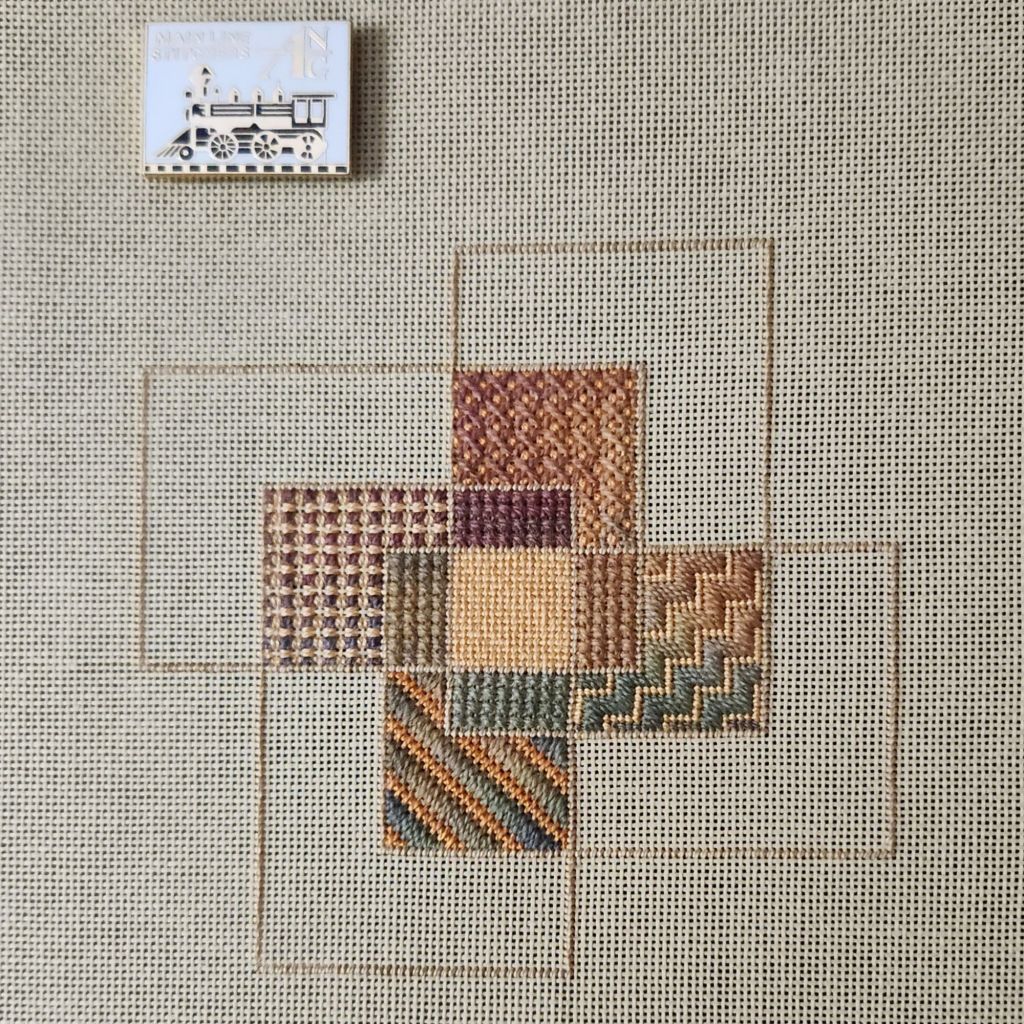
Heart Swirls by Janet Zickler Casey was a half-day class (8:30-11:30 am). In such a short time, we only got about 1 strand done per area. I heard it takes 30 minutes to teach a stitch and that’s about what we got through. We did spend extra time on the second and third areas (moving left to right). So, we didn’t stitch in the 6th or 7th area.
Once home, I found stitching the Alternating Reverse Gobelin Rectangles in the 2nd area was easier moving vertically rather than horizontally. Once I got the rhythm of the stitch, I moved horizontally on the bottom half.
Compensation was a little tricky in a few spots, especially in the 5th area. But, in several other areas, it seemed like I picked the perfect spot to start because the compensation worked out great.
The 7th area called for a Woven Scotch Variation with long laid threads moving diagonally from NW to SE, but in such a skinny area, I didn’t like it. So, I selected the Mosaic Stripe, which usually uses 2 different threads, but I used the same 3 threads that were used in the first area. Once I got stitching, I realized the right side needed to be higher by 2 canvas threads to match the left side. The over 2 stitches in the Mosaic were with Very Velvet, and the over 1 stitched was done with Neon Rays+ stitched twice because it sunk down, disappearing between the thicker Very Velvet stitches. I filled in with the gold Fyre Werks but not stitched twice because they appear sunken in the first area. I’m very happy with the substitute stitch.
Most of this was finished during the National and American League Division Series games. It is with a heavy heart (pun intended) that we watched our Phillies lose. They had a great first half, mediocre second half, and a disastrous finish. You’ve got to be red hot like this heart in September, not June.

The Kansas City ANG Seminar heart magnet was also perfect to use with this piece. I had a couple of needles working, and so both magnets were helpful.
FYI: I found my KC clip magnet in a pocket of my purse. Now I can’t find a felt bookmark I made for myself. But I found the gold sequins for my butterfly in the cushion of my chair as I recovered a needle threader for the umpteenth time, which is now connected to a beaded fob, so I don’t lose it again. Only one needle went missing during this project. The saying should be, “You find some, you lose some.”
Filed under: ANG Main Line Stitchers Chapter, Fibonacci Swirls by Olivia Hartshorn
Linda is leading our ANG Main Line Stitchers chapter on Fibonacci Swirls by Olivia Hartshorn (from Needle Pointers Mar/Apr 2022).
I have finished the C Areas on canvas (top) and Congress Cloth (bottom). I am controlling the flow of the overdyed threads trying to get a flow of color that will accompany the swirls that are stitched last. We’ll see what happens.

I am ready for our next meeting this coming Monday.
Filed under: Books in My Library, Embroidery Books, Making Needlecraft Landscapes by Mary Carroll, That’s Not Needlepoint (It’s Inspired Art Created with Your Needle), which is by dede Ogden
Neither of these are “stitch books” because they are focused on creating projects, but both show you how to apply stitches to create a realistic design.

Making Needlecraft Landscapes by Mary Carroll has 32 landscapes, and stitches are provided to make them. The color photos, diagrams, and detailed description of stitch placement are great.
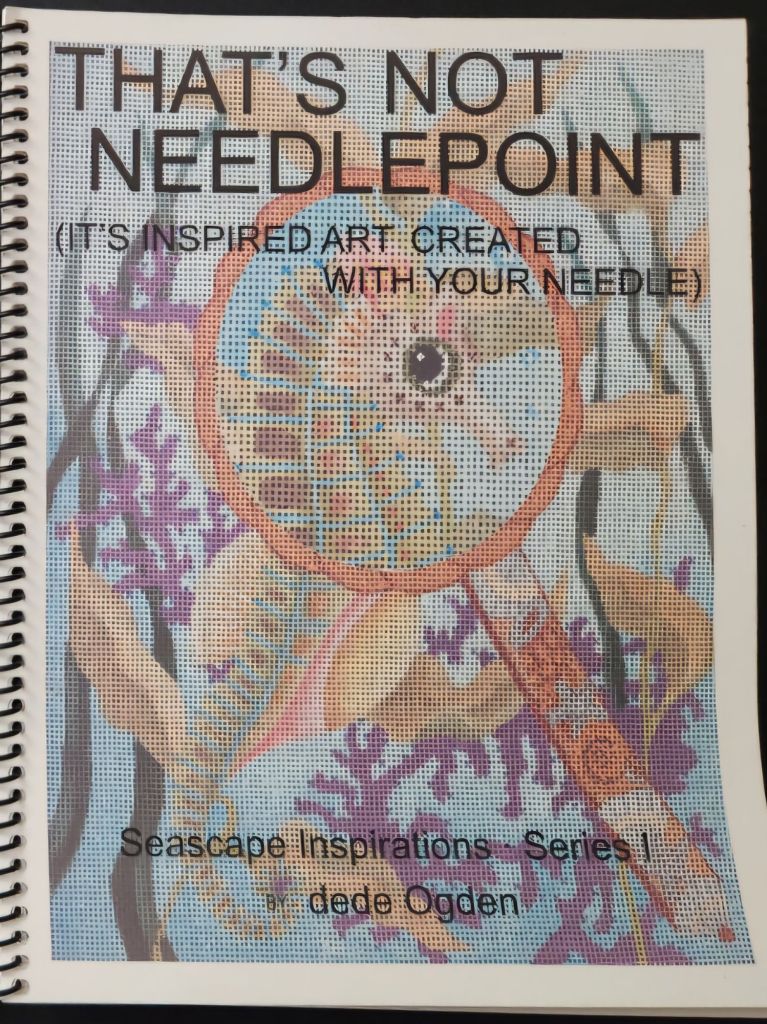
I did post previously about the other booklet, That’s Not Needlepoint (It’s Inspired Art Created with Your Needle), which is by dede Ogden (2011) and represented by Fleur de Paris, Inc. It’s not intended to be complete charts or diagrams to finish the various painted canvases but to offer suggestions for types of elements found in seascapes. The first canvas discussed is Seahorse Spyglass 18073 and is still available (and so is a stitch guide by Tony Minieri). Other canvases discussed are still available from a variety of sources including Undersea Fish 1373, Glass Aquarium Tropicals Green Fish 18015, Glass Aquarium Tropicals Blue Fish 18034, Undersea Garden 1378, Seahorse Pillow 18056, and Enchanted Mermaid Dream 18050.
The Casalgudi stitch is discussed, although I can’t understand where it’s executed. The photos could be better. And, without padding, it’s probably better called a wrapped stem stitch. The Railway Stitch makes a good background stitch. Sue has an interesting Bead Cup Stitch and shows how to expand an overlapping cross stitch to fit fluctuations in the width of seaweed.
Filed under: Books in My Library, Needlepoint and Beyond 27 Lessons in Advanced Canvas Work by Edith Anderson, Needlepoint Books

In a previous post, I pointed out a chapter in Needlepoint and Beyond 27 Lessons in Advanced Canvas Work by Edith Anderson Feisner entitled Variations in which she describes varying a stitch by size, by direction, by proportion, and by combination. In fact, she stitched a small landscape in all white using all variations of only cross stitch.
Since I am working on attaching stones, shells, and various objects, I read the chapter on Stones, Beads, and Found Objects. In addition to detached buttonhole which Dawn Donnelly discussed in her class at the ANG Seminar, Treasures from the Great Lakes, needleweaving is also described to hold a shell.
In the Texture chapter, Edith ranks 25 stitches in 6 categories from smoothest (basketweave) to roughest (Turkey).
The book covers a lot:

Well, I started in the center, filling in around the center motif, skipping the next area, filling in the next area, skipping the next area, and stitching the Smyrna border. I made sure to start the next length of Wildflowers in the same color as where I ended in order to maintain the color flow of the skein by always cutting in a stretch of purple. I thought random colors would be better because too much color matching might actually detract from those lovely swirls and corner mock Chilly Hollow motifs.
This part was almost finished during the baseball wildcard playoff games. It really worked up quite easily once I got into the rhythm. When I did get off a couple of times, I saw it quickly. That wider area with the Jessicas is probably going to require more concentration.
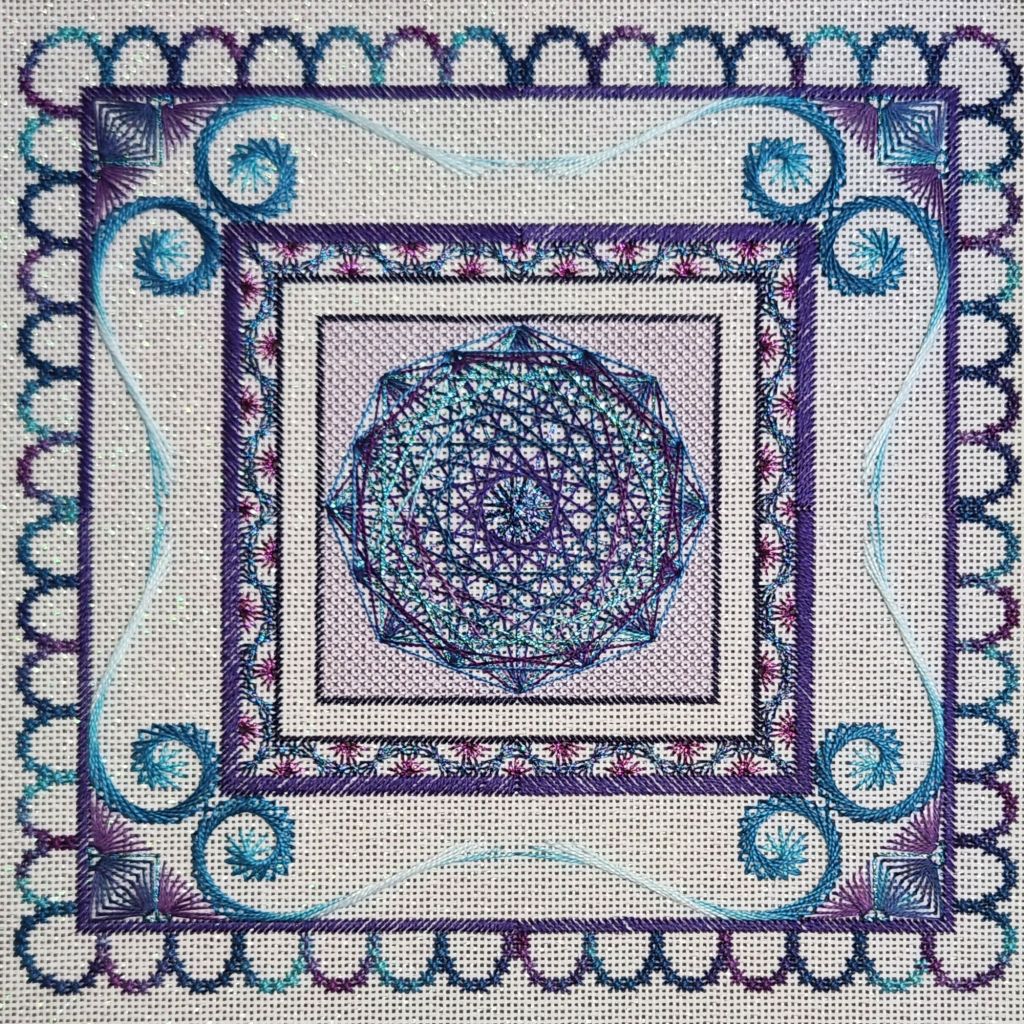
I do love a good counted piece and seeing it take shape. At least so far, I prefer completing all of one stitch rather than a quarter at a time.
 Melitastitches4fun's Blog