Filed under: Books in My Library, Needlepoint Books, Traditional Silk and Metal Thread Techniques on Canvas by Jane Zimmerman
As the title implies, Jane Zimmerman discusses Traditional Silk and Metal Thread Techniques on Canvas.
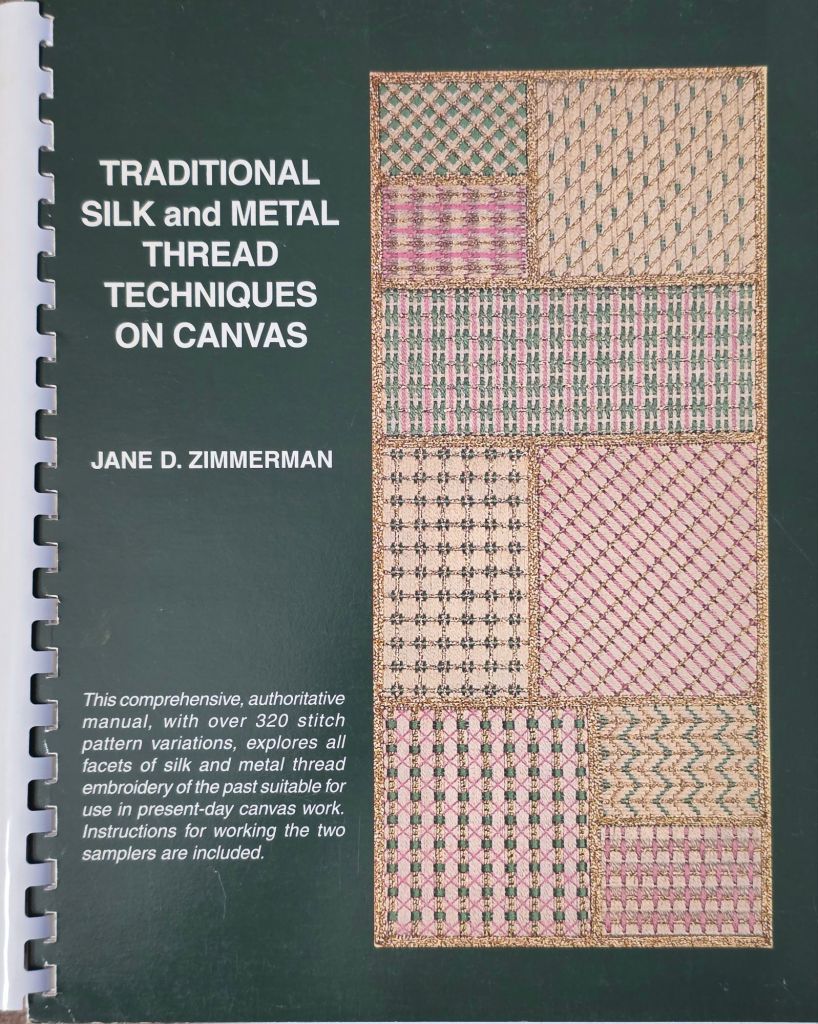
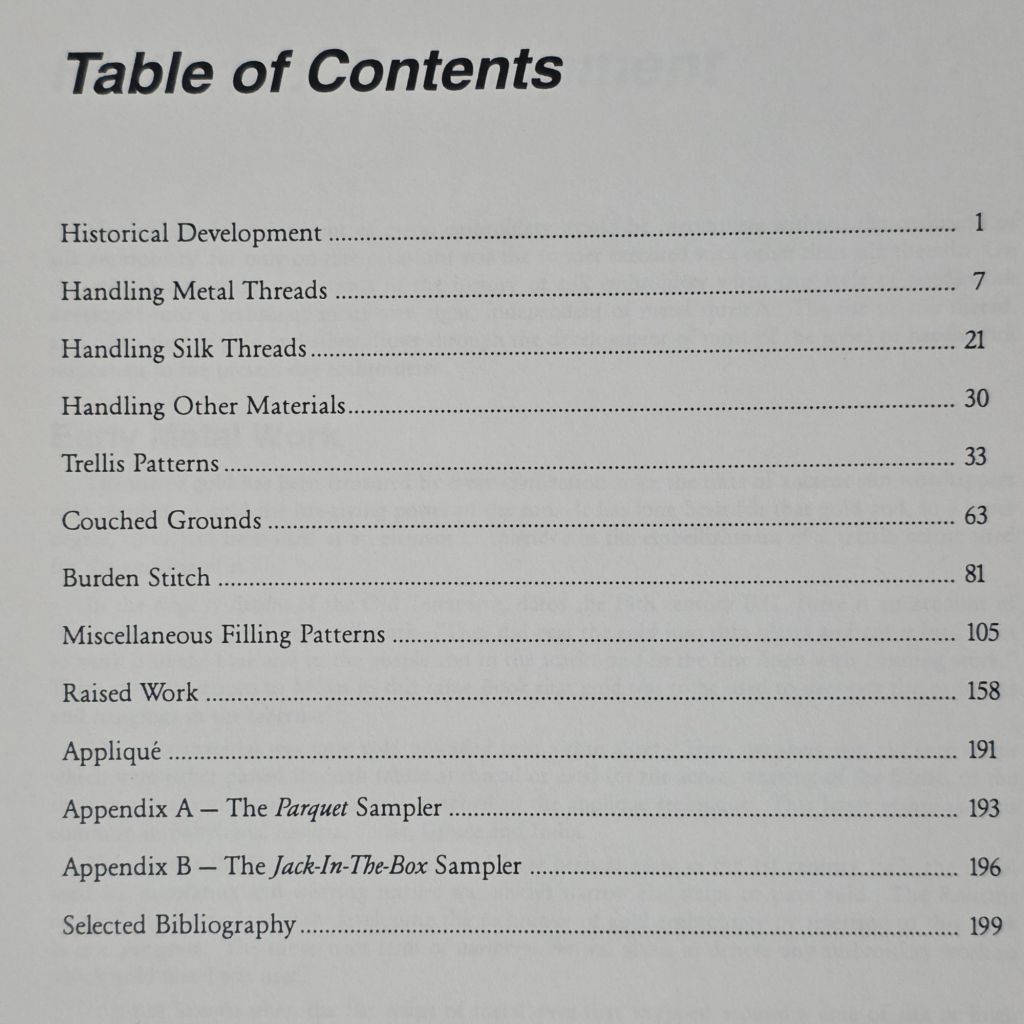
I don’t do much goldwork but this goes over enough to answer any questions I might have for that technique.
Even better, Jane provides hundreds of stitch patterns that can be used with any combination of threads. In fact, the 2 projects indicate that Kreinik can be substituted for the gold threads. But, I do have a box of leftover gold threads which I would love to play with but not now since I still have a few more 2025 goals to work on.
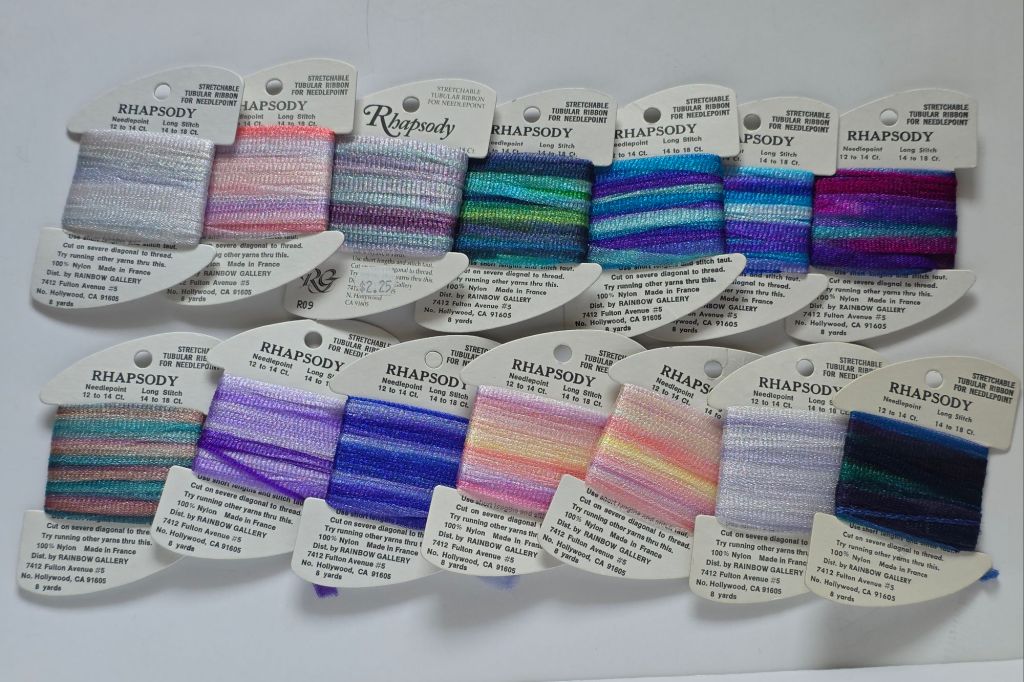
Maybe it’s too well known that I was looking for Rhapsody! But, thanks to Kristen and the great Ebay deal she found that I couldn’t pass up, I now have enough Rhapsody to keep making another set of these ornaments in a variety of colorways!
Eventually, I will need more cabochons. I bought more rimsets because some were bent. The 10 mm (also sized 45 ss whatever that means) pointed rimsets in silver were not available so I got them in 40 ss hoping they would work but they do not. So, I will have to find slightly smaller cabochons. But, that should be easier than finding Rhapsody or rimsets!
Luckily, I was able to unbend the existing silver rimsets and got extra gold 10 mm rimsets. I remembered seeing a jewelry tool for enlarging rings and found a pen to substitute allowing me to reshape to round with a little the help of jewelry pliers.
It’s funny that as much as I love overdyed threads I know one woman in my ANG Main Line Stitchers chapter who hates them! On which side of the thread aisle do you gravitate towards? Overdyed or not and can you explain why? I’m intrigued by the combination of colors and seeing how the color shifts.
Filed under: 2025, Flowering Maple with Celeste Chalasani, National Academy of Needlearts (NAN)
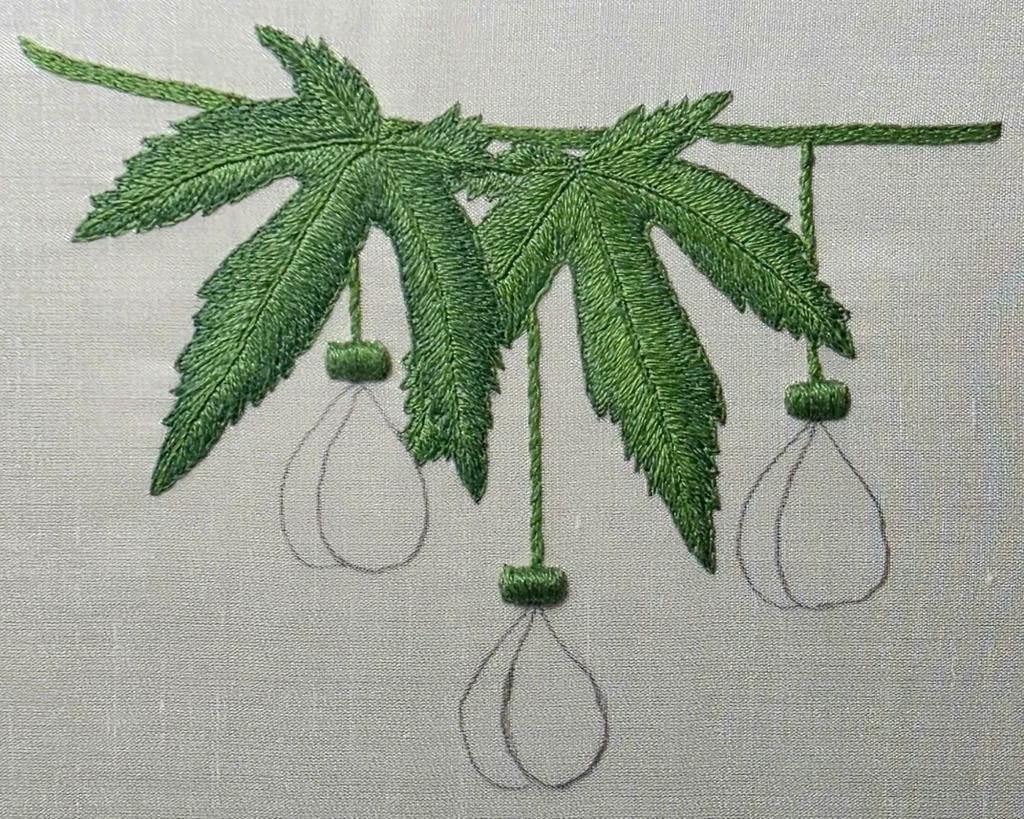
The petals on the silk shantung were done the same way as the leaves – long short in 3 colors.
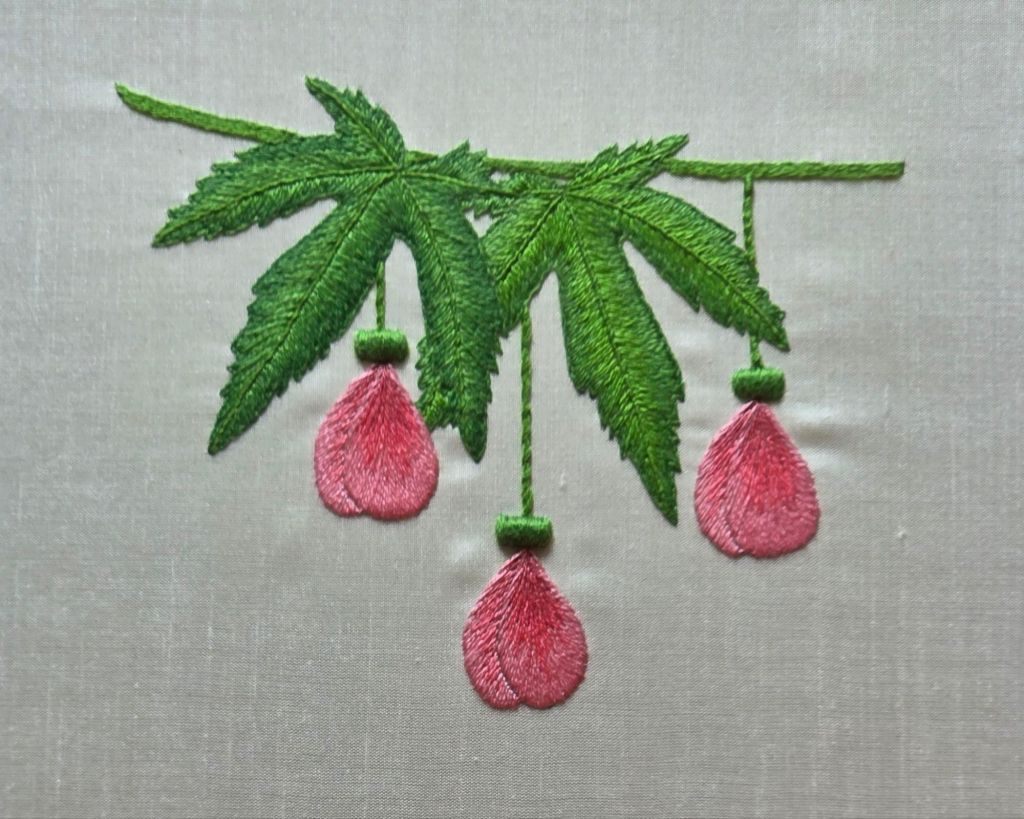
The 3 Calyx were already stitched (https://melitastitches4fun.com/2025/03/18/flowering-maple-with-celeste-chalasani-at-national-needlearts-academy-nan/) and now they’re attached. I cut away as much fabric as possible but it still bunched up on the bottom raising them to 4 mm. More French Knots filled in the gap.
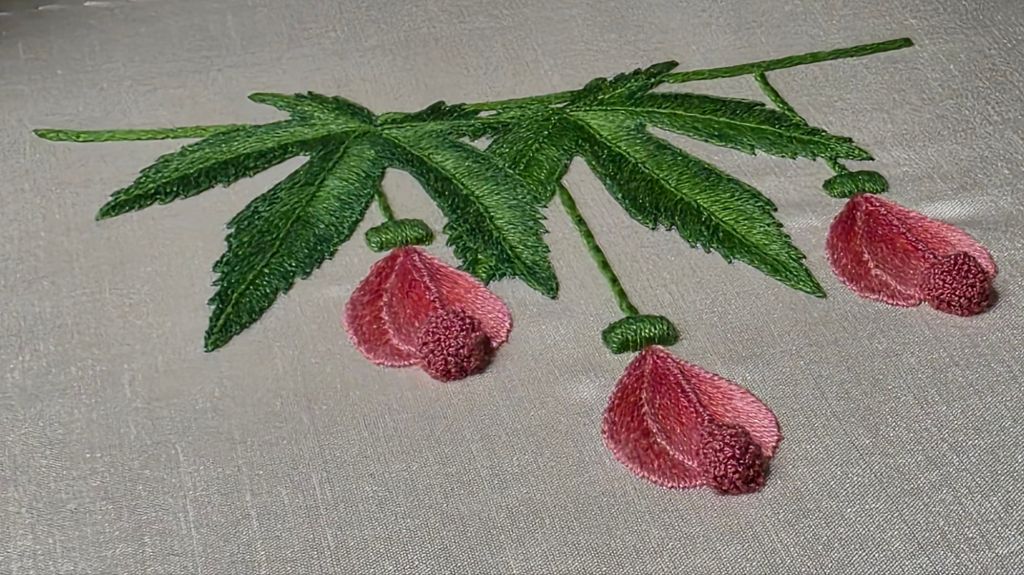
The sepals have been inserted but are not secured until the rest of the petals are placed.
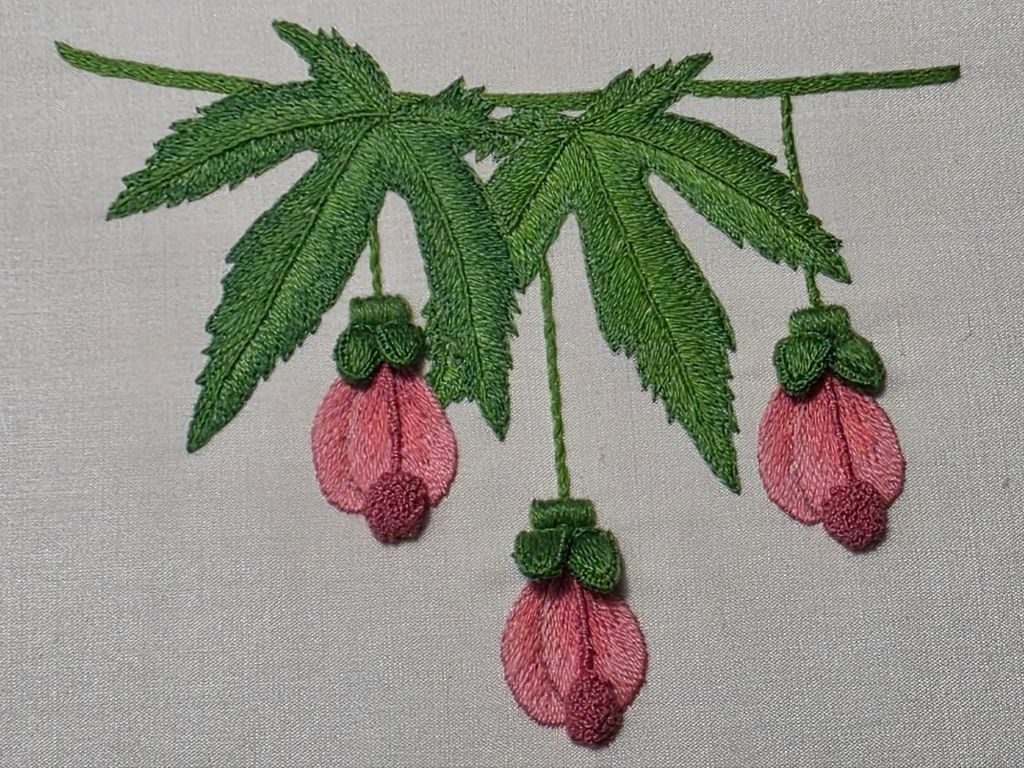
The stumpwork petals are attached and sepals are secure!
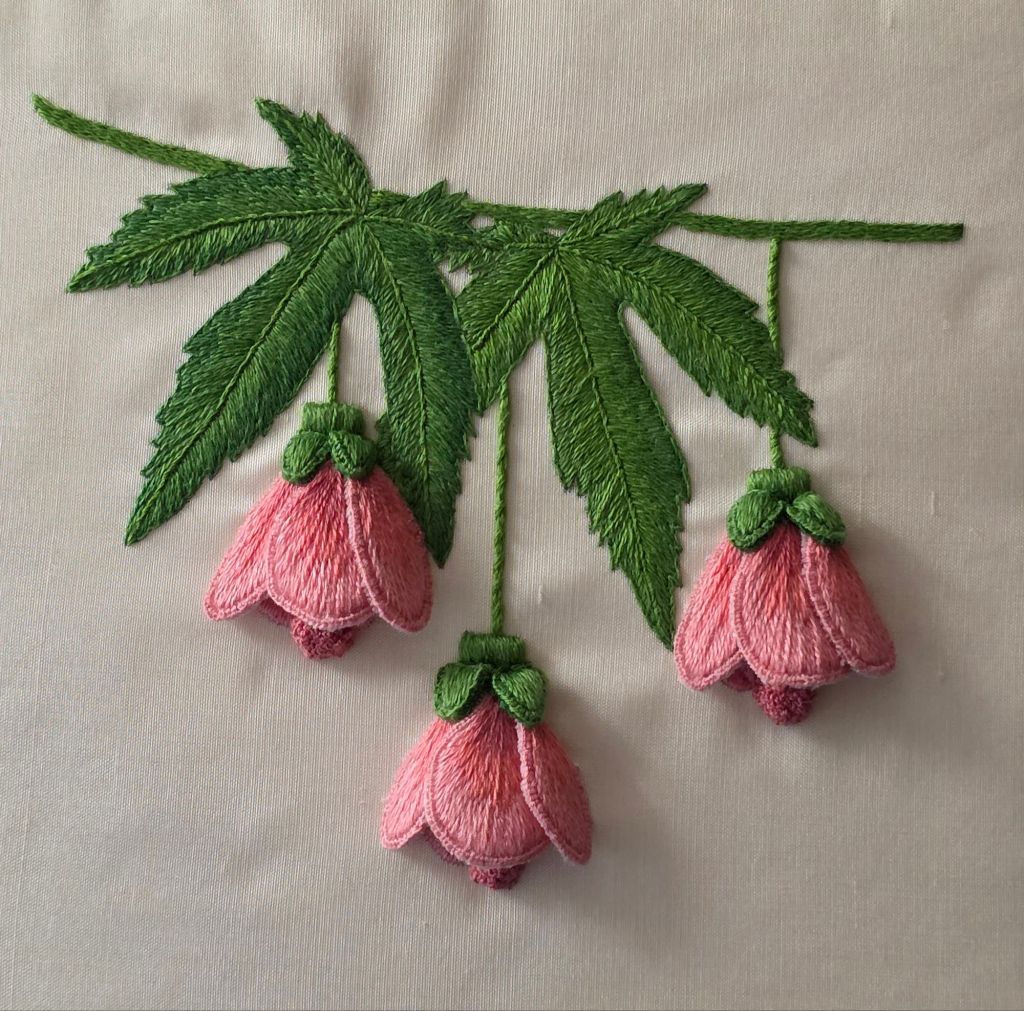
I found a lovely little display frame (6″ x 6″), used piece of felt to pad a foam board, attached it with Nickel Tidy Pins by Loops & Threads, folded back the edges, and pinned it to the cushion backing.

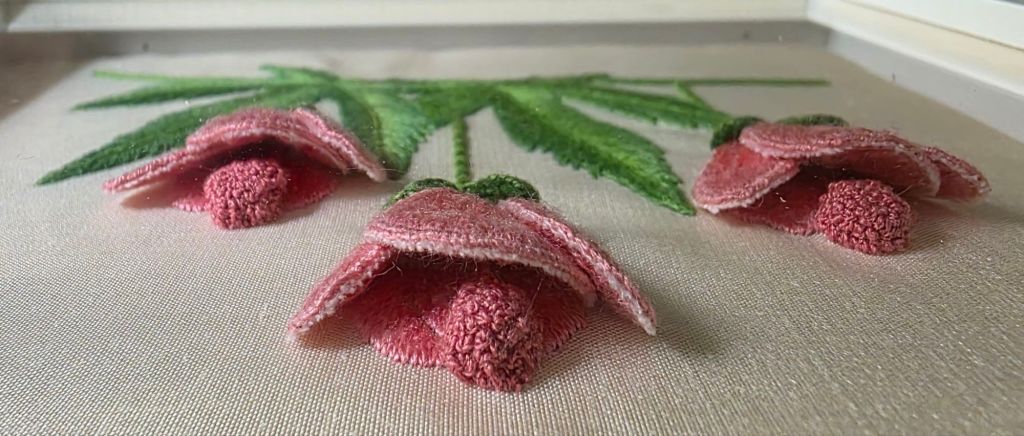
Here’s a great shot too.
Goal #17 is DONE. And, I have 2 sets of 12″ Evertites ready for ANG 2025 Seminar classes.
Nights in White Satin by Jennifer Riefenberg had a little pre-work. The tent stitch outlines inner motifs and for the border outline, I chose to do two wide.
This 2-day class is only 3 weeks away! It will be my third class of ANG’s 2025 Seminar consisting of canvaswork stitches – my comfort zone.
Charity is the 2nd in the Cabochon Series by Susan Portra. All designs are based off a Rhapsody, a discontinued Rainbow Gallery thread. This one is R18. This card says, “Try running other yarns thru this.” I ran an overdyed thread thru white Flair for a nice effect in Beautiful Ohio, a technique that I learned from teacher, David McCaskill. It helped me win the ANG Princess Grace Award (https://melitastitches4fun.com/category/melitas-adaptations/ohio-star/).
This card of Rhapsody is too dark but a solid color through a lighter one would be nice to try. Learning/Sharing #1.
I did change to the Diagonal Greek stitch from French Knots that were supposed to go above the 5 diamonds. I found the pattern in Painted Canvas Embellishment by Carole Lake and Michael Boren. The French Knots were supposed to be on every Canvas thread with 5 strands of floss. It seemed to heavy. I used 2 strands for Diagonal Greek (3 strands were still too heavy). It really fits the design and reminds me it’s ok to change a stitch to what you prefer. I’ve heard more than one teacher say that once you purchase their piece, you can do what pleases you. Learning/Sharing #2.
I stitched on Charity last month and this month at our ANG MLS Stitch-in. Although I spent over an hour shopping for threads to fill in the kits for the other designs in the series, I did finally sit and stitch. That’s when I learned from Linda M (who learned it from teacher, Toni Gerdes) that using glue stick on the end of Tiara will control that from splitting apart. And, it really does the trick. Linda and Toni to the rescue! But, I will not seek opportunities to use this thread. I don’t see an advantage to it over other threads not requiring special handling. Learning/Sharing #3.

That leaves the bugle beads and Cabochons to do. Here I got the location of the prongs established and enlarged the holes with a large needle to ensure placement looks consistent. Learning/Sharing #4.

We talked bead trays and at least one person didn’t know that the square sticky bead tray with a cover can rest on the canvas while stitching with the cover bent backwards. Another reason this wasn’t a favorite bead holder was because you can’t turn the canvas over without it falling which I agree is a bother. So, I added a magnet inside the box. Problem solved. Lesson/Sharing #5.

I can’t take time now to do the finishing but I had to finish the bugle beads and attach the cabochons.
The directions show this finished sideways.

I stitched it thinking I’d finish it this way with the center motif looking like a heart.

Then, I solicited opinions from everyone yesterday and my husband today. I think it was unanimous to go this way.
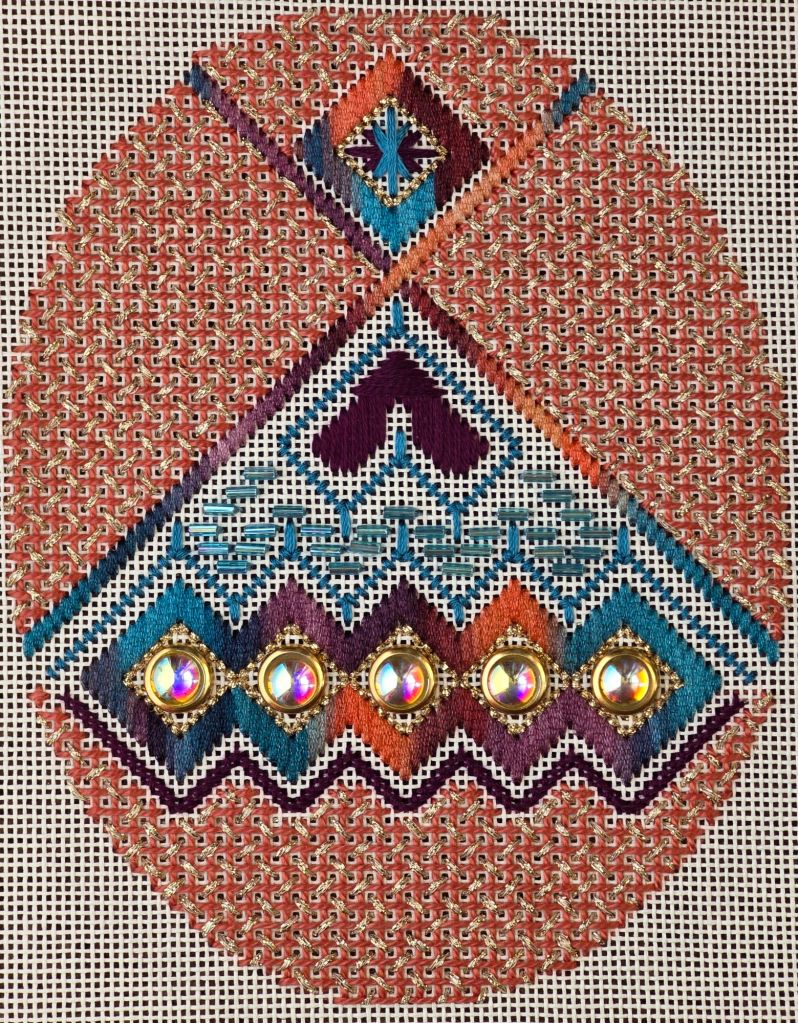
What do you prefer?
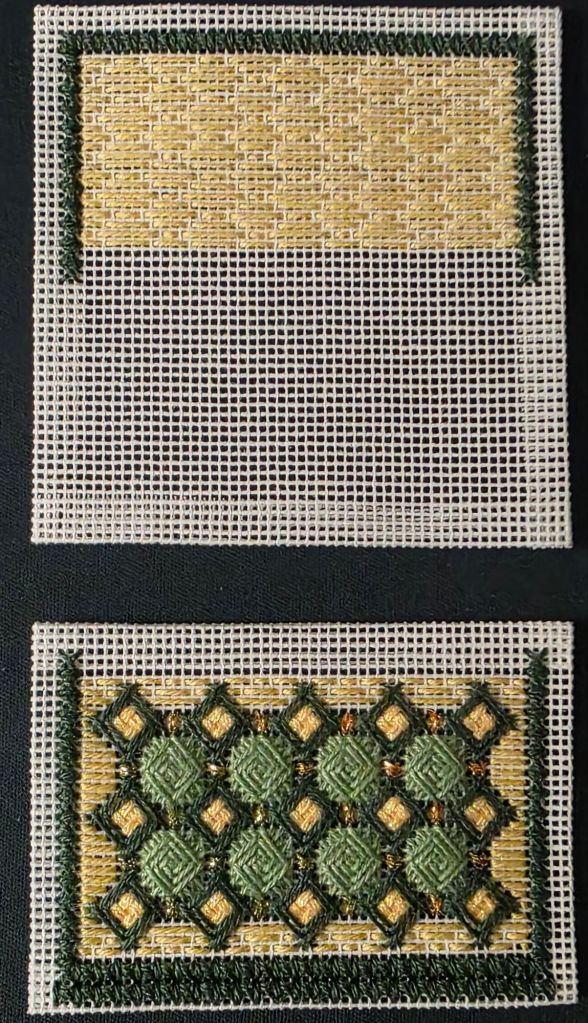
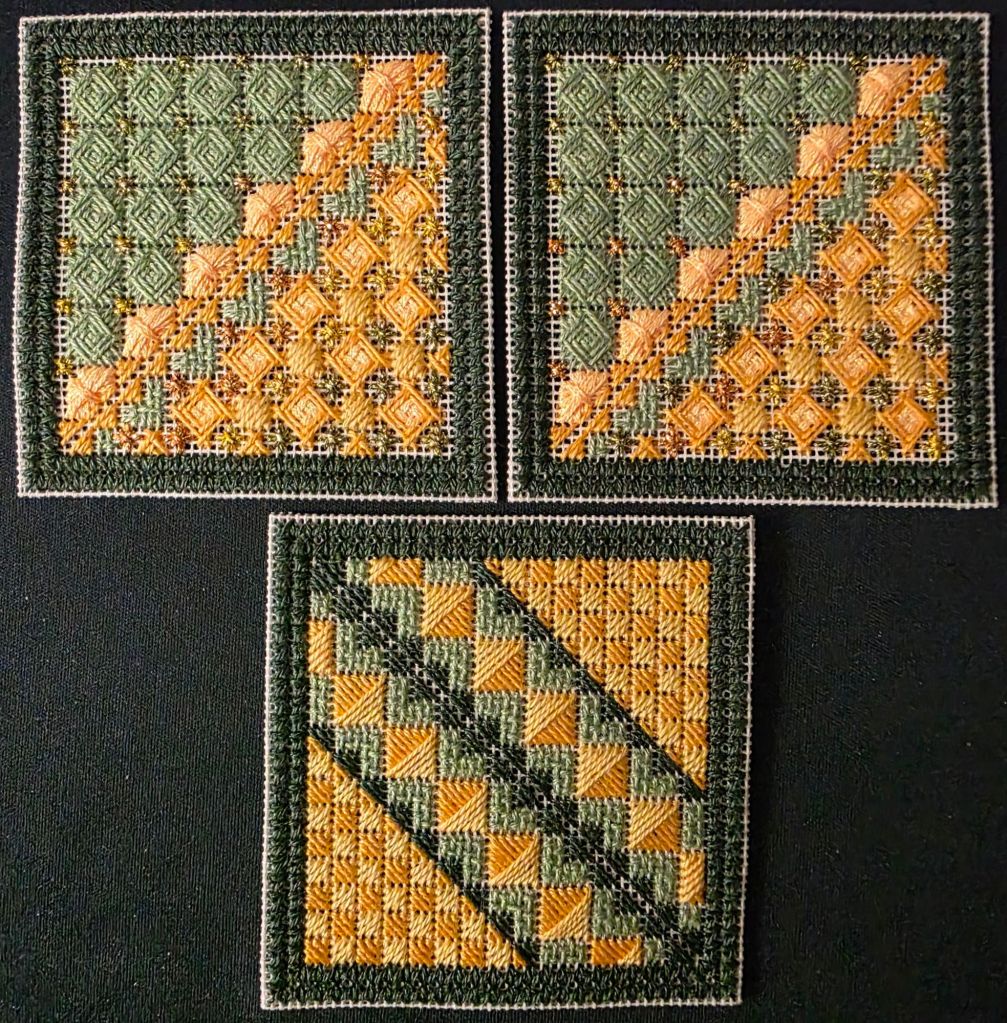
There were 4 patterns to use or not as we saw fit for the bottom of the Folding Ort Box by Marilyn Owen. I modified the bargello pattern by adding the short red rows. The color matching is pretty close.
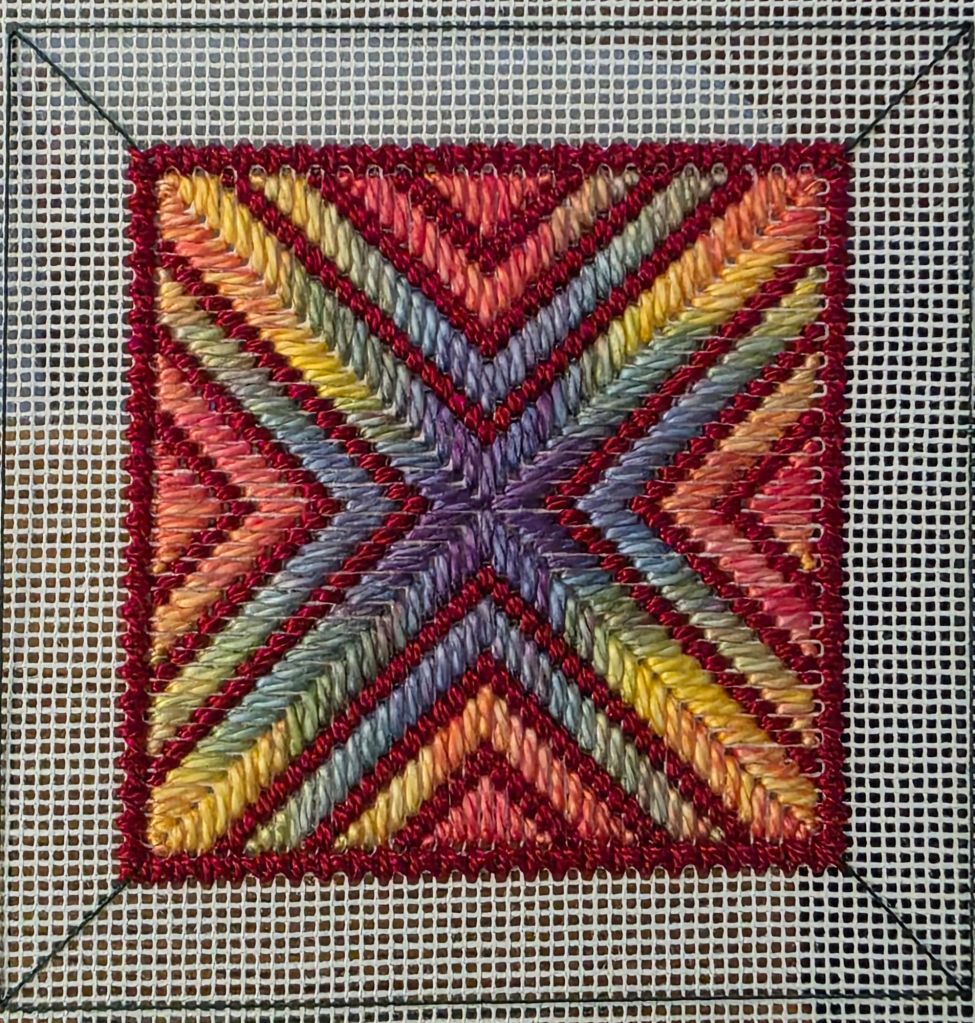
I’ve already used solid red for the inner borders and decided another red border and red binding will not be exciting enough. So, I tied in the Watercolours used on the bottom for the outer borders. Then, for the binding, I will go back to red.

The Ort Box with Pockets also needed to be cut apart, edges folded back, and lots of cross stitches for the borders. The holes all have to line up to stitch the borders correctly.
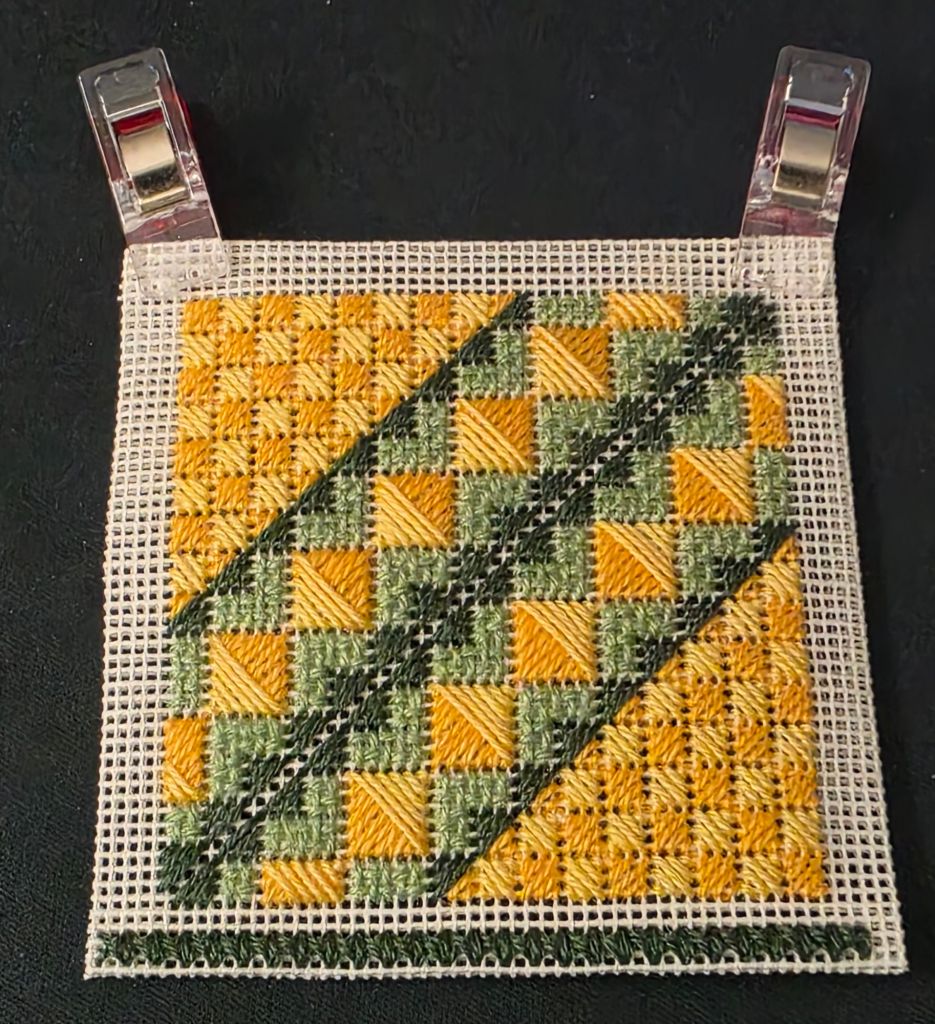
Next up is how to do the lining by August 11, our next ANG Main Line Stitchers Chapter meeting!
Filed under: 2025, Flowering Maple with Celeste Chalasani, National Academy of Needlearts (NAN)
Flowering Maple with Celeste Chalasani began in March at National Needlearts Academy (NAN). I worked on it some in April but then it took a back seat until now.
It moved up in the queue so that I could get my 12″ bars available for ANG Seminar classes in August. If I can’t get it done, I can thank Linda’s Boutique because she let me know she has them available!
I am reminded why I prefer canvaswork after working on this over the past few days. I’m using one strand of floss in a small embroidery needle, size 10. The repetition of pressing against my middle finger hurts so much I had to pull out a finger pad. I’m stitching through 2 layers. The background fabric is silk shantung and we were instructed to stitch it to a cotton backing as part of our pre-work assignment. It not really thick it’s just that the needle keeps pressing the same spot.
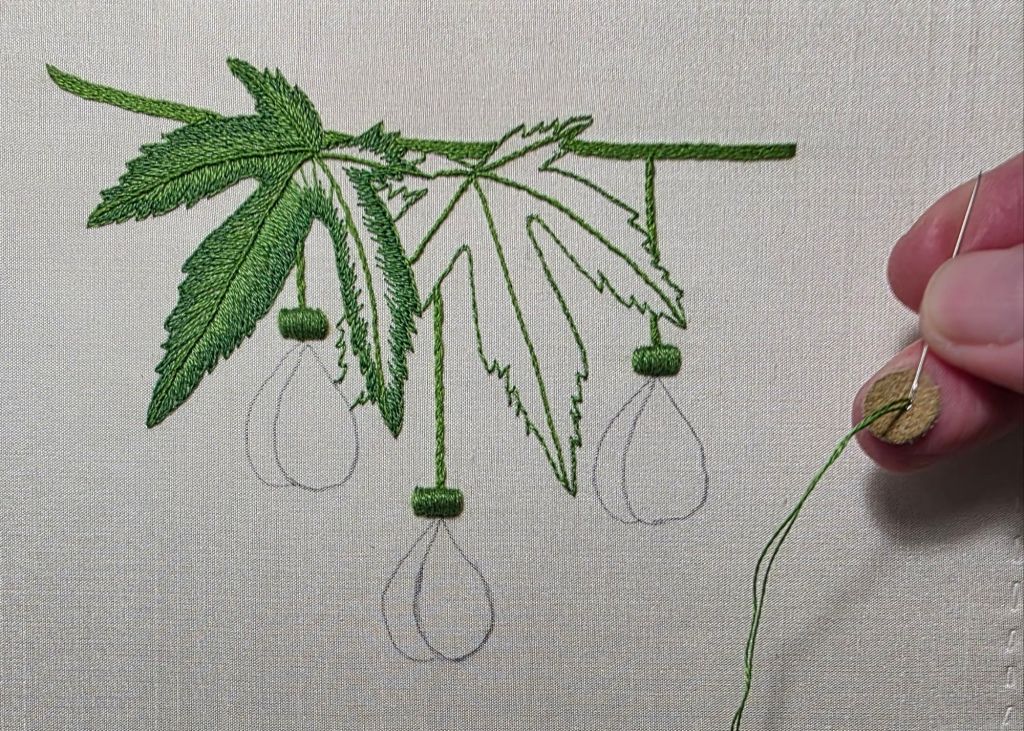
I like previewing the direction of the stitch and placing them along the route and going back to fill them in – good tip from Celeste.
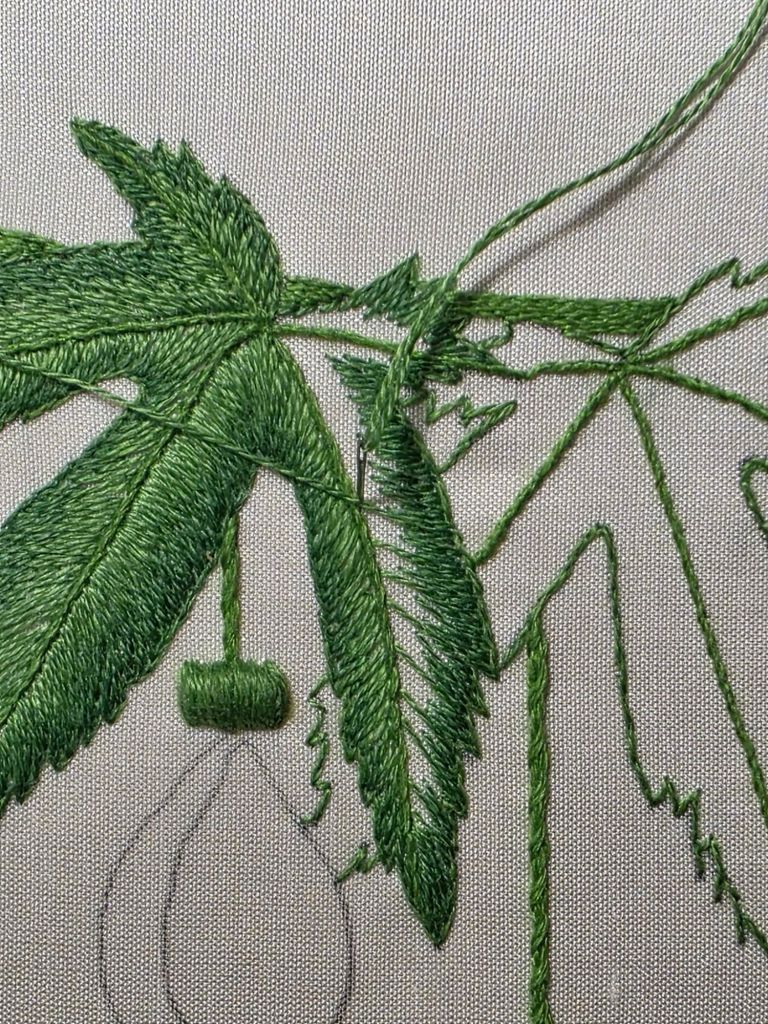
A rainy weekend, the PGA Open Championship, Phillies, and PBS Sunday night TV (Patience and Grandchester) makes for great stitching time! I needed this time because Seminar is less than a month away.
The small needle was starting to bother my index finger too. Petals are next but I’ll give my fingers a few days rest. I did 3 in class and need 6 more. Then, there is cutting (the scary part) and attaching them.
Filed under: Brandywine Chapter, Embroidery Guild of America, General comments, Needles, Tools, Zokins
Lots to share about my EGA Brandywine Guild meeting earlier this week!
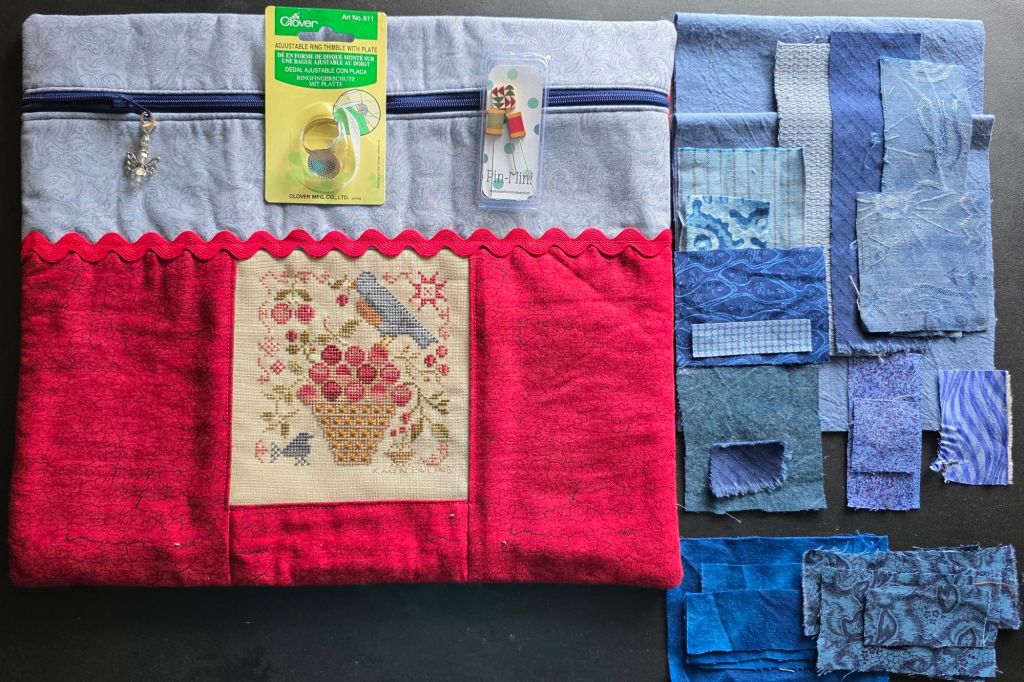
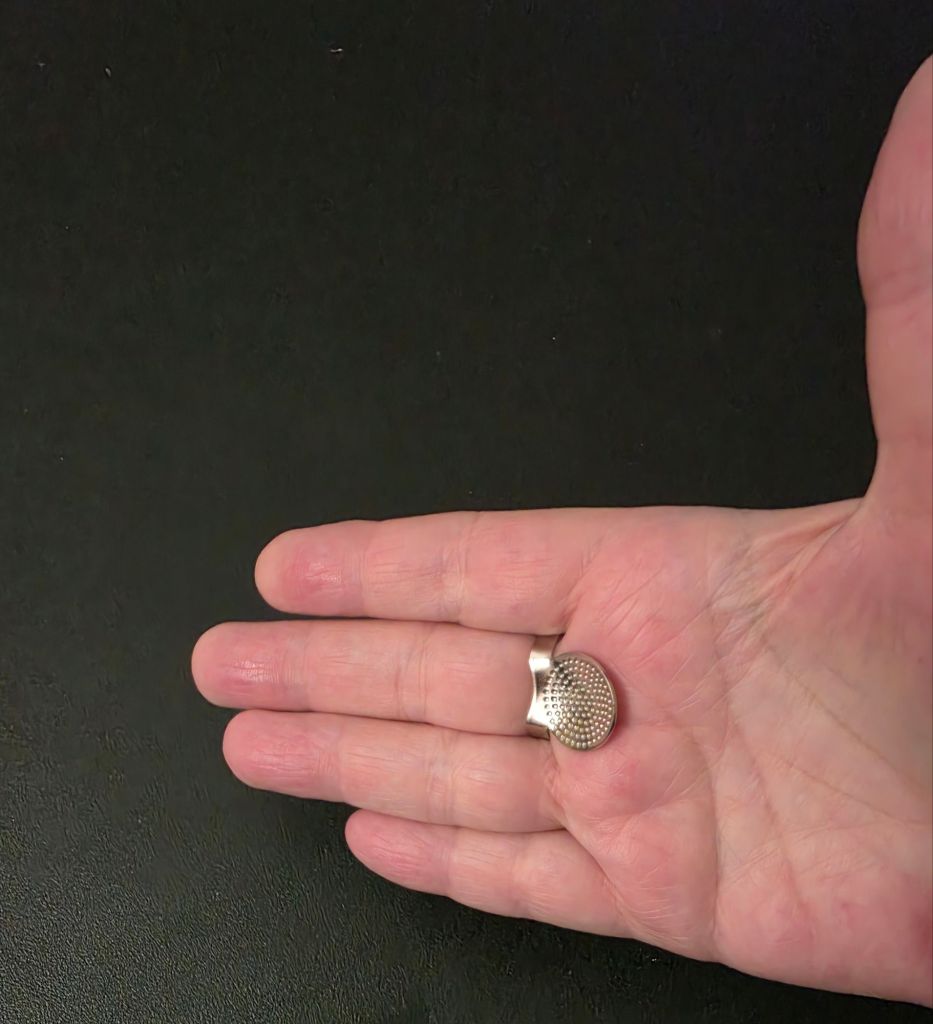
Kathy A and Karen S had prepared pieces of blue cloth and scraps of various fabrics for us to select. The right side of photo are the pieces I took. There were 12 of us. There could have 12 more and still had fabric left over! They also purchased a Clover adjustable ring thimble with plate for everyone. A new tool. It feels comfortable. Looking forward to trying it.
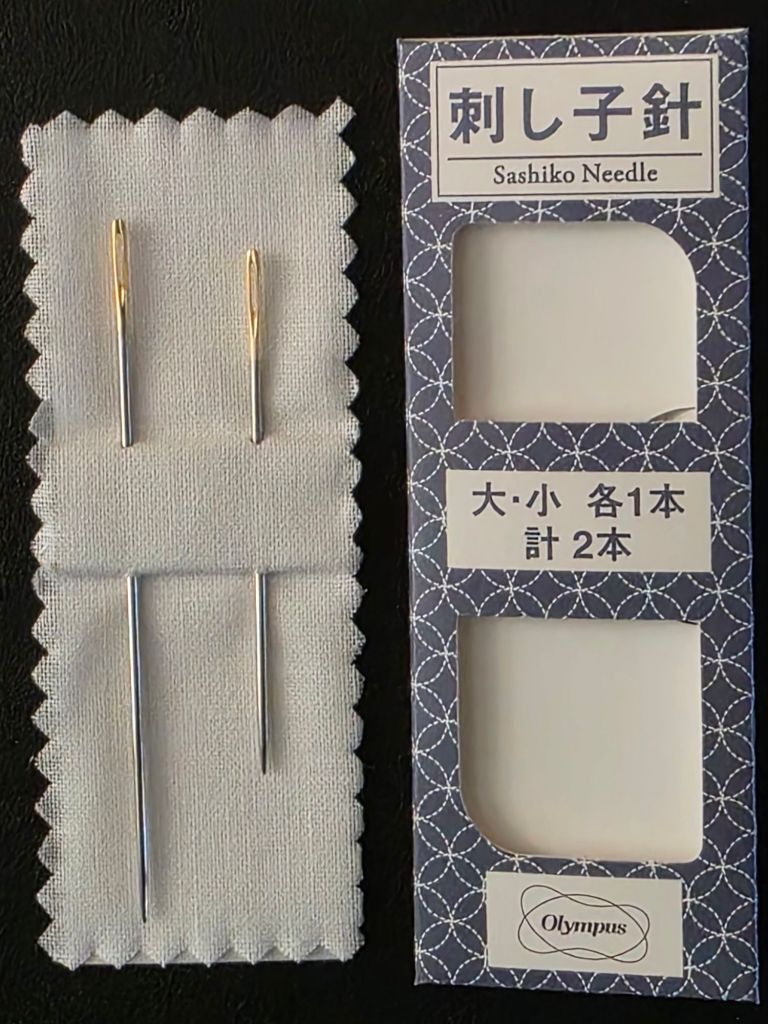
You stitch boro like you stitch Sashiko. So, I can use my Sashiko needles! I have a 2 pack. They have large eye for easy threading. The shorter (almost 1″) needles are for smaller, decorative designs while the longer needles (a little over 1.5″) are for straight stitches and basting. So, I will use the long one.
And, we got to share in the two opportunity baskets that Sue S, our Chapter’s MAR Rep won at the EGA-MAR Regional Seminar in Gettysburg! One of the baskets was from the EGA Molly Pitcher Stitchers Chapter in Carlisle, PA who are celebrating their 40th anniversary as a chapter. Congratulations and thank you for your generous contribution – it was a huge basket! Between the two baskets everyone got multiple gems. Not pictured are three red kitchen towels that I took.
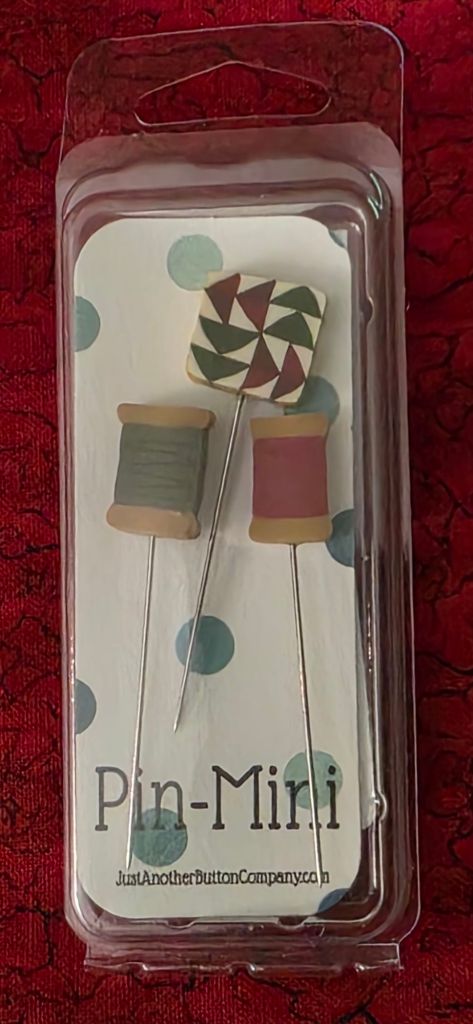
I wanted and needed the project bag for the blue fabrics since I had intended to work with my fabrics and still will. Karen R from Molly Pitcher Stitchers stitched a lovely design and finished in coordinating colors. The Mollies have stitched two of my designs, Overdyed Spools and A Spring Sampler. I visited them after Overdyed Spools was posted as a Petite Project. So, I really appreciate having something of theirs. The counting pins are cute and came from them too! These will be perfect to carry in my travel tool bag.
Here’s the arrangement of my fabrics ready to stitch into place. I used all the straight pins I own!
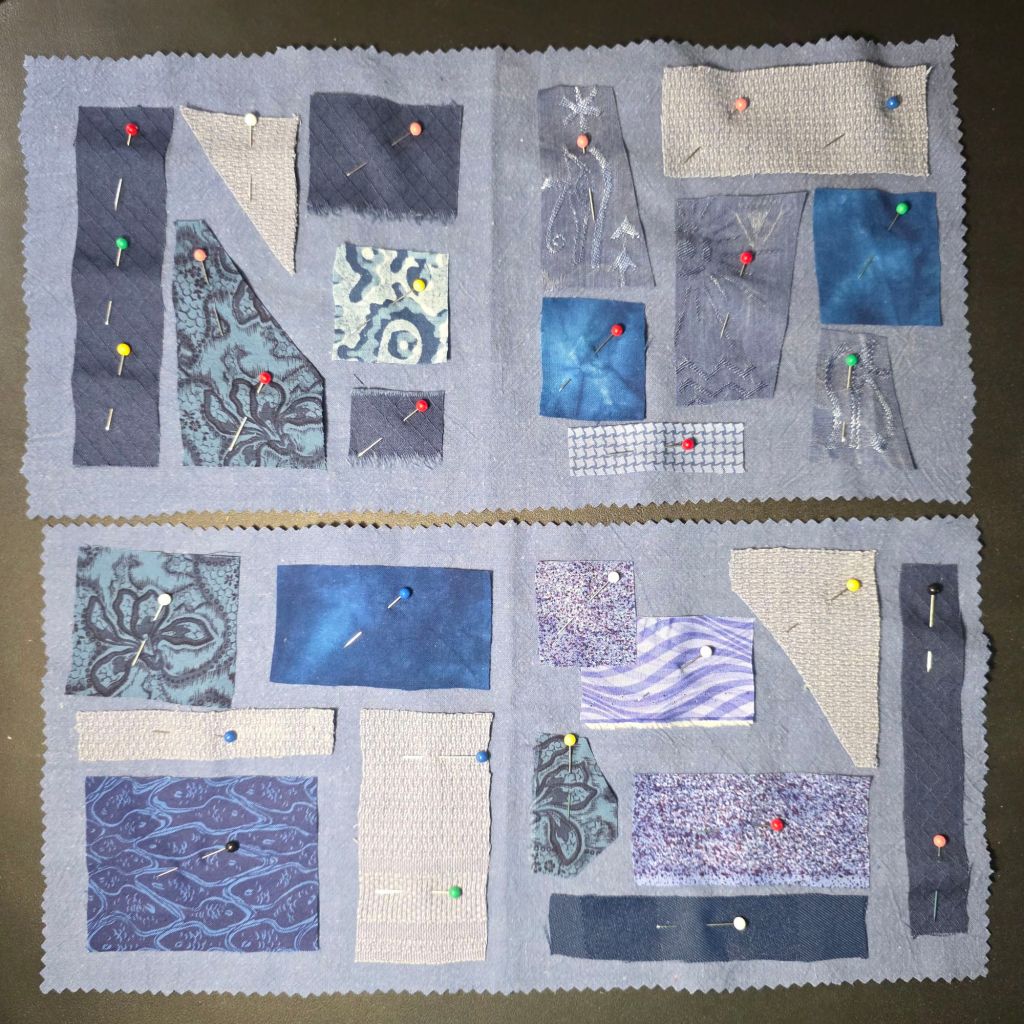
We have until September to stitch the small pieces onto the larger ones when we finish them into a cloth booklet (back to back with pages).
Kathy A and Karen S are leading the next 3 events (July 16, August 12-looking at the EGA Study Box on Surface Embroidery, and September 17-finishing what we start in July) for my EGA Brandywine Guild.
I really do not have remnants of fabric from clothes or rags which would be traditional materials for boro, a Japanese mending method of patching. I do have some lovely swatches of fabrics and a piece of blue fabric for the base. I won’t need all these but I like options! I’m upgrading from cotton thread to Planet Earth 6-ply Silk for stitching the swatches to the fabric, thus creating a zokin. I believe that is an accurate description of what I am getting into!
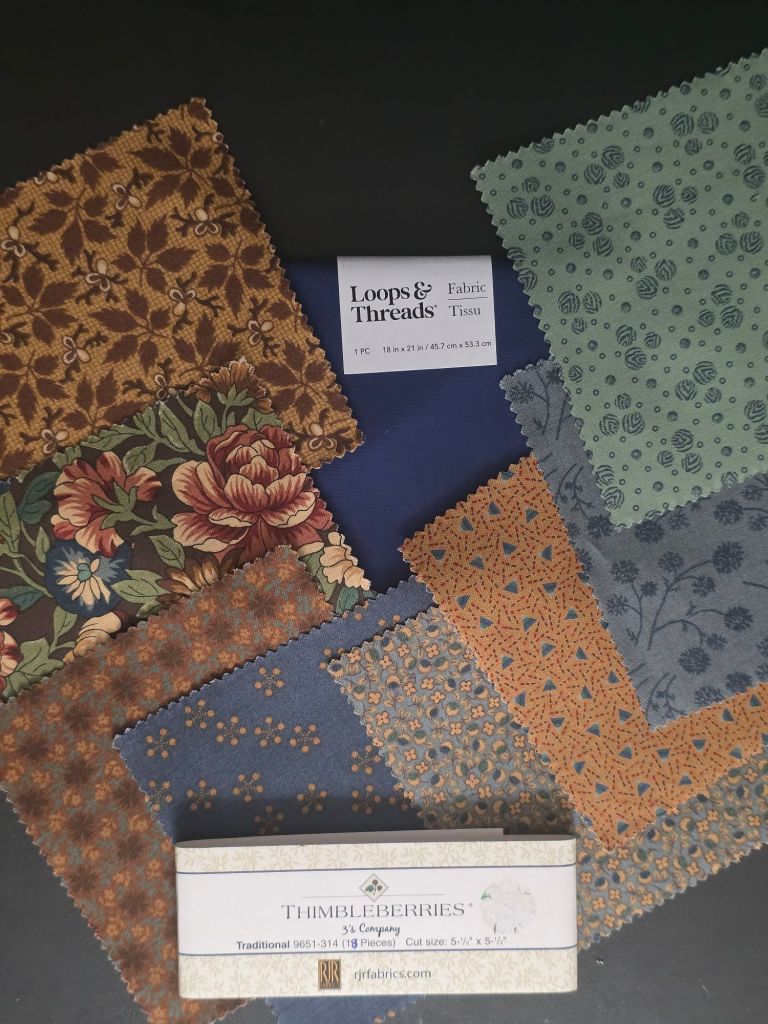
I believe running stitches will be used to attach small pieces of fabric to the base cloth. The cloth will cover a small lined notebook (5.5″ wide x 8″ high) I had sitting around.
It’s going to be a fantastic opportunity to use my self-threading needles. They are sharp.

Looking forward to what is now later today!!!
There may be alot of controversy over AI (Google in Chrome browser) but it’s sure easy and quick to get answers!
While handling Soie d’Alger right after Splendor in a project, I realized that Soie d’Alger is softer. They are both 100% silk. So, why the difference? Here’s what AI Overview provided:
The perception of Soie d’Alger being softer than Splendor is mainly due to differences in their manufacturing processes and fiber characteristics.
Soie d’Alger
Spun Silk: Soie d’Alger is a stranded spun silk made from “strusas,” a high-quality spun silk.
7 Plies: It is composed of seven easily divisible plies.
Softer Twist: Soie d’Alger has a slightly softer twist compared to cotton, which gives it a better “spread” when stitched and makes it feel softer.
Natural Sheen: It possesses a natural, soft sheen, unlike the chemically produced sheen of mercerized cotton.
Versatile: It’s suitable for various embroidery stitches and is known for its beautiful satin stitch and long and short stitch.
Splendor
Spun Silk: Splendor is also a spun silk, with 12 plies, according to Rainbow Gallery.
Tighter Twist: The twist of each individual strand in Splendor is tighter than many other silks, making it easier to handle and potentially less prone to snagging.
Handles like Cotton Floss: Due to its tighter twist, it handles more like cotton floss, which some stitchers find easier to work with.
In essence, Soie d’Alger’s softer twist and inherent softness contribute to its luxurious feel, making it particularly appealing for needlework where a delicate and elegant finish is desired. Splendor, while still a high-quality silk, has a tighter twist that can make it feel slightly firmer to some users.
Very interesting and it called for a test.
Using 4 strands of each, I stitched diagonal stitches over 1, 2, 3, 4, 5, and 6 canvas threads. Coverage is excellent for both but it did seem like Soie d’alger (tan) was more difficult to lay the threads and have them stay there. They have some loft to them that Splendor (blue) does not. Splendor held snug to the canvas with each stitch.
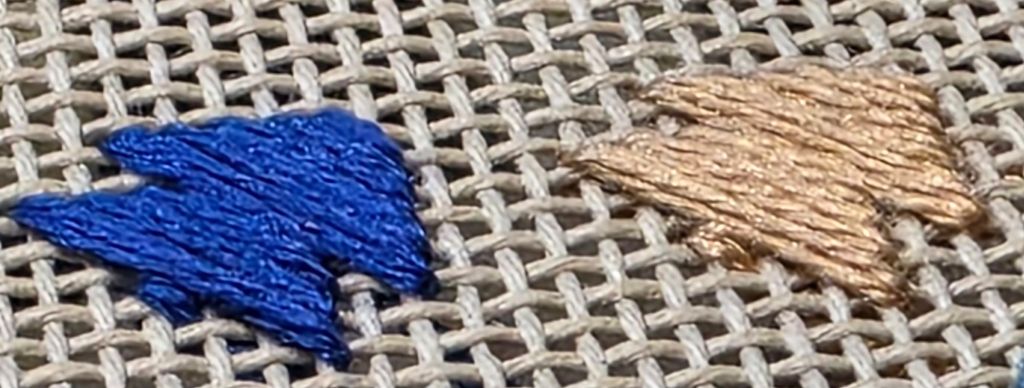
Using 3 strands of each, I found the Soie d’Alger easier to lay, stayed flatter than 4 strands, and coverage was still fantastic. It was a little harder to get the 3 strands of Splendor to cover but I did. The 3 strands of Soie d’Alger laid like 4 strands of Splendor.
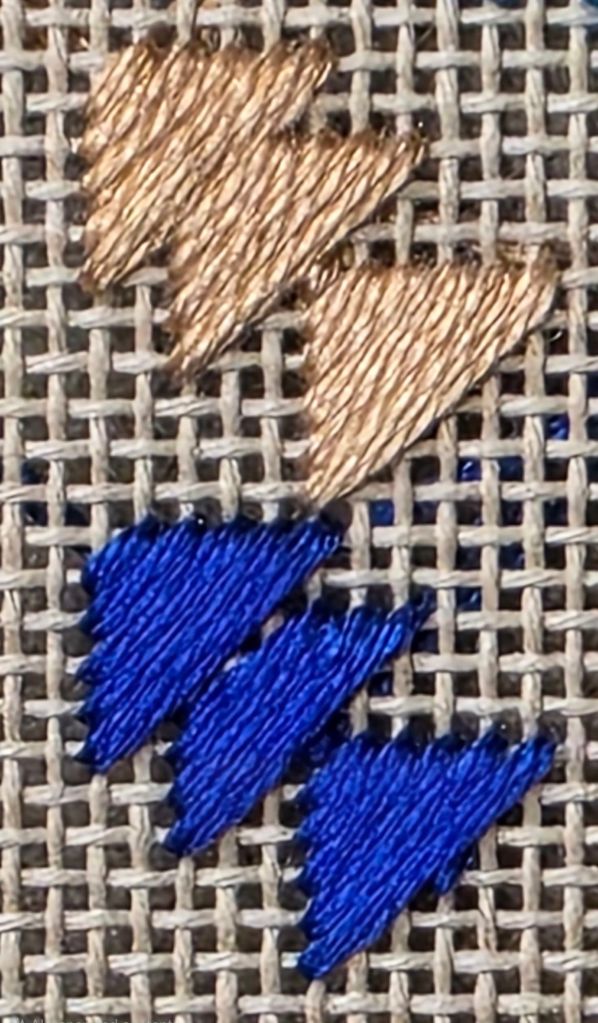
Very interesting indeed!
 Melitastitches4fun's Blog