Filed under: ANG Seminar 2010, Melita's Adaptations, Monet's Poppy Field, Poppy Field
I can’t remember where or when I fell in love with Monet’s Poppy Field in a Hollow near Giverny (1885). But, I am convinced some day I’ll capture it in needlepoint. No, it won’t be Monet’s Poppy Field, it’ll be my interpretation of it. But hopefully, it’ll be something I can gaze upon & feel it take me to a patch of that long grass.

My first attempt was all about testing stitches. I really like the Whipped or Laced Running Stitch (Elegant Stitches by Judith Baker Montano) for the light blue on the right. I didn’t care for it as much for the 2 greens to the left of that area. I also liked the stitch Serendipity used in the top blue-green portion for the distant tree line & Rococo for the dark green bushes in the middle (both are from Stitches To Go by Suzanne Howren & Beth Robertson). It’s size is 4&1/2″ x 4&1/2″ & too square.

The quest continued for stitches in my second attempt. I had it in my mind that a large stitch pattern base would work for the poppies & then thought random french & colonial knots would make the flowers on the field appear random but it became too dense. I did like the Knotted Stitch on the upper left & a similar stitch with less slope for the area to the left of the center dark green bushes called Diagonal Roumanian. Then, I created a variation of Kennan for the area left of the center dark green bushes. These stitches came from Stitches To Go by Suzanne Howren & Beth Robertson. It’s size is 4″ x 4&1/2″.

I felt pretty good about stitches & decided in this attempt I better test some colors & threads. To combat the density of the poppy field, I switched to a thinner thread. It was better but it wasn’t right – it seemed flat & lifeless. So, I put it away for a long time deciding further experience was needed before I could improve the piece. It’s size is still 4″ x 4&1/2″.

Always on the look out for new threads, I tried a variety of threads. I also tried some different stitches. I liked this version much better, especially the poppy field because I used various shades. David McCaskill’s suggestion to use a canvas with the blue tint to it improved the piece as well because areas show through, depending on the stitch/thread. While I saw improvement, I wasn’t sure where to go next & decided to put it away – again. It’s size is 4&1/2″ x 4&1/2″.
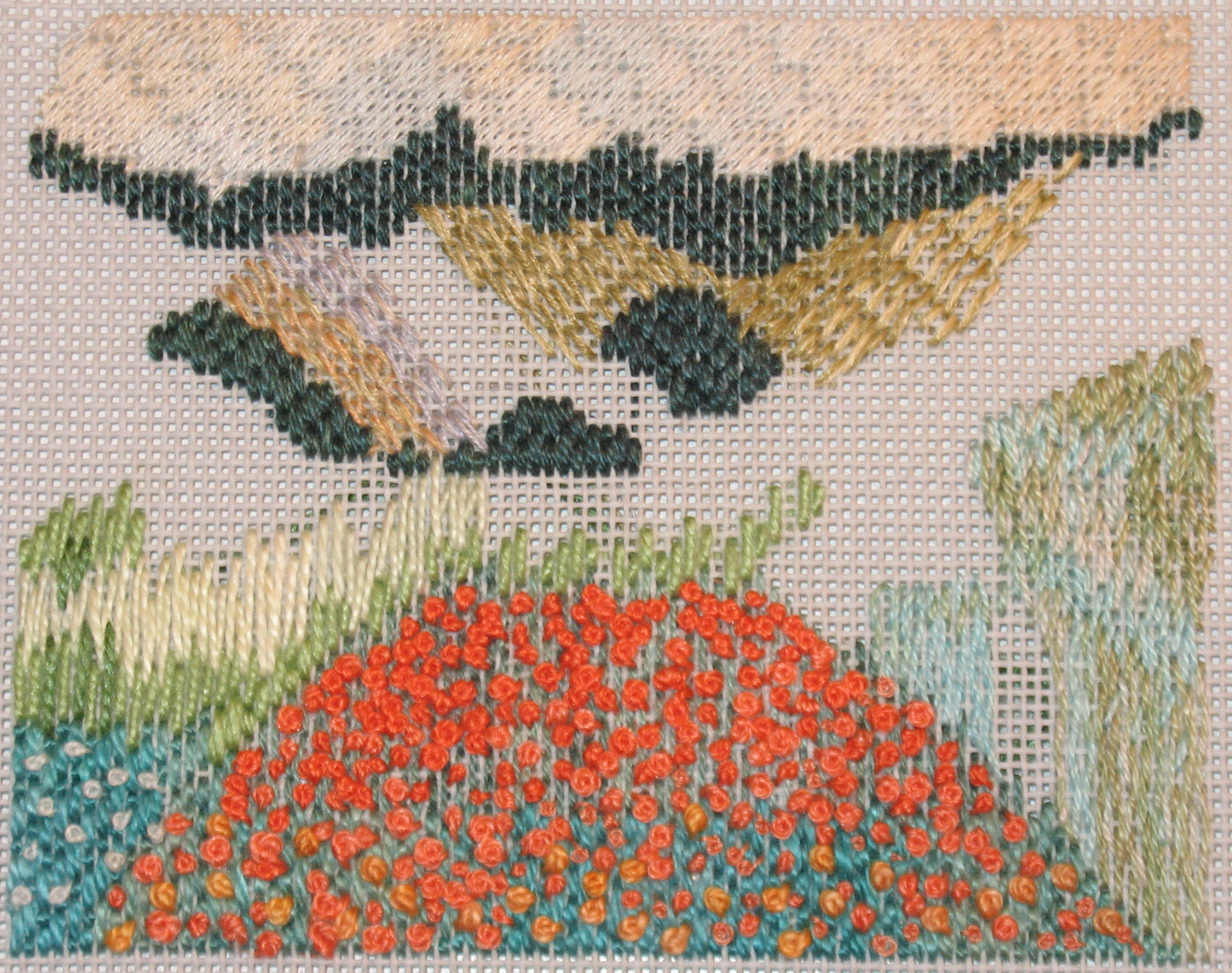
Then, I saw the class teaching design & stitching techniques for landscapes advertised for the 2010 ANG Seminar taught by Lois Kershner. I wasn’t familiar with her work but could tell by the description of the class it’d be perfect for me to help figure out my poppy field. So, I attended my first seminar. Now, I am armed with knowledge from her class as taught by Pat Rusch. Will my fifth attempt be my last? It is full size (8″ x 9&1/2″) still on blue canvas. As you can see, I didn’t get much stitched during class because I was studying the techniques in the book and reconsidering threads & stitches – again! Wish me luck!!

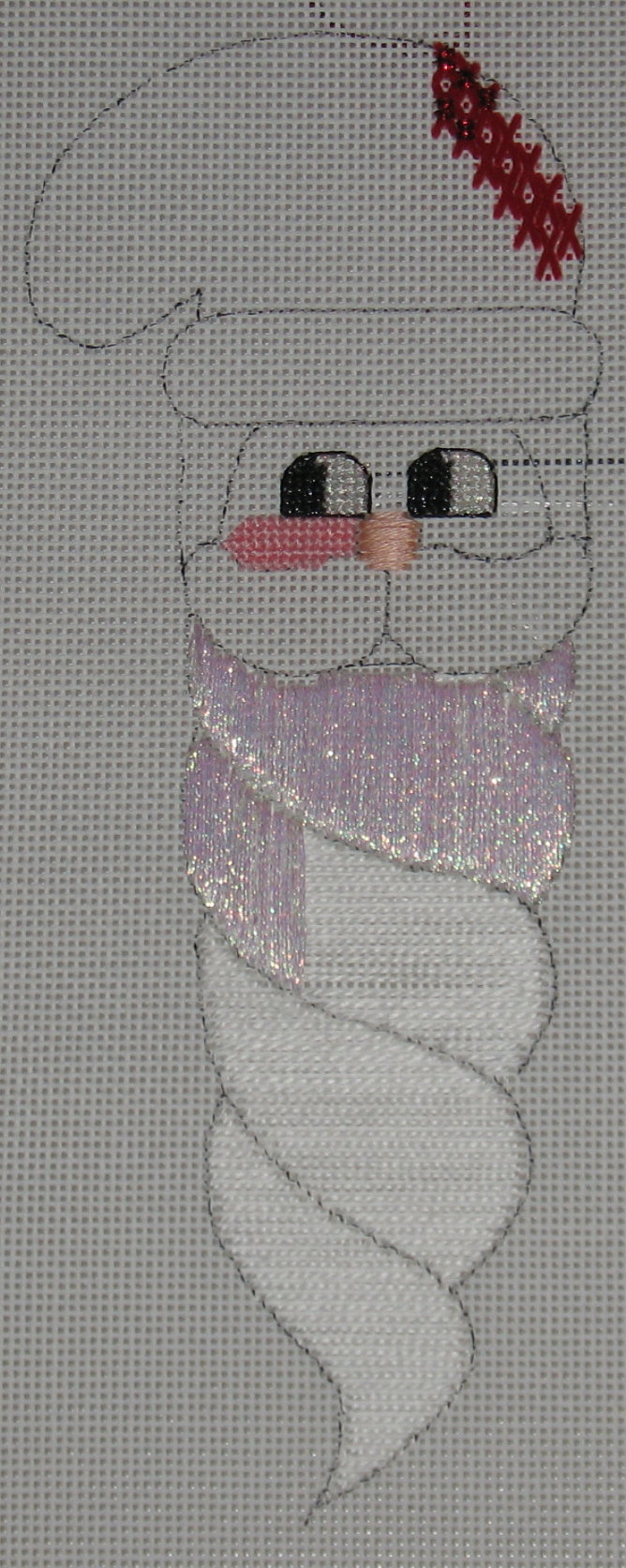
At the ANG Seminar in October 2010, I took this half-day class taught by Janet Zickler Casey called Santacicle. I love icicles & Santas – so, I gravitated to this project.
There isn’t a lot of stitching that I could get done in 1/2 day. Yet, Janet discussed how to stitch all the sections – so, it moved at quite a rapid pace. Some of the beard was done during class & then worked on when I first returned from class. Since then, I got distracted on other projects. There are some new threads for me to work with such as Metallic Ribbon Floss which is what I’m using now to cover the Perle Cotton on the beard . . .
The trivet is done & joins my coasters & napkin ring to complete the Pieces of Eight Project.
Well, I changed my mind quickly when I started outlining the disappearing octagons in green – it wasn’t right. So, I switched to red. And, I decided that before I got too far because this had to be ripped out.
 Better in red:
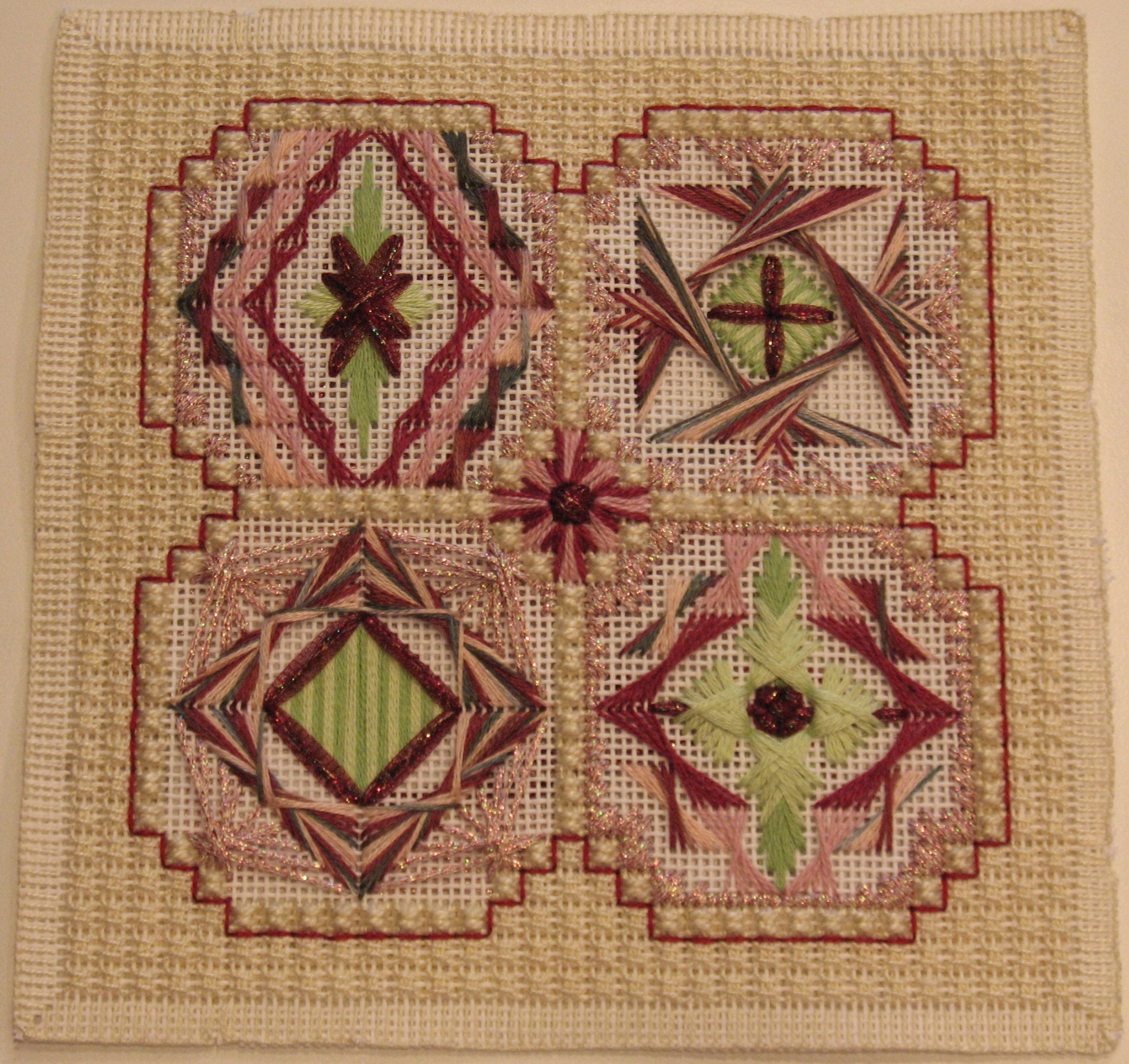
The trivet is acrylic, apparently can withstand temps up to 350 degrees, & came from AllStitch (http://www.allstitch.net/product/hot-plate-trivet-acrylic-embroidery-blank-3952.cfm). They have quite a selection of acrylic embroidery blanks for tables, bathrooms, & personal items – cheap too. So, here it is, placed in the acrylic shell (bottom snaps into top):

And, the set:
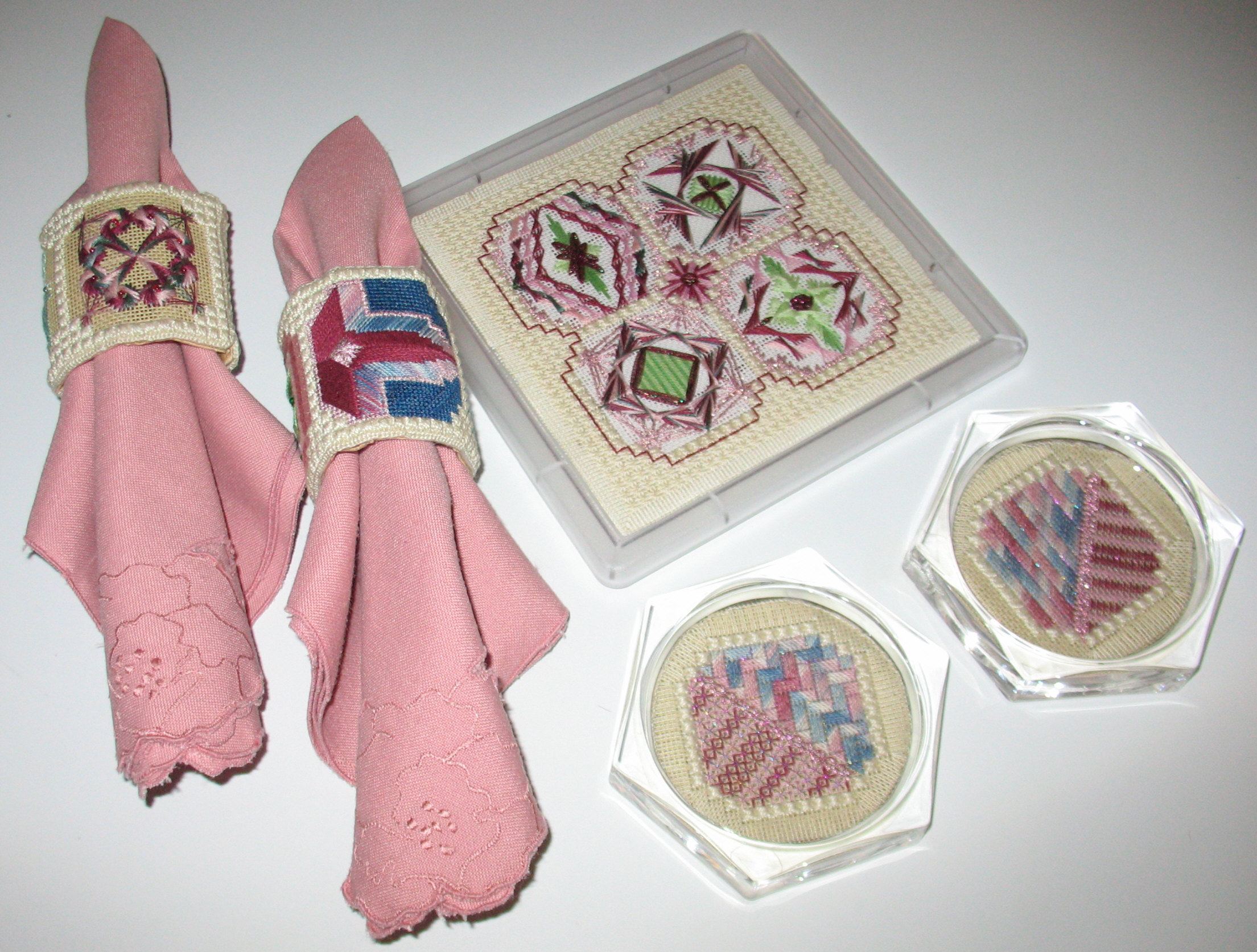
As someone else said, I did get a lot out of this project – I did that by exploring wonderful alternatives for finishing needlepoint pieces. And, I feel a sense of accomplishment.
As a reminder, the directions for ‘Pieces of Eight’ by Gayle Bicknell are available at http://www.needlepointnow.com/pdf/nn_form_reprint_05_14_09.pdf. They are reprinted all in one issue for $18.
Neither I nor Main Line Stitchers have any financial interest in any of the companies mentioned.
Come join us at 7:15 pm on the 2nd Mon of each month just 30 minutes from Center City Philadelphia & 10 minutes from King of Prussia. Or contact us at: MainLineStitchersChapter@needlepoint.org for more information.
The 4 octagons are going into a trivet & is the last of the Pieces of Eight project which we began last year at ANG Main Line Stitchers Chapter. This matches the coasters & napkin rings to make a nice set.
I finished the edges in a blanket stitch to match what I’d done with the coasters. But because I used the same color & stitch for the background, even the lighter weight thread is not sufficient to distinguish the main shape of the large octagon. So, I’m going to have to outline the larger octagons in a color – maybe green – ‘cuz I’m not ripping out!

Filed under: ANG Main Line Stitchers Chapter, Scissors Sheath Band Sampler
All done! It turned out nicely. The buttonhole stitch creates a wonderful edging. This did work up quickly but not as quickly as I expected. I had thought it was something we could stitch & finish at 2 of our 2-hour meetings. But, that’s not happening – which is fine! So glad I tested the waters.
And, I realize I didn’t read the instructions on finishing completely before I proceeded. The fabric lining was meant to extend out to the far edge of the scalloped sides so that they can be stitched into place when stitching the 2 sides together. Although with the bonding I used, even mine should be fine. If I hurriedly put the scissors into mine, over time, I’ll probably have issues. So, I’ll give the chapter members a bigger piece of lining.


Come join us at 7:15 pm on the 2nd Mon of each month just 30 minutes from Center City Philadelphia & 10 minutes from King of Prussia. Or contact us at: MainLineStitchersChapter@needlepoint.org for more information.
Filed under: ANG Main Line Stitchers Chapter, Scissors Sheath Band Sampler
The scissors sheath is coming along nicely. This is the pattern as it appeared in Sampler & Antique Needlework magazine (Summer 2009) for Plimoth Scissors Sheath, except that I changed the date to 2011.
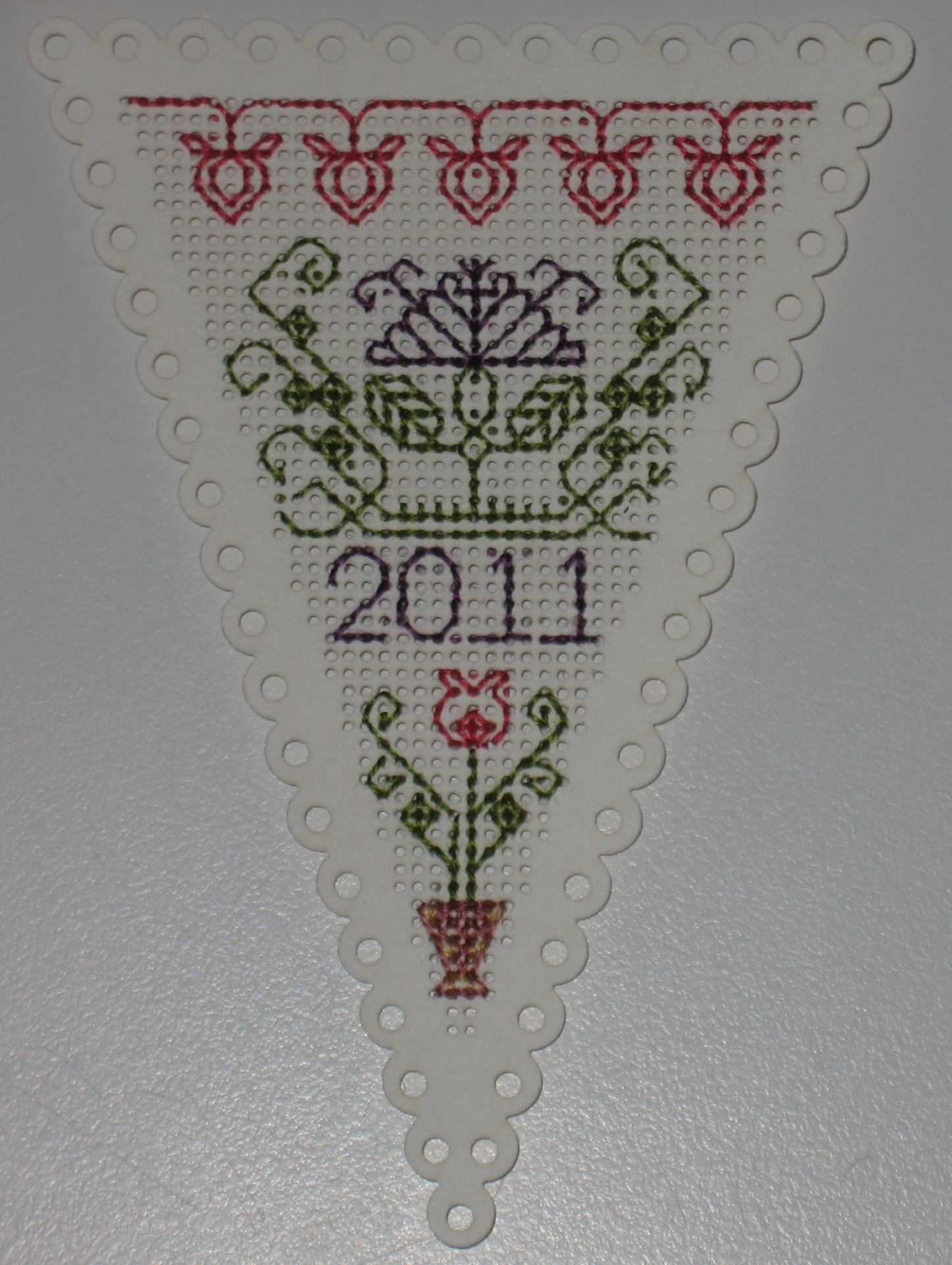
At AC Moore, I found Peel n Stick which are sheets of double-sided adhesive film. It cut to size, created an instant bond just by pressing, should add some support to the perforated paper, & will be easy to place in everyone’s kit. Then, I cut the lining which is Fabric Palette’s Craft Fabric in lime green that has a little glitter to it. You won’t be seeing the lining really but white seemed so boring & this looked spring-like to me. The last step will be to sew both sides together. Well, really, the last step will be putting kits together for everyone.

Neither I nor Main Line Stitchers have any financial interest in any of the companies mentioned.
Come join us at 7:15 pm on the 2nd Mon of each month just 30 minutes from Center City Philadelphia & 10 minutes from King of Prussia. Or contact us at:MainLineStitchersChapter@needlepoint.org for more information.
Filed under: ANG Main Line Stitchers Chapter, Scissors Sheath Band Sampler
After I picked out my colors, I decided for the cost of DMC floss, I’d get 2 of the 4 colors I was missing! The green is just as good. It stitched up quickly. But, it took me longer than I could do in one 2-hour meeting. They should be able to finish both sides in a month. Then, at the 2nd meeting, we can glue backing onto each half & begin stitching the sides together.
Again, the stitches from the top band down are: Four-sided, Algerian-Eyelet, Diagonal Satin, Queen, Montenegrin, Cross for letters, Marking, Long & Short, Four-sided, & Surface Satin.

Next, you’ll see the back as diagrammed in the Sampler & Antique Needlework magazine (Summer 2009) for Plimoth Scissors Sheath. It is a pretty pattern too & I didn’t want the back & the front the same.
Come join us at 7:15 pm on the 2nd Mon of each month just 30 minutes from Center City Philadelphia & 10 minutes from King of Prussia. Or contact us at: MainLineStitchersChapter@needlepoint.org for more information.
Filed under: Baby pieces
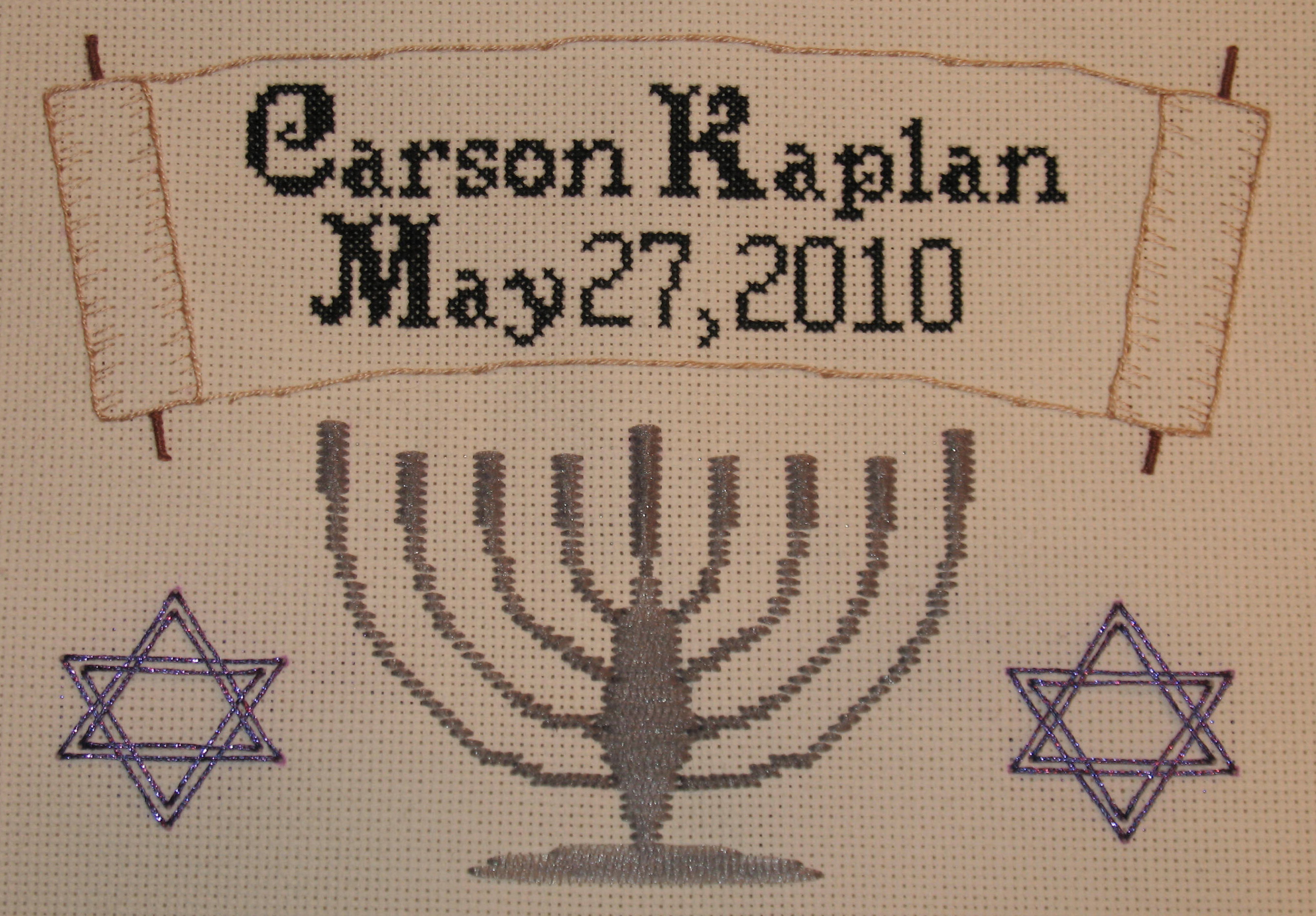
Just in case someone notices on FB that these are completed, SURPRISE! I didn’t forget about the boys.
To personalize the one, I asked my friend, Traci, to send me a picture of the menorah they light for holidays.
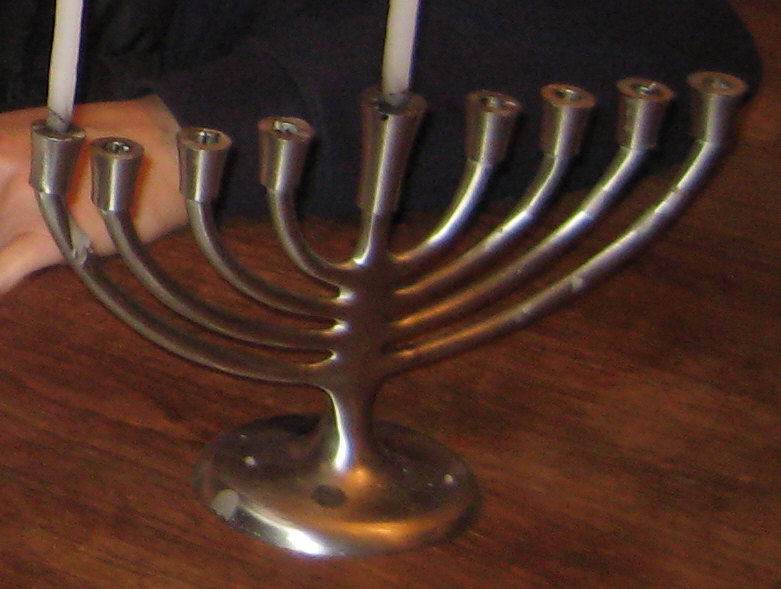
It ended up being a tad bigger than it seemed on paper. So, I made the stars smaller. And, the tree of life probably could have been bigger.

Filed under: ANG Main Line Stitchers Chapter, Scissors Sheath Band Sampler
For our ANG Main Line Stitchers meeting in November, we gave each attending member a copy of Sampler & Antique Needlework magazine (Summer 2009) that I chose specifically because of the nice variety of items discussed. For one, there was a late 17th/early 18th century band sampler which discussed the European influence with the introduction of particular motifs and stitches. And, there was a Plimoth Scissors Sheath pattern which I thought would be great for a small spring project using stitches identified in the 17th/18th century sampler.
The scissors sheath is made on 20-count Confection Perforated Sewing Cards from Tokens and Trifles. However, they were out of stock until at least February. But rather than wait & find myself in a difficult position of having to scramble with little time, I started contacting retailers identified on the Tokens & Trifles website as being retailers. Well, I ended up contacting 3 stores still in operation who had a few packages in stock. So, I’d like to thank Lavinia from Counted Embroidery in Califon, NJ, Sue from The Log House in New Castle, PA, and Judy from Judy’s Stitchery Nook in Harlingen, TX all of whom were generous to give a discount on the packages. In addition, Sue sent along patterns for other ornaments in case our chapter members would be interested in doing any of them. So nice!! I also want to mention that Nordic Needle, who was selling back issues of the magazine, referred us to the publisher, Hoffman Media LLC, because we wanted 20 copies & we got a 40% discount when we told them we were an ANG Chapter!
Neither I nor Main Line Stitchers have any financial interest in any of the companies mentioned except to thank those retailers that gave us a discount. We appreciate it!

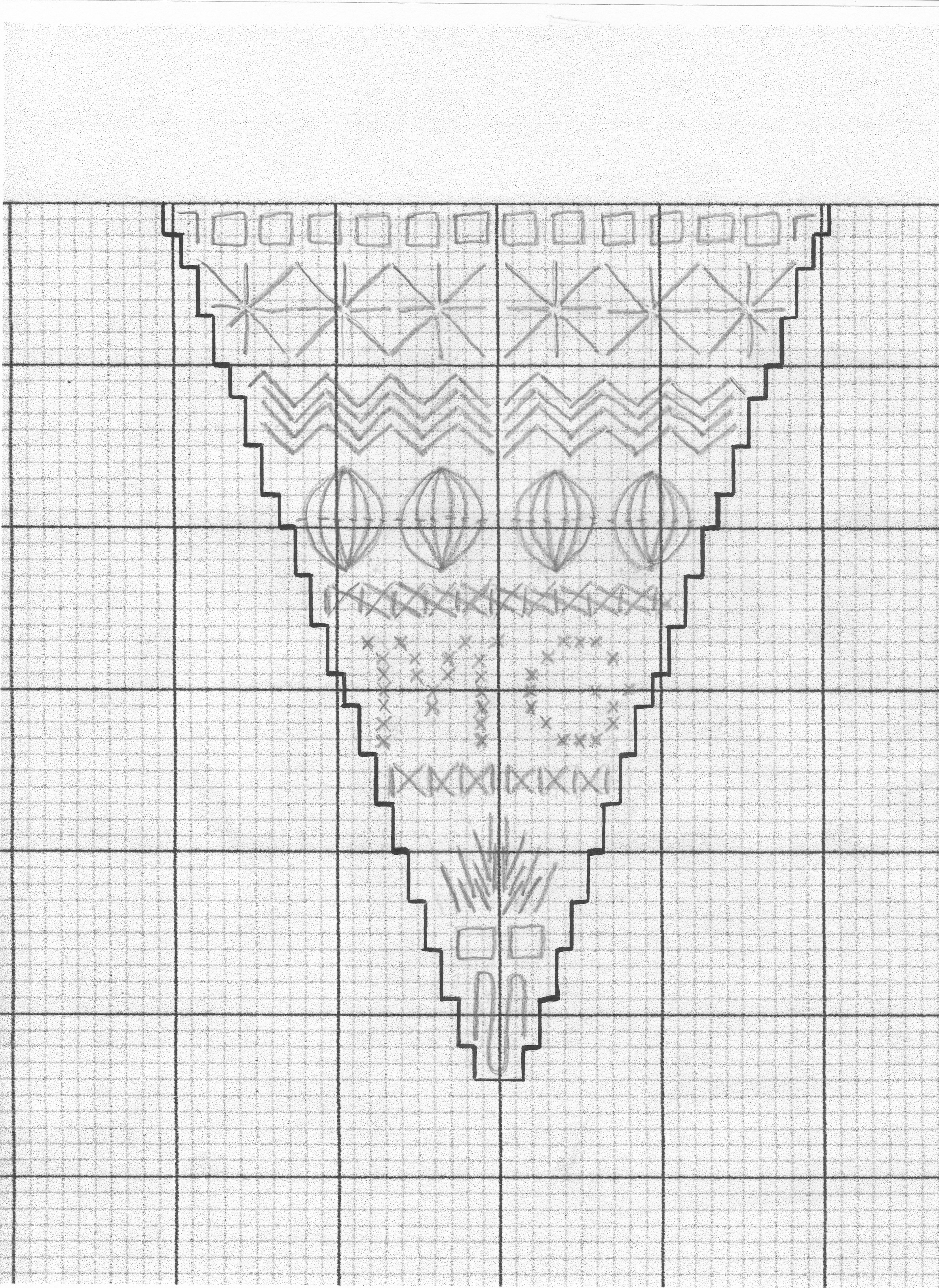
So, I last night I used stitches diagrammed in the 17th/18th century sampler to design a banded scissors sheath! I hope the chapter members like it. But, they can stitch the design provided (mostly back stitching) or design their own if they prefer. The stitches from the top band down are: Four-sided, Algerian-Eyelet, Diagonal Satin, Queen, Montenegrin, Cross for letters, Marking, Long & Short, Four-sided, & Surface Satin. Tonight, I picked out my colors. Of all the DMC floss I have, I only had 2 of the 5 colors. I can’t get more stash for a small project like this. So, I found others that are just as good. I’ll stitch at least one side to show in our next newsletter.
Come join us at 7:15 pm on the 2nd Mon of each month just 30 minutes from Center City Philadelphia & 10 minutes from King of Prussia. Or contact us at: MainLineStitchersChapter@needlepoint.org for more information.
The Ladies’ Work-Table Book (from 1844)
Containing Clear and Practical Instructions in Plain and Fancy Needlework, Embroidery, Knitting, Netting and Crochet
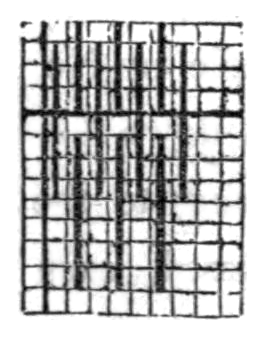
Irish Stitch.—This is the production of an Irish lady of high rank. Bring your needle up No. 1 over four threads down 41, one stitch back two threads, up 22 down 62, up 43 (observe this is in a line with 41) down 83, up 64 (in a line with 62) down 104, up 102 down 62, up 81 down 41, continuing thus over the square. The spaces left between every other stitch must be filled up with half stitches; for instance, up 81 down 101, up 83 down 103. It is also some[67]times worked covering six and eight threads of the canvas at a time, coming back three or four threads, in the same proportion as the directions given. This stitch is proper for grounding, when the design is worked in tent or cross stitch; and the effect would be heightened by two strongly contrasted shades of the same color. It can be applied to a great variety of devices, diamonds and vandykes for example, and many others which will suggest themselves to the fair votaries of this delightful art. It looks pretty, and is easy of execution.
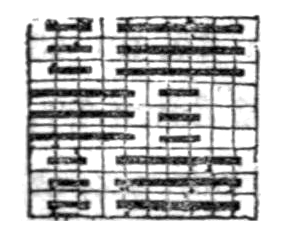
Basket Stitch.—This is the same as Irish stitch, but the arrangement is different. Work three stitches over two threads; these are called short stitches; and then the long ones are formed by working three over six threads, the centre of which are the two on which the short stitches were worked. Thus you must continue the short and long stitches alternately, until you have finished the row. In the next, the long stitches must come under the short ones; and this diversity must be kept up until all the rows are completed. To finish the pattern, you have only to run a loose film of wool under the long stitches on each of the short ones, and the task is done.
Project Gutenberg is a wonderful resource!
 Melitastitches4fun's Blog