Filed under: ANG Main Line Stitchers Chapter, Fibonacci Swirls by Olivia Hartshorn
Linda is leading our ANG Main Line Stitchers chapter on Fibonacci Swirls by Olivia Hartshorn (from Needle Pointers Mar/Apr 2022).
I have finished the C Areas on canvas (top) and Congress Cloth (bottom). I am controlling the flow of the overdyed threads trying to get a flow of color that will accompany the swirls that are stitched last. We’ll see what happens.

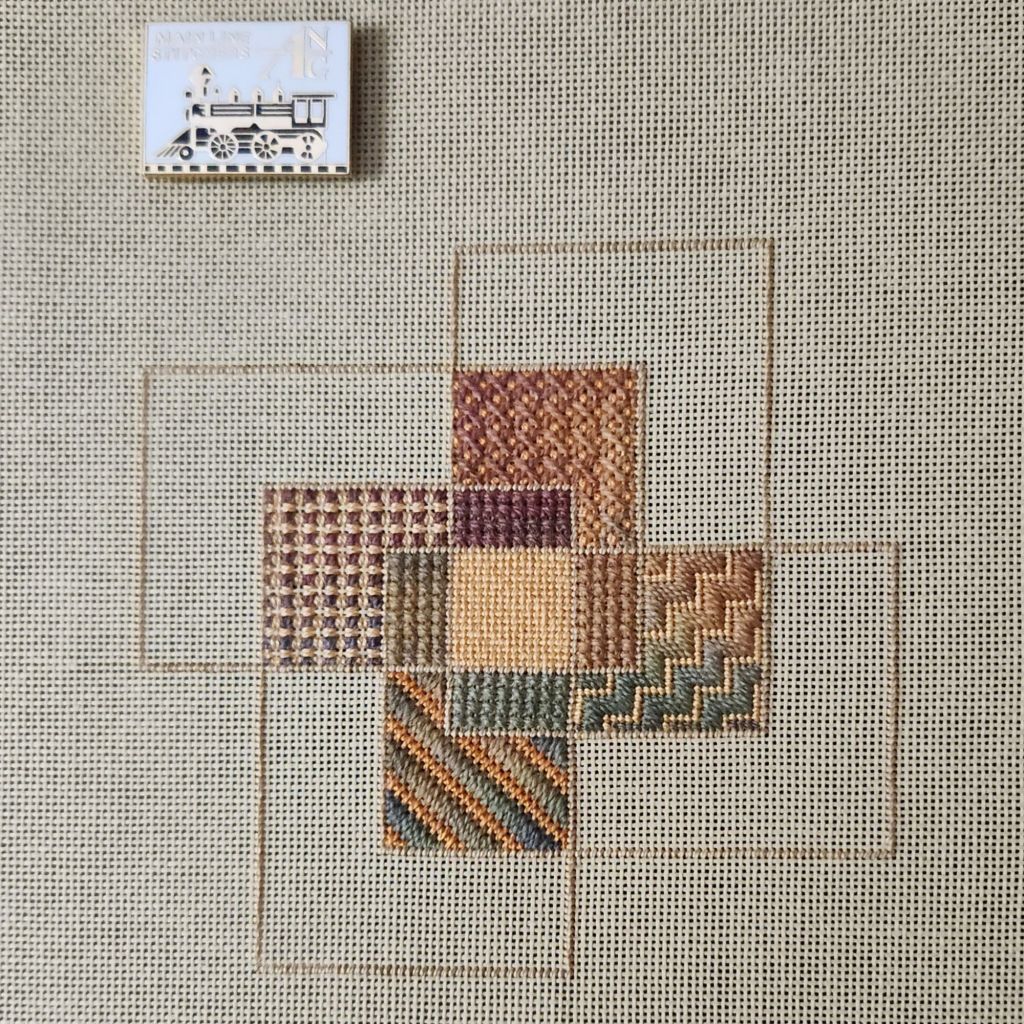
I am ready for our next meeting this coming Monday.
Filed under: Books in My Library, Embroidery Books, Making Needlecraft Landscapes by Mary Carroll, That’s Not Needlepoint (It’s Inspired Art Created with Your Needle), which is by dede Ogden
Neither of these are “stitch books” because they are focused on creating projects, but both show you how to apply stitches to create a realistic design.

Making Needlecraft Landscapes by Mary Carroll has 32 landscapes, and stitches are provided to make them. The color photos, diagrams, and detailed description of stitch placement are great.
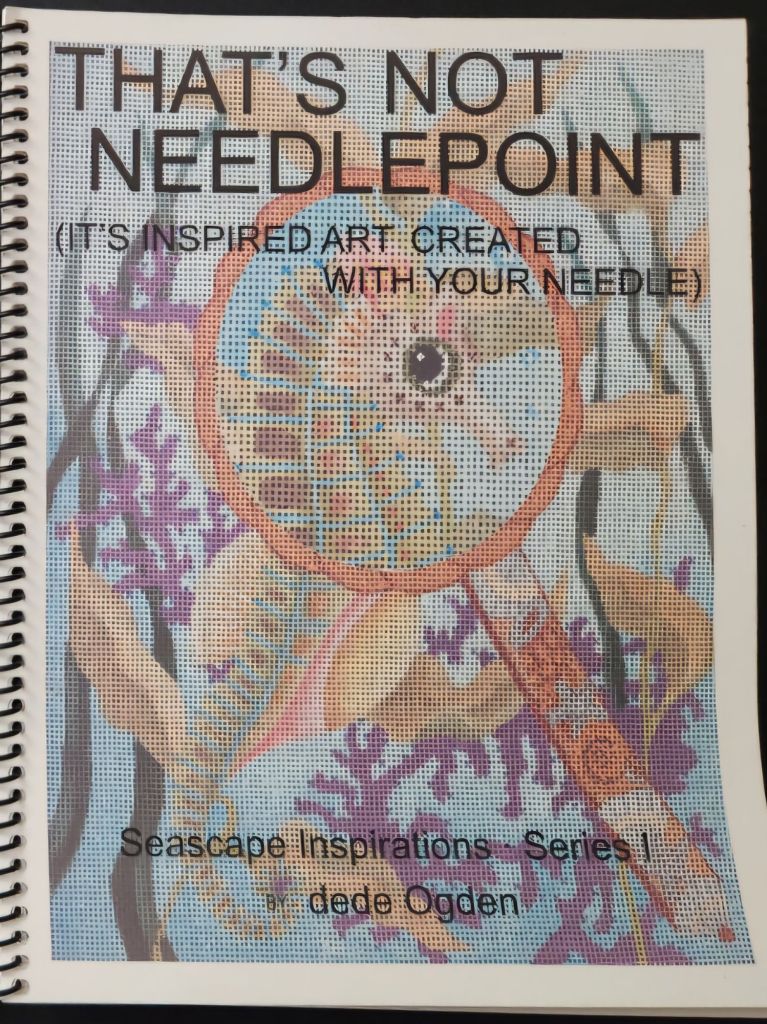
I did post previously about the other booklet, That’s Not Needlepoint (It’s Inspired Art Created with Your Needle), which is by dede Ogden (2011) and represented by Fleur de Paris, Inc. It’s not intended to be complete charts or diagrams to finish the various painted canvases but to offer suggestions for types of elements found in seascapes. The first canvas discussed is Seahorse Spyglass 18073 and is still available (and so is a stitch guide by Tony Minieri). Other canvases discussed are still available from a variety of sources including Undersea Fish 1373, Glass Aquarium Tropicals Green Fish 18015, Glass Aquarium Tropicals Blue Fish 18034, Undersea Garden 1378, Seahorse Pillow 18056, and Enchanted Mermaid Dream 18050.
The Casalgudi stitch is discussed, although I can’t understand where it’s executed. The photos could be better. And, without padding, it’s probably better called a wrapped stem stitch. The Railway Stitch makes a good background stitch. Sue has an interesting Bead Cup Stitch and shows how to expand an overlapping cross stitch to fit fluctuations in the width of seaweed.
Filed under: Books in My Library, Needlepoint and Beyond 27 Lessons in Advanced Canvas Work by Edith Anderson, Needlepoint Books

In a previous post, I pointed out a chapter in Needlepoint and Beyond 27 Lessons in Advanced Canvas Work by Edith Anderson Feisner entitled Variations in which she describes varying a stitch by size, by direction, by proportion, and by combination. In fact, she stitched a small landscape in all white using all variations of only cross stitch.
Since I am working on attaching stones, shells, and various objects, I read the chapter on Stones, Beads, and Found Objects. In addition to detached buttonhole which Dawn Donnelly discussed in her class at the ANG Seminar, Treasures from the Great Lakes, needleweaving is also described to hold a shell.
In the Texture chapter, Edith ranks 25 stitches in 6 categories from smoothest (basketweave) to roughest (Turkey).
The book covers a lot:

Well, I started in the center, filling in around the center motif, skipping the next area, filling in the next area, skipping the next area, and stitching the Smyrna border. I made sure to start the next length of Wildflowers in the same color as where I ended in order to maintain the color flow of the skein by always cutting in a stretch of purple. I thought random colors would be better because too much color matching might actually detract from those lovely swirls and corner mock Chilly Hollow motifs.
This part was almost finished during the baseball wildcard playoff games. It really worked up quite easily once I got into the rhythm. When I did get off a couple of times, I saw it quickly. That wider area with the Jessicas is probably going to require more concentration.
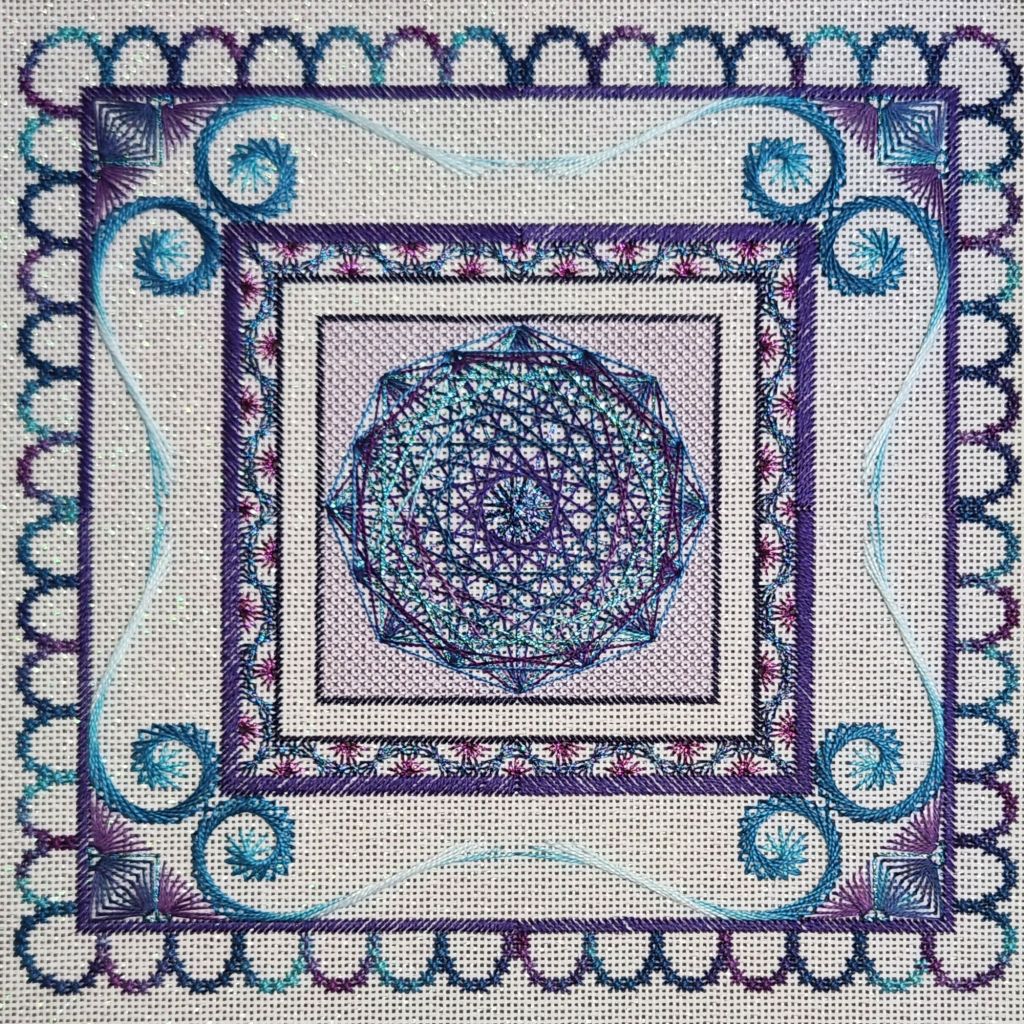
I do love a good counted piece and seeing it take shape. At least so far, I prefer completing all of one stitch rather than a quarter at a time.
I wanted the search terms to pick up fix, repair, mend, torn, or ripped, which accounts for the title.
Katie C on Needlepoint Nation shared that one of her canvases has a small tear. She asked for any tips on how to fix this spot.
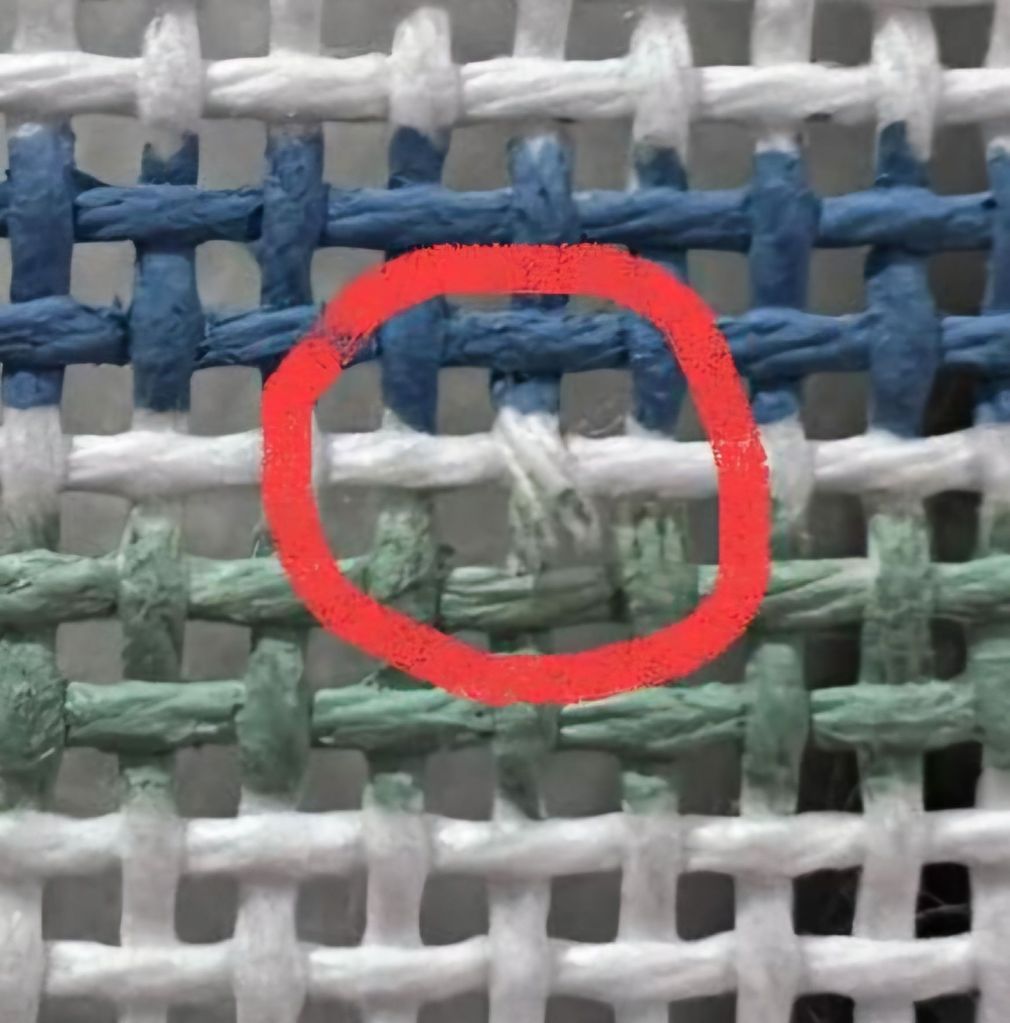
She got such good responses that I need to save them. I just hope I never need to try these.
Felice F said, “You might consider cutting a small square of canvas and placing it underneath so when you stitch the area, you stitch through both canvases.”
Michael J said, “For tiny spots like this, you can use a piece of dental floss. At least an inch away start an away knot or waste knot with the dental floss in same line that is broken. Weave in and out. Go past your affected area about 1 inch. Your dental floss will become your new thread. Finish off by burying your tail and end with waste knot that will be covered.”
Susan K P said, “Many years ago, in a class, the instructor had us cut the canvas on purpose. She then had us pull a single thread from the selvage, and weave it in about two/three threads below and above the cut…… making sure we ended up on the reverse side. Snip it with scissors and stitch. This is the same method to repair cuts on linen or other fabrics like that. It is simple, easy, and quick. No need to to cut and attach a square to your canvas or pay someone to repair it. Same thing can be done to a damaged, yet stitched, canvas or fabric. It is also the method used to repair hardanger that has been cut incorrectly.
But what ever method you do….. please don’t use glue on that expensive canvas with the expensive fibers. Unless you have access to a “restoration” type product, the chemicals in the glue can damage the canvas and can cause the fiber colors to change.”
Thanks to those who shared their knowledge. Do you have any more suggestions?
Had it been in the middle of a large area and not doing a tent stitch for a pillow, I think I probably would have selected a Smyrna, Scotch, or Rhodes to cover that one small rip.
Filed under: All That Simmers by Sundance Beads, ANG Main Line Stitchers Chapter
I’m glad I worked on All That Shimmers at my ANG Main Line Stitchers Saturday Stitch-in because Kristen was there. She’s already stitched it.
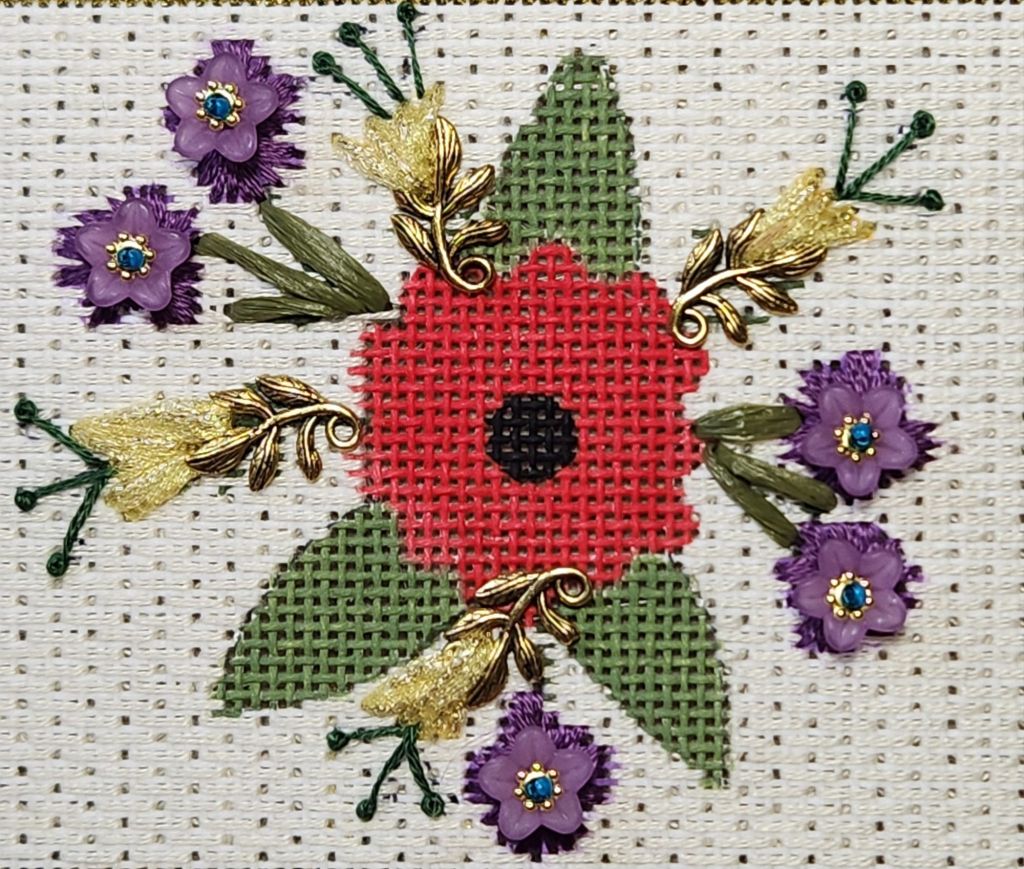
Underneath the purple flowers, I just couldn’t use the magenta overdyed thread. Kristen helped me pick DMC floss 327 to be the shadow underneath the flowers. Much better.
Once home, I pulled out the raffia and thought it was plastic! But Kristen used it on hers, and it looked nice. I also googled it and found out it is from the leaves of a raffia palm tree. Luckily, as I threaded the needle, it ripped down the center, which thinned it, and I like. It’s a very stiff thread, but I was able to anchor it in the stitching underneath the flower.
The raffia opens up to 1.25 inches wide and is very thin. So, I actually only ripped off 0.25 inches.
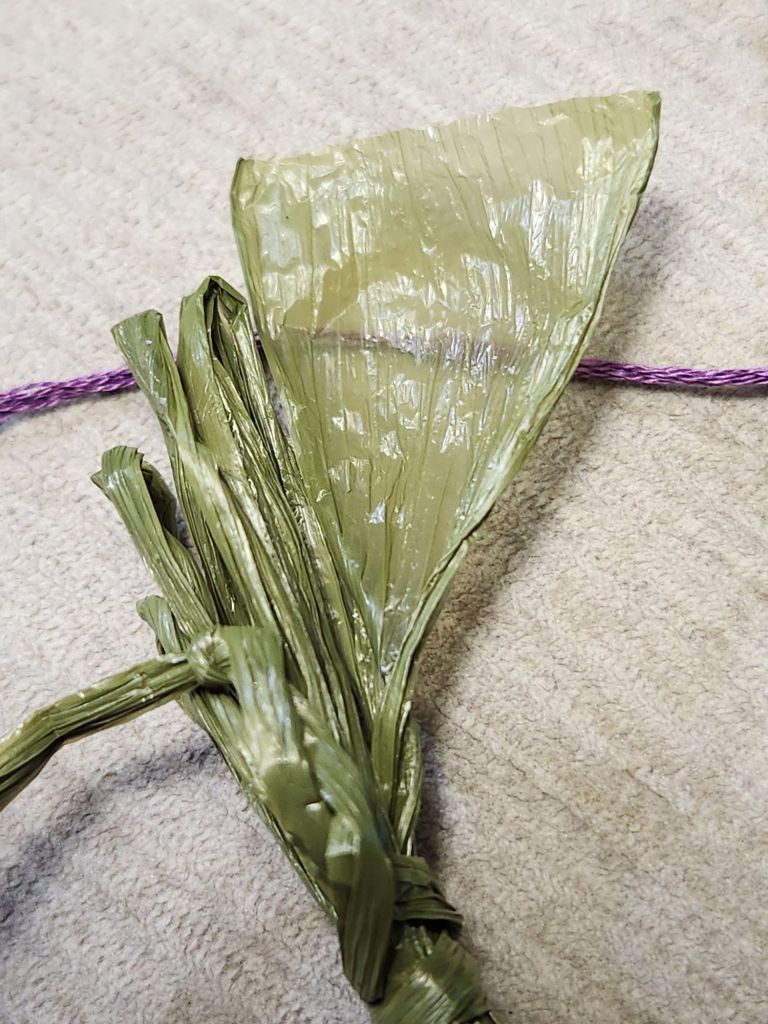
I’ll throw it into my stash, but I can’t say I’ll be seeking out more of it.
In order to get the 15 mm wide ribbon (BE Ribbon-Retro Avocado) threaded for the leaves, I needed an 18 Tapestry needle. I enlarged the hole and still had to work to pull it through (left long ends). I didn’t want to rip the canvas. I only ran it under the yellow Frosty Rays. Then, I did the veins and secured the ends of the ribbon with that thread.
Lastly, I tent stitched the red in the center and covered the gold ends.
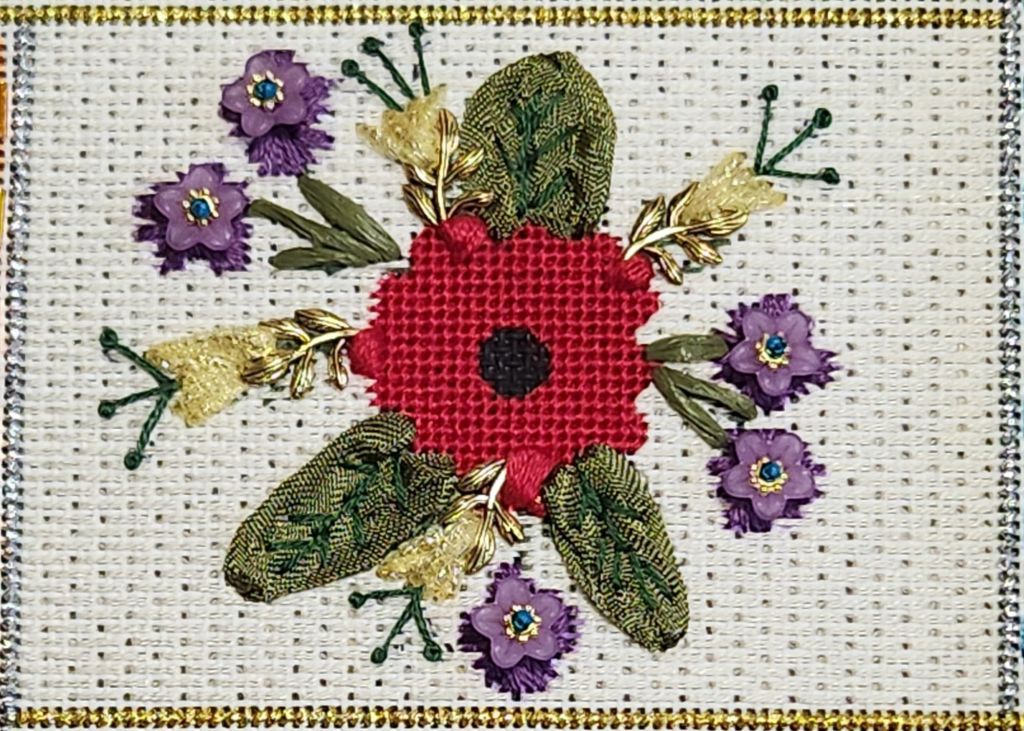
We’re letting folks catch up, and the red center flower will be discussed at our November meeting. It’s looking good!
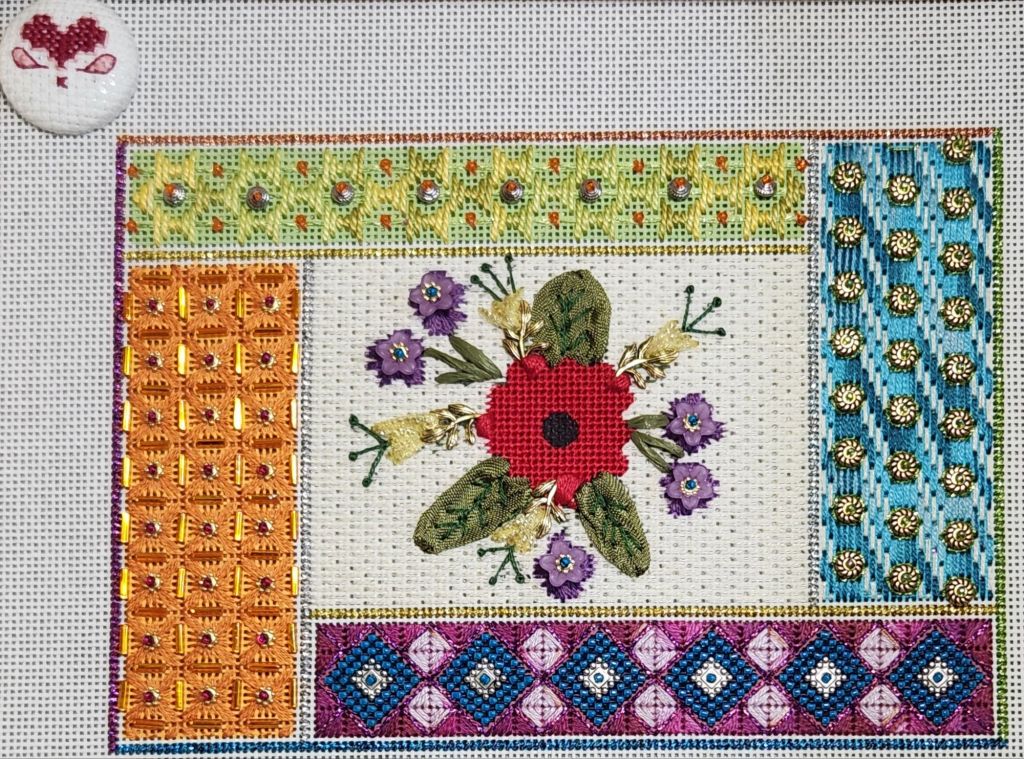
We’re using a stitch guide by Sundance Beads.
Filed under: Books in My Library, Desert Island Stitches, Volume 1 - Ideas for Small Spaces, Desert Island Stitches, Volume 2 - Ideas for Creative Borders, Needlepoint Books, Painted Canvas Embellishment: An Idea Book by Carol Lake and Michael Boren
These books by Carole H Lake and Michael Boren are intended to aid stitchers of painted canvases. But, they are stitch books, making them relevant and useful for selecting stitches for any project.
Painted Canvas Embellishment: An Idea Book
There is an excellent 5-page introduction of general thoughts, including choosing threads and stitches.
The pages on thread characteristics are not exciting, but I have skimmed them at least once. I underlined “chainette” in 8 places (2 are noted as discontinued – maybe more than that by now). It would make a good reference if you’re threading up an old project that calls for discontinued threads so you know better what to substitute.
Stitches cover faces, fur, clothing, foliage, snow, wings (good for my butterfly that I’m working on but not posting about until the big reveal for my ANG Main Line Stitchers chapter), stars, motifs, small areas, medium areas, very large areas, backgrounds, borders, lines, shading, combinations, and beading.
Desert Island Stitches, Volume 1 – Ideas for Small Spaces
It covers tent stitches in the first 2 pages. Can you think of 12 patterns? They did! Then, they go into diagonal stitches, oblique stitches, straight stitches, and cross stitches.
Desert Island Stitches, Volume 2 – Ideas for Creative Borders
These borders are arranged in 6 sections: continuous borders, mitered corners, center miters, log cabin borders, corner motif borders, and center motif borders. I love the reminder to combine several narrow borders to make a wider border. That makes me think of Autumn 3-Ways by Toni Gerdes and 5 Vases with Curly Bamboo by Sharon G.

The center Rhodes diagrammed by Lorene Salt was not preferred by at least one of her testers and a second option was provided. Since both options interfered with the north, east, south, and west spokes, I created my own.
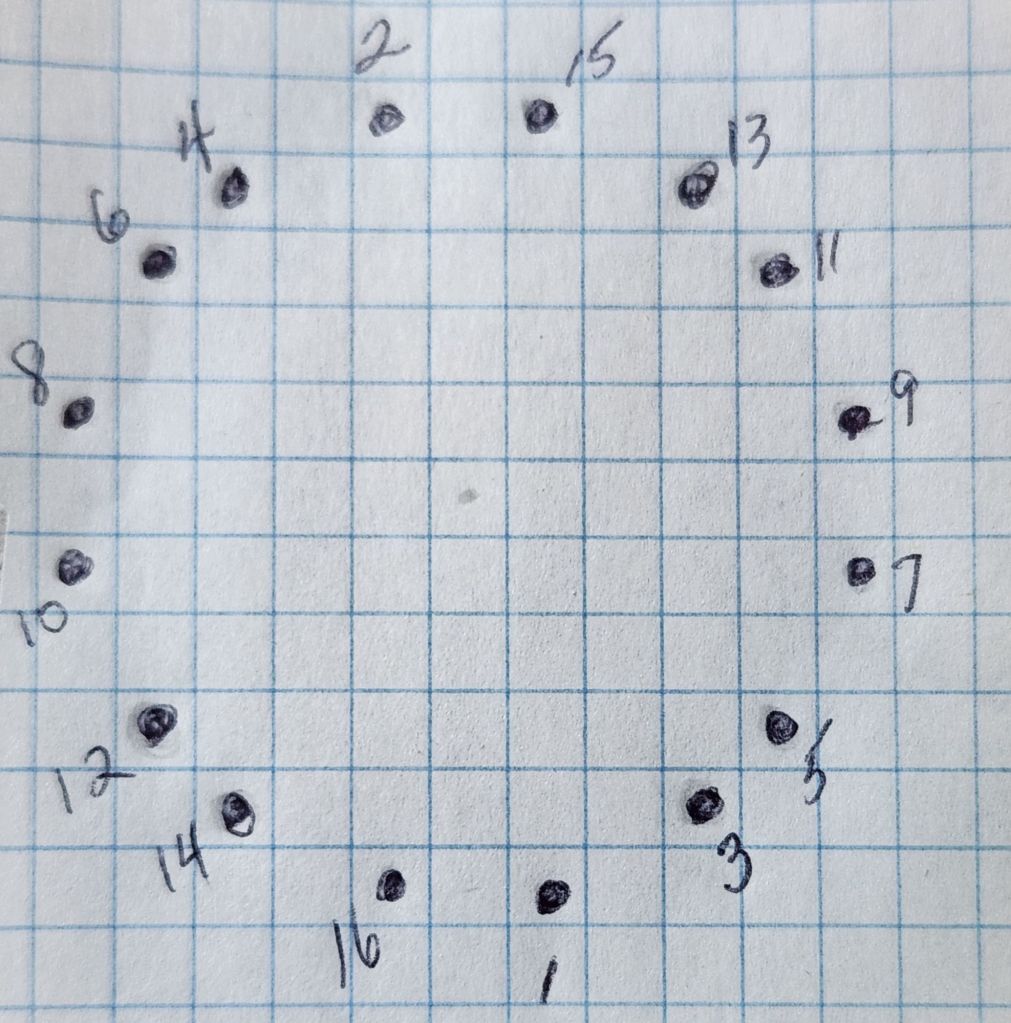
Next I worked on the color-matched areas that I had started in class because they seemed the trickiest. Finding the matched lengths actually was harder than the stitching but worth it! That took a few hours during class. I had made a knot at the end of the thread where I wanted to anchor in order to start each large crescent and end up with a match when stitched. That made picking up where I left off easy.
Finishing the last of the borders allows another anchoring area. Very smart of Lorene to work these into the design.
Did you notice my coordinated needle minder?! I made this one in a class with Michelle Arsenault. The heart needle minder accompanying Heart Swirls was one I made from Michelle’s class, too.

Hmmm. Where to go next? I made a mistake by adding up the number of different motifs that are coming up. There are 508 Smyrnas, 90 partial eyelets, 49 Jessicas, 40 tied sheafs, 26 crescents, 4 Sprats Heads, and some 4-way Continental. Whew!
How would you proceed? All of each stitch? A quarter at a time?
Filed under: ANG Seminar 2024
During ANG’s Seminar, there is always Expo! night and I forgot to post about my purchases. Knowing that I was going home with 3 new projects, I couldn’t buy more. But, I can always use a magnet and a stitch book.
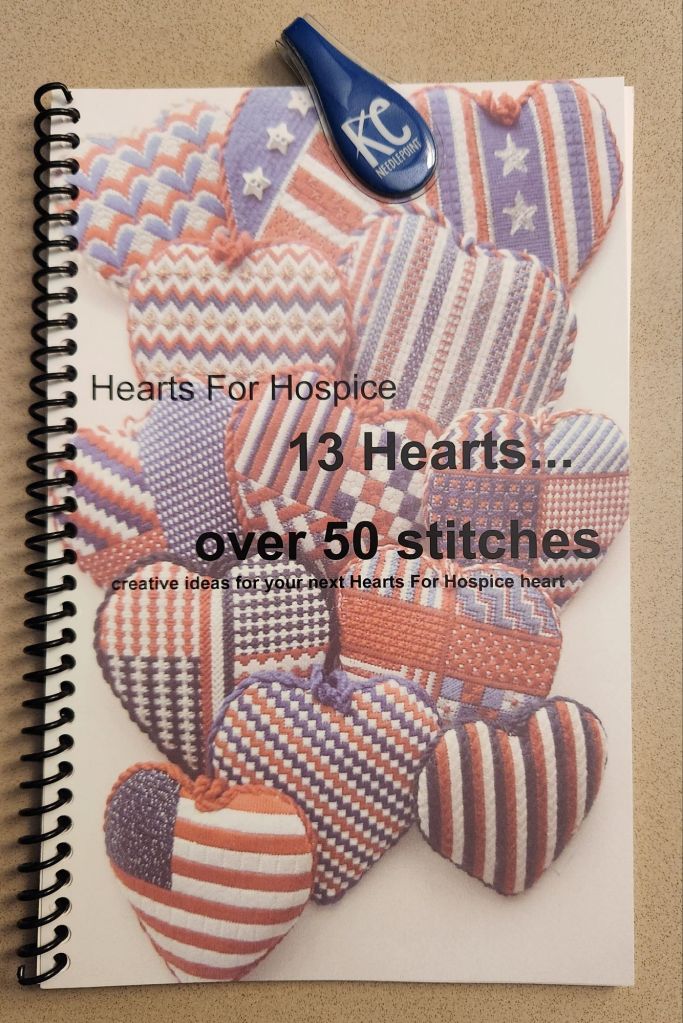
The fine folks in Kansas City with Hearts for Hospice had a table and had newly printed booklets for sale. It’s called 13 Hearts . . . over 50 stitches. Their fantastic story is inside. They started by providing a dozen hearts a month to one hospice to donating over 60 hearts a month to 3 local hospice centers. They have distributed over 5,000 hearts across 26 states and 4 countries. Very commendable.
Their suggestion to treat the hearts as a stitch sampler is excellent. Stitch, take notes, photograph, and send it to them for finishing. Some stitches you will like better than others but don’t rip, send it to Hearts for Hospice.
There are some interesting Nobuko variations and a dozen Cashmere variations. There is a Rhodes Heart and a very clever butterfly.
I’m sure you can order the booklets from heartsforhospiceofficial@gmail.com – great gifts.
Now, what did I do with that magnet? I look forward to finding it . . . one day when I am looking for something else!
Filed under: ANG Needle Pointer's Timeless Treasures From the Archives
The ANG Pine Tree Chapter (Maine) sponsored a series of three Zoom lectures by Susan Hoekstra in support of a non-profit heating assistance program by Penquis in Maine. The three lectures were:
April 10, 2024 The Elements of Design
May 8, 2024 The Principles of Design
June 5, 2024 Using Color Theory to Your Advantage
At the May lecture, I decided to see how well optical color mixing or pointallism would work with needlepoint.
So, I decided on a simple sunset scene (yes, I coordinated my needle minder magnet). You can easily see the red DMC #5 Perle 666 and yellow 973 have combined to create orange just as Susan explained. I am using skip tent basketweave.


As I was in the middle of stitching this, I was reading 8 articles on color and design written by Gene Wright. The 5th article mentions achieving optical blending through needle blending. The left side in my sample below uses 4 strands, and the right side uses 2 strands.

Join American Needlepoint Guild (ANG) to get access to more about this topic in the Timeless Treasures from the Archives article in the current issue of Needle Pointers (September/October 2024) and all the issues since the 1980s. Read about all the ANG member benefits at: Click here.
 Melitastitches4fun's Blog