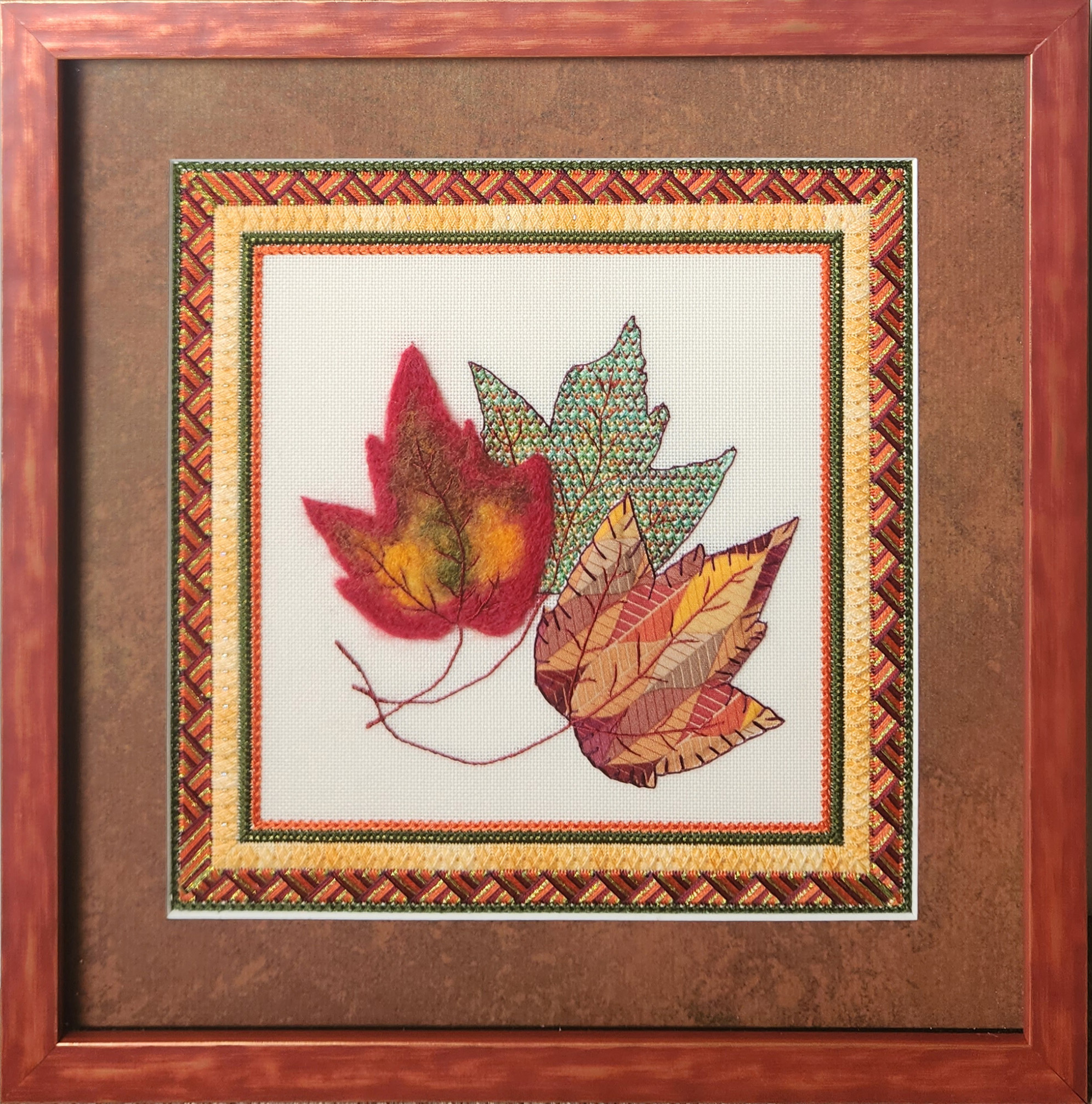
Another framed piece that I forgot to post. The ANG Central Jersey Chapter (CJC) hosted the Autumn 3-Ways Workshop with Toni Gerdes in the fall of 2022 although we had to do it remotely in winter of 2023 because of Toni’s flight cancellation.
Those of you who know the piece will know the piece is framed upside down but I didn’t notice that until I got home and my husband and I decided we like it that way! Finished by Frames Plus in Feasterville, PA.
Filed under: Annette's Bouquet with Deborah Mitek, Embroidery Guild of America, Seminar 2021-Chicago
Annette’s Bouquet with Deborah Mitek was one of the classes I took at the 2021 EGA Seminar and has been framed since November 2021 but I forgot to post it here. A fillet allowed enough space so that the French Knots, Colonial Knots, and the bow would not get crushed by the glass (museum glass). Romeo’s did the framing but they are closed now.
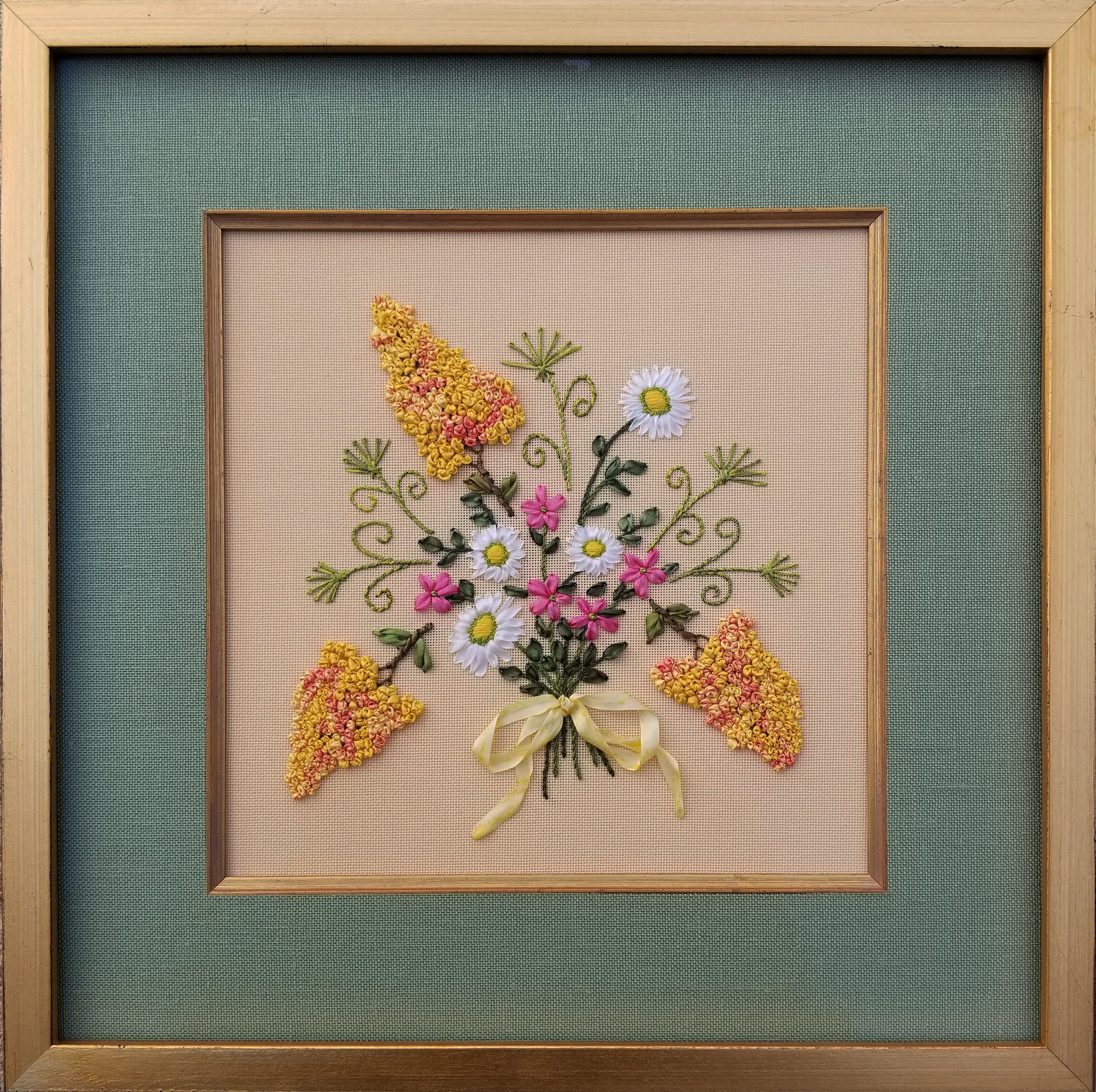
I’m very happy with how it turned out and enjoy looking at it – flowers that never need watering and will never die! Perfect.
Filed under: ANG Main Line Stitchers Chapter, Imperial Topaz by Sue Reed
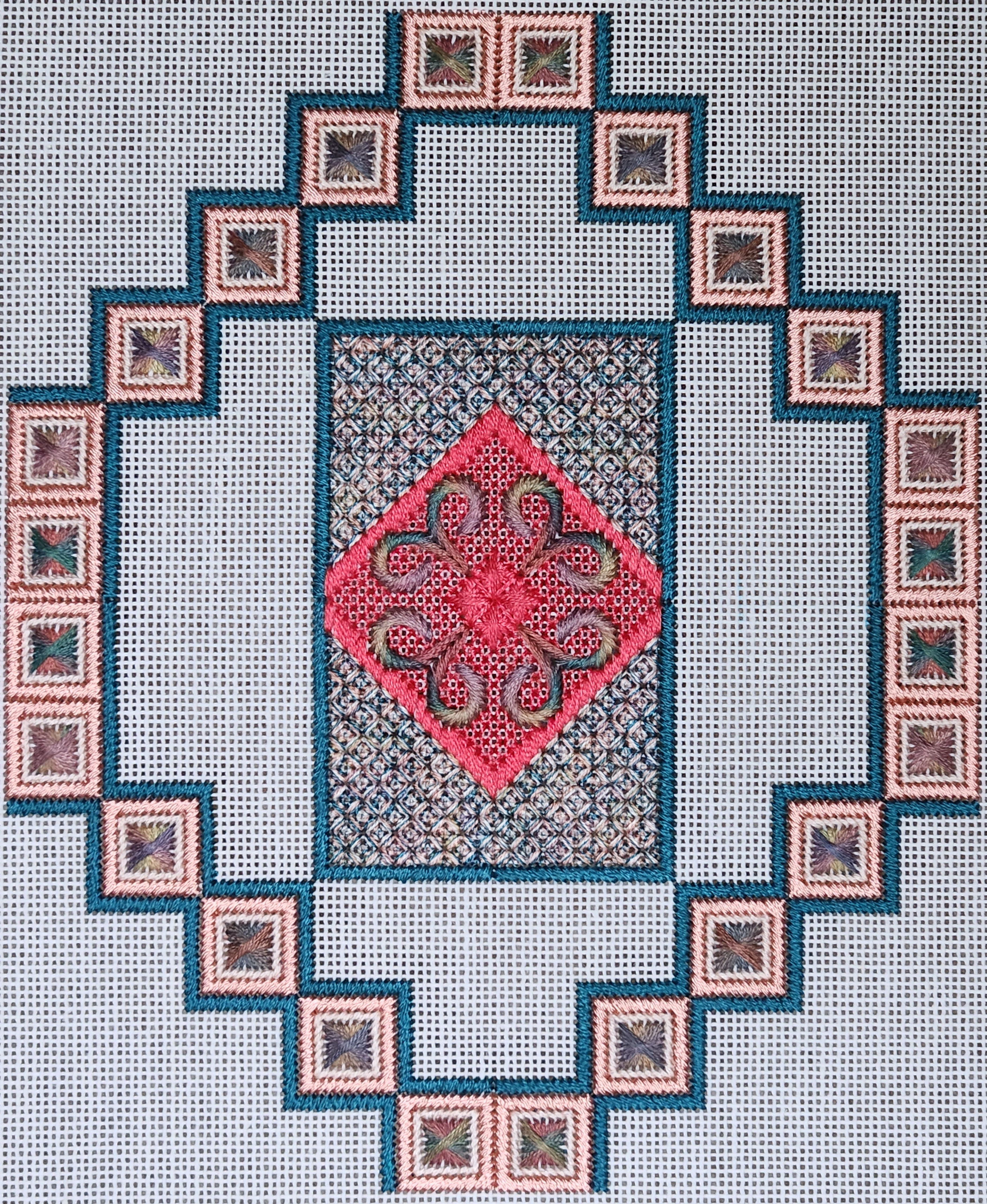
Getting the Square Rhodes color matched and reflected went well. I got all the colors in the overdyed thread, 168 Rainforest, represented. Counting that far away from where you stitched was a bit tough because the first stitch in the Square Rhodes stitch is not one of the corners. I was off once, but thanks to double-checking, I caught it relatively early and was able to reuse the thread. I needed about 32″ to stitch three of them. All the top stitches point towards the center.

All the slanted gobelin stitches surrounding the Square Rhodes in the 4 quadrants are pointing to the center as well. So I wouldn’t forget the slant while talking at our Saturday Stitch-in, I had already started with the inner most over one stitch and the over 2 with Neon Rays in some of each quadrant. I did have to take my curling iron – a must when working with Neon Rays. But, no mistakes. Not a very exciting portion to stitch, but it was a rainy weekend here, and I finished it. Yes, the north, south, east, and west sides are purposely not closed in.
Filed under: Embroidery Guild of America, Pomegranate Heart by Melissa Sherbring, Seminar 2023 - Boston
It’d been almost 2 weeks since returning from EGA Seminar and I had not stitched on the Pomegranate Heart, the one-day class with Melinda Sherbring.
Glad to say, I picked up easily where I left off with the Ceylon/Ladder stitch.

The pair-wrapped ladder worked up well.

This is a 4-column Crown (working on this upside down). The center rungs got lost until I got to the center pointed tip. Since I’m not sure it would rip out easily, I am leaving it alone.
I’m working with Gold,Silver, and Copper Passing Thread. It is a thin flat metal thread wrapped around silk or cotton. It does fray but wax applied at the end helps. Because these threads are more expensive, Melinda makes up smaller spools for kits to keep costs down. Very considerate but certainly adds kit preparation time. The white spool is a harder plastic tube than the green plastic straw. Each have cuts in the end for anchoring the end of the thread. They would make a great spool for leftover threads.

The Ceylon Circle is a little too small so maybe I should have placed the framework stitches further out. I only looped around twice, and I think Melinda got around 3 times. Oh well!

The Corded Lark’s Head Filling offset stitch was tricky – going down and over, up under, and down and under repeated. Working with a magnifying glass didn’t help much. Then, I realized that my tension was probably too tight. Looser thread and the magnifying glass made working the bottom half go easier. So, you can see it is a little denser on the upper half. Again, I am leaving it alone.
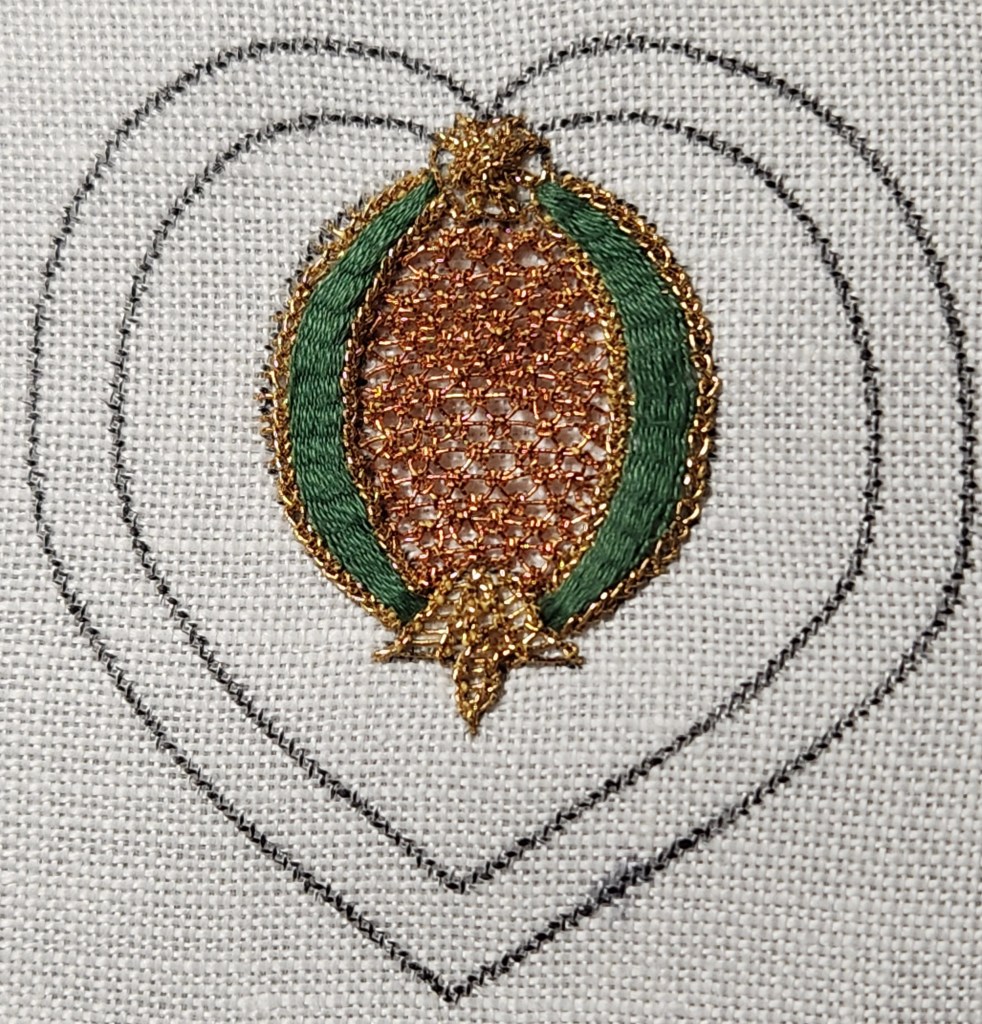
It’s kind of slow going because I can only stitch with the magnifying glass so long.
Thanks to Facebook’s Needlepoint Nation,
this is from Amanda Lawford’s old line, Les Nouvelles, circa 1970s/1980s. “Patty Paints Needlepoint” replied to tell me she worked as a copy artist for her, and she remembered painting this canvas. If you haven’t heard of Needlepoint Nation, you are missing a great resource.
Patty has also replied to my inquiry about a certain area of the canvas where I wasn’t quite sure what I was seeing. She graciously responded, and that issue has been resolved. I’m still not 100% sure about a couple of smaller areas and if extra stitching along the outer edge is needed for the finisher, but I’ll bring it to the next greatest resource I have, my chapter members from ANG Main Line Stitchers at our Stitch-in Saturday.
The angel came to me partially stitched belonging to a woman who started it 40 years ago. We met, and I have taken it on as my first stitch for hire project. Why? She is very nice, trying to establish a work-life balance, and can’t fit this in. And I don’t have a basketweave project to work on now. As soon as I agreed, she said she felt lighter. She did an excellent job on what she already did. She used 6 stranded DMC floss as is (not laying the thread). So, I will do likewise.

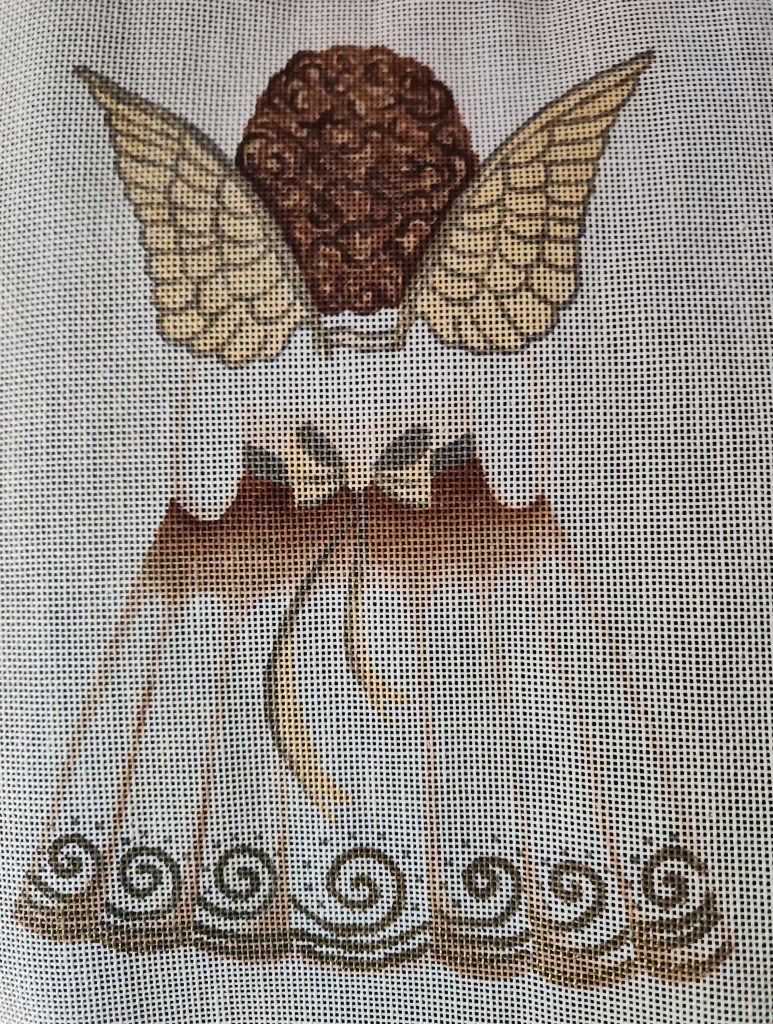
When I got home and looked more carefully, I found her threads were neatly organized in bags and labeled as to what areas they are to go to. I didn’t promise it’d be done by a certain date because I do have other projects. It wouldn’t be able to get finished by Christmas this year anyway. It’s coming into baseball playoffs, and football is back. So, I should make good progress.
Filed under: Embroidery Guild of America, Lady Sybil, Melita's Designs, Seminar 2023 - Boston
I was pleased to see Lady Sybil got a 2nd Place ribbon at the EGA Golden Needle Exhibit. The critique was late arriving but I finally got it.
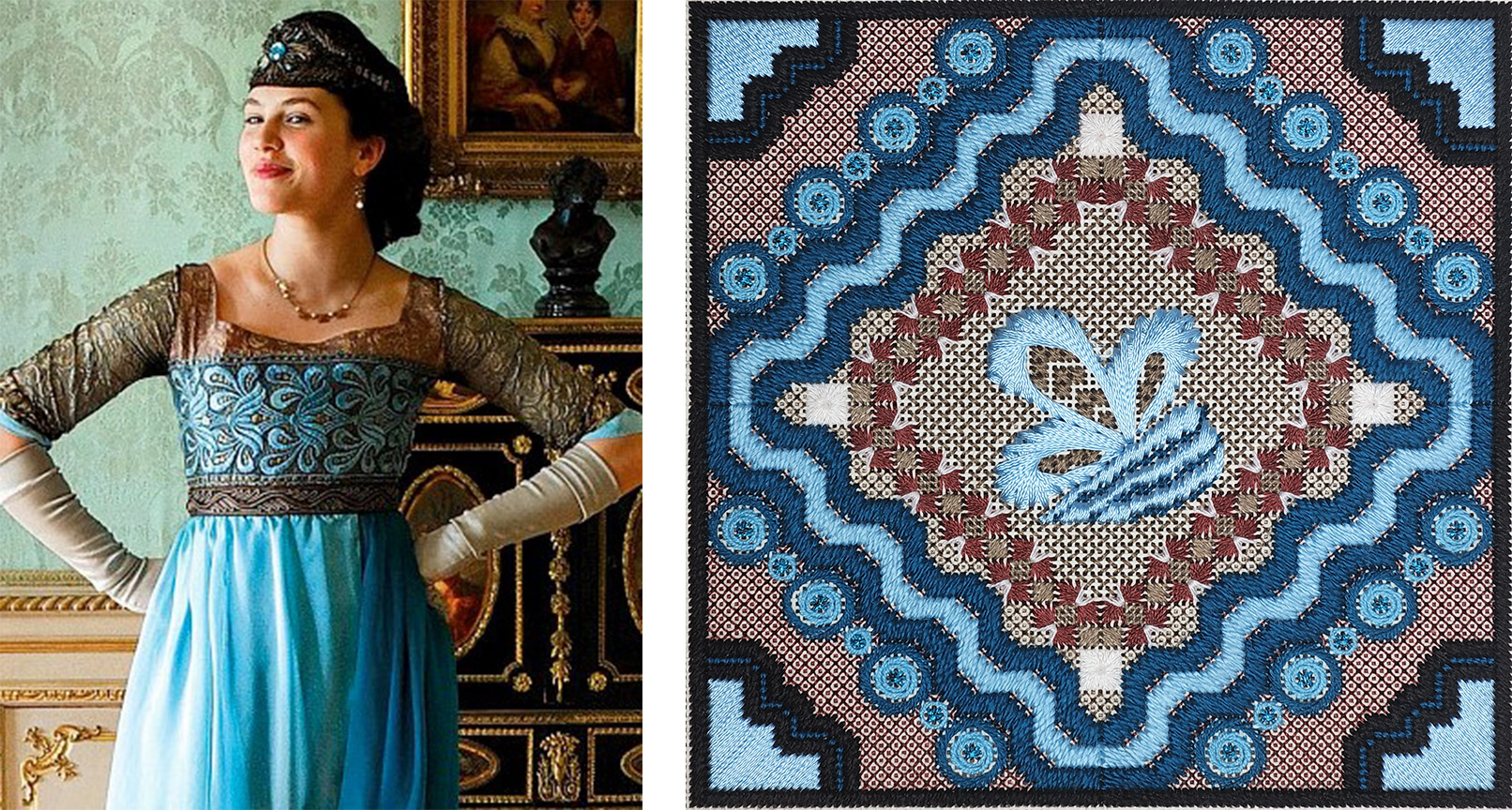
For some reason, my photo of Lady Sybil didn’t appear in my Artist Statement. So, that didn’t help the judges. And, I do agree with the judges that the artist’s statement needed more connection to the theme of the exhibit, “Stitch Party.” I indicated that it was a party of Jean Hilton stitches. Not that I could have said much more about it. I don’t much care for entering themed exhibits to begin with. But, I didn’t realize the theme/Artist Statement weighed in at 40% of the judging.
Otherwise, they said, “Your work scored high in Aesthetic Quality, which defines a design’s unity in visual terms. (balance, color, repetition, pattern, scale, shape, and value).” The Pepper Pot Silk showed irregularities but the rest of the piece exhibited a high quality of skill in the execution of the work.
If you have Evertite Stretcher Bars, you have a Bondhus Hex T-handle. This looks like a lethal weapon and would never keep it in my carry-on luggage figuring it might get confiscated.

Someone mentioned (probably on Facebook) that any 3/32″ Hex Dogging Key would work. I found a pack of 10 of them on Amazon. So, I got them to have one hanging off my lamp next to me where I stitch and one in my travel tool bag. It’s so much easier to carry. A few of the rest are part of gift bags. It works just as well.

Filed under: Embroidery Guild of America, Seminar 2023 - Boston, Understanding Color Relationships: Luster and Luminosity with Patricia Goaley
I did manage to finish the class assignment from Understanding Color Relationships: Luster and Luminosity with Patricia Goaley last night after dinner.
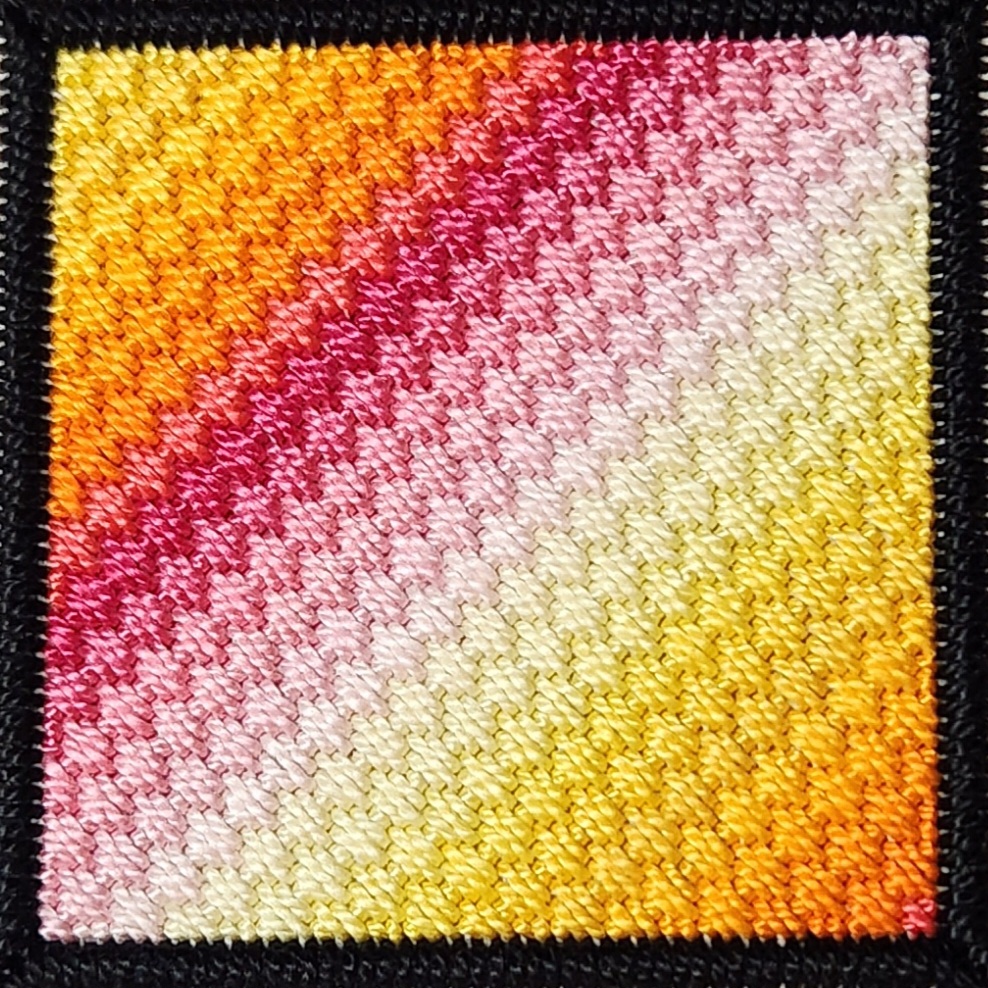
I have enough thread left. Perhaps I will make a companion piece for a pair of coasters.
Eventually, I will rework my tiny weaving project. First, I think I will finish the Pomegranate Heart while it’s fresh in my mind but not tonight. Even though I didn’t drive home, it was a long day. We enjoyed Boston and the Seminar but it’s nice to be home!
Filed under: Uncategorized
What a surprise – I enjoyed meeting Kim, the designer of the lovely Medusa Sea Jelly ornaments. I mailed my check for the design before I left for Boston. So great to see these in person!

Others stitched it in different colors. All great.

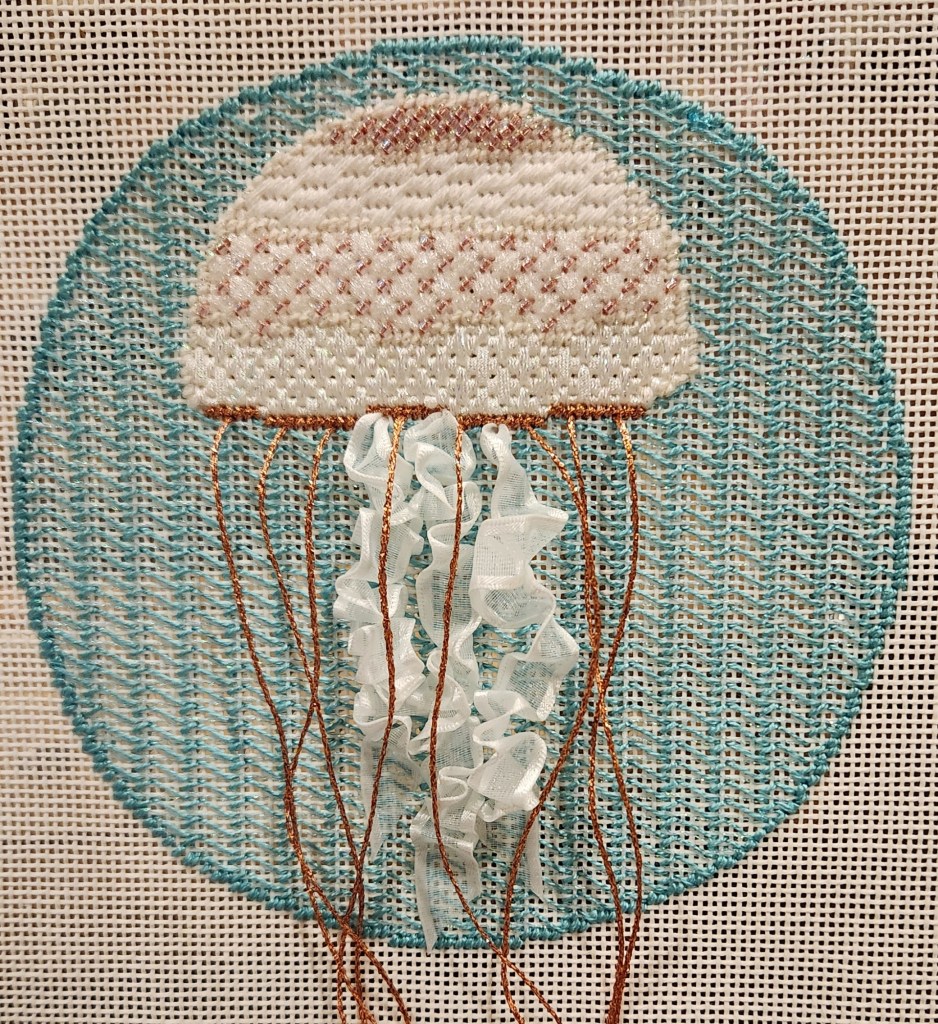
You can still get the instructions and more info about the September 23 Zoom class from Kim:
This design is being sold to raise funds to sponsor the exhibit, Shoreline Stitchers Showcase, held every two years. Since COVID the cost has escalated to $11,000-12,000 every exhibit. It seems like an excellent way to share our work—even if it is on the wrong side of the country (in CA).
Information about our Sponsorships and Donations are available on our website
http://needleartistsbythesea.org/shorelinesstitchers.htm
Hope you will help us!
Please let your chapters and others know about our events and sponsorships
Regards,
Kim G
Needle Artists by the Sea (NAS) chapter President
Shoreline Stitchers Showcase Manager and Fundraiser Chair
Filed under: Embroidery Guild of America, Pomegranate Heart by Melissa Sherbring, Seminar 2023 - Boston, Understanding Color Relationships: Luster and Luminosity with Patricia Goaley
My second class, a two-day class, was Understanding Color Relationships: Luster and Luminosity with Patricia Goaley.
Class description from EGA’s website: Using simple forms, we will experiment with advanced color relationships using various colors of number 8 pearl cotton and 18 count canvas and 28 count overdyed linen. This low stress class will play with luminosity and luster over 2 days. If you have overdyed linen that you are at a loss how to use, bring it and look at the future possibilities. There will be some choice in color chosen for fibers and foundation materials. Tricks will be discussed for improving overall appearance of your needlework and increasing the intensity of the color relationships.
I looked up the definition for luster. It is a gentle sheen or soft glow, especially that of a partly reflective surface. And, luminosity is the relative brightness of something.
Learning more about color and low stress sounded good!
In our first day, we made our own grayscale and hue color chart.
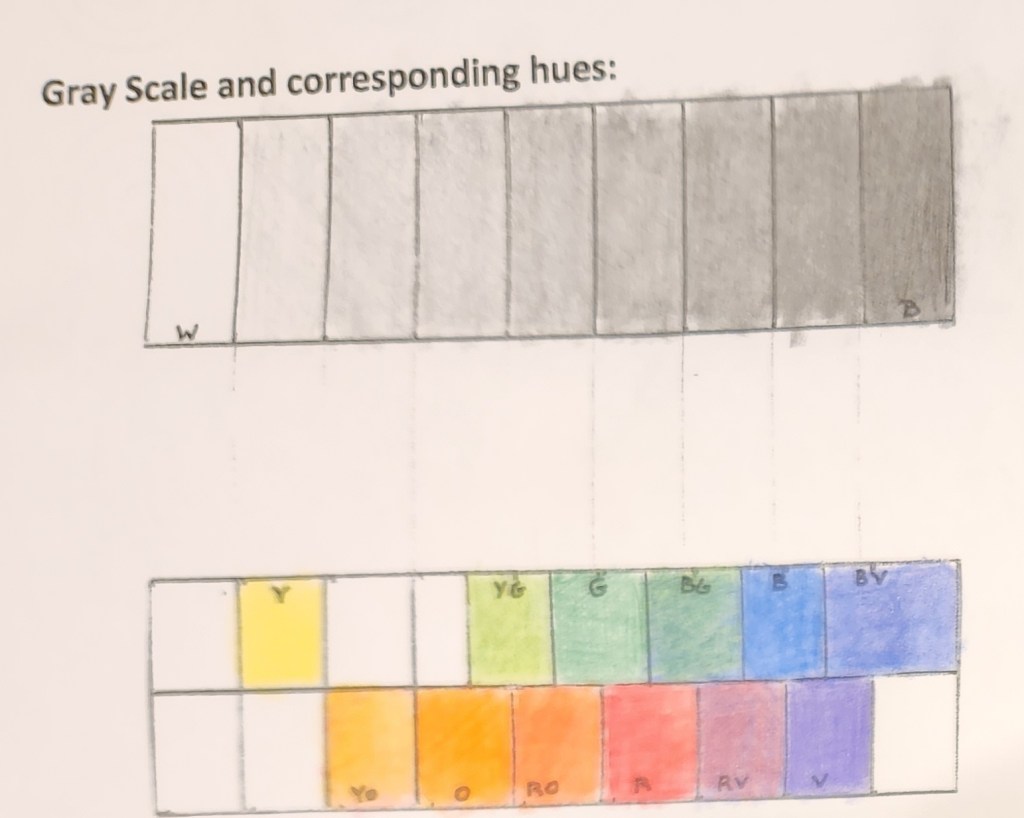
We added value with color (red example below) and density of stitches (green example below).

Then, we stitched to watch the interaction of color as you add each color.

The luminosity is created with the lightest values and the luster will appear as reflected light becoming more evident when a significant value difference is incorporated. Because I am working on the gray canvas, I added a black border to make it pop (after dinner and a delicious Espresso Martini). This isn’t fully stitched yet. Does the bottom one look a little washed out compared to the one with the back border?

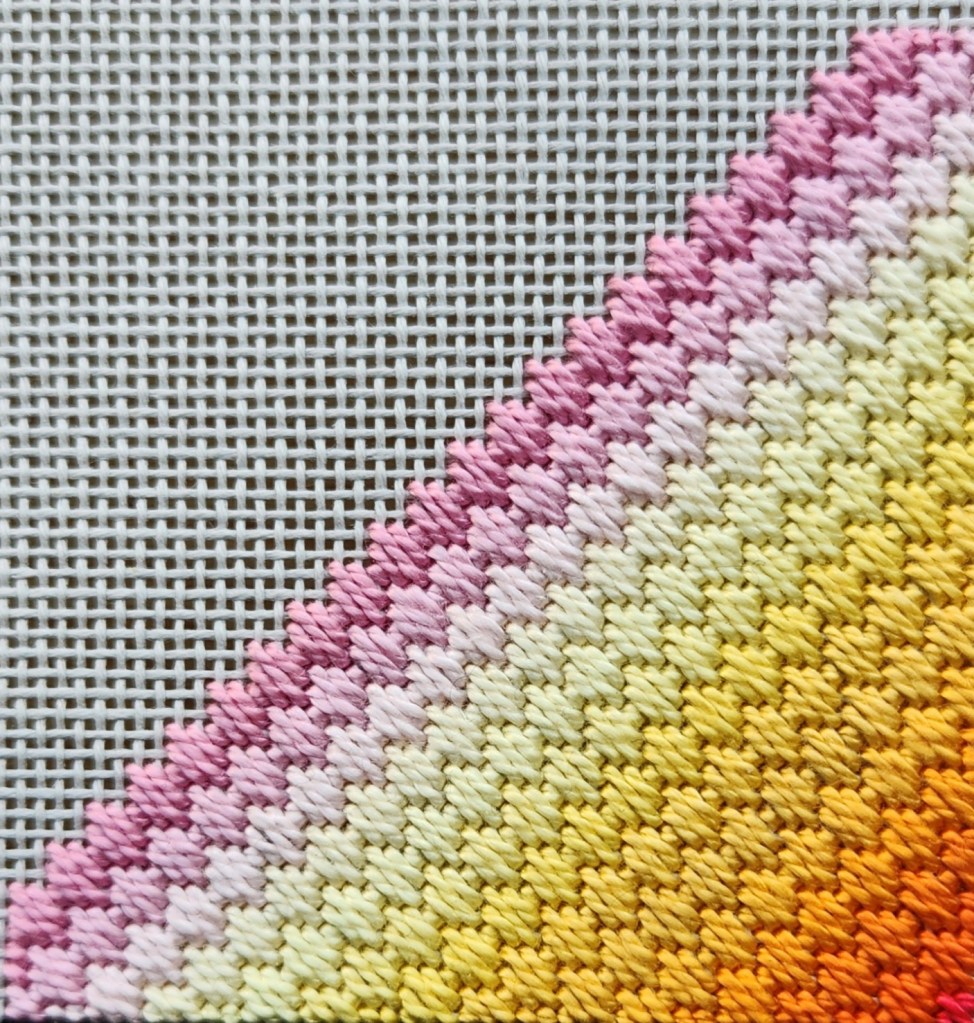
Thanks to the other students who pitched in to distribute Day 2 class materials. Lots of stuff!

These were my morning paintings – masterpieces! We went from black and white to color. We had QTips and paint brushes to play with. I could have done this all afternoon.


But, it was time to move onto weaving. Look at this teeny, tiny loom! The fork was used to push down the threads.
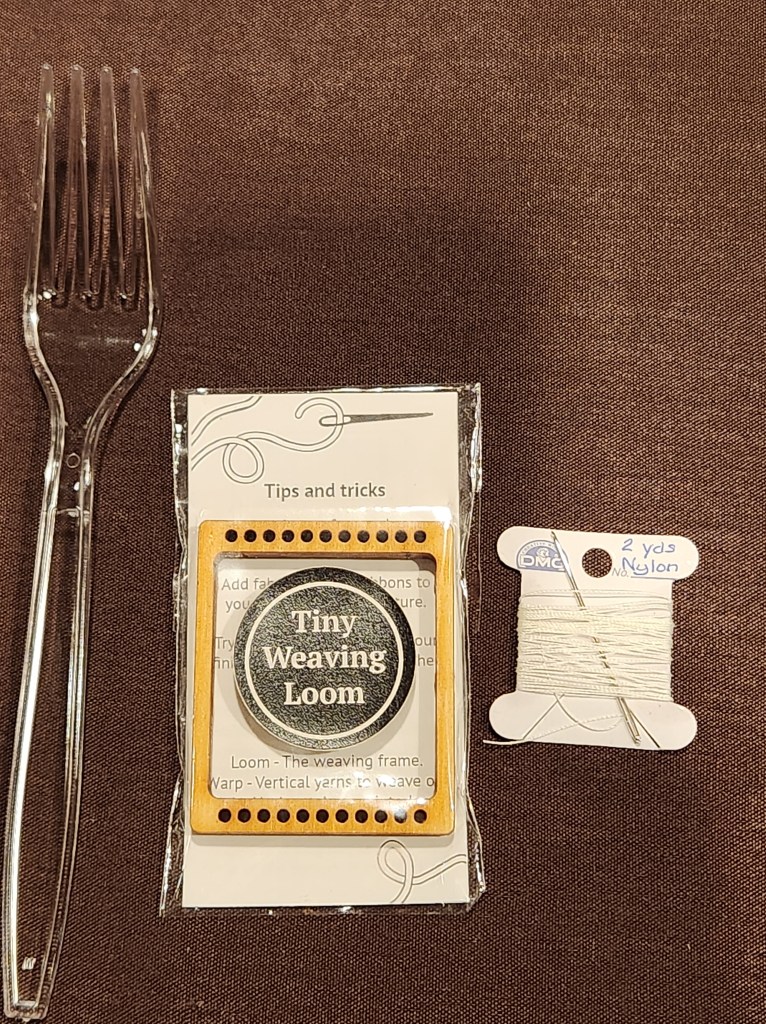
This was my afternoon’s weaving project. At one point, Pat mentioned that you can stitch on the weave you produce. So, I am going to trash this and restart it. My tension got tighter in the middle which is the same thing that happened to me with the larger loom.

Working on linen as described in the class description would have been nice but getting to weave again was fun and let me learn that Surface embroidery could be combined with weaving. A fun mixed media project. I’m thinking about what to do!
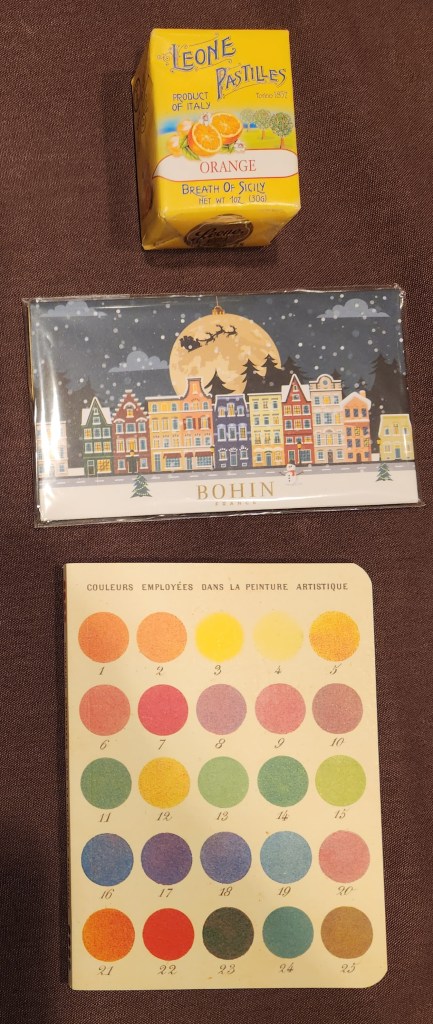
Pat gave me an entirely unexpected gift bag for being Class Angel. The Bohin needlecase has 40 different needles in a variety of sizes. Orange is my favorite flavor of hard candy. And, can always use a notebook.
 Melitastitches4fun's Blog