I liked the Waterlilies 168 Rainforest because it’s muted and selected the Color B (coral) thread, AVAS Soie d’alger 2921 Rouse Ancien, to brighten the Waterlilies and provide the contrast. One of the colors in Waterlilies looks like a shade of AVAS 2921 which means black would have been added to AVAS 2921. I didn’t want the exact match because that would wash out the crescents. In fact, Sue mentions that you do not have use any of the colors from the overdyed skein for Color B.
I cut the thread just where the shade close to the coral would start the crescents near the center solid diamond. The stretch of thread that follows offers a nice cross section from the skein of Rainforest.

The value contrast wasn’t what I expected but there is contrast of color and temperature (reviewed my notes from Laura Smith’s lecture, “The Seven Ways of Color Contrast”; excellent talk).
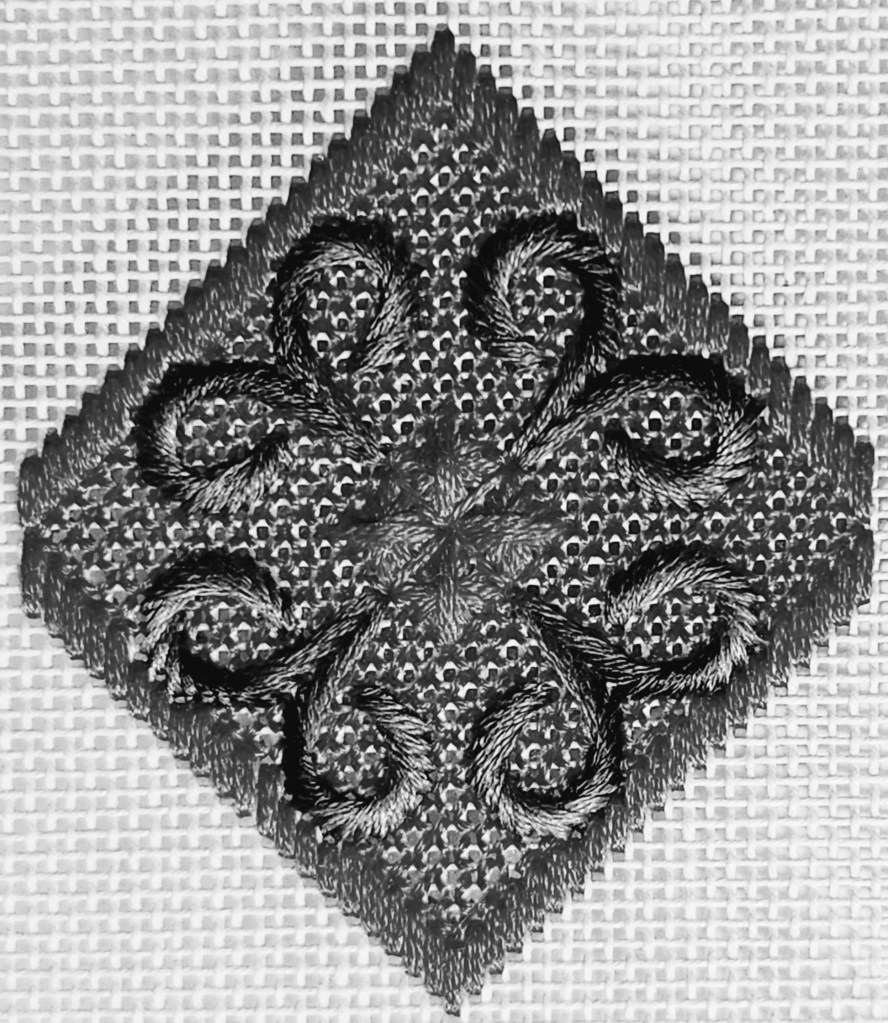
I’m ready for our July ANG Main Line Stitchers chapter meeting Monday night.
I decided to make the Or Nue Flag into a needle minder by stitching a row of tent stitches around the border first with Kreinik#8 Braid in matching 002HL. I placed two round magnets inside and two on the outside of a piece of the top edge of canvas and folded it down to meet and tuck under an upturned bottom edge. I cut the sides right up to the stitched sides which probably wasn’t the best way. The magnets won’t come out but those sides will wear faster than the top or bottom edges. I did a cinching kind of running stitch with Kreinik #4 Braid 002HL along the 4 sides. Not a pretty finish on the back but I’ll be looking at the front!
It is about the right size to be made into a pin but I’ll get more use out of a needle minder.


This Tuesday I will discuss the 2 pieces of goldwork and an Or Nue piece I’ve stitched for the folks at the Needlework and Textile Guild of Media’s monthly meeting. Then, I will demo Or Nue with a 1.5″ x 1″ flag. I have materials and instructions to give anyone willing to give it a try.
I’m using Kreinik and flosses on canvas not real gold threads to at least give a sense of how it is accomplished.
While preparing a resource document, I discovered that couching 2 gold threads would be a more authentic technique. Also, I’ve seen the couching thread go over the gold thread only, over the gold thread and one canvas thread, and over 2 canvas threads and the gold thread (which is what I have done). Working on monocanvas is less authentic than a linen ground. So, maybe there is no “correct” way on monocanvas. Anyone have any thoughts?

Join us at The Media Arts Council (11 East State Street in Media) at 7 pm on Tuesday July 11. It’s always the second Tuesday of the month.
Filed under: Crewel Stitches - Judy Jerow, Embroidery Guild of America, Mid-Atlantic Region
Back in May, I went to the EGA Mid-Atlantic Regional Spring meeting held in Wilkes-Barre, PA. I went up because the Take Home a Project (THaP) class was Stitching with Crewel Stitches with Judy Jerow, an expert in Crewel.
There really are 3 different greens, purples, and yellows Appleton wools but they are so close, the shading isn’t as evident as I expected. I had greens: 355, 354, 352; first 2 too close; purples: 103, 104, 105; first 2 too close (differences showed up the least of the 3 colors, probably because they are darker threads); yellows: 471, 472, 474; first 2 too close.
The stitching is done but this will not get “finished”. Nothing really wrong with it but can’t hang everything. I never came to like Appleton wool as I continued to stitch with it. Maintaining the twist is constantly required, it’s a hairy thread which looks messy to me, and the feel is rough. I was threading the correct end. More crewel work is not in my future. I’m also not comfortable working on a hoop – it feels awkward which would probably pass if I used it more often. Working on Twill Linen wasn’t easy because I pulled too hard (maybe?) which makes it pucker (I can flatten it in the hoop). Again, something that might not happen with practice.
I do want to use the Burden stitch and love her French Knots. The Raised Outline and Stem make great leaves. These stitches could all be done with different threads and on a different ground. It’s always fun to learn something new from a project and teacher. I throughly enjoyed Judy and her class.

ANG Main Line Stitchers chapter is starting another counted needlepoint project now that Circles is done. Needlepoint Now sells reprints for $3 (https://www.needlepointnow.com/product-category/project-reprints/). We began Imperial Topaz by Sue Reed with a road trip to Busy Lizzy, a store (open on limited days behind her home) owned by one of our members, Cleo. Two of our other members and employees, Karen and Louise, were holding down the fort the Saturday we went. Linda, who already stitched the project and who is leading it helped Lori, Buff, Kristen, and me pick out threads in 3 color families which work with the overdyed thread selected. On a second road trip to Fireside Stitchery to meet 2 other members, I switched from the blue I had chosen to a blue-green that Betsy recommended. All set now!
My overdyed is Waterlilies Rainforest 168.
Color A (blue green) threads are Splendor S869 Dark Green Aqua and Silk Lame Braid Petite SP214 Lake Blue.
Color B (coral) thread is AVAS Soie d’alger 2921 Rouse Ancien.
Color C (peach) threads are Splendor S1150 Deep Flesh, S895 Dark Flesh, and S1149 Light Peach Flesh; Neon Rays N117 Medium Peach.
Kreinik #12 Braid 0013 and 1/16th Ribbon 013 Beige.

At our June meeting, Linda discussed how to find the color matching portions of an overdyed skein. Sue Reed wrote a very complete article about that topic in Needle Pointers magazine March/April 2021 page 22 in the same issue) on “Color Matching Hand-Dyed Threads”. Selecting portions of overdyed threads for manipulation and thread blending are the 2 main lessons in this piece.
No matter the light source, the Coral appears brighter in the picture than it does in person where it is slightly muted.
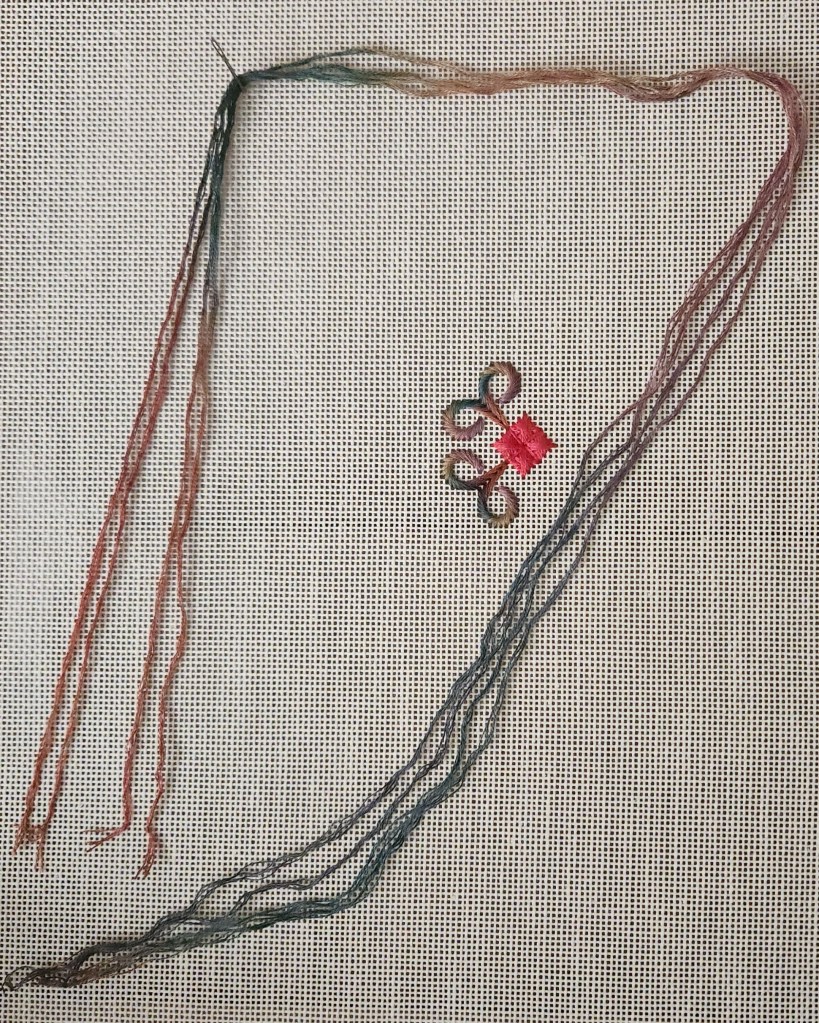
I am celebrating Happy Thread the Needle Day which is an entire day devoted to stitching! Hope you got some stitches in today. Even one length of thread stitched per day will allow you to progress on a project. Enjoy your time!
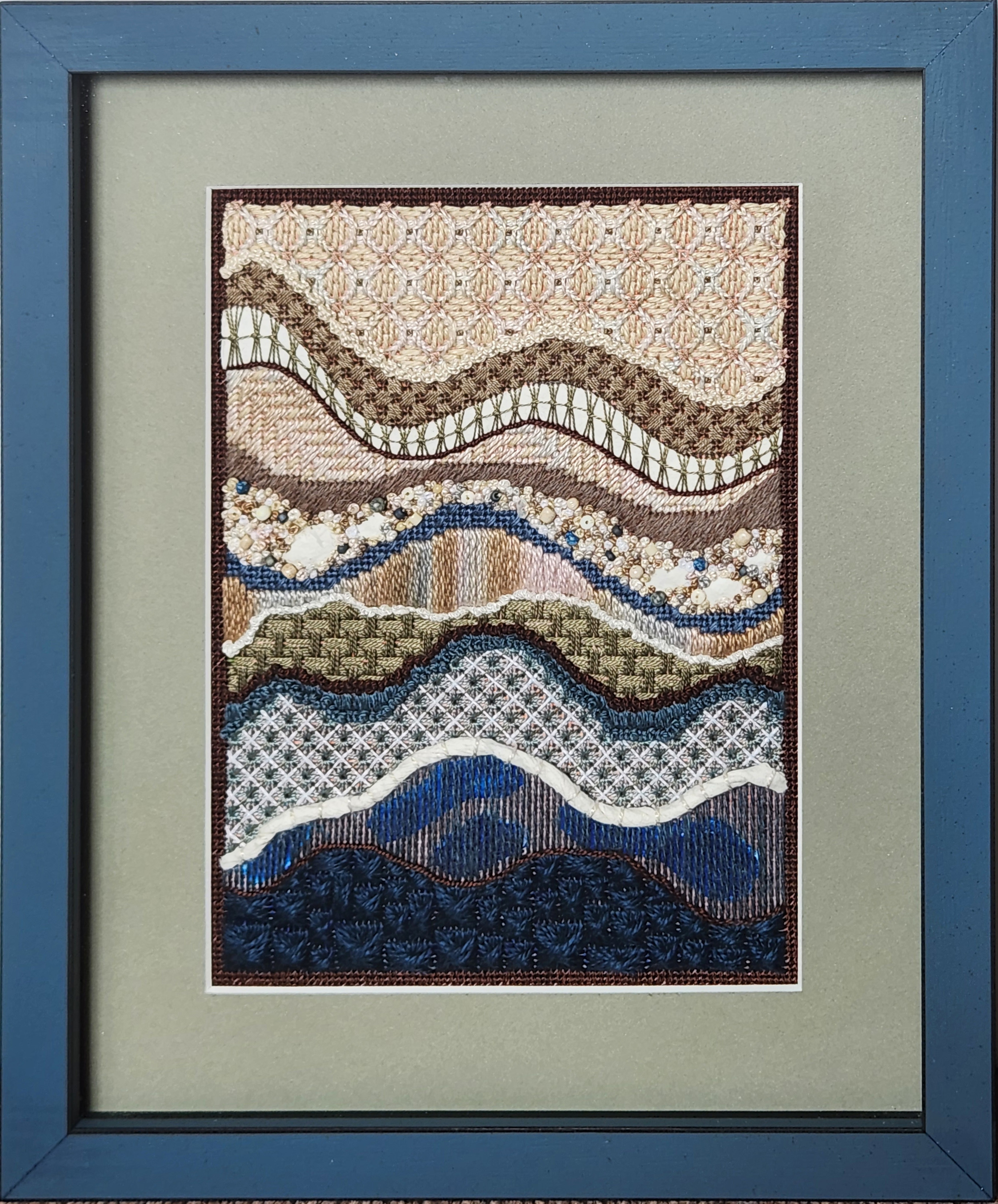
I finally took Blue Hills to get framed. You may recall from a previous post this was from an excellent class with Dawn Donnelly at the ANG 2022 Seminar. It is a “mixed media” piece that incorporates Dawn’s hand-made paper. It’s about 6″ x 8″ on 14 count. It was fun to stitch.
The small brown outer rows of basketweave was my idea so that none of edges would get covered by the mat. The bottom edge was the only even row. I’m very happy with how it turned out.
Filed under: ANG Main Line Stitchers Chapter, From Dawn to Dusk by Textured Treasures
The third motif required needleweaving which was easier and faster than I expected and fun. The color matching is with N-S and E-W because one length could do two of the four legs.

There are 4 Spider Webs. I enjoy making these but I couldn’t tolerate the spokes being uneven as they had diagrammed. So, out it came. This is the same 12 x 12 space but has 9 spokes evenly distributed. Plus, I prefer the center to be an eyelet rather than crossing side to side with an extra spoke added in. It’s so much easier to keep the center centered. So, here’s my diagram.

The other odd thing is that they say go over one and under one spoke where you should under two, back over one, and under two again. Here are my Spider Webs. Very happy!

The rest of the background went along smoothly except that working on 28 count is tougher on my eyes than even 24 count. I found a tube of Autumn Seed Beads (probably 11/0; manufacturer unknown although they are marked Made in Japan). They are a lovely mix of yellow, green, and amber. The amber was perfect. I needed 37 beads and had way more than enough. They added a lovely final touch.
Several weeks ago, after a few months hiatus, I finally made it back to a meeting of The Needlework and Textile Guild of Media.
My Show and Tell was all six Steps of my EGA Master Craftsman program for canvas. Everyone was quite interested. It was fun to see them all together! The fireplace is at the framer getting ready to go to Boston. I digress.
The demo portion of the evening came from Merril who showed us her felt applique pieces. Then, we selected 6 pieces of varying colored felt shapes and threads. She gave a handout with whipstitch (hidden and visible), blanket stitch, running stitch, and backstitch to use to attach the shapes to a 6″ square gray piece of felt.
I played with the shapes until I got an arrangement I liked. How would you have arranged them?

Then, I attached each shape with a different stitch.

Since we were given 2 large square bases, I made a second piece rather than use it as a backing for a small potpourri pillow.
I came up with the second design to allow me the opportunity to practice the French Knot technique taught by Judy Jerow. I learned that all felt is not created equal. I had to switch to a denser felt because the French Knots were sinking into the fluffier felt. Her French Knots are the tiniest! I used Wildflowers 027 Lemon N Lime for the flower. And, I wanted to try a scalloped buttonhole described by Mary Corbet (https://www.needlenthread.com/2013/04/stitch-fun-scalloped-buttonholed-chain-stitch.html). For that, I used Wildflowers 066 Jade. Very nice effect.
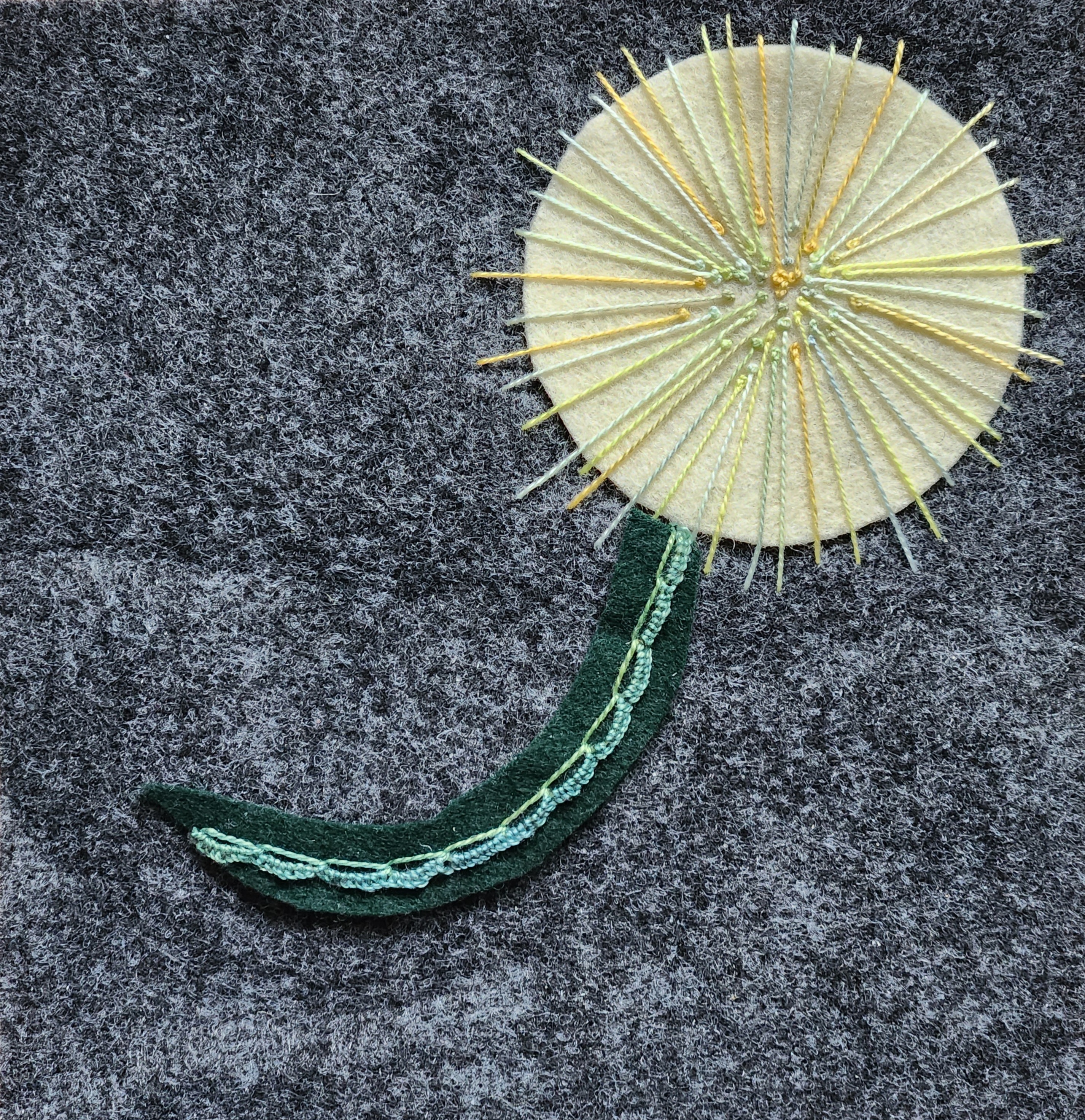
They are a perfect size for trivits. So, I ordered 2 of them from YarnTree. They withstand up to 350 degrees. The felt was just as thick as what would fit.

Join us at The Media Arts Council (11 East State Street in Media) at 7 pm on Tuesday June 13. It’s always the second Tuesday of the month. On July 11, I will share my limited experience with goldwork.
Filed under: ANG Main Line Stitchers Chapter, From Dawn to Dusk by Textured Treasures
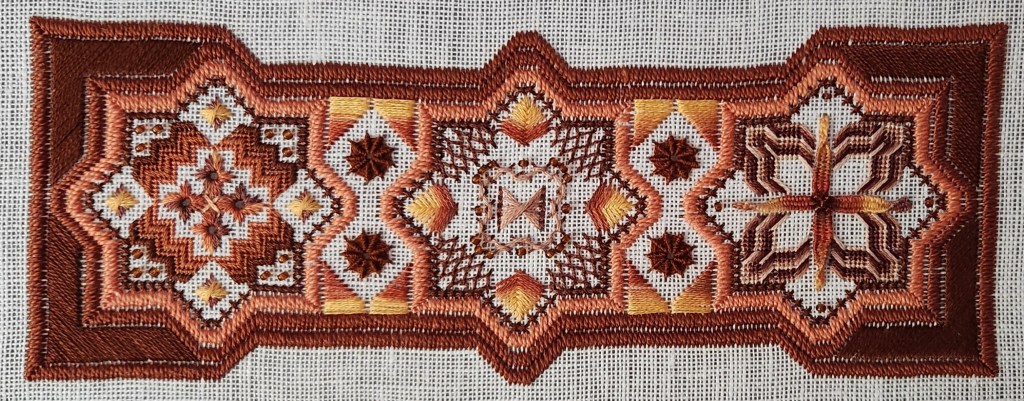
Back in October, my ANG Main Line Stitchers chapter started From Dawn to Dusk by Textured Treasures (you can find them on Facebook). The full design is 12 motifs done on 18 count canvas. But, they also sell the instructions in batches of three done on 28-count on Lugana and four motifs individually (count unknown). I think I am working on 28-count Cashel linen or Lugana.
In December, I added the outer border but didn’t feel it was blog worthy!
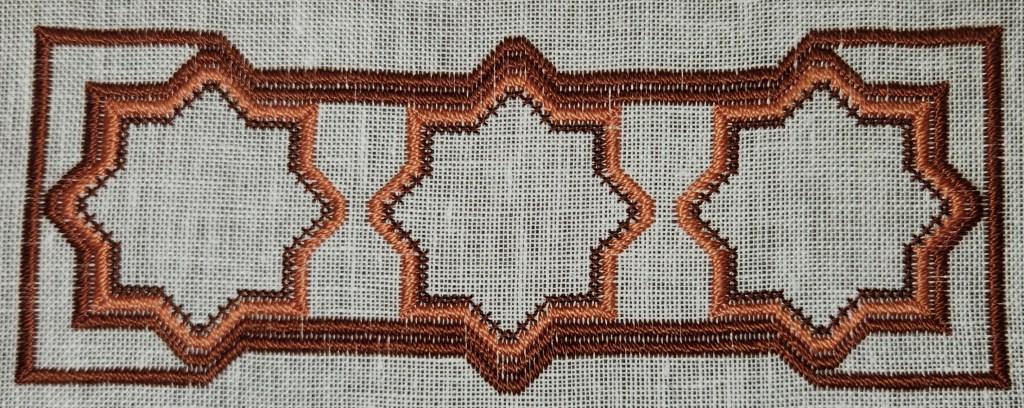
Well, I decided to get back to it for my Saturday Stitch-in project today. So, I had to stitch some difficult areas over the last couple of days. Kristen has given us some good tips for the motifs. The Mexican Stitch in the corners of the center motif and the raised Chevron Stitch were very challenging stitches. The Mexican Stitch would make a good background.
I color matched my overdyed thread in the first two motifs so, I will have to color match in the third! I still have a few beads to add. In the left motif, I used the largest yellow section of the overdyed thread for the diamond Rhodes and the darker colors for the Algerian Star eyelets.
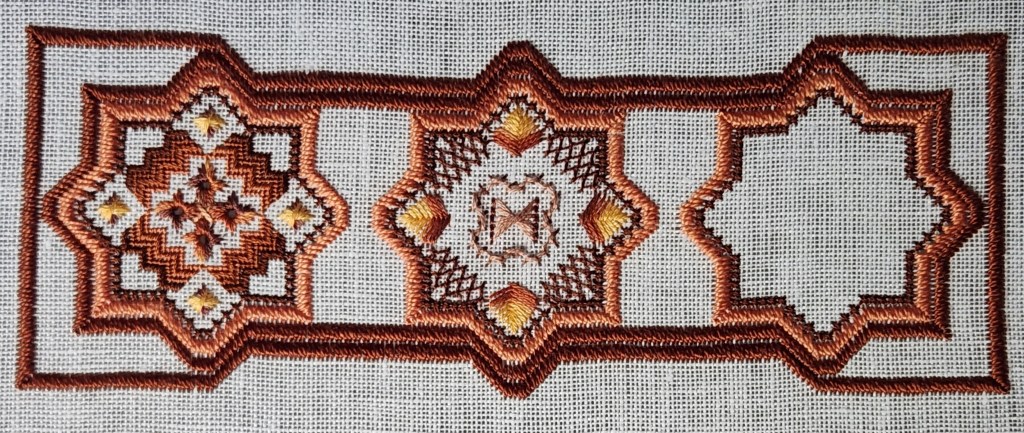
I’m going to focus on this piece until it’s done!
Filed under: ANG Certification Programs
Did you know Sheila B was the first to complete American Needlepoint Guild’s (ANG’s) Master Needlepointer Program revamped program? Her experience with the first 4 stages is written up in the Sept 2018 issue of Needle Pointers. Briefly, there are 2 phases. The first 4 stages test the stitchers techniques, use of color, and texture. The first 2 pieces require transferring a design provided by ANG and the second 2 pieces require you to select stitches appropriate to a painted canvas (either one you paint or purchase) with a landscape or a seascape. The second phase, Senior Master Needlepointer, requires creating original designs. Judging is twice per year but you can take up to 5 years to complete the first 4 stages.
The other four ANG certification programs are discussed in the following issues:
- Master Needle Artist, Sept 2020; “designed to advance the artistic skills within the Candidate and to develop that ART into an original needlepoint design”.
- Judging Certification, May 2021
- Master Teacher, Sept 2021
- Needle Appraisal, Nov 2021
Brenda has shared her experience with ANG’s Master Needlepointer Program on her blog, Brenda’s Needlepoint Studio. She learned about this program from an article written in ANG’s January 2021 issue of Needle Pointers where a description of the four stages was given. Brenda completed Stage 1 which had to use 8 of 20 stitches including a pulled thread stitch in a monochromatic colorway using DMC floss to demonstrate the usage of the appropriate number of strands. She used basting and pencil to transfer the design to Congress Cloth. Brenda worked within the blue-greens and used a variegated thread from ThreadworX. Brenda passed by receiving 99 out of 100 points. Love her colors. Looking forward to seeing her second stage piece!
For more info go to https://www.needlepoint.org/page/Certoverview

 Melitastitches4fun's Blog