Filed under: Embroidery Guild of America, Going Places: Hands-On Design and Color Class with Laura Smith, Seminar 2026-Orlando
From my starting point in the morning using paper to preview, I decided the arch was too wide and my vase/urn was too small. But, I decided on the background fabric to go underneath the painted Lutradur. Which would you choose?
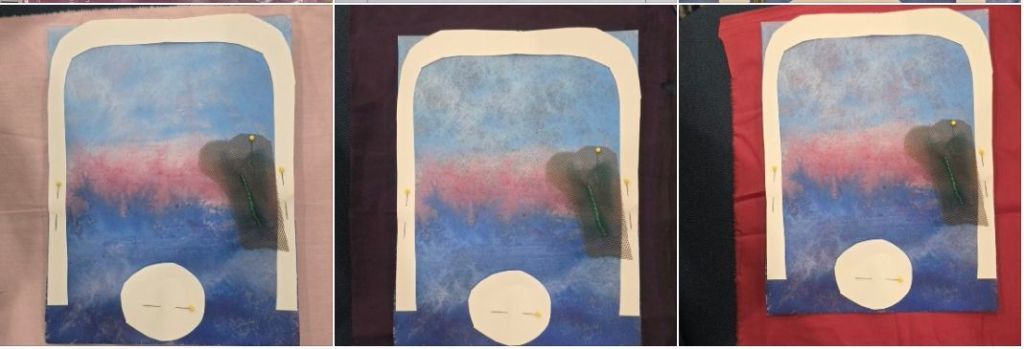
I went with pink. And, I narrowed the arch and enlarged the urn. Laura had raffia that might work for the trees except I want a brown. That’s a tree on the right using window screen in green on top of a brown that would then get stitched.

So, I got this far with yesterday’s design in the morning. Before proceeding, I feel the need to work out the size and shape.
I regrouped at lunch knowing I still had 1 and 1/2 days of class. So, I pulled up another image, Flower Garden and Bungalow in Bermuda by Winslow Homer, a wedding gift from Ann D.
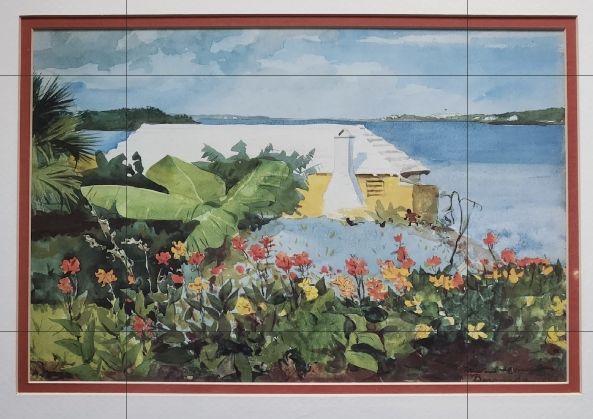
Back to painting Lutradur and then pulling fabric got me here by the end of the day. There is a lovely print under the painted green area adding subtle coloration. I utilized the fluid medium to prevent fraying of the fabric used for the white roof and yellow building. But, I see now my roof isn’t long enough.
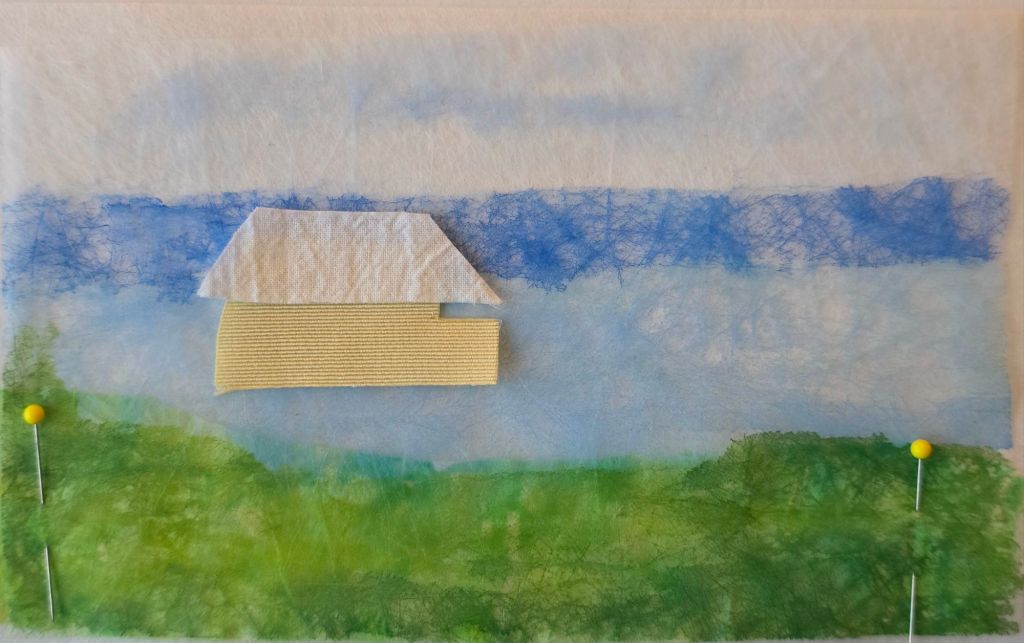
Only the roof needed to be recut because the building will be covered by foliage. I kept extra and redid it before the closing banquet (held the night before the last day).
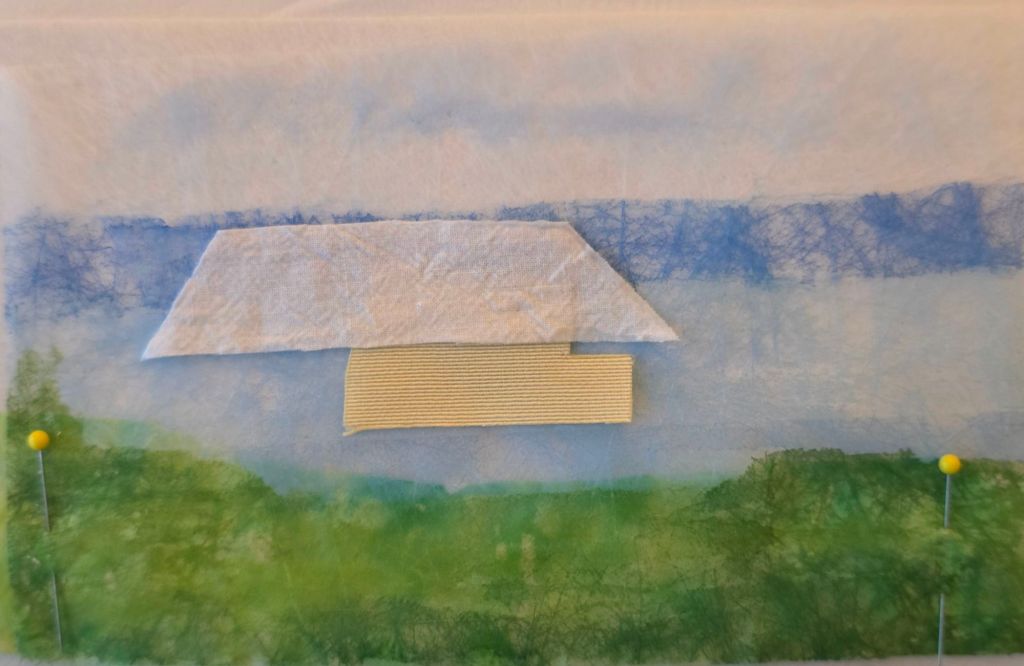
I keep reminding myself that mixed media is not my normal area and it’s not likely to be fantastic. But, I look at my classmates progress and honestly feel like I’m not getting it! Bill is very encouraging and I doubt that I can find a counted canvas class willing to adopt me for a day!
Filed under: Embroidery Guild of America, Going Places: Hands-On Design and Color Class with Laura Smith, Seminar 2026-Orlando
It’s been a couple of years since I attended an EGA Seminar. But, the 3-day class with Laura Smith Going Places: Hands-On Design and Color was something I didn’t want to miss.
Here’s our kit with lots of unusual items including Lutradur. We also have access to Laura’s Class Treasure Chest.
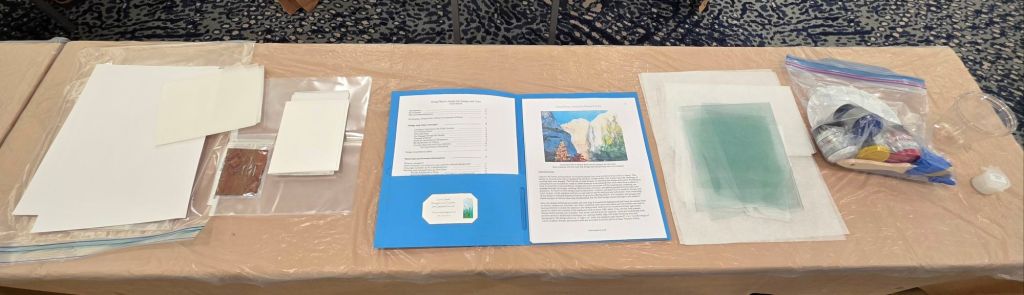
We’re getting a lot on design principles and hands on painting today.
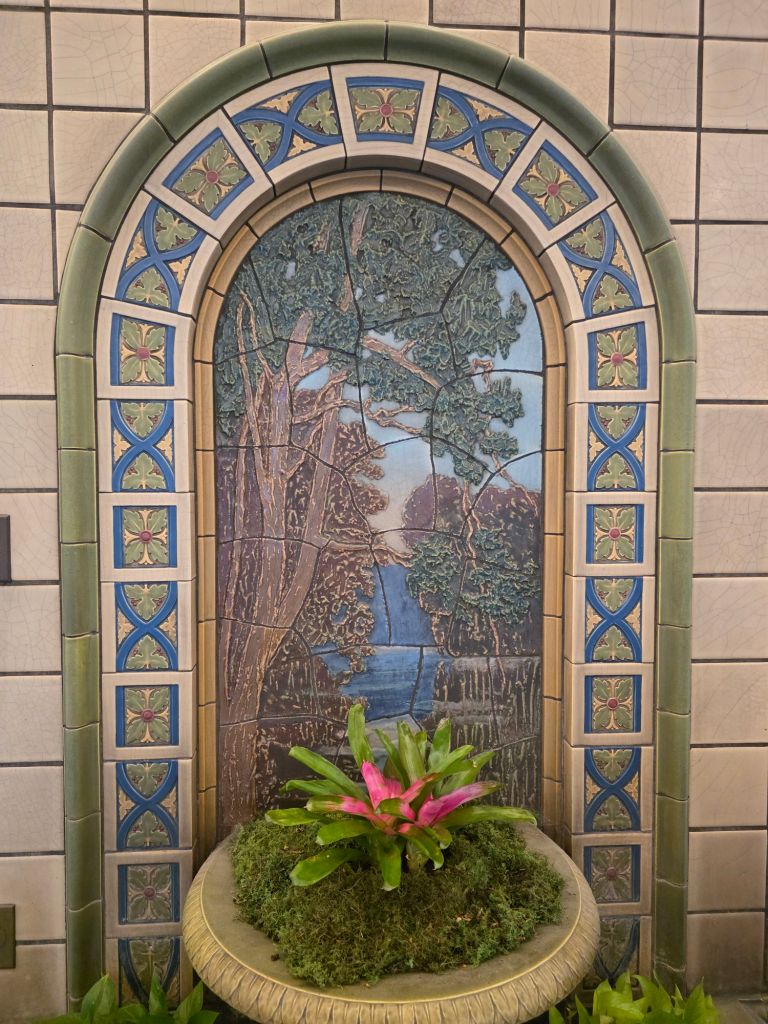
I took this photo during the Anheiser-Busch tour in St. Louis. Thanks to Laura and my classmates, I discovered the flower is a bromeliad plant. This is what I will attempt to recreate!
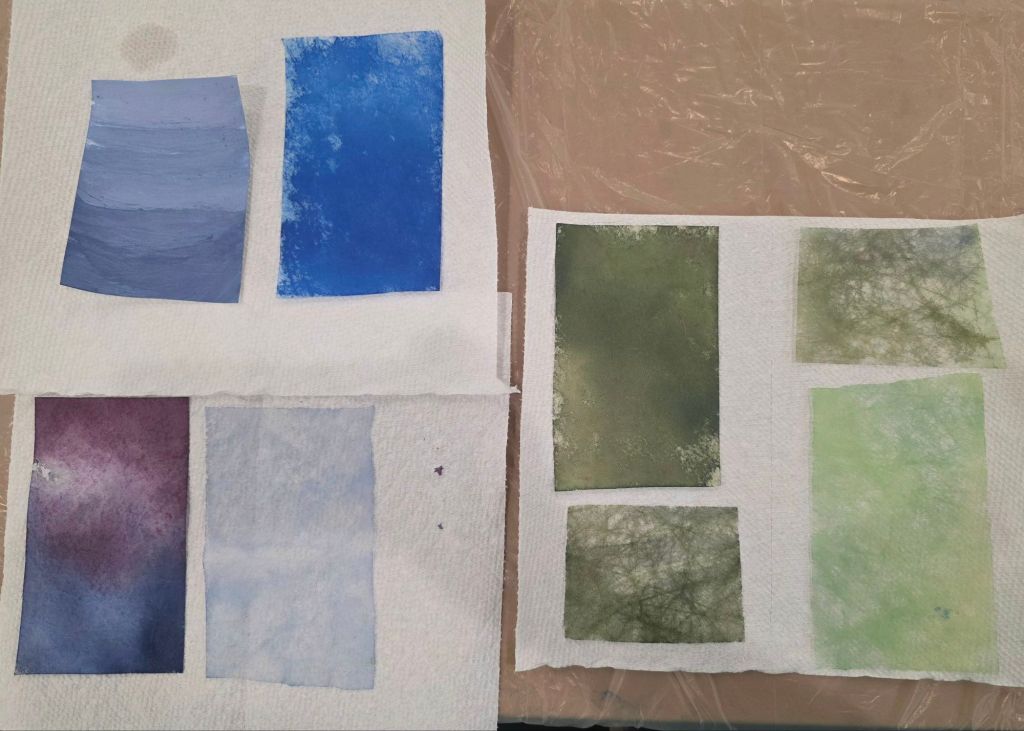
Here’s my practice painting to get used to the 2 weights of Lutradur. We got white, yellow, red, and blue which enables us to mix any color we want. The paints are Jacquard Dye-na-Flow, that despite the name, is an acrylic paint not a dye. My key takeaway was the Lutradur sucks up the paint. You’ve got to mix up enough to start with because you probably won’t get the same color blend.
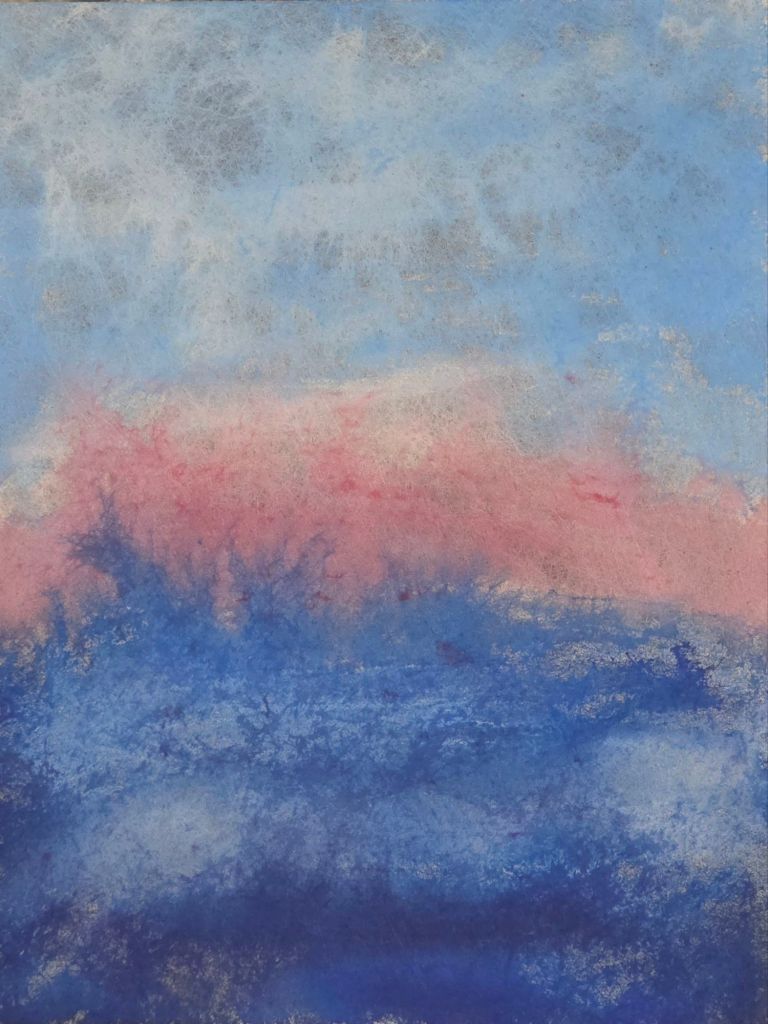
After the afternoon break, I painted my background on the heavy weight Lutradur. Most of this will get covered. Apparently, it’s easy to stitch through. I painted an 8.5 x 11 piece but am not likely to use it all. My issue came from stitching two colors to close together. They bleed on this material. Had I let one area dry before painting next to it, it may have been less evident. But, Laura helped me blot it from spreading too much. And, stitching will cover it. I have more Lutradur and could try again. Or, maybe painting over some of this. I’ll consult with Laura tomorrow.
Filed under: ANG Main Line Stitchers Chapter, Razzle Dazzle by Ann Strite-Kurz
Ribbon 3 of Razzle Dazzle by Ann Strite-Kurz is taller than the first 2 ribbons and has 5 steps!
Step 1 with long rows of Trame was easy and done quickly. Step 2 was the exact opposite. Small Ray stitches and lots of them made for slow going. It took multiple sessions to complete Step 2 of just one ribbon and there are 4 on each colorway. Steps 3 and 5 were easy enough. The blackwork in Step 4 was slow going too but it is worth the effort for the lacy effect.
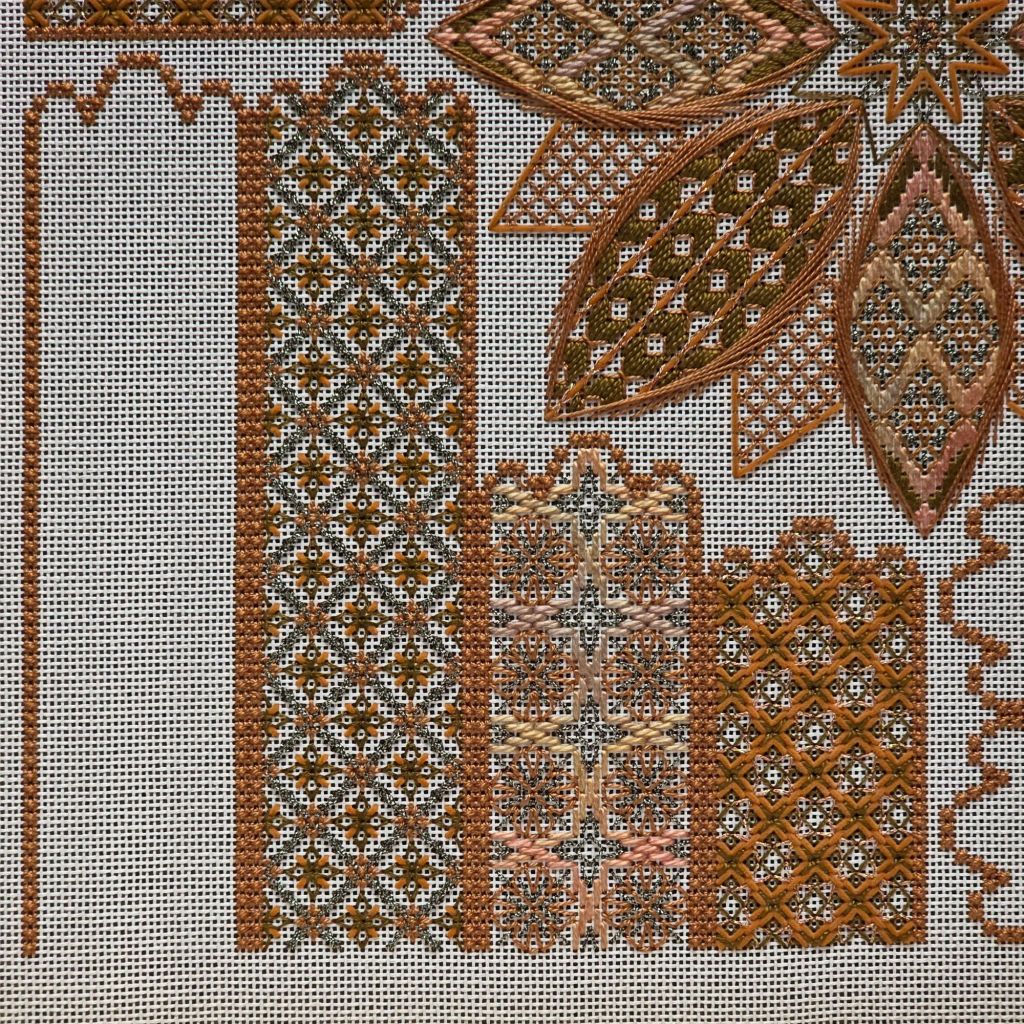
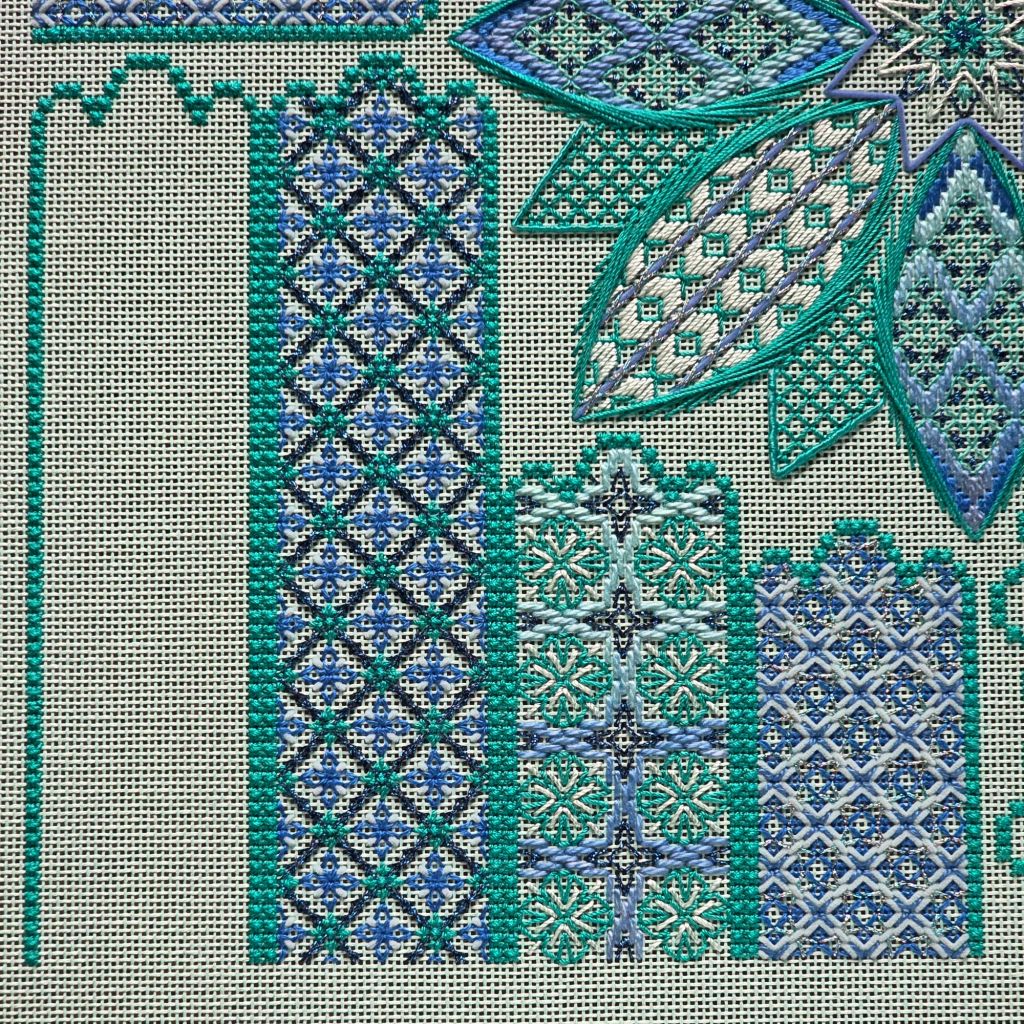
I didn’t get all four Ribbon 3 areas done before our ANG Main Line Stitchers chapter meeting (Monday night) but I am over half done on each colorway. Linda M knew folks would need extra time for this project and that’s why we’ll start our next counted project in March. January and February will be Zoom lectures.
Filed under: ANG Main Line Stitchers Chapter, L O V E, by Raymond Crawford
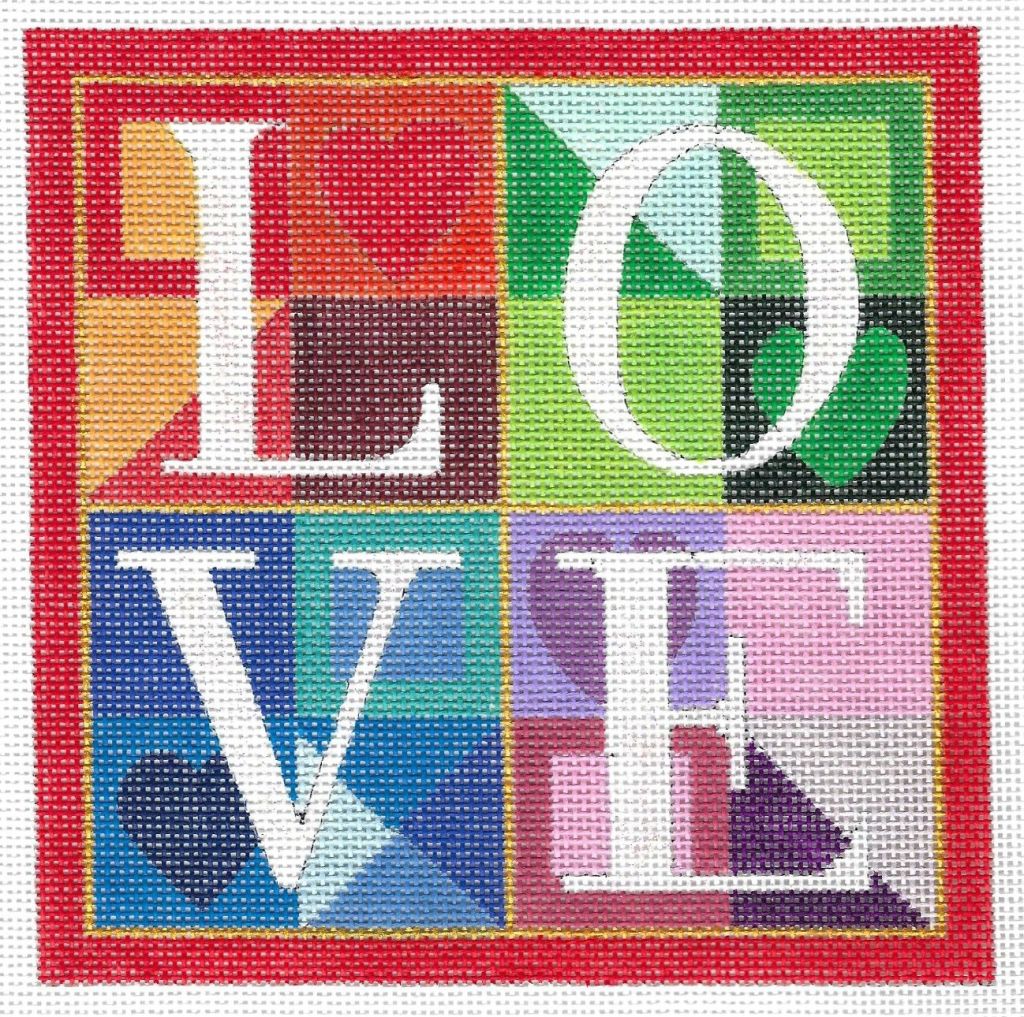
In anticipation of Colors of Praise letters (we ordered 17 letters and expect it’ll take months to get them painted), we will discuss my painted canvas, LOVE, that has lots of small spaces at our next few ANG Main Line Stitchers chapter meetings. It’s a Raymond Crawford canvas (HO-196).
I have these four needlepoint books that focus on small stitches:
• SuZy’s Small Stitches by SuZy Murphy
• Quick Stitch Variations by Custom of Needle Arts LLC (for local needlepoint stores to sell)
• Mary’s Whimsical Small Stitches, Volume 4 by Mary Legallet
• Desert Island Stitches, Volume 1 Ideas for Small Spaces by Carole Lake and Michael Boren
I’m almost afraid to ask (and tempt me)! What can you add to those?
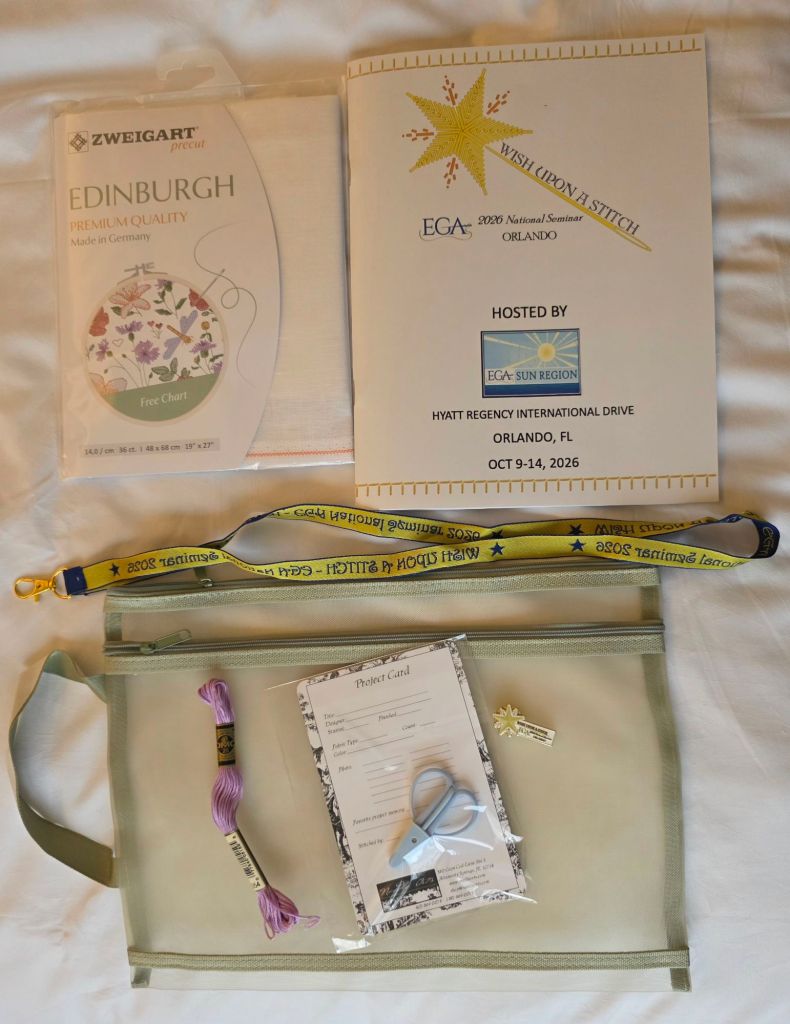
I was able to check-in for EGA Seminar today and got lovely Welcome Favors in a project bag (love the handle and 2 pockets), Zweigart Linen (36 count 19″x27″), DMC skein, scissors (from Needle Orts in Altamonte Springs, FL), and such a cute needle minder. Very nice.
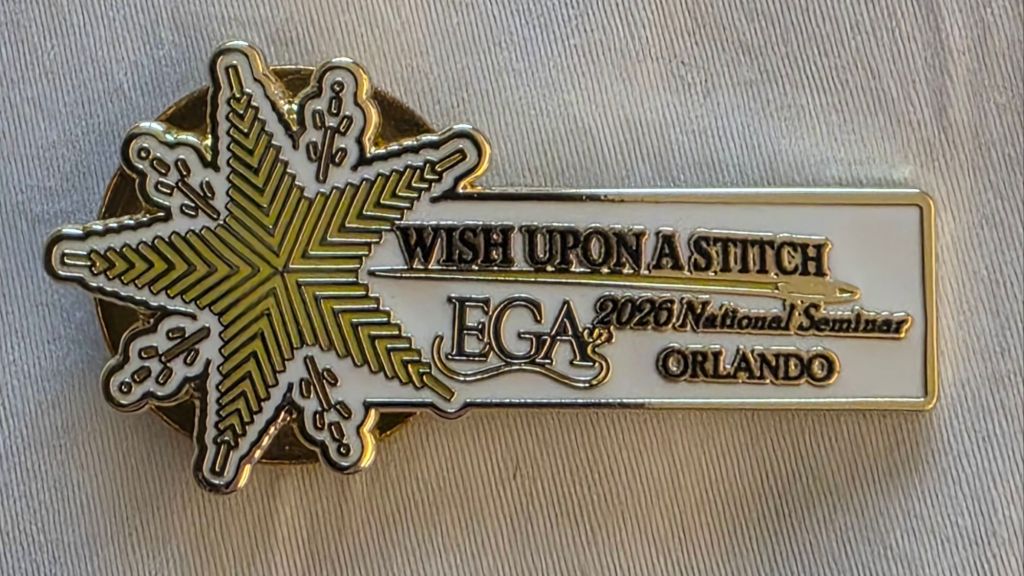
The storm in the Gulf of Mexico has been and will be potentially impacting us up until my 3-day class begins on Monday but it’s sunny, hot, and humid today. So, we’re going wandering.
The EGA folks digitalised the brochure. So, I can read it on my phone taking a break in the shade while Bill wanders in Old Town stores. I’m in and out! Fun day.
In preparation for stitching Colors of Praise letters next year with my ANG Main Line Stitchers chapter, I purchased SuZy’s Small Stitches by SuZy Murphy. I have a couple of books on stitching in small areas but I didn’t have this one. It was published in 1998.
Amy Bunger and Jean Hilton were proofreaders. Jean comments on the book in an introduction by urging you to read what Suzy says and experiment with stitches. Sounds like my kind of book.
In addition to the many stitches, I am looking forward to reading all her tips, tricks, and humor she picked up from many of the teachers in her day. Suzy passed away in 2019 at 75 years of age.
The Table of Contents is 5 pages arranged into sections by Tent Stitches, Straight Stitches, Diagonal Stitches, Cross Stitches, Round and Square Stitches, and Pattern Stitches. There are 185 Stitches in total.
At the back of the book, there are 5 pages of stitch samples in color covering 170 of the stitches. That’s followed by an alphabetical index of the stitches and a Bibliography with some fantastic books. I’m missing a few from her list such as Brenda Hart’s Favorite Stitches and two of Marnie Ritter’s books on canvas patterns.
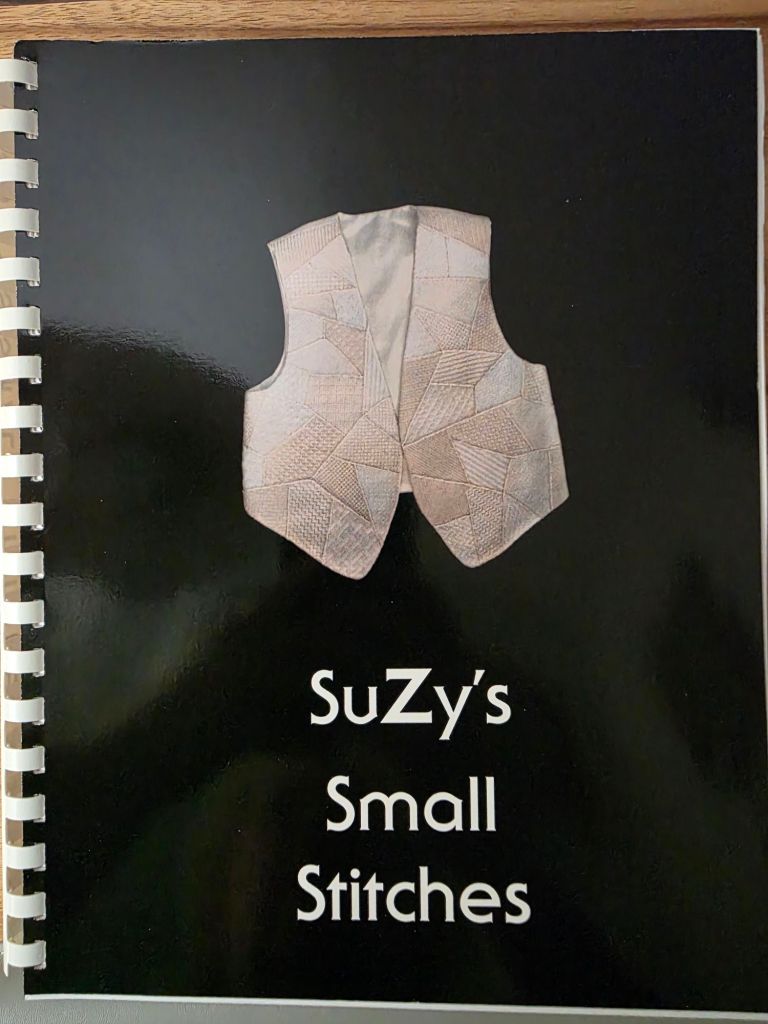
Based on one of her comments, Suzy must have stored her threads in color families. That’s how I have mine.
Each stitch has its own page with large diagrams, a sentence or two about the stitch, what the stitch would be good for (such as hills, water, etc.), and an insight about some aspect of needlepoint. After reading tips on the first 50 pages (of 162), I was familiar with all of them but one suggesting a folded paper in a triangle be used as a needle threader if you don’t have anything else available.
I heartily agree with Suzy in that it’s our patriotic duty to keep the economy going by supporting cotton farmers, wool growers, textile mills, and stitchery shops!

