Filed under: ANG New Jersey Needle Artists Chapter, Tumbling Stripes by Marilyn Owen
Last month, Jacqui from New Jersey Needle Artists continued Tumbling Stripes by Marilyn Owen by going over Stripes 1-4 (working from the center out).
Stripe 1 in blue floss (DMC 797) worked fine with 3 strands of floss. Two strands looked skimpy with just enough speckles of white showing through to make me go to 3 strands. Apparently, coverage on 24 count isn’t that much different from 18 count.
Then, I thought I would use the darker blue floss shown (DMC 820) and the Petite Sparkle Rays in Stripe 2. The dark blue 820 looks a lot darker in the photo but sure didn’t when I stitched with 2 and 3 strands up against 797 (no photos). I tried both because 3 was way too heavy, and 2 was still heavy. Then, the Petite Sparkle Rays was way too wide for the stitch on Congress Cloth.
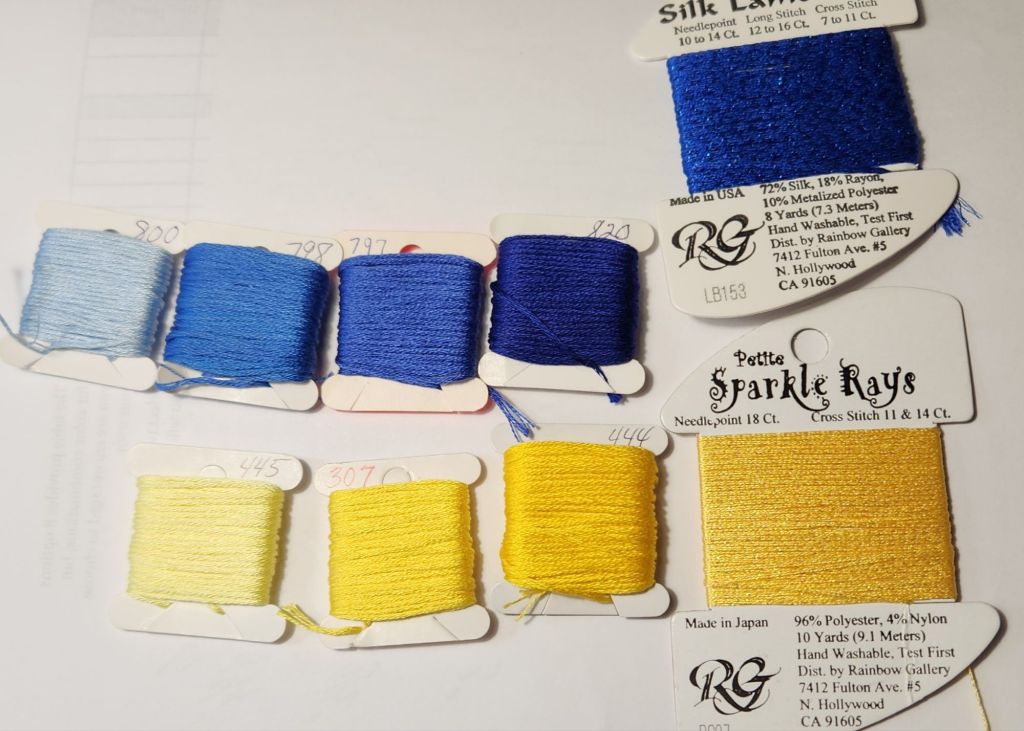
So, I pulled my old favorite Bijoux MMT437 Sapphire (same value) and decided to use 2 strands and go even thinner. And, the Petite Silk Lame Braid SP11 was thin enough to work. So, this stripe may not have the same color contrast as the original, but it definitely contrasts with Stripe 1. I was hopeful that it would work with Stripe 3, and it did.
For Stripe 3, the blue Silk Lame Braid was the right color but was too heavy (For 13 count). So, I pulled out 2 silk and 1 rayon fibers (the same as what Petite Silk Lame Braid comes as). I can’t remember the teacher who told us you can thin down Silk Lame Braid, but it works. I decided that combining them together would too, and it did. I wouldn’t recommend this for larger pieces, though. Also, since I had to repeat the first and third rows in the same DMC floss and Herringbone is worked left to right, I used half of the long floss on the top row while the rest of the thread was parked out of the way.
For the 4th stripe, I stayed with 3 strands of floss and my makeshift Petite Silk Lame Braid.

I’m ready for our next session tonight!
I heard about Adjustable Stretcher Bars by Frank A Edmunds and found a set of 12″ and 16″ online and had to try them – because they exist!
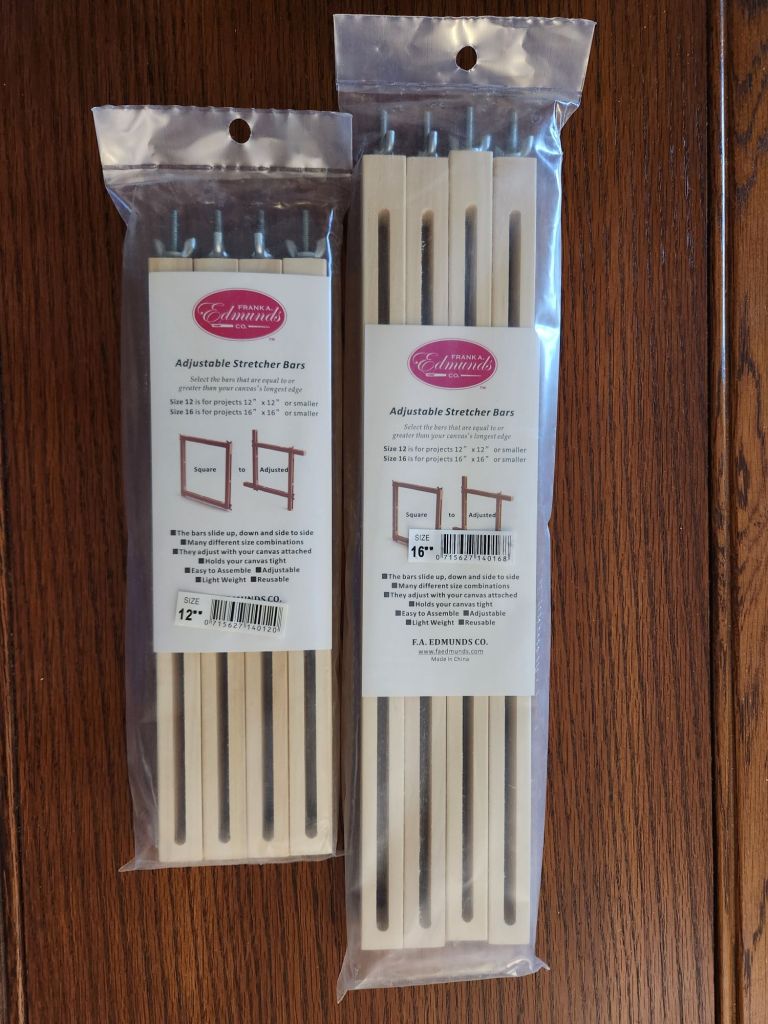
They are easier to put together than Evertite bars (no hammer needed) and square up better. But, some of the bars hang off. With the first arrangement, I could attach my lap stand along the upper left extended bar which which would be good but the lower right extended bar would be cumbersome because I am right handed.
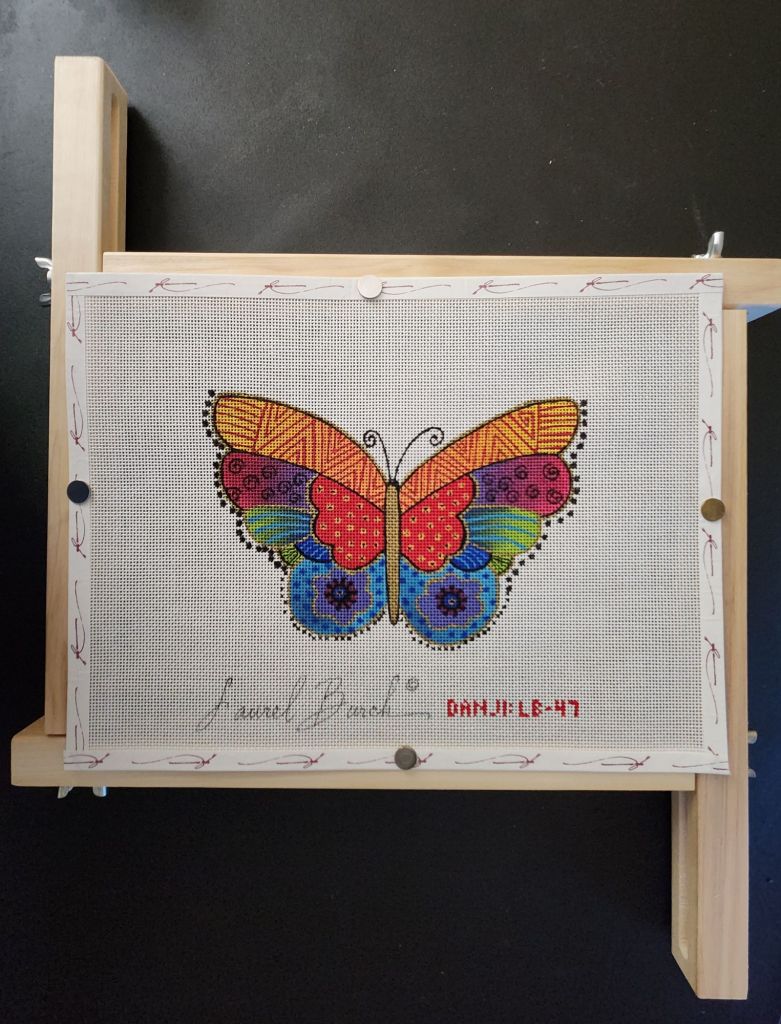
So, I switched orientation.

I can’t make the canvas more taut by shifting the bars because they interlock. Evertites are easy to stretch taut with the turn of a screw.
Once I get stitching on this project, I’ll see what it feels like.
Does anyone else use these?
Updated November 2024: They are going to Ebay. They didn’t keep the canvas tight. And, they easily got bumped out of shape. Not for me.
Filed under: ANG Needle Pointer's Article, ANG Needle Pointer's Timeless Treasures From the Archives
It’s rare for me to have worked on the diagrams for a piece in the ANG Needle Pointers magazine and still have the stitched model (unless it’s my design). But, my Needle Pointers magazine arrived today, and I still have it.
At some point, the stitched piece went from Ginny, the stitch guide writer and stitcher, to Maureen, the editor in Maine, who took it to Seminar in Atlanta, gave it to Kristen who I know flew with it back north to the Philadelphia area, and finally gave it to me. I am waiting for the shipping address to return it to Ginny. I wonder home many miles this has traveled! Hopefully, it will go home before the next Seminar!

As you can see, there is usually plenty of time to get photos, diagram, and put the stitch guide writer’s text into the format for the magazine. Consider:
- volunteering your time to help with articles. Staff does need to rotate periodically.
- offering your painted canvas stitch guide for an upcoming magazine. Keep track of threads and stitches used, and we can turn it into a lovely stitching project like this one.
And, I would be remiss if I didn’t mention the Timeless Treasures From the Archives. I love reading the old issues. This month takes us all over the internet and back to various alphabet diagrams that never go out of style.
Past and present issues are available online to all ANG members (needlepoint.org).

Bill and I will not make it to Woodlawn until the end of the month. But, photos of the special award winners are posted and a list of the just over 400 entries with award winners named are also posted at https://www.woodlawnpopeleighey.org/2024specialawardwinners.
I went through the list and only saw 2 entries for Canvaswork Multi-Stitch (4+), Original design, Adult. My Fireside Sampler got a 3rd Place award and the other by Mercedes B for Porch at the Grand Hotel got 2nd place. I never took a photo of my framed piece before sending it for exhibit! So, that will be in the post when I get it back from the exhibit along with any other comments from having seen the exhibit in person.

There were some Canvaswork Multi-Stitch (4+), Commercial Design pieces that I recognized by name including Pyramids of the Oasis, Swan Song, Razzle Dazzle, Confetti, Medieval City, Raffie, Africana, and Northern Lights which were all from ANG New Jersey Needle Artist Chapter members. There are a couple of pieces called Fibonacci but not sure if they are the Fibonacci Swirls by Olivia Hartshorn (ANG Needle Pointers Mar/Apr 2022), and Anaszi Dream, and Walking on Waters Edge that are name I recognize. There are plenty in the category, close to 100, but I don’t know them by name.
Deborah Merrick-Wilson had 3 original designs in goldwork win awards – always lovely pieces!
And, Norma C won (for the second year in a row) the Director’s Award for her work on The Majesty in the Miniature category which is when the piece is worked on at least 32 count over 1 thread. It does not have anything to do with the size of the piece. She told me her piece is about 15 inches by 7 inches and is worked on 36 count linen over 1 thread. I’m looking forward to seeing her piece in person, too!
Congratulations to all regardless of awards – it is always a great exhibit. It’s running through March except on Tuesdays.
I’m still cleaning up and organizing my needlepoint (fighting a never-ending battle against acquisition, clutter, and letting go). One pile had this experiment with skip tent basketweave and skip tent horizontal that I decided (for a little while) did not have to continue.

Then, I found another 3″ square already stitched. So, I decided to finish this one for a pair of coasters (not that they match). When these get worn, I won’t mind (as much) throwing them away.
I found the repeat of colors on a skein of Watercolours (Painted Desert 093). I made sure colors did not repeat when folded in half. Then, I cut the threads the same length. Each of the 4 areas was stitched differently as follows:
The upper left corner for 19 diagonal rows starting in the upper right corner of that square: Skip tent basketweave, reverse thread to fill in, then skip tent basketweave.
The upper left corner for the next 11 diagonal rows: Basketweave every other stitch up and back down, reverse thread, and repeat. Ok, I admit that I actually made a mistake following my own diagram and wasn’t ripping it out! I can see the middle is different from the two corners.
The upper left corner for the last 15 diagonal rows: Skip tent basketweave, reverse thread to fill in, then skip tent basketweave.
The upper right corner starting in the upper right corner: Skip tent horizontal, reverse thread to fill in, then skip tent horizontal.
The lower left corner starting in the upper right corner of that square: All basketweave.
The lower right corner starting in upper right corner of that square: Skip tent basketweave, reverse thread, then skip tent horizontal.
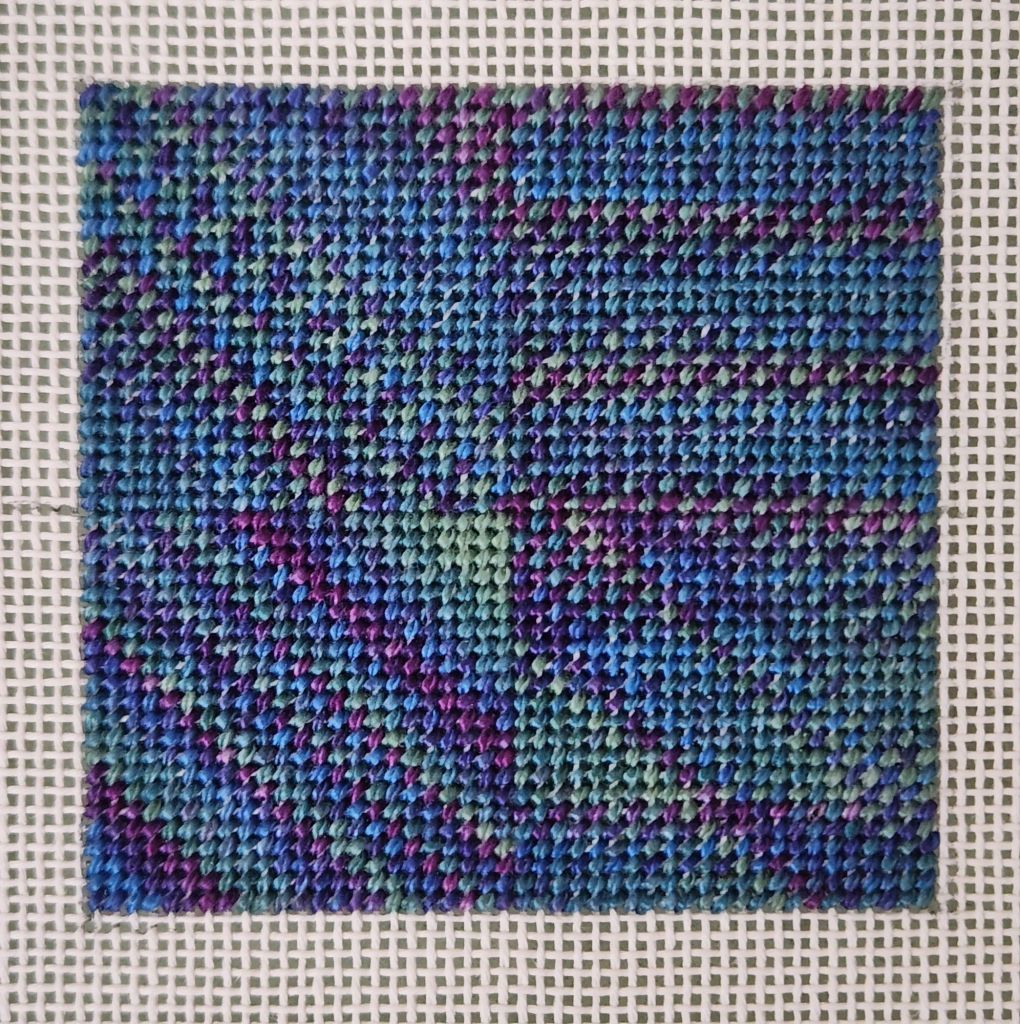
What did I learn besides what I already knew which was that the stitch path makes a visual impact on the color flow?
The skip tent basketweave may have had the least streaking if I stitched it correctly.
A horizontal effect can be obtained. That was a surprise, probably because I had never stitched skip tent horizontally before.
Basketweave created the most streaks, which are clearly diagonal.
Combining skip tent and skip horizontal resulted in some diagonal streaking and some clumping of colors.
Another overdyed thread probably would have yielded different results. And, where you cut the thread will also change the look.
Filed under: ANG Delaware's Seashore Chapter, Stitches in Sterling by Nancy Cucci
The beaded center of Stitches in Sterling by Nancy Cucci is done in just 12 years and 5 months! It was not nearly as intimidating as it was when I started it.
That’s a lot of beads in a small area. Very fun. The 40ss Swarovski Crystal jewel was the last to go on. It took some effort to get the prongs of the ring mount through the stitching far enough to bend them inwards to hold the bead securely and not have the stone jiggle.
We’ll be visiting Jim at Repenning Fine Art for framing sometime soon.

Filed under: A Spring Sampler, Brandywine Chapter, Embroidery Guild of America
I had a Stitch-in Tuesday with my EGA Brandywine Chapter members. Patrick has been stitching on this project with regularity, and it’s coming along nicely.
I can’t remember when I stitched Bands 5 and 17, but all Tuesday, I kept looking at them, thinking something wasn’t right. It wasn’t until I got home and finishing up the now bottom Band 18 that I realized I had used the wrong thread for Bands 5 (second from top) and 17 (second from bottom).

It really pays to start and end your threads carefully enough to be able to rip out without disrupting the adjoining area.

And, here are Bands 5 and 17 looking much better. Agreed?

Filed under: ANG New Jersey Needle Artists Chapter, Tumbling Stripes by Marilyn Owen
I ditched the threads I’d gathered for Tumbling Stripes in favor of DMC cotton floss. The first batch just didn’t look right to me when I went back to start the project, Tumbling Stripes by Marilyn Owen.
My floss has a better selection of light, medium, and dark yellows and blues. So, I matched the yellow Petite Sparkle Rays to 445, 307, and 444, and the blue Silk Lame Braid to 800, 797, and 820. I included yellow because Jacqui, who is leading this for the ANG New Jersey Needle Artists chapter, has a Zoom talk, Why You Need Yellow in Your Life, which we enjoyed a while ago.
Our assignment this month was to select threads and baste. Well, I don’t like basting. So, I stitched the blank faces of the cubes first. They are actually the last step before the borders, but they line up with the stripes. Since I am doing this as an ornament, I will have to round it out after the stripes are all completed with the same light yellow thread.
Because I am stitching on Congress Cloth, I am using one less strand than suggested for 18 count canvas. I am all ready for February’s meeting next Wednesday night (thanks, Cathryn for reading my blog and letting me know about the date change for February; I even updated the NJNA website but not my calendar).

Filed under: ANG New Jersey Needle Artists Chapter, Ruby Razzle Dazzle by Ann Strite-Kurz
A few years ago, quite a few members of the ANG New Jersey Needle Artists Chapter (NJNA) stitched Ruby Razzle Dazzle by Ann Strite-Kurz. They came up with some great colorways (https://njneedleartists.org/njna-workshops/sotm/2015-sotm-ruby-razzle-dazzle/).
I have had these instructions for a year or so. After reading Ann’s books and seeing Diane’s completed piece at the NJNA Holiday Luncheon in January, I decided to try the patterns. But I can’t commit to doing the whole piece – maybe sometime.
By choosing the shortest ribbon to work first as a stand-alone piece, I was able to test the waters. Ann explains her thought process and logic for stitch paths, which is much more detailed than in other counted designs. It’s like taking a design class from her.
I completely understood and followed the logic of the shifting direction of Smyrna stitches because I went into that in my Crescent Journey design.
Ann describes how she developed the variation for this diamond lattice from a Scotch Stitch. Then, she explained how she placed the pattern. Wow! This may be too much information for some stitchers, but I think it is fantastic and brings together the concepts described in her books.
However, her recommended path and pivot concept to conceal the traveling path on the lattice reminds me that I did not do well in organic chemistry whenever I had to go from one compound to another in over 10 steps. Seeing 5 or so steps was my limit. No threads show through. I never would have thought of her efficient stitch path.

While the sequence for filling in the units made sense, Ann made it sound like it could be done in 2 paths, but I needed 3. My threads weren’t long enough anyway. Still no threads showing through, though, which is good.
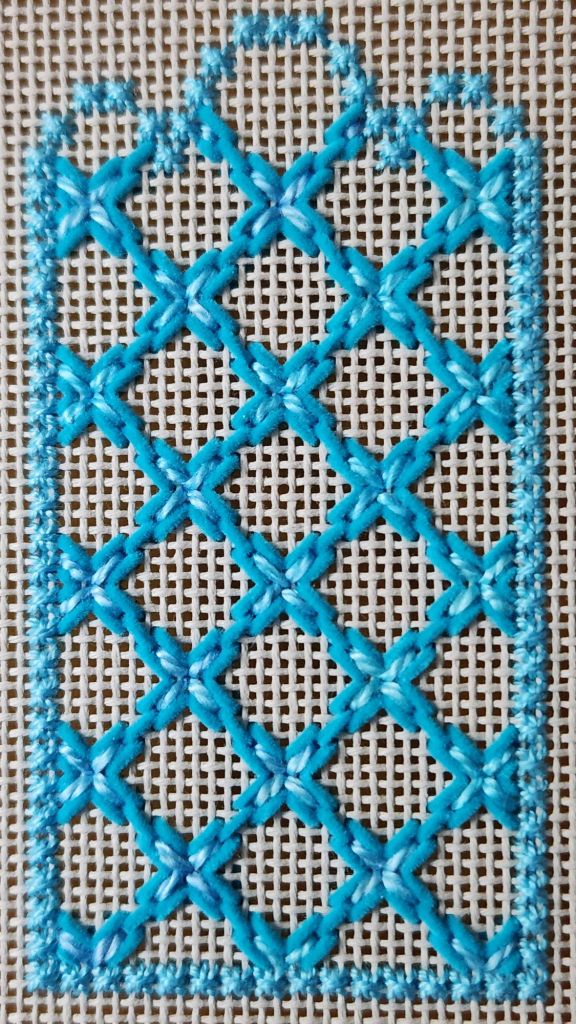
The blackwork pattern used 2 strands and was easy enough to follow. My canvas is pewter a light blue gray, but since this is such an open pattern, a more colorful canvas might be better.

The last step is also a blackwork pattern used a double running technique, which also made sense to me.

I used some different theads than recommended, such as Pearl #12 for the Smyrna stitches, because none of the Pearl #8 in my stash was the right color. I had a Petite Very Velvet. I went with one strand of Watercolours instead of a Pearl #5 and two strands of Weeks Dye Werks instead of 2 strands of DMC Floss.
I wonder what the next band will be doing?
Filed under: Explore and Design with Debbie Rowley, Other People's Designs
Thanks to Marilyn O, I signed up for Explore and Design with Debbie Rowley.
As of now, there are still 6 openings (of 20 max) for her inaugural class on this topic. There will be 6 weekly Zoom classes between March 14 and April 18, and I have no conflicts!
Interested in joining the fun? Registration ends February 25 or when the openings are filled. Read all about it at https://debbeesdesigns.com/product/explore-and-design/
This is a collage of some of her designs on the cover of her booklet, and the bee sits on a green magnet. Very nice!


