Filed under: Backgrounds, The Finishing Touch by Ann Strite-Kurz, Books in My Library, Canvas Applique by Ann Strite-Kurz, Diaper Patterns by Ann Strite-Kurz, Needlepoint Books, Potpoutti of Pattern Encore by Ann Strite-Kurz, Stitch Refinement for Canvas Embroidery by Ann Strite-Kurz, Stitch Variations and Mutations Partsc1 and 2 by Ann Strite-Kurz
Ruby Razzle Dazzle captured my attention and introduced me to Ann Strite-Kurz’s designs. It is a collection of a variety of techniques which looks exceedingly complicated but lovely! I did get the booklet of instructions recently and will get to it. But, it is not a needlepoint book.
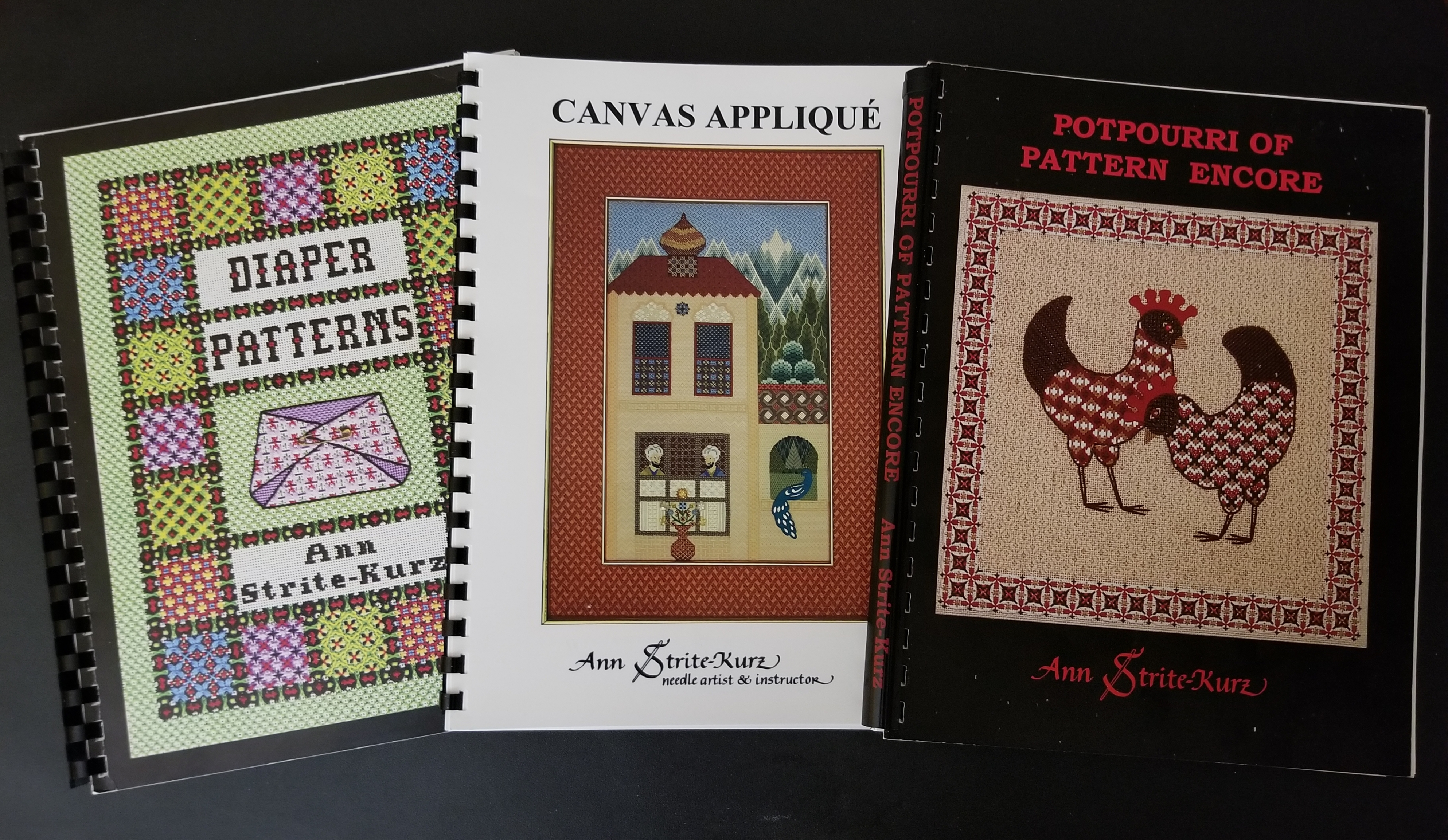
The first book in my collection of books by Ann is Diaper Patterns. I needed it in order to create a diaper pattern for Step 3 of the EGA Master Craftsman program. Ann’s inscription to me reads, “Welcome to my world of Diaper Patterns”. What a comprehensive booklet with 131 pages and a CD with about 500 images! The diversity of the outstanding examples are due to many contributors who provided finished pieces and stitch samples. Many of the people I have had a pleasure to meet over the years or take classes from. It’s such fun to read about a piece that I admire even if I haven’t stitched it. Linda from ANG Main Line Stitchers completed Dorothy Lesher’s The Snowbird beautifully and Ann describes and diagrams (with Dorothy’s permission) one of the white and blue patterns which is a diapered variation of the Old Florentine stitch. Ann explains that the white pattern on her dress could be a diaper pattern if the short outline stitches were executed in a contrasting color. With the images Ann provides, this provides hours of entertainment and education. Ann describes a diaper pattern succinctly as “visual diagonals in both directions” and then goes on to describe differences between groundings, stripes, and diapers. Ann describes 8 basic diaper pattern networks which I incorporated into my EGA Master Craftsman piece. I had to use at least 4 patterns and used them all. Or, I thought I had until I sent the image to Ann. Apparently, the center pattern is actually overlapping circles rather than ogees. However, keep your eyes open for a Stitch Refinement Zoom lecture by Ann that she’s working on. My pastel design may be used to illustrate how to use intensity to keep the colors separated.

The Canvas Applique booklet provides step-by-step instructions for mounting regular and irregular shapes of canvas to canvas, reverse applique, kid and ultrasuede applique, gauze applique, stone and mirror settings, and Cretan pockets. There are also a good number of illustrations using her stitched pieces. I have my two small irregular-shaped stitched pieces ready to remove from the bars to mount to my canvas for Step 5 of the EGA Master Craftsman program. I am worried about the mounting process. However, I should take the plunge and start! For those with knowledge of the process, that was an intended pun. For those unfamiliar, you pull all the canvas threads out up to the stitched portion and then weave some to the back of the small piece but most canvas threads get plunged through to the back of the main canvas and woven to the back of the main canvas. My main issue is that the appliques I designed are larger than the minimum one inch square and that is going to be a lot of canvas threads to weave or plunge and weave. But, I’ve read the mounting process several times now and have got to bite the bullet and do it!
The third book I have is Potpourri of Pattern Encore which is a collection of previously unpublished patterns for canvas and counted thread use (129 pages). The Introduction and Techniques chapter includes basics and lots of color photos of various pieces to be discussed in the subsequent chapters with more details about background patterns, border patterns, laid fillings, composite patterns, and diaper patterns. The last chapter analyzes a dozen different stitched color combinations of the same design. Fascinating. Another good book to take a deep dive into.
Updated February 2024.
I was sent Backgrounds, The Finishing Touch by mistake from an Etsy site but didn’t complain after one look inside. It includes another CD with full color plates of the 118 images described in the text. Ann’s husband, Bill, put it together for her. The best husband’s are named Bill! Well, there might be at least one of my blog readers who would disagree with that statement.

In Chapter 1 of Backgrounds, Ann discusses how and why she selected backgrounds for each piece. In subsequent chapters, she discusses planning and execution, darning patterns, back-stitched outlines, textured patterns, and couching patterns.
Stitch Variations and Mutations discusses the structure of stitch families in order to plan stitch variations. The Summary Sheet at the end of Part 1 offers 35 ways to derive stitch variations. Part 2 picks up 16 years later with 16 more ways she’s compiled to develop new stitch treatments.
Stitch Refinement in Canvas Embroidery expands and extends principles discussed in Science of Canvas Embroidery (Ann said I did not need both). Composite stitches and open patterns are followed by solutions to canvas dilemmas such as compensation, stem versus outline stitch, and differences in designs with center holes compared to designs with a center thread.
Filed under: ANG New Jersey Needle Artists Chapter, ANG Seminar 2021, Secret Window by Kurdy Biggs
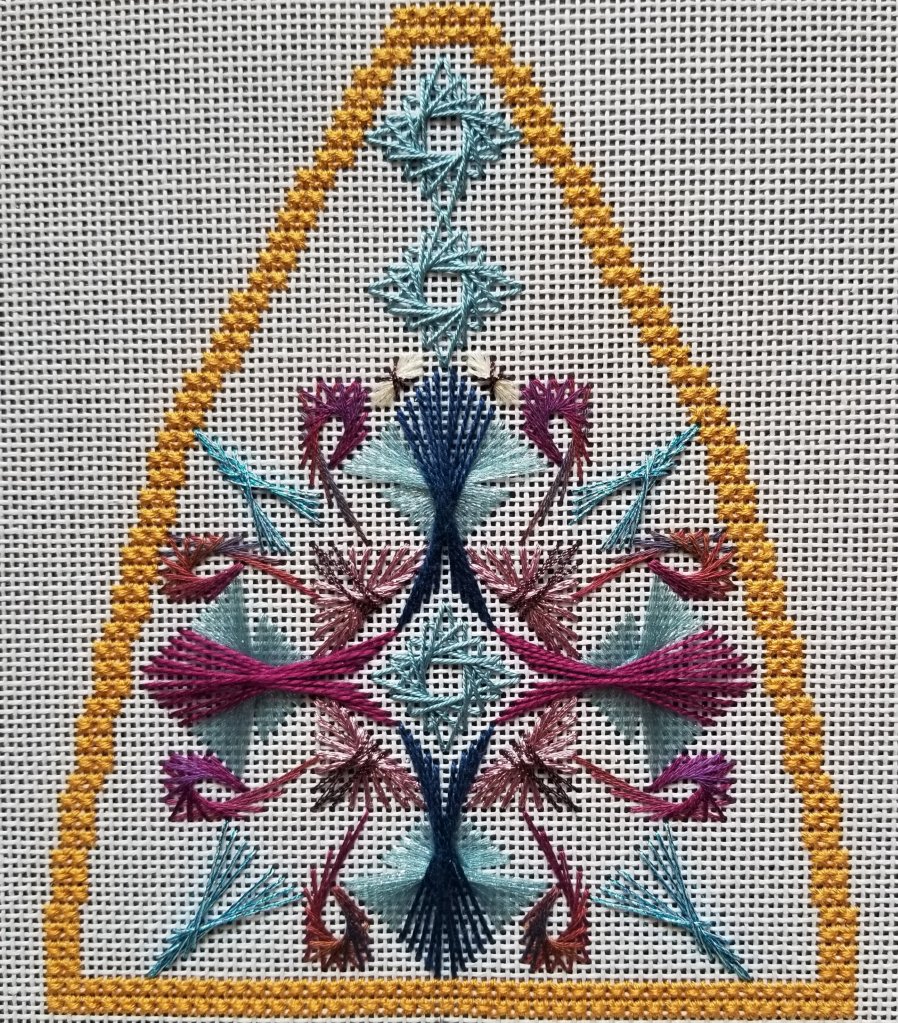
The center was squared off with Two Tone Sprats Head (Entice and Bijoux). For the eight crescents, I used Harmony, a natural-dye (explained on the Treenway website), 6-strand silk floss (from a particular silk worm also described on their website). I didn’t try to color match the skein (find the repeating color pattern). Instead, I used 4 of the 6 strands and started on the top on each side by working 2 strands counterclockwise to the left and 2 strands clockwise to obtain matching color movement.
I love the shape of the blue Plaited Ray’s between the Sprats Heads in the corners.
The 2 tiny Diagonal Sheaf stitches use 4 strands of Accentuate. It’s not my favorite thread and I realize that I have 2 spools of it. Each spool is 50M. I better learn to like it! But, for now, I was given the option to add some sparkle on the last 3 stitches. So, I did and used 2 strands of Bijoux in the center for the last 3 stitches.
Filed under: ANG New Jersey Needle Artists Chapter, ANG Seminar 2021, Secret Window by Kurdy Biggs
The Kurdy Biggs Zoom Group had a great gab fest yesterday although we missed Jacqui. Most are working on her perforated paper Ornament Diamond Drops and Linda on Cathedral. I’m doing Secret Window from ANG’s virtual Seminar in 2021.
Besides agreeing that she has lovely designs, we agree a piece of hers has to be done with a lot of concentration. Counting is essential.
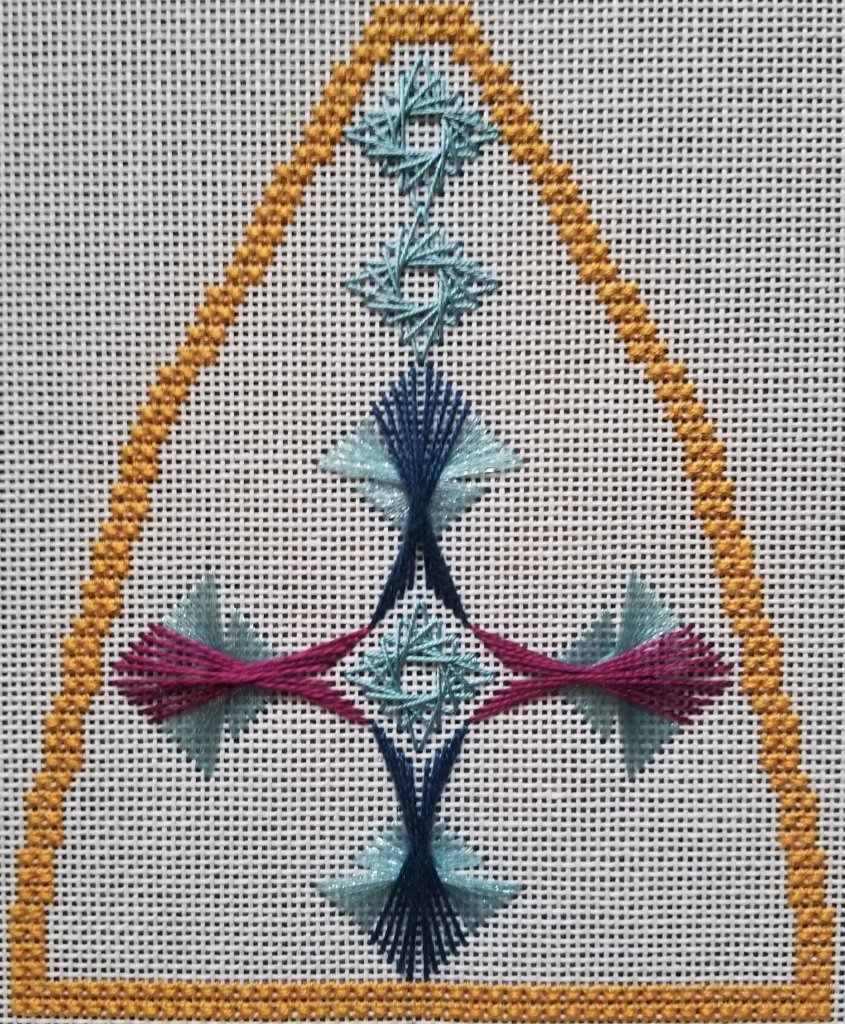
Star Jessicas got me off and running. This is the first I’ve worked with Treenway silks. This thread is Tranquility, a fine cord, between a #8 and #12 perle.
Those big motifs are called Swing Stitches which is similar to Sheaf Stitches but doesn’t allow thread to show through (using 2 colors of Zen Shin) with Hat Crescents (Water ‘n Ice). Zen Shin is a 100% spun silk 20/2 and equivalent in size and twist of #8 perle.
I haven’t seen this thread line any of my local needlepoint stores. It’s always fun to try new threads!
Filed under: ANG Main Line Stitchers Chapter, ANG New Jersey Needle Artists Chapter, ANG Stitch of the Month, 2020, General comments, Star of Stitches, Woodlawn Needlework Exhibition
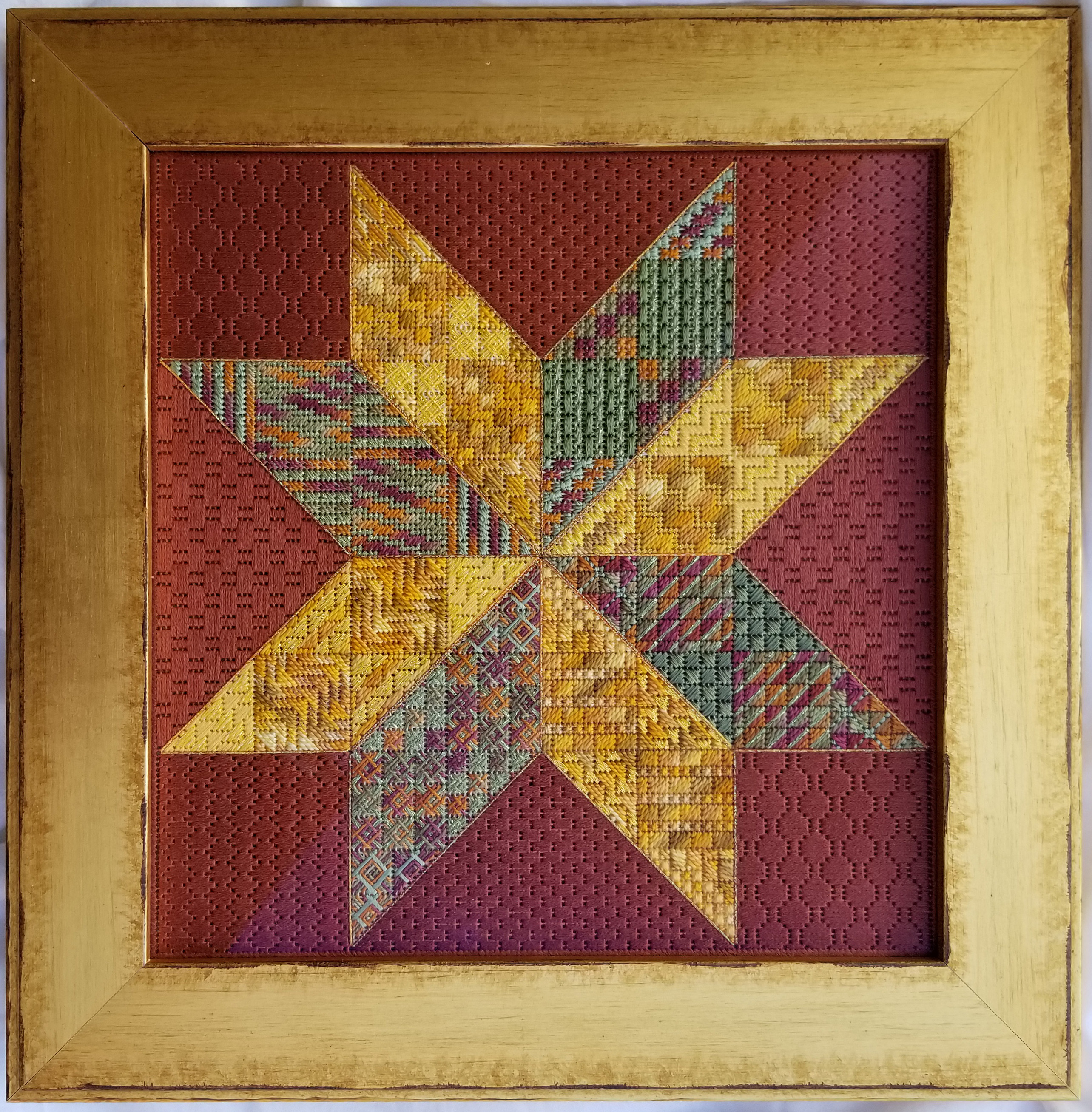
The Star of Stitches by Kathy Rees was an ANG Stitch of the Month for 2020 and the ANG Main Line Stitchers chapter followed ANG’s New Jersey Needle Artists (NJNA) chapter stitching it a year later. We gained some good insights by seeing how they made out. Main Line enjoys selecting their own colorways as much as NJNA.
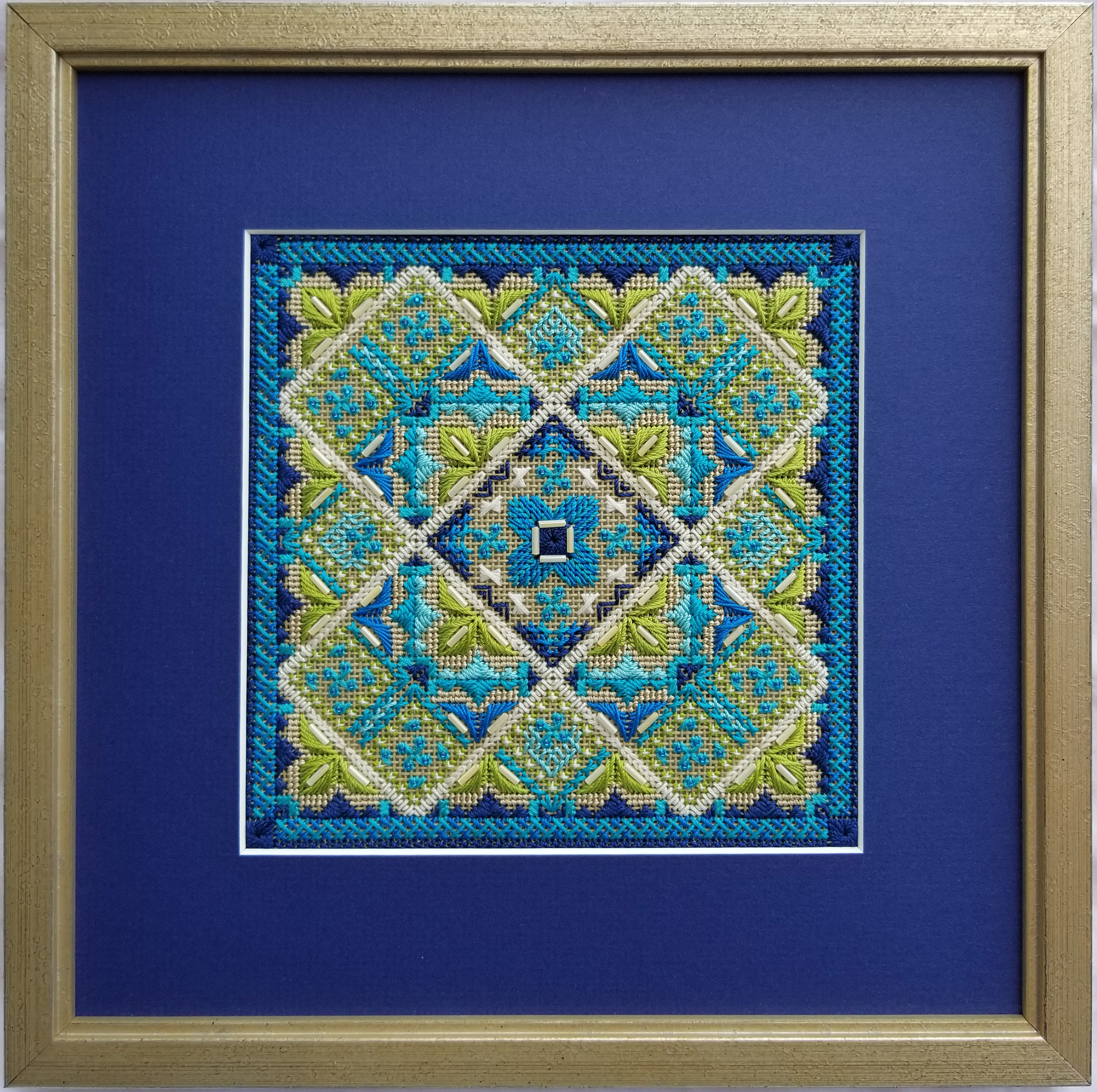
I have been hitching a ride to Woodlawn with NJNA for a couple of years now. And, since Zoom offered the opportunity to join them, I am now a member of that chapter too. I finished and framed Star of Stitches in time to accompany theirs into the 2022 Woodlawn exhibit. They have been scattered throughout the exhibit as a scavenger hunt opportunity for kids attending the exhibit.
The frame came from Jim at Reppening Fine Arts in Audubon, NJ. He had just brought it out of the back room for the first time in a year. It was sitting on the work table and was the fastest selection of a frame ever!
I’m also sending Crescent Journey in the beach colorway. In 2019, I had sent the original colorway which didn’t get a ribbon although it did get a favorable critique with constructive comments that I hope this colorway addresses. Jim framed this too.
Thanks again to Linda M (from NJNA) and her husband for taking all the pieces from NJNA for the Woodlawn Needlework Exhibit. They drove down in rain but the sun greeted them today for check-in. It’s wonderful that Woodlawn has made submission and check-in electronic. You upload a photo and print 2 forms per piece. Nothing needs to be attached to the piece now. It’s faster for all as well. I got an email as soon as Linda checked mine in.
Filed under: Uncategorized
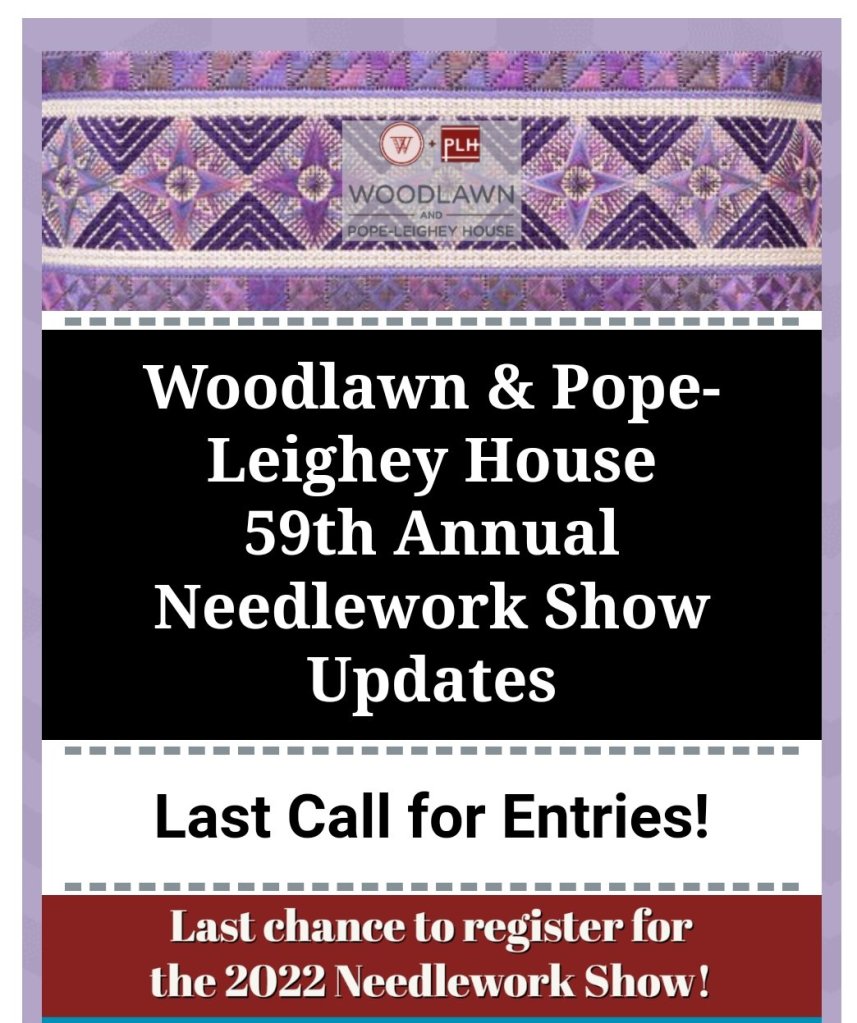
The reminder that Woodlawn Needlework Exhibit sent out used A Spring Sampler in the header! How cool is that!!
Filed under: ANG Main Line Stitchers Chapter, ANG Seminar 2017, Orange Orchid & Bamboo
The Main Line Stitchers chapter held our Stitch-in a week late (scheduling issues) over Zoom (winter weather issues) on Saturday. It was nice to sit and chat safe and snug as the snow fell outside.
I organized my threads in my new bag and started on JP’s Orchid and Bamboo canvas, the companion piece to JP’s Bird of Paradise canvas that I finished last year.

I started on the orange orchid at Seminar in 2017 but only partially completed the orchid you can see some of the padding. The band on the far right was started Friday night to be sure I knew what I was doing and the worked on it Saturday, and finished it Sunday during football. The full design area is 15.5″ x 8″. I had to take a photo after stitching each white medallion, print it, and work out the compensation on paper before stitching inside the medallion. For the next Stitch-in, I’ll work on the far left side.

Filed under: ANG New Jersey Needle Artists Chapter, ANG Seminar 2021, Secret Window by Kurdy Biggs
Instead of a typical New Jersey Needle Artists (NJNA) Stitch of the Month project where we all meet to stitch the same project in different colorways and since some of us are remote members, several of us formed a “KBZ Group” who will stitch Kurdy Biggs projects during the year and meet monthly on Zoom to discuss progress and challenges of her lovely pieces.
I suggested Kurdy Biggs specifically because of Secret Window which I had not started since getting it in the fall during ANG’s 2021 Virtual Seminar. Kurdy’s husband made the wood frame and that came with the kit.
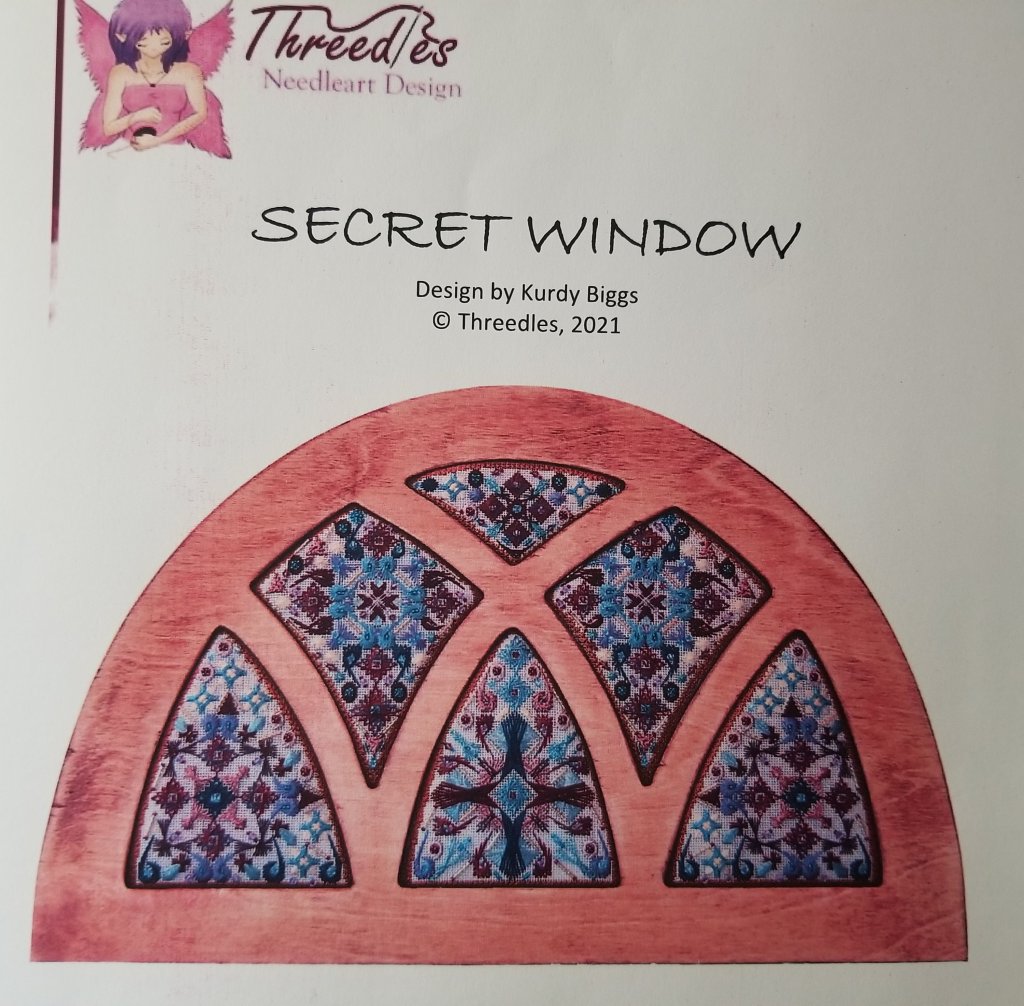
For multiple reasons, I have decided to stitch this on a single large piece of canvas and am having a custom Cathedral-shaped made for it. That may raise questions but all will be revealed in time. Since it will take time to stitch this, you’ll just have to check back later.
There are 6 sections and each one is outlined in a double row of Smyrna stitches. That will be 1,525 Smyrnas. While the number of Smyrnas is large, what seems even more daunting about them is that Kurdy gave us 2 cards of Splendor which is 8 yards each. Splendor has 12 plies and I am using 2 plies! I can’t imagine using all that Splendor for these.
One thing became clear is that I can only stitch so many Smyrnas at a time. And, I can’t have the TV on because I have to pay attention to where I am on the chart. In order to keep track of where I am along the Smyrna border, I am using a yellow marker to color the completed stitches (like I used to do when following a cross stitch chart). Very useful. I also worked up along one side with one length of thread and then the other side checking against each side. Getting the border correct is crucial to fitting the interior motifs. So, in the morning while my husband reads his morning papers (paper and online), magazines, and/or books, I am working on Smyrnas. So far, no ripping but a long way to go!
If you look at the image provided by Kurdy, the Smyrna border looks reddish but Kurdy says, “if it looks different that is due to monitor setting or the photo settings”. In the directions, she does mention that the thread color was selected to match the wooden frame (which is not at all red in person – it is a very light colored wood). The Splendor is a yellow/gold. The canvas color is French Blue (barely colored). This center bottom area is 4″ wide at the base and 5″ high.

Over the coming months, I will appreciate the support of like-minded stitchers including Noelle, Jill, Jackie, Brenda, and Linda! That’s who are the KBZers so far. They are doing other Kurdy Biggs projects including the perforated paper ornaments available from ANG Workshops through January 31. Kurdy has lots of lovely designs.
I was fortunate to be on an EGA-sponsored Zoom lecture given by Claudia Dutcher Kistler on the History of Perforated Paper Needlework 1840 – 1900 this past Saturday. Claudia has quite a collection and is very enthusiastic about the topic. Quite interesting.
She has a couple of websites: Bristolsamplers.com (not paper samplers); Dutchtreat.com & perforatedpaper.net (both paper related). Most of her pieces with descriptions & some history will be found on the website with .net & she sells on the .com website. Sheets of perforated paper in 14 and 18 count are available. Mill Hill makes 14 count 9×12 sheets (google perforated paper to find a variety of sources).
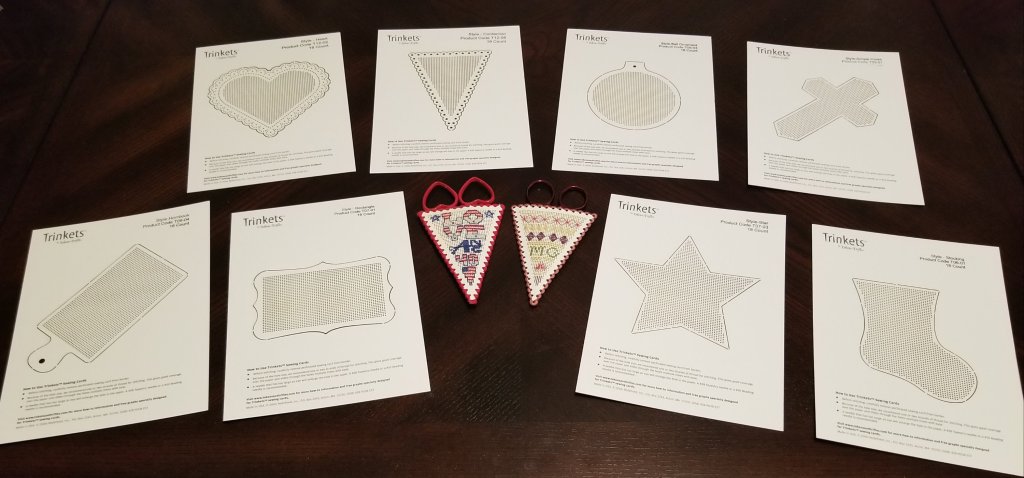
I have stitched on perforated paper before for a color wheel on sheet of 14 count. The scissors sheath for both designs in the photos below are stitched on 20-count Confection Perforated Sewing Cards from Tokens and Trifles. They also had some designs on 18 count but all have been discontinued.
It took some digging through my stash to find these and had no idea I had purchased so many different shapes while they were available (around 2010). Glad I did! While these were available, they also posted graph paper of some of these shapes to work out designs before stitching and I printed them.

So much fun stuff in my stash! I never need to buy anything else but I probably will anyway.
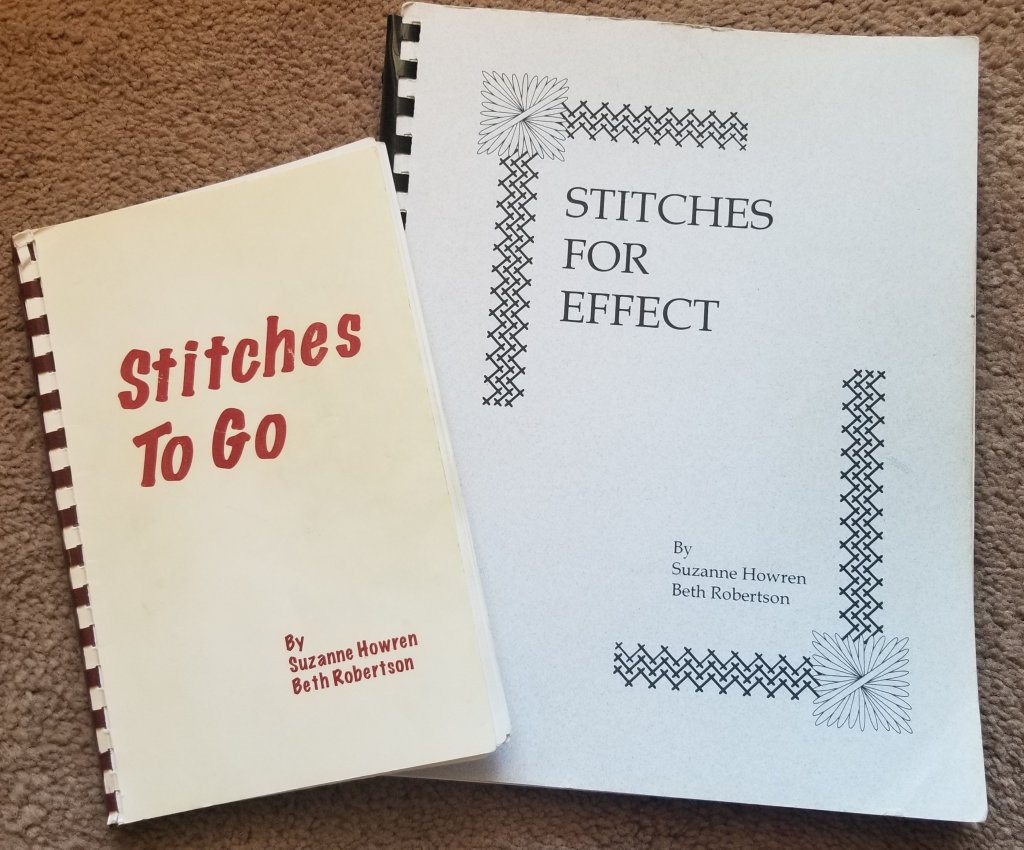
Filed under: Books in My Library, Stitches For Effect and Stitches To Go by Suzanne Howren and Beth Robertson
Except for The Needlepoint Book which was discussed previously, I’ve probably mentioned these books by Suzanne Howren and Beth Robertson more than others.
Stitches For Effect has 4 indexes including a thread index (some are probably not available now), a stitch index (in alphabetical order), an effect index (such as trees, roads, sky, etc), and a general index. Can’t say I ever used the thread index but I skimmed through it to write this review looking at just threads I use most. Occasionally, an equivalent weight to a pearl cotton is stated and that can be very helpful to save time practice stitching with a thread. I discovered that if you use 6 plies of stranded cotton, then you could use 3 strands of Floche (2:1 ratio). I have not tried combining Kreinik #8 Braid with 3 strands of a coordinating stranded cotton for a subtle shimmering effect which sounds like a good idea (stranded silk would probably work too). I will have to look more carefully next time I use Impressions because it is a 50/50 woll/silk blend and the two fibers reflect light differently creating depth. There are conversion charts to indicate a suggested number of strands/plys for use on canvases/fabric of different sizes including: 13/14, 18, 22/24, and 28. The diagrams are next to a paragraph discussing what ground, threads, and effects are good for that stitch diagram. Very interesting to read and they are excellent diagrams.
I never bought More Stitches for Effect and Even More Stitches for Effect although getting the indexes would probably be useful. Do you have and like either of these books? I’d be curious to know.
The second one of theirs I did get was Stitches To Go which contains every stitch in the three books I mentioned above. Although it doesn’t have any of the indexes, it is always by my side!
Filed under: Books in My Library, Needlepoint Books, The Needlepoint Book by Jo Ippolito Christensen
I’ve probably mentioned The Needlepoint Book by Jo Ippolito Christensen this book more than most others. Everyone has there “Go To” books. This is always within reach.
The Second Edition remains my preferred edition mainly because it is lighter to hold and most importantly I have added notes next to the diagrams that I want to keep. Part 1 covers basic information, procedures, and stitching techniques. She offers suggestions for left-handed stitchers since most diagrams are written for right-handed stitchers (turn the diagram upside down). Part 2 covers design and color. These topics are books in and of themselves but Jo covers key points clearly. Part 3 covers putting everything together such as my favorite tip (on page 108 – Mixing Stitches) to stitch diagonal stitches before straight stitches when they share holes. Part 4 offers stitch diagrams and stitched samples (all in black and white). The stitches are divided into chapters: straight, diagonal, box, cross, tied, eye, leaf, line, decorative, and open. At the beginning of each chapter, a grid is presented to show characteristics of each stitch such as would it be good for a background stitch, accent stitch, shading, would it snag or not, does it have texture, does it create a weak, medium, or strong pattern, and more.
The Third Edition does have the same great information including how to mix stitches on page 148 and four new chapters, and 225 new illustrations including 62 new stitches. Since some images are not as good as in the Second Edition, 75 of the stitches were restitched and rephotographed to replace the less-than desirable photos. The main difference is more information covering color and design issues under the chapter title Interpreting the Painted Canvas although much of it really applies to those principles in general not just for painted canvases. Parts 1 – 3 covered 132 pages in the Second Edition and now covers 202 pages of information. Part 4 reorganized a few diagrams, added new ones, and offers the same great charts at the beginning of each chapter.


