Filed under: ANG Chapter Book Projects, ANG Main Line Stitchers Chapter, Starburst by Patricia Hartman
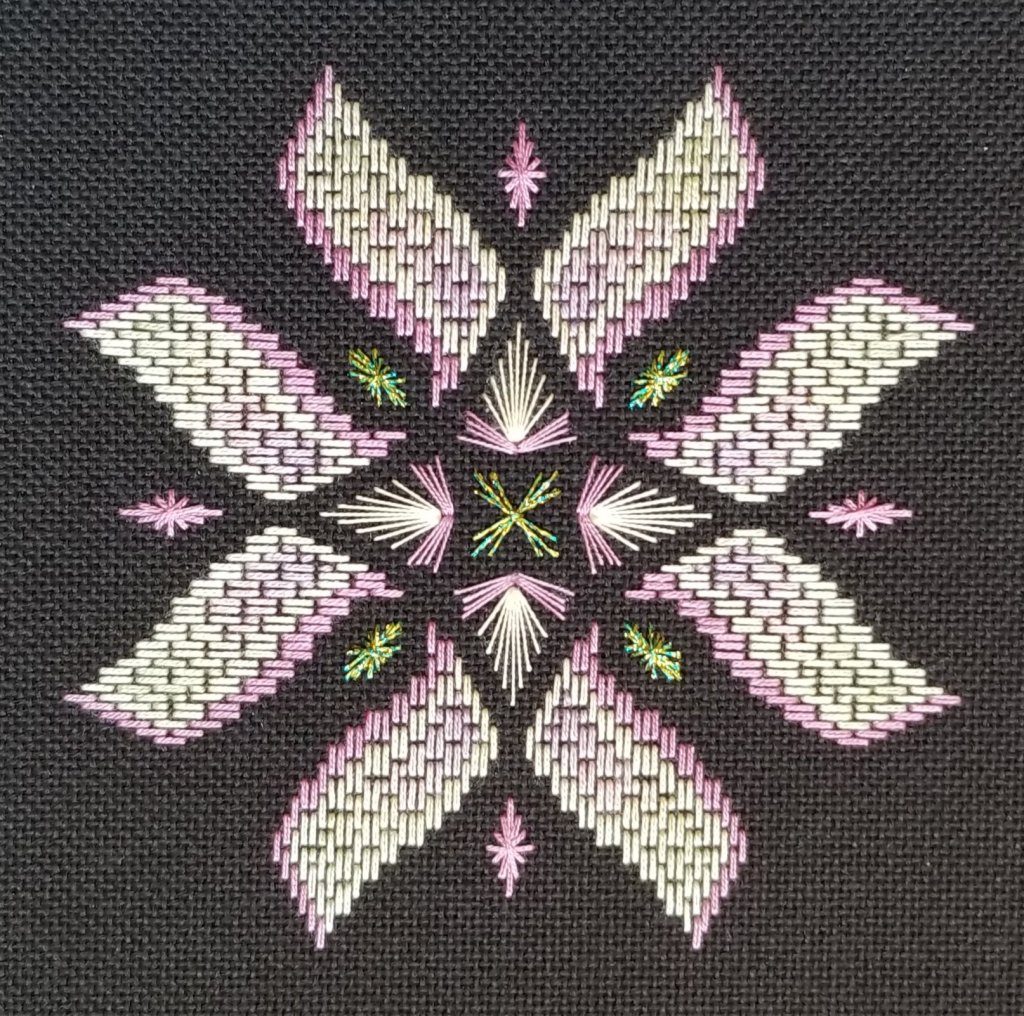
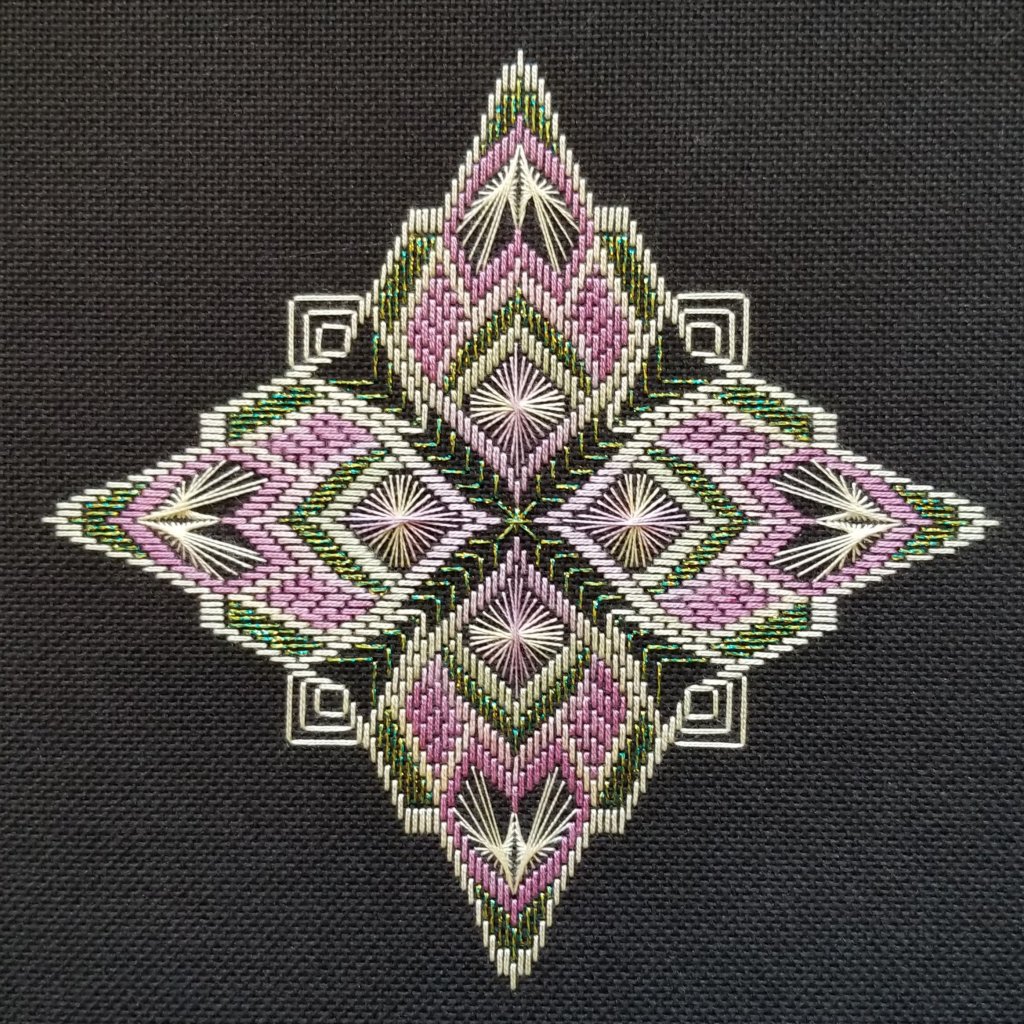
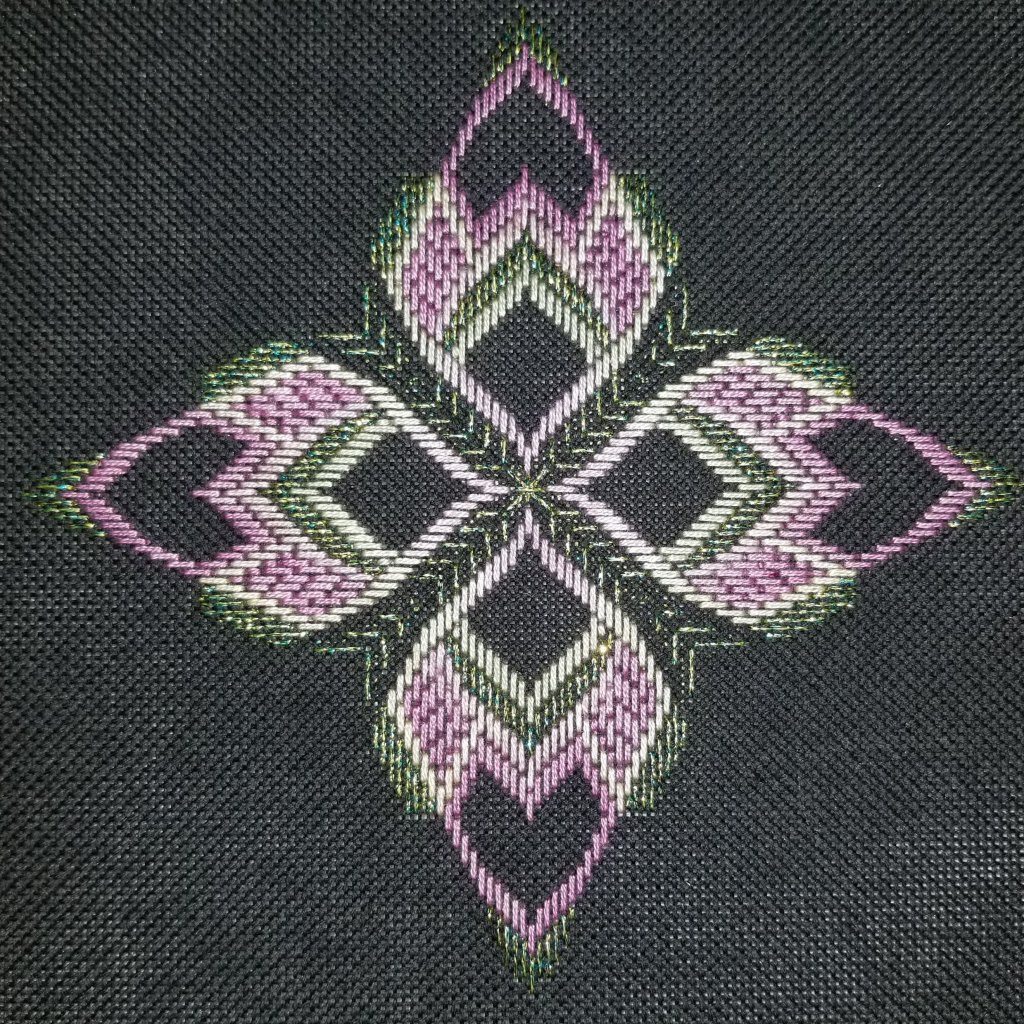
What I am calling the companion piece to Orchid Lady by Mary Knapp is Starburst by Patricia Hartman. They are both on black Congress Cloth using Heather as the key overdyed thread in my kit from Ann-Marie Anderson-Mayes from Australia. The others at ANG Main Line Stitchers are stitching Anne-Marie’s design, Celestial Twist, with her threads.
Oddly enough, the same 4 threads are all I need for this piece and I have plenty.
I love the movement of the 4-way bargello pattern. Very appealing design. It was in the ANG Chapter Project Book in 2015 and we did it as a project but I didn’t have time then. So, now I’m doing it. It looks like it’s bursting out from the center!
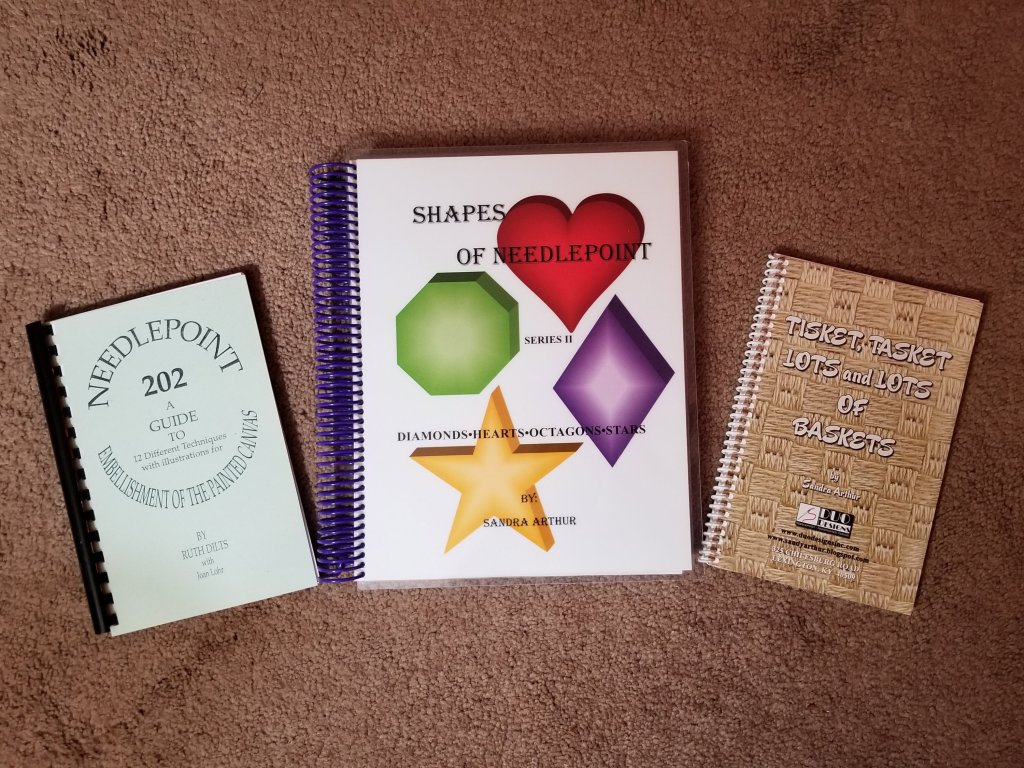
Filed under: Books in My Library, Needlepoint 202 by Ruth Dilts, Needlepoint Books, Shapes of Needlepoint Circles, Squares, Triangles, Rectangles - Series I by Sandra Arthur, Shapes of Needlepoint Corners, Hexagrams, Ovals, Parallelograms - Series III by Sandra Arthur, Shapes of Needlepoint Diagonals, Horizontals, Verticals - Series IV by Sandra Arthur, Shapes of Needlepoint Diamonds, Hearts, Octagons, and Stars - Series II by Sandra Arthur, Tisket, Tasket, Lots and Lost of Baskets by Sandra Arthur
Books are always appreciated! And, I’m sure I’ll enjoy these.
In May 2012, I donated quite a few books in an effort to make room available for what turns out to be more books (https://melitastitches4fun.com/2012/05/20/books-no-longer-in-my-library/). I still have (probably) more books than I need or use. Then in August 2012, I started a post of “Books I Am Keeping” but never completed that draft. That was almost 10 years ago! Well, I think I’d like to resurrect that idea and discuss books I do own. So, this is my first post to begin a series of book reviews.
Needlepoint 202 A Guide to 12 Different Techniques with Illustrations for Embellishment of the Painted Canvas by Ruth Dilts intrigued me because my ANG Main Line Stitchers chapter has been discussing how to stitch painted canvases. I’ve not read every page but I found the discussions of thread painting and tufted couching particularly interesting. The book (from 2007) provides stitch guides for 12 painted canvases of which I easily found 4 are still available (online google search) including: Baby Carriage by Cooper Oaks, Moose in the Birches (Oval) by Kathy Schenkel, Slavic Doll by Shelly Tribbey, and Grape House Gingerbread House by Susan Roberts. The stitch selections for all the canvases are still interesting to read. I liked the thread blending for the shading of the Water Maiden by Terry Medaris (Sundance Designs). That canvas doesn’t appear to be available but the shading on the painted canvas is seen quite often and is similar to that seen in Madonna #2 by Terry Medaris (Sundance Designs). There are 42 stitch diagrams in addition to the technique diagrams. And, Ruth discusses aspects of 32 threads used in the models. I didn’t know that the twist of Splendor is tighter than most silks making it easier to use and unlikely to snag on your fingers/hands (unless they are really rough). I haven’t read too many stitch guides for painted canvases but what I have read are presented in a table with columns for Area, Thread, and Stitches. Ruth writes conversationally rather than in a table format which I found made for more of an enjoyable read.
Shapes of Needlepoint Diamonds, Hearts, Octagons, and Stars – Series II completes my collection of Sandra Arthur’s series of 4 books covering all different shapes. I love that Sandy indexed them by shape and by thread count. However, they can be adjusted to fit the space you have available. The diagrams are large and easy to read. Google duodesignsinc and look for the tab for books and you’ll see details of each 100-page book and examples of the diagrams. Past Christmases brought the others in Sandy’s Shapes of Needlepoint. So, I might as well include them in this post as well. They are: Circles, Squares, Triangles, Rectangles – Series I; Corners, Hexagrams, Ovals, Parallelograms – Series III; and Diagonals, Horizontals, Verticals – Series IV.
While waiting for my husband to golf at Shipyard on Hilton Head last month, I pulled up a chair to the book table at Needlepoint Junction (basically just across the street in a mall) and found Tisket, Tasket, Lots and Lots of Baskets by Sandra Arthur. I have an idea about baskets that I’d like to pursue at some point. Sandy really captures the art of basketry. I hadn’t see this book on her website or in her Etsy shop. So, this was a must have!

Filed under: Uncategorized
It was 2 years ago when I got a lovely project and matching thread bag from Linda who excels as a needlepointer and quilter! I do enjoy being a test recipient of new designs. This, “Sew Together Bag” has the same fabric making for quite a lovely set!
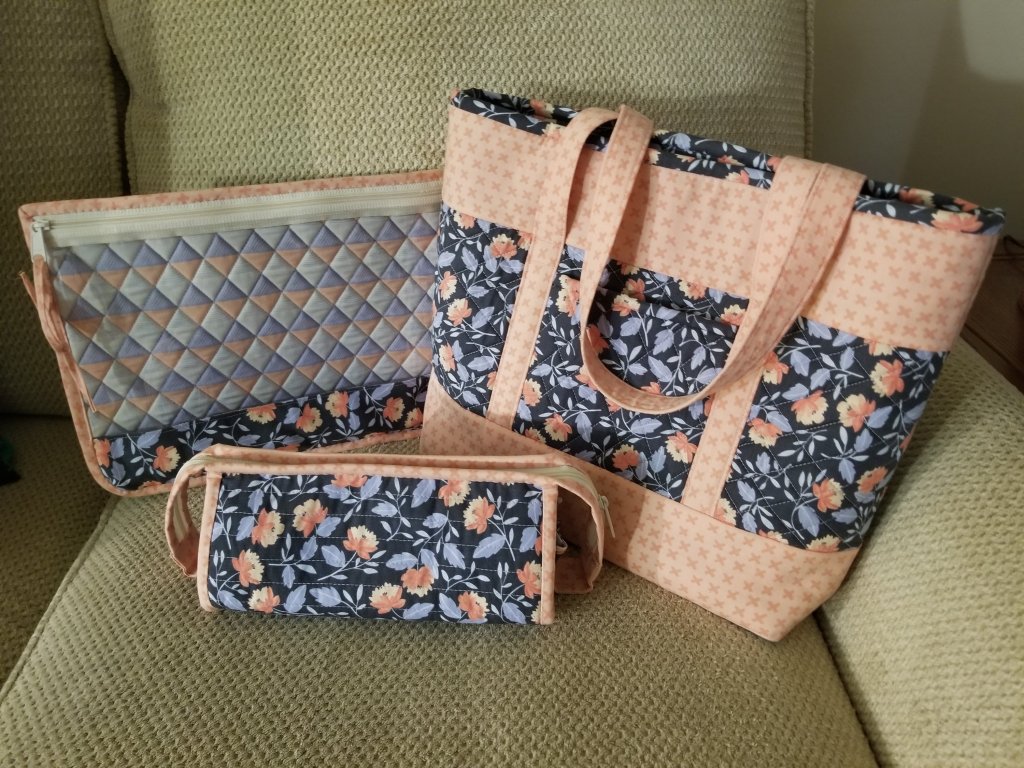
There are 4 open pockets, 3 zippered pockets, and a zipper to close up with two carry handles! It’ll hold tools, threads, or both! It fits nicely inside the matching project bag. Linda even included a lovely selection of threads. I can sew a button back on but that’s it. This looks very complicated to put together. Thanks again Linda!

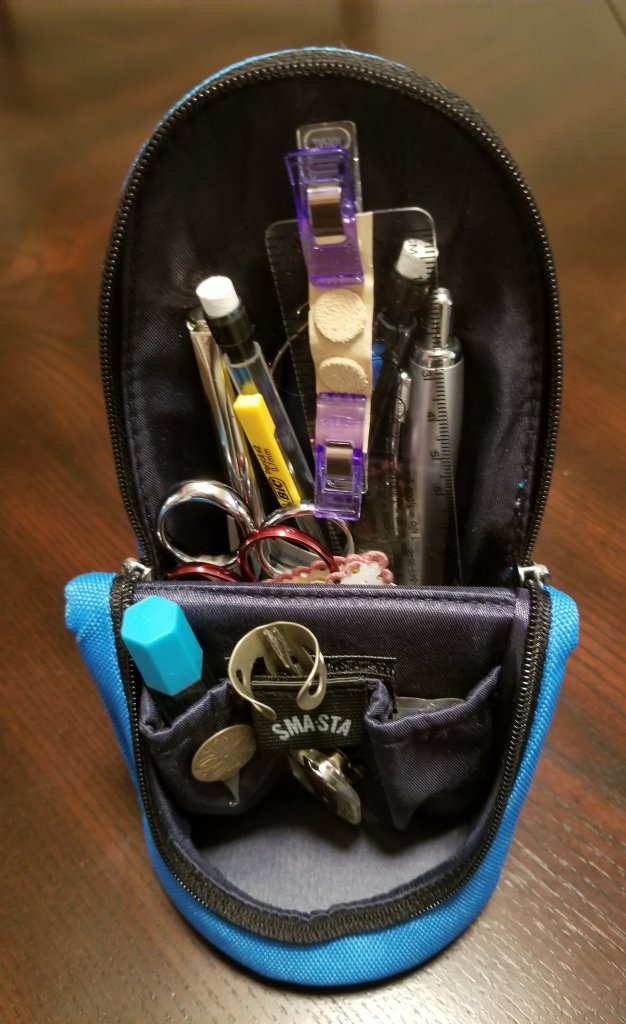
By finally exchanging Christmas gifts with Linda, I can now use my Smasta! It’s a fantastic travel tool tote because it zippers open and stands up to show all your tools and have them ready at your fingertips. I saw someone using it at the EGA Seminar and ordered one for me and one for Linda. Not as pretty but hopefully as useful and she didn’t already have it!

Filed under: ANG CyberPointer's Chapter, ANG Main Line Stitchers Chapter, Orchid Lady by Mary Knapp
Heather is the key overdyed thread in my kit from Ann-Marie Anderson-Mayes in Australia for Orchid Lady by Mary Knapp on black Congress Cloth. The others at ANG Main Line Stitchers are stitching Anne-Marie’s design, Celestial Twist, with her threads.
The 4 center Rhodes used 4 strands from the overdyed skein with the away knot placed the same distance from the starting hole. Since I rotated the canvas as I stitched, the green fell in the center long stitches in a circular position.
An Amadeus that share the center holes can be tricky on the second side unless you hold your working thread off to the side so you can see the holes for you to insert needle into and then pull the thread taut. A huge help especially on black Congress Cloth! I decided to make these and the outer bargello border yellow.
There is plenty of threads for the next piece.
Filed under: ANG Main Line Stitchers Chapter, ANG Seminar 2017, JP Bird of Paradise & Bamboo
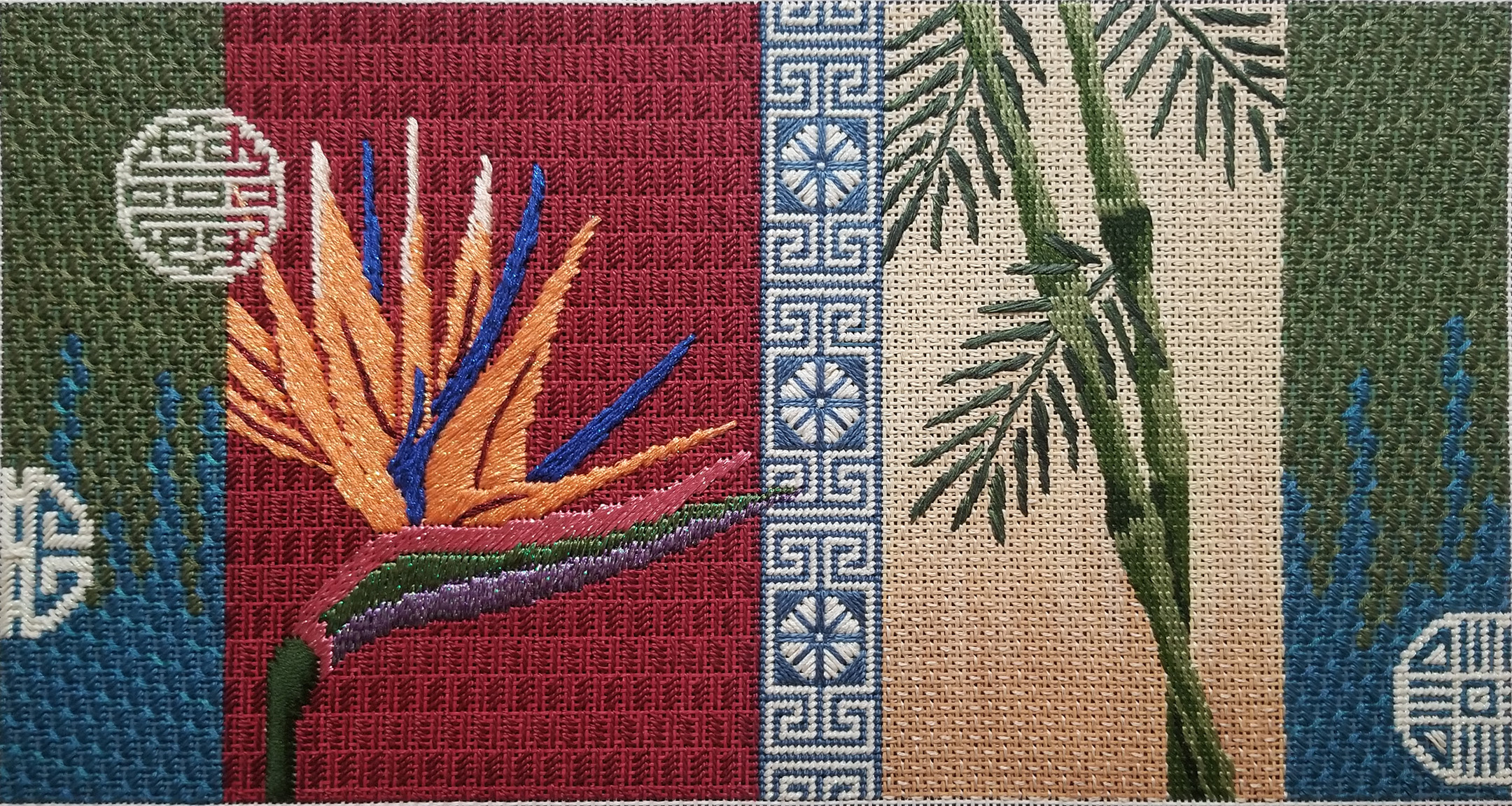
Sometime before March of 2016, I had purchased JP’s Bird of Paradise & Bamboo canvas at Gazebo Plus in New Hope, PA (sad to say, it has since closed permanently). In March of 2016, I found a companion piece at Waste Knot in Arlington, VA, JP’s Orchid & Bamboo with almost the same motifs.
My opportunity to begin them came with the 2017 Seminar where Cynthia Thomas was having a Painted Canvas Embellishment Class. She was gracious enough to address the additional panel on the second canvas for the orchid since I wanted to have them match as much as possible. The Bird of Paradise is done now thanks to our painted canvas project at ANG Main Line Stitchers and Beth for stitching the same canvas. Beth used threads and stitches suggested by Betsy at Fireside Stitchery (although I’m not going to post her piece here, I will mention some differences). Beth actually finished before I did! So, I had to buckle down and get ‘er done for this month’s meeting! Members of our chapter continue to enjoy our canvas discussions during our MLS monthly meetings.
I forgot to post this last month. So, here are the final discussion points.
Bird of Paradise Panel: Both stitch guide writers, Betsy (for Beth’s) and Cynthia (for mine), selected the same pattern but oriented it in the opposite direction. Isn’t that amazing that of all the stitches, they selected the same one. Both threads are red although Beth used a very slightly overdyed cotton floss and I used a solid perle. Both pieces highlight the lovely colors in a Bird of Paradise. Beth used all Vineyard Silks for the flower and Rainbow Linen in tent stitch for the stalk. I used all sparkly threads for the flower and Needlepoint Inc Silk over a padding of Very Velvet for the stalk.
Center Blue and Beige Panel: Beth stitched this center panel in all tent stitch as had been done for the 3 larger coin motifs on the outer left and right panels. On this panel, a little sparkle is added by using Neon Rays+ and Silk Lamé Braid (rather than the beige ThreadworX for the 3 larger coin motifs). I stayed with the same beige Kreinik used for the 3 larger coin motifs and also used Vineyard Silk for the blue areas. I stitched mostly tent except for 3 square motifs where I used diagonal stitches to fill in the area.
Bamboo Panel: Beth transitioned from a light ThreadworX overdyed thread to a darker Sampler Thread overdyed thread using the Nobuko stitch for a full coverage. I used 2 strands of a beige Splendor in a very open stitch (Railway Woven) allowing the shading from the painted canvas to show. I used Interlocking Gobelin for the stalks and random or long/short as did Beth for the leaves.
So, how long will it take for me to finish the other one? I hope to finish it in 2022. They will be a set of pillows and probably my last pillows for quite some time! Have you seen the Dr. Rick commercial with the pillows? Well, that woman will be me and my husband will be Dr. Rick if I don’t stop with the pillows (do a google search for youtube dr rick pillows – makes me laugh every time)!
From Woodlawn’s email:
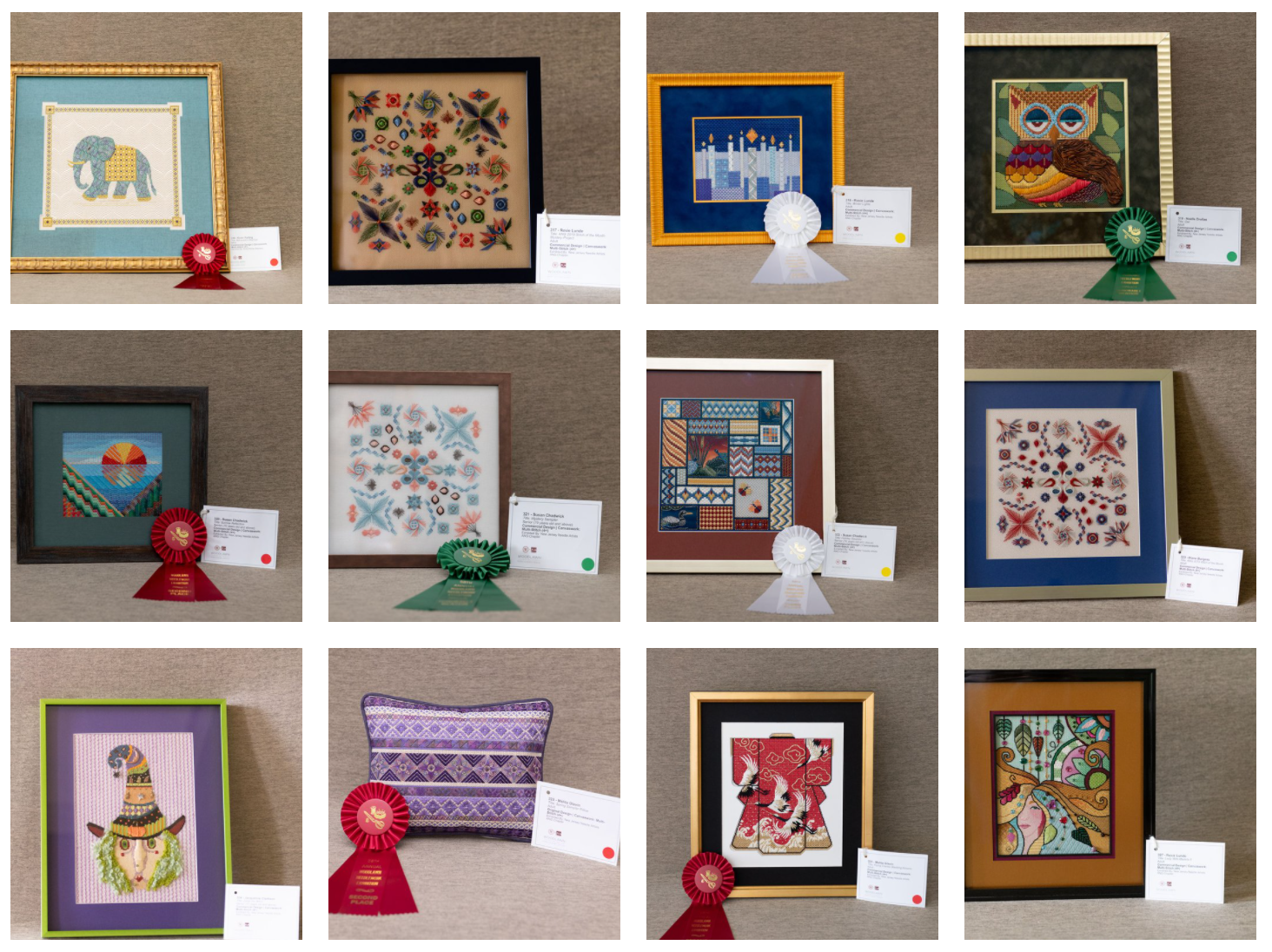
Woodlawn’s 58th Annual Needlework Show was earlier this year. Perhaps you weren’t able to make it to Woodlawn to see all the pieces, or maybe you came and want to see all the incredible work again!
If so, we proudly announce the second annual virtual showing of Woodlawn’s on-site Needlework Show. Our 2021 Needlework Show, “Hindsight 2020: Needlework Expressions of a Historic Year” is now available to view online! Purchasing a ticket allows you to peruse the hundreds of beautiful pieces that appeared as part of May’s in-person needlework show via our online platform. We are so excited to virtually share this wonderful show with you!
To purchase tickets, please visit the following link: https://tinyurl.com/VirtualNeedleworkShow
After you purchase your ticket, you will receive a confirmation email with a link and a password to view the Virtual Show, which you can view at your leisure from December 6, 2021 through January 6, 2022. Your ticket price helps us preserve this tradition and supports our efforts as we prepare for the 2022 Needlework Show.
Here’s a small sample of the photos & when you click on one, close up photos of that piece can be seen as well! They have really done a lot of work for the online exhibit & it’s wonderful.
Filed under: ANG CyberPointer's Chapter, ANG Main Line Stitchers Chapter, Beautiful Stitches, Orchid Lady by Mary Knapp, Threads
I’m using threads from Ann-Marie Anderson-Mayes in Australia for Orchid Lady by Mary Knapp on black Congress Cloth. The others at ANG Main Line Stitchers are stitching Anne-Marie’s design, Celestial Twist, with her threads.
I had to pull out the magnifying glass with a clip-on light (which I found when organizing after the carpet was cleaned). I need it to work on the black Congress Cloth. It’s a StarMag by Daylight Company. I’m glad I found it when I did!
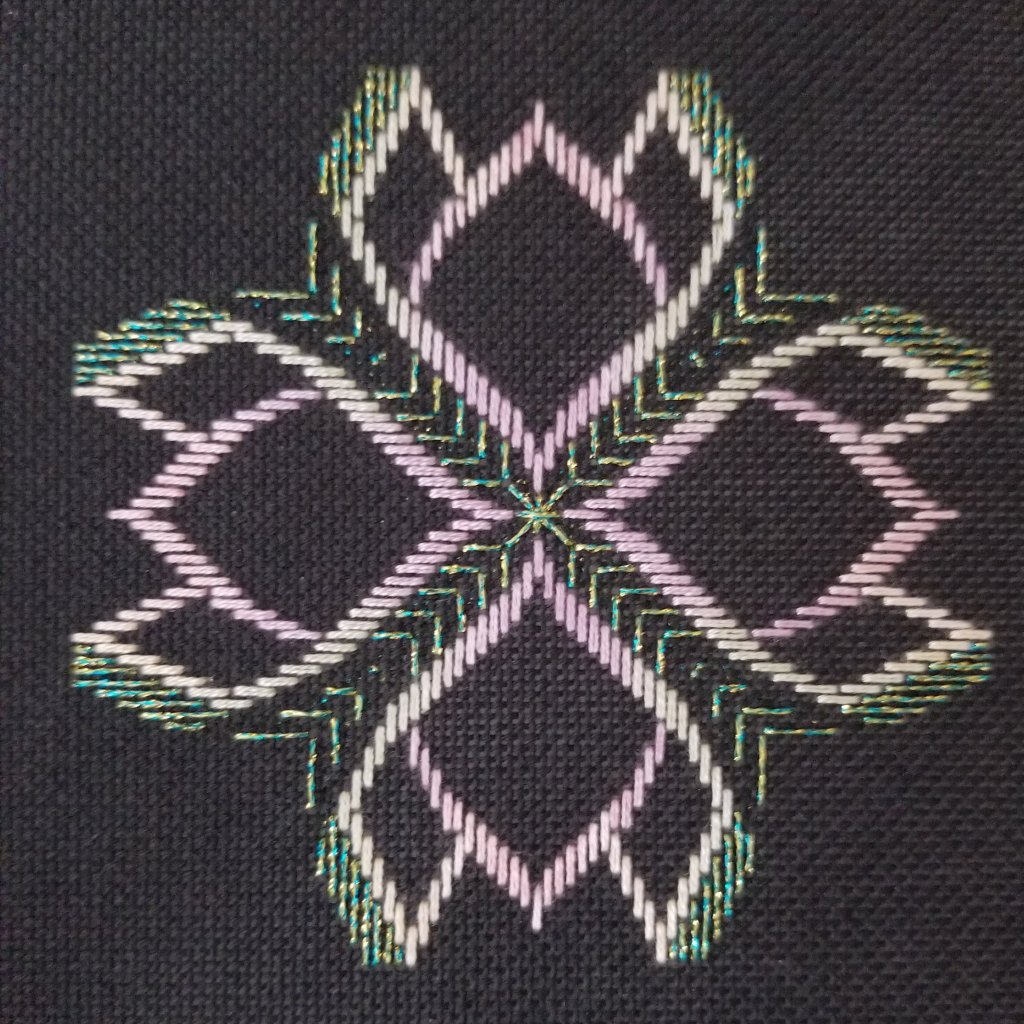
The overdyed thread, Heather, has yellow, green, and purple, and pink areas. I cut the overdyed skein in the middle of a large stretch of purple expecting to see more green and yellow. But, a good amount of purple is apparent too. Since I have worked with purple so much, I decided to use the solid green and yellow colors instead of two values of purple (not stitched with the solid colors yet). So, I selected a Kreinik #4 Braid 2829 that has green and yellow in it.
I really lucked out and the 36″ resulting length was ideal for completing the inner motif. And, I started the thread half on each side of the center so that the colors are symmetrical as they are worked outwards. And, it results in less wear and tear on the longer length of thread. I had to finish all four directions in order to be sure I stitched it in the same direction for a consistent color flow.
I love that the purple fell in the four center areas and the green and yellow are in the eight side areas. Very happy with the start! Now if I could get a great photo! It looks more yellow in the photo and more green in person – photographing needlepoint is tough.
Filed under: ANG CyberPointer's Chapter, ANG Main Line Stitchers Chapter, Beautiful Stitches, General comments, Orchid Lady by Mary Knapp, Threads
I expected to use the green and yellow threads but once I separated the plies and only used 2 strands, you couldn’t see the difference between the two colors. And, they blended into the eight areas losing the definition of the design. So, it’s a good thing I like purple! I am using two of the three purples from the kit. This is the lighter of the two to be added. It’s such fun watching the piece develop in front of you! This brings the piece out to 5″ x 5″. It will be 5&1/2 x 5&1/2″ when finished. Only dark purple and more of the overdyed to go.
This is the 4th piece of the Downton Abbey series by Gay Ann Rogers. I worked on the overstitching with the darker plum Impressions in the corners of the Scotch stitch variation yesterday at our ANG Main Line Stitchers chapter Stitch-in. Due to Thanksgiving next weekend, we moved it to a week earlier than usual. Robin was a most generous host with a great soup and chicken salad lunch and brownies made by Pat. Last night, I finished the overstitching and filled in the Smyrna stitches. This morning, I finished the overstitching on the long diagonal chains with black Kreinik 1/16 Ribbon. I love it!
Gay Ann Rogers was inspired by this photo of Violet Crawley. Once again, Gay Ann captured the look and feel of the photo in her geometric. According to her website, Gay Ann will be releasing “Dowager in the Evening” at some point but it will be larger and beaded. While I may get it, I have a plan to design two more Downton Abbey pieces based on pictures I have selected. Then, I will frame all six together (or maybe three and three). I’ve had the threads for my first piece for awhile (they were in the dining room mess). After Thanksgiving, I hope to have completed all or most of the design on the computer and start stitching it. Oh boy, that’s a fifth piece calling to me!


Filed under: General comments
As we enter the third year of the pandemic, coronavirus variants are still causing havoc and I must comment. The saying “History repeats itself” is so true. The 1918 influenza epidemic (which began in January) had 4 waves of infection and finally became less deadly causing ordinary seasonal flu (which can still cause severe illness and death). Luckily, thanks to the vaccines including booster doses, it’s not causing as much severe illness and my husband and I are back to some traveling (by car not planes), dining in restaurants, and meeting others in person. We love it that proof of vaccination has been and is being required in various venues and starting Monday in Philadelphia restaurants. Since we are in the fifth wave, more than likely due to vaccine hesitancy among too many people, this virus will continue to circulate through at least 2022 and probably beyond. We will learn to live with it as we do the flu. Luckily, again thanks to therapeutics being developed, illness caused by the virus will likely reduce the chance of progressing to severe disease. The government and the pharmaceutical industry have really stepped up to the difficult tasks of developing a vaccine and recently an effective treatment. Was everything perfect – no – but so many individuals only need to get the vaccine and wear a mask – how simple for the individual.
In 2021, I posted 74 times which is the exact same number as posted in 2020. The only other years that I posted the same number, 70, was in 2015 and 2018. The fewest at 54 was in 2017 during my first year of retirement and the most at 85 was 2019 with little else to do due to the onslaught of coronavirus. My blog saw a few more visitors than last year, a little over 7,200 visitors, and still from all over the world. Thanks again to everyone who visits especially those who comment, send a comment via email, or tell me in person that they enjoy reading my blog.
Connecting with people is one of the things about needlepoint that makes it wonderful. I did that this year not only through my blog, but I joined New Jersey Needle Fest after missing it in 2019 because I was on a stitching cruise and due to coronavirus cancellation in 2020. It was a wonderful day. And, I am looking forward to the expanded 2-day format in May 2022.
I also attended my first EGA Seminar in Chicago and saw half of some familiar faces (we were masked) and met many new people. Preview alert: Gail Stafford encouraged us to go home from her EGA Seminar class, Overdyed Thread Notebook, and make a sampler which has resulted in two small samplers using overdyed threads which I hope to share in 2022. Two other EGA classes will be discussed in a minute.
Susan Hoekstra taught Teaching Needlework 101 virtually in 2020 which came in handy this year because I taught Overdyed Spools to a group of 31 EGA Mid-Atlantic Region members, half of whom will return to their chapters to teach it to their chapter members. It was a good experience and I would do it again. But, a lot of work goes into teaching just as a lot of work goes into “finishing” a piece. Stitching, designing, and diagramming are more fun than work – for me anyway! The ANG Seminar was online and on Zoom this year where Susan Hoekstra taught her class Interpreting Color Theory which used our painted canvases as a teaching tool and allowed me to finally finish a small seashell. There is a lot to learn about color! The other ANG class made the To Do list will be discussed at the end.
After our trip to Woodlawn in March which is always enjoyable, I also connected with Anita B who designed and stitched Women From the Dawn of Time – A Tapestry of Female Trailblazers Throughout History, my husband’s favorite piece this year. A note by Anita’s piece at Woodlawn mentioned that she was selling her design on a shirt and Bill filled out a paper requesting more information and she replied. We chatted via email and eventually I created the first pictorial draft of her booklet which she has since self-published. She sent me a final copy (actually twice because USPS is not what it used to be but I will not get started on that subject). In her booklet, she acknowledges my contribution and even Bill for introducing me to Anita and for being her first “customer” of her invincibles.threadless.com shop (we got a T-shirt, small bag for travel, and a shower curtain; Anita sent us 2 travel coffee mugs as a thank you for my efforts). Woodlawn does a great service by allowing that exchange of information with the exhibitors. And, for a second year, Woodlawn offers photos to be viewed online for a month. You can still view them through January 6, 2022. Purchase tickets at: https://tinyurl.com/VirtualNeedleworkShow
Since I am also learning Photoshop in addition to Adobe Illustrator to help Needle Pointers over the past year, I was able to help Anita. One thing leads to another. I’ve worked on diagrams for about 8 projects for Needle Pointers and started writing or modifying text (depending on what is provided) to accompany them. Preview alert for ANG: There are lots of articles and projects coming in 2022 but the one with 3 stitchers is particularly of interest to me. Can’t say more. Preview alert for EGA: My work on Needle Pointers prompted EGA to reach out for help with diagrams for a project that is being pilot stitched now.
In Jan/Feb 2021, Needle Pointers published A Tale of Two Stitchers (actually was Three Stitchers) featuring Vases with Curly Bamboo which I stitched with 2 other members, Beth and Linda, of the Main Line Stitchers as part of our painted canvases discussions. Instruction for Tahitian Treat appeared in the Mar/Apr issue and from June through August, Meg W posted her progress with Tahitian Treat on Needlepoint Nation creating quite a buzz! I heard some people joined ANG to obtain the instructions and that Karen at Nimble Needle in NJ had gotten several orders for the threads. Meg’s enthusiasm was wonderful. An errata sheet was issued to revise one diagram and adjust the number of skeins needed (https://cdn.ymaws.com/www.needlepoint.org/resource/resmgr/needlepointers/tahitian_treat_errata_2021_m.pdf). And, the Sept/Oct issue shared information and the link to the ANG Main Line Stitchers chapter online needlepoint exhibit which is still available to view at
https://mediaartscouncil.org/mac-gallery-guest-artist-mainline-stitchers/ Many thanks again to Stephanie and Media Arts Council (MAC) for their support. We shared much more than we could have in person. Preview alert: Watch for an in person needlepoint exhibit in 2022 featuring a local artist and hopefully a few of our pieces! MAC has a new location in Media right on State Street and I wish them all the best.
My first publication in Needlepoint Now, Prime Examples, appeared on the back cover of the Sept/Oct issue. That was exciting! Preview alert: Watch for an another design to be published in 2022!
I finished stitching 11 counted projects including Rainbow Ribbons by Kam Wenzloff with Colour Complements threads from Needlepoint Now; Star of Stitches by Kathy Rees from ANG’s 2020 Stitch of the Month which is going to Woodlawn in February for the month-long March exhibit; Flutterby, from the 2017 ANG Chapter Project Book by Kurdy Biggs, which is buzzing about My Mauve Pansy (not back from the finisher yet), a small Tree Ornament by Vicky Witterschein (taught via Zoom through the New Jersey Needle Artists). And, all four Gay Ann Rogers Downton Abbey pieces were finished: Lady Edith, Lady Mary, Cora, Countess of Grantham, and Violet, Dowager Countess of Grantham. Preview alert: I’m about ready to start stitching my interpretation of Lady Sybil (the youngest sister) based on this photo. I’ve got the threads and am very pleased with the design which I’ve worked out on my computer.
The last 2 counted projects were completed with the same thread line called Beautiful Stitches from Ann-Marie Anderson-Mayes in Australia. They were Orchid Lady by Mary Knapp (a Cyberpointers project from 2021) and my final finish of 2021 which is Starburst by Patricia Hartman (from the 2013 Chapter Project Book and was a Main Line Project years ago).
Four years after I began JP’s Bird of Paradise & Bamboo at the 2017 ANG Seminar in the Embellishment class with Cynthia Thomas, it was finished! A 2022 goal is to finish the companion piece, Orange Orchid & Bamboo. The other painted canvas I finished was Swirling Leaves, a Dream House Ventures painted canvas, with a stitch guide by Janet Perry’s class begun even earlier in 2015!
These are neither counted projects nor painted projects exposing me to stumpwork with My Mauve Pansy, a 2021 EGA Seminar project designed by Allison Cole and taught by Kay Stanis; ribbon work with Annette’s Bouquet designed and taught by Deborah Mitek also at the 2021 EGA Seminar; and needle felting with Watering Can designed and taught by Vicky Witterschein through a Zoom class with New Jersey Needle Artists. All were enjoyable projects but I still prefer counted projects.
My ANG Main Line Stitchers chapter is stitching various colorways of my design, A Spring Sampler. Linda and I found it challenging and fun to help people pick threads. Based on our experience, I added more tips to selecting threads for a Zoom presentation to EGA’s Philadelphia Area Chapter in advance of them selecting threads and stitching it in February/March 2022. I enjoyed the opportunity to join two EGA members on a Rittenhouse Run to select threads and we may do another run in January with more members.
I passed Step 4 for the bargello design of the EGA Master Craftsman with distinction and it was on display along with my Steps 1, 2, and 3 at the EGA National Seminar in 2021. Other people from the various Master Craftsman programs were displaying theirs too. It was an amazing collection of interesting pieces. I wrote up the instructions for Bargello Bowls from Step 3 and two members of the ANG New Jersey Needle Artists will be stitching that in 2022.
I did not send Step 5 in for review in October. It is demonstrating the technique of applique and I needed extra time after discovering that the applique must be a smaller count ground than the main design. That tops my To Do list along with Lady Sybil and Orange Orchid & Bamboo. Joining that list is a couple of new projects not started yet including Secret Window by Kurdy Biggs (from this year’s ANG virtual Seminar) and Razzle Dazzle by Ann Strite-Kutz which was a gift from Linda from the ANG New Jersey Needle Artist chapter.
That covers everything except to send you best wishes for a Healthy and Happy New Year!