Step 2 is finished and so is this piece! It was a very enjoyable project. In this step, there is only one variation of mine but it was by choice. The single brown Plant Earth thread between the couched long Pepper Pot Silk diagonal stitches seemed to get lost. So, I used 2 threads between and to tie.

Gay Ann was inspired by this photo for her design.

Filed under: ANG Main Line Stitchers Chapter, ANG Stitch of the Month, 2020
I’m making good progress on the Star of Stitches by Kathy Rees which is an ANG Stitch of the Month for 2020 and an ANG Main Line Stitchers chapter project.
We skipped a space and so for the fourth stitched area, it consists of Cashmere stitches in different sizes (2×4, 2×6, and 4×2). I didn’t care where the colors fell in this area.
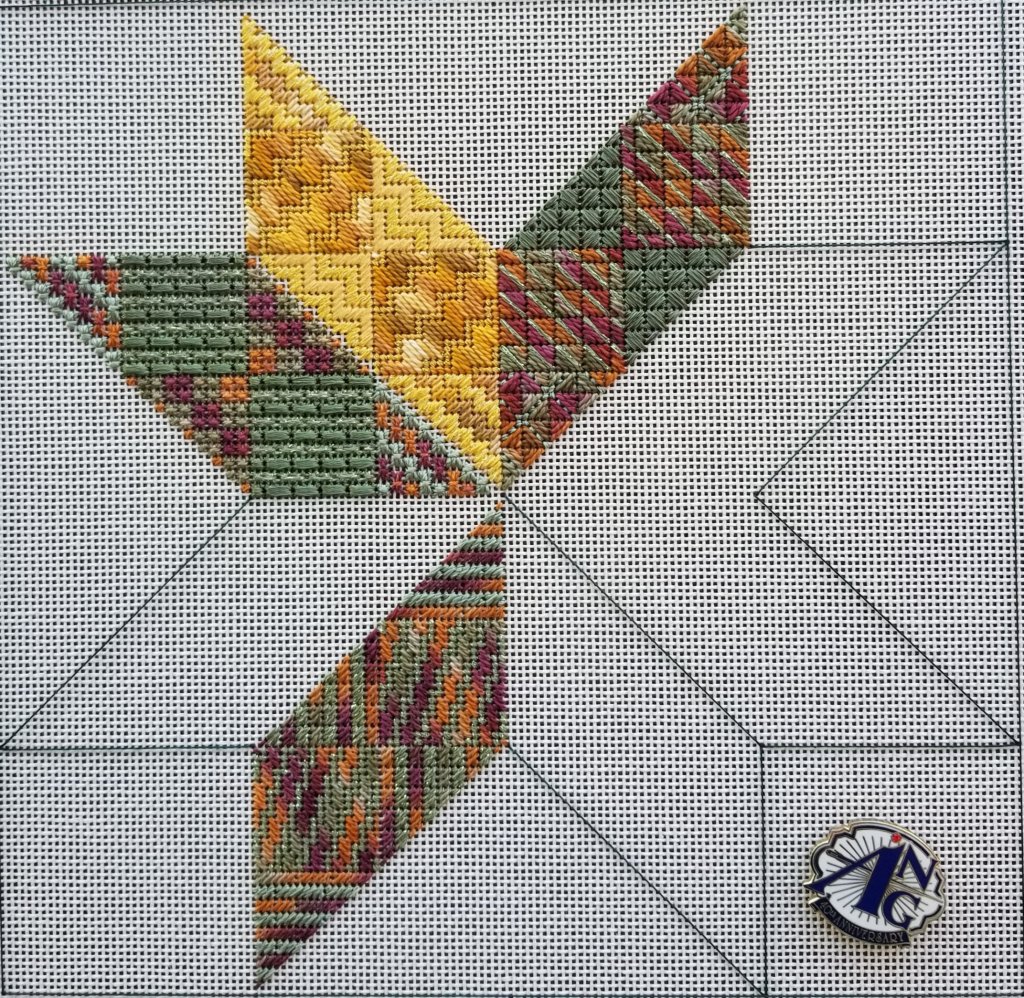
For the fifth area, Milanese stitches are used in three different ways. I switched from the overdyed thread to Neon Rays+ in Area C so that the contrast was better and because Neon Rays+ had been used in the opposite area.

The sixth area presents the waffle stitch which usually is a square, large or small. But, it can be compensated. Kathy provided excellent diagrams showing the precise compensation.

Moving right along! Hard to believe that 6 months have passed since we started this project. I’m all ready for our Monday night Zoom meeting.
Some in my ANG Main Line Stitchers chapter are already done stitching Rainbow Ribbons by Kam Wenzloff (Nov/Dec 2019 issue of Needlepoint Now). Others of us are doing this as a year long project. We’re each using different threads from Colour Complements and they all look great.
I forgot to post Bands 6 and 7 which I finished last month. The souffle stitch for Band 6 was one which I had to do with 2 needles. Others in my chapter found it easier to stitch the all small tent stitches first and others all the longer diagonal pattern first. Whatever works for you! No needlepoint police in our ranks. Band 7 was a giant rice stitch.

And, now I am ready with Band 8, a Greek stitch alternating with a slanted gobelin row. Apparently, reading is not my forte. And, I didn’t look at the pictures of either the stitched sample in the magazine or the one being done by Linda in my chapter who is leading the project. Good thing there is no needlepoint police in our group. Mine has 3 rows of Greek after what I thought was a compensation single row of Greek. The Greek rows were supposed to be 1, 3, 3 repeating with 1, 3, 3 throughout. Oh well! I realize now another chapter member did the same thing as me. I even commented in the newsletter that the two were different and look good either way. Perhaps subconsciously I preferred it this way! Let’s go with that rationale. I do like the flow back and forth of shifting colors.

Filed under: Brandywine Chapter, Embroidery Guild of America, Tree Ornament Vicky Witterschein
My EGA Brandywine Chapter hosted a class earlier tonight with Vicky Witterschein so she can gain experience towards her teaching certification with the National Academy of Needlearts (NAN).
Many thanks to her local needlepoint shop, The Edwardian Needle and Pam, for donating 20 kits to each of EGA’s 5 regions. It consists of 5″ x 5″ piece of 18 count canvas, Santa Fe Sage, 2 mm ribbon, Kreinik, pearls, needles, and beading thread.

Vicky led us through the stitches, had video demonstrations, and several of us finished the project during the 2-hour Zoom class. She is well on her to being an excellent teacher.
It could be done as a diamond like I did (2″ x 3″) or a Christmas Tree. Any ribbon thread will work, if I want to make up another. It’s great that the stitches work up easily into 2 different designs.

The center waffle has a variation in it because I was watching TV. I have to blame it on something other than I can’t follow well written instructions. This is my first piece from Gay Ann Rogers. Only looking closely at the original would anyone know. I actually like it just as well.
In my opinion, this is not a piece for someone just starting counted projects. In order to get this correct, I had to stitch in a different order than Gay Ann suggested. There was no way I would have counted correctly doing all the Tied Diagonal Stitches without stitching the Plaited, Slanted, and Elongated Cross Stitches first. Working from the center out is safer for me. Also, I am happy that my husband golfed when he did and is reading a 1,000-page book about Abe Lincoln (the period before his presidency) because the TV is off. I am proceeding well. Everything is matching up as expected.
By the time of my ANG Main Line Stitchers chapter Stitch-in yesterday, I had completed the inner brown border of Elongated Cross stitches. So, stitching the rest of Step 1 was easy while we chatted over Zoom. The difficult counting was done.
All this was Step 1! I just love it. It’s broken up into only 2 steps. While I’m anxious to forge onward, I will switch to a different project to be sure that I am ready for our chapter meeting on Monday February 8.
Filed under: General comments
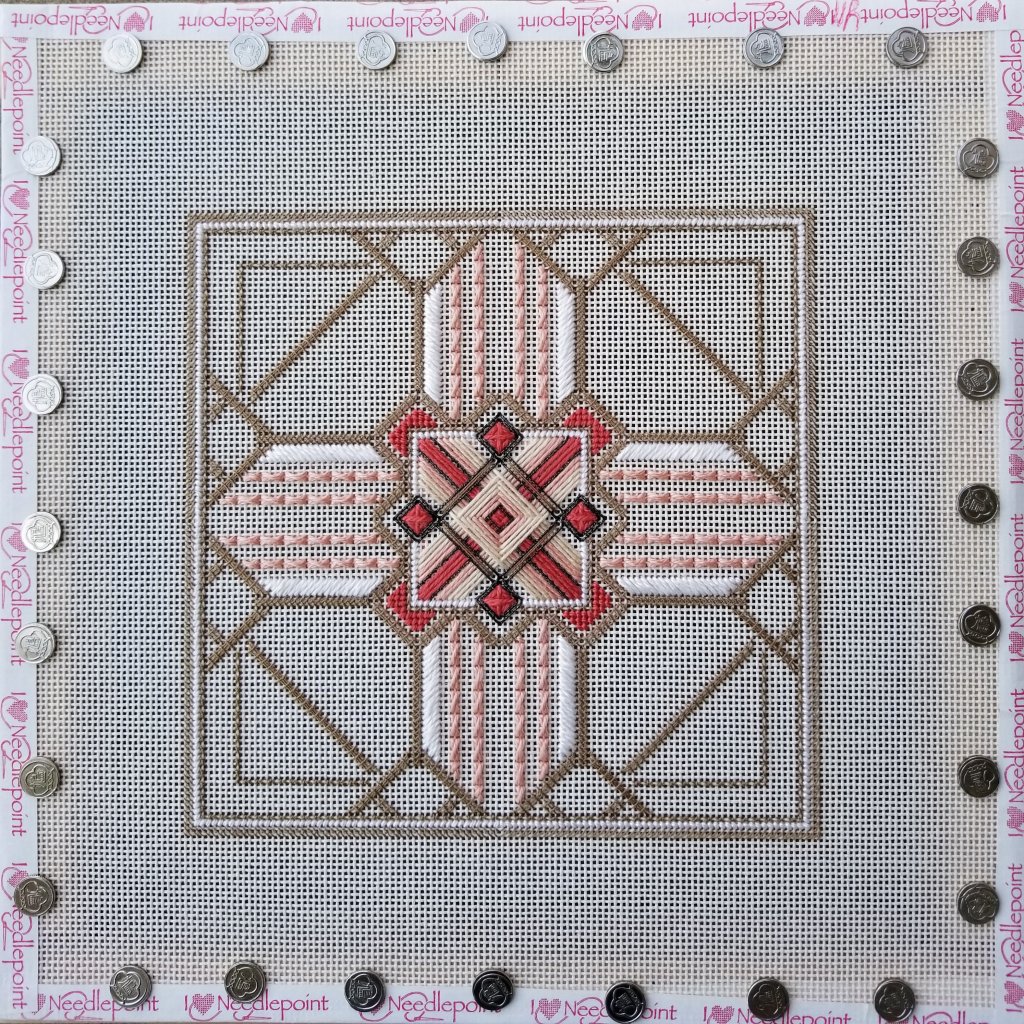
I love these vintage tacks and use them on special projects. I must have gotten them from a past chapter member’s stash, probably Mae V-D. The symbols may be Chinese and I wish I knew what it says. I tried a translate feature that I found online and ‘text ninety soldiers’ is what I get. There might have been 90 tacks in the container at one time but I only have 38 now. They hold up well (don’t bend upon carefully removing them) and I don’t see the wear on the heads like the newer tacks. Another, “They don’t make things like they used to.” example.
If anyone knows what the symbols are, please leave a comment!


Filed under: Gay Ann Roger's, Countess of Granrham, Gay Ann Roger's, Dowager Countess, Gay Ann Roger's, Lady Edith, Gay Ann Roger's, Lady Mary, Other People's Designs
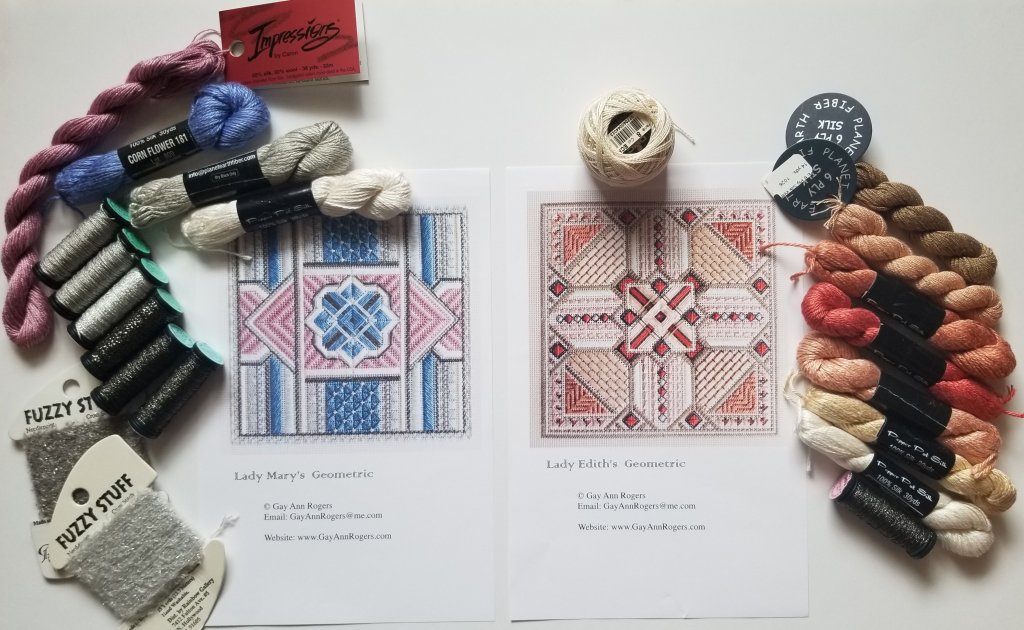
It took ordering from 3 stores to compile the required threads to stitch all 4 Gay Ann Roger’s Downton Abbey pieces. Everything including the 4 pieces of canvas are now ready to go. I only substituted Fuzzy Stuff which I had in my stash for the Planet Earth fiber Furr-Fuzz-Funn. One of the Kreinik colors has been discontinued but I was able to get it. I thought it was interesting that 3 of the 4 pieces use DMC Ecru and Lady Mary’s does not. Nothing as common as Ecru for her!
The next decision is in what order to stitch them? Do I stitch youngest to oldest or vice versa? This decision is based on one key point: The Dowager Countess is the newest design just released in her October sale and I would her done hers first. But, it uses Watercolours Amethyst 006 and I have stitched with Waterlilies Amethyst 006 recently. So, I will start with Lady Edith.

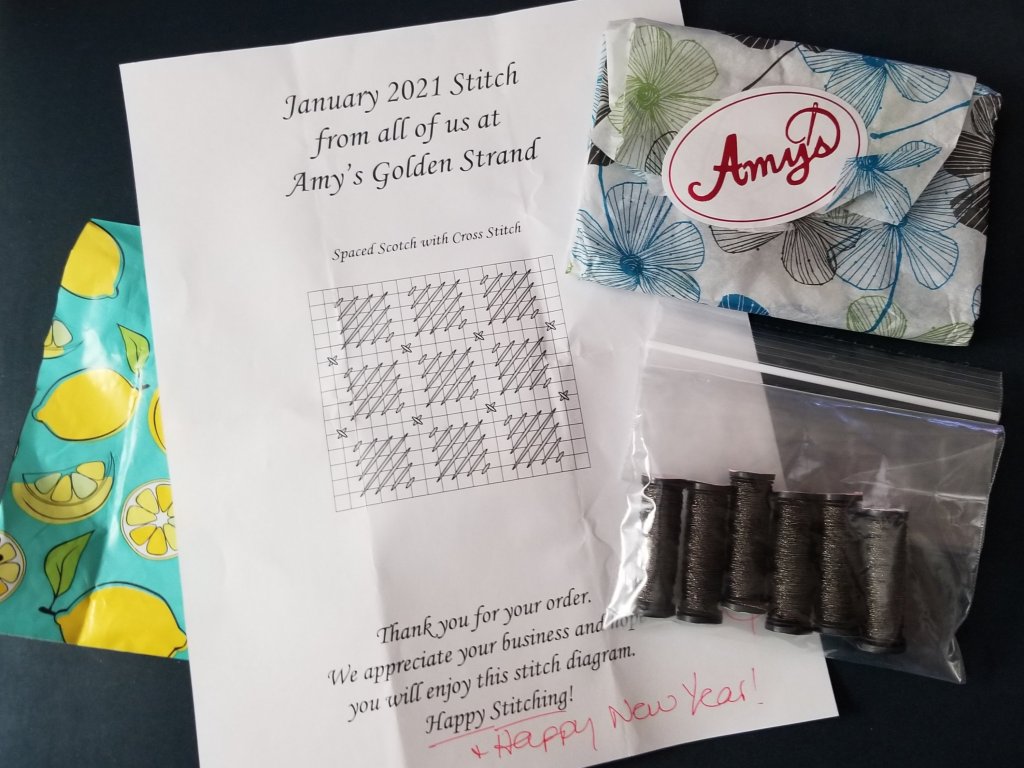
I’ve ordered online from a few needlepoint stores over the years and only a few packages arrive so prettily packaged that I choose to remember them. This order from Amy’s Golden Strand was not a large order but still they took care to place the threads in a sealed plastic bag (essential), wrap in a pretty tissue paper, and a fun plastic envelope. But, they went one step further by adding a thank you note with a stitch diagram saying they appreciate my business and a hand-written note wishing me a Happy New Year! It looks like they change the stitch diagram monthly. Thank you Amy’s Golden Strand for making my day. I look forward to placing future orders with you.
Filed under: ANG Cyberworshop, ANG Main Line Stitchers Chapter, ANG Seminar 2020, Blanton's Bottle, Build Your Own Geometric-Kurdy Biggs, General comments, Interchange by Linda Reinmiller, Needle Me Canvas Contest
Many thanks to Meghan and Rebecca at Michael’s framing department in Pottstown. Meghan did a great job helping my husband and I select the mats and frames. They have a very clever device that displays an image on the computer of your piece in the mat and frame to see how it will look before finalizing. I really liked the shape of the mat for the diamond shape piece. I’m very happy with final pieces.


Kristen, one of my fellow cruisers who knew we’d purchased 4 bottles of Blanton’s, discovered that Rittenhouse Needlepoint sold the Blanton’s Bottle canvas and reminded me while we were on a shopping trip for threads in November 2019. I ordered it, it arrived in December as a Christmas gift to myself last year and it is appropriate that I finish it at Christmas time this year! Recently, we found a bottle of Blanton’s allowing us to save the last bottle from our May 2019 cruise.

I love the mesh bag that comes on the bottle and that influenced my decision on the background to select Chicken Wire from More Backgrounds for Needlepoint by June McNight. Her other book, Decorative Backgrounds for Needlepoint listed the 10 Commandments and the second one surprised me. A dark background brings the main design forward while a light background may melt into it. I held up a dark brown Floche and a light brown Floche next to the bottle and could see immediately that the darker one was better.
Initially, I tried 11/0 Mill Hill seed beads for the rider, horse, and rim but they were too big for basketweave and backstitching (stringing beads in a straight line) on 18 count canvas. So, I reached out to my chapter member Linda and found out that her resources and experience indicated that smaller 15/0 seed beads were better for basketweave.
As it happened, Michael’s only had Miyuki 11/0 in Delica black beads which are more tubular than the round seed beads. So, I bought them because I still wanted the black beads to be bigger than the rider and horse to mimic the actual bottle. And, I thought they would backstitch really well on the black rim which are completely straight rows.
You can see the difference in size and shape between 11/0 seed beads and 11/0 Delica beads in this photo. Four seed beads cover 1/4 inch and five Delica beads cover the same length.

The 11/0 Delica seed beads allowed me to contrast in size and basketweave with the smaller Miyuki 15/0 seed beads in a light bronze for the horse and rider.
Here’s the sizes of 3 different round seed beads 15/0 Miyuki (6 left), 14/0 Sundance (6 center), and 14/15 Sundance (6 right).

It’s not until you use more beads will you start to see a slight difference between the 15/0 (12 left) and 14/0 (12 right). So, when you have a larger area of basketweave, you’ll probably find 15/0 preferable.

No doubt that we will be ringing in the New Year with a wee bit of Blanton’s and toasting to my last finished piece of the year. Happy New Year everyone!

 Melitastitches4fun's Blog