Filed under: ANG Main Line Stitchers Chapter, ANG Seminar 2017, Orange Orchid & Bamboo
The Main Line Stitchers chapter held our Stitch-in on Saturday in person (3 members) and on Zoom (3 members and baby Hallie!). The church is working great and with small numbers on both “sides”, the conversation flowed well as we stitched. Hallie slept through most of the 4 hours but did wake up long enough to eat and let us see how cute she is. I’m so glad Meghan Mom can join us.
I got started on the Band 4 background beforehand and finished it Sunday during the first NCAA basketball game.
This background (red one for Band 4) is easier to compensate than the outside bands. I also stitched the stem as Cynthia Thomas recommended in her stitch guide which is a wrapped double chain with 4 strands of floss. I used all dark on the left side and 2 dark/2 medium for the outer part and the wrap.

Lorraine has thread kits for Framed Sevens which is in the current issue of Needlepoint Now (March/April 2022) at Colour Complements: https://colourcomplements.com/product/framed-sevens-thread-kit
She has 8 other custom thread kits with designs either published in Needlepoint Now (love those hearts) or as a download at https://colourcomplements.com/product-category/custom-thread-kits

My design, Framed Sevens is in the current issue of Needlepoint Now (https://www.needlepointnow.com/product/march-april-2022/). Elizabeth, the publisher/editor/art director, does a lovely job displaying pieces for the magazine. The issue in the mail and hitting our area this week! It is bigger than Prime Examples (https://www.needlepointnow.com/product/september-october-2021/) but still works off the number seven and inspired by another Mary Legallet article. But, I found stitches covering 7 canvas threads from a variety of stitch books. And, the threads are from Colour Complements. Lorraine makes such pretty and wonderfully coordinating hand-dyed threads.

I actually finished the stitching the rectangular design in Variations of a Florentine Design by Pat Mazu over the 5 days of the ANG Cyberpointers chapter meeting. Fun project.
The reddish, round, seed beads were the best match from my stash. Not sure what brand or size they are. They look like the same size as the Miyuki Japanese Seed Beed 10/0 Delica pictured next to it. Pat’s design called for 3 Delica beads to be strung together. They are more tubular (left bead in photo) than the round seed bead (right bead in photo).

I didn’t care for how 3 of the rounded ones lined up. The middle one looked like it was being pushed up. So, I modified the left and right side motifs by using fewer beads and more Kreinik. My neutral thread color didn’t work well and so I used the darker Marigold. I’m very happy with how it turned out.
Big thanks to Pat for sharing her designs. Dare I try finishing this? She certainly provides all the necessary instructions. And, she’ll answer any questions.

Thanks to two of my ANG Main Line Stitchers chapter members, Debra and Linda, I have quite a stash of Pearsall’s Silk embroidery thread. Since it has has been discontinued, I’ll use it for other people’s designs when I want to use my own colorway. And, that opportunity arrived with Variations of a Florentine by Pat Mazu which is this month’s program for the ANG Cyberpointers chapter.
Pat is providing 2 booklets (pdf downloads), one with the design which can be made into 4 different options and the detailed instructions for finishing them. And, at no charge! She provides 35 pages including an extensive bibliography mainly on bargello for the designs and 47 pages also with an extensive bibliography for finishing. Very generous of Pat to share her experience with ANG Cyberpointers’ members.
I’m working on the design in a rectangular shape which will be for a travel eyeglass case. I have a leather tooled case that my grandmother made and I don’t like taking it out of the house in case I were to lose it. Isn’t this lovely!

I’ve got 2 colors and a neutral: Marigold, Sage Green, and Olive Brown, respectively. I had 5 shades of Marigold to choose from. The lightest one was too close to the Olive Brown when stitched. It looked like more contrast when they were in the bags. Pearsall’s is a very pretty silk but a little difficult to handle. It catches easily and is difficult to lay. Mary Corbet describes it as “bumpy”. Is this what people use thread conditioners for? An internet search revealed they are beeswax mainly. I don’t think I want to try that. Using shorter lengths and ironing the threads are helping. Dampening the threads very slightly was also suggested and is helping some too.

Filed under: ANG New Jersey Needle Artists Chapter, ANG Seminar 2021, Secret Window by Kurdy Biggs
The top and bottom upside down crescents and rounded Jessicas in the center dome window of Secret Window are done except for the beads which will be added last.

Filed under: ANG Main Line Stitchers Chapter, ANG Seminar 2017, JP Bird of Paradise & Bamboo
The Main Line Stitchers chapter held our Stitch-in on Saturday. It was a small group of 5 and a few on Zoom. It was the first time to meet at United Methodist Church in Paoli. It’s locked at all times so people must call me upon arrival to get in. It worked well. Two long tables were wide and long enough for five. Great lighting. The Zoom people could hear well even without the eSpeaker. They can’t see everyone but that was fine.
I progressed on the left panel of Orchid and Bamboo. There wasn’t any more football on Sunday but the Philadelphia 76ers (basketball) actually have a team that can win. It’s not as easy a sport to watch and stitch as either football or baseball but I finished the left panel anyway later that day. Again, I took a photo and superimposed the stitches on top to figure out the compensation inside the medallion.

Filed under: Backgrounds, The Finishing Touch by Ann Strite-Kurz, Books in My Library, Canvas Applique by Ann Strite-Kurz, Diaper Patterns by Ann Strite-Kurz, Needlepoint Books, Potpoutti of Pattern Encore by Ann Strite-Kurz, Stitch Refinement for Canvas Embroidery by Ann Strite-Kurz, Stitch Variations and Mutations Partsc1 and 2 by Ann Strite-Kurz
Ruby Razzle Dazzle captured my attention and introduced me to Ann Strite-Kurz’s designs. It is a collection of a variety of techniques which looks exceedingly complicated but lovely! I did get the booklet of instructions recently and will get to it. But, it is not a needlepoint book.
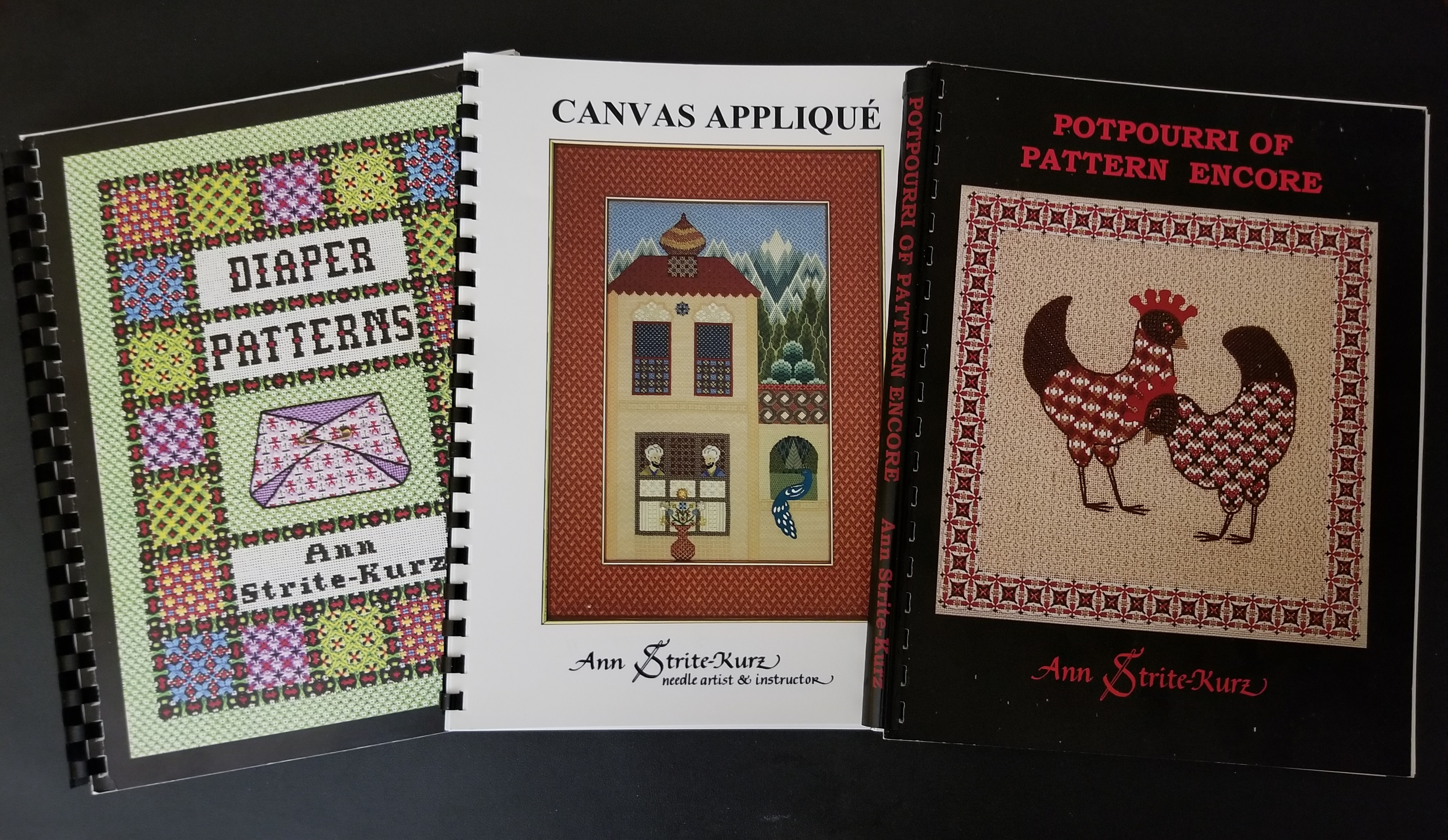
The first book in my collection of books by Ann is Diaper Patterns. I needed it in order to create a diaper pattern for Step 3 of the EGA Master Craftsman program. Ann’s inscription to me reads, “Welcome to my world of Diaper Patterns”. What a comprehensive booklet with 131 pages and a CD with about 500 images! The diversity of the outstanding examples are due to many contributors who provided finished pieces and stitch samples. Many of the people I have had a pleasure to meet over the years or take classes from. It’s such fun to read about a piece that I admire even if I haven’t stitched it. Linda from ANG Main Line Stitchers completed Dorothy Lesher’s The Snowbird beautifully and Ann describes and diagrams (with Dorothy’s permission) one of the white and blue patterns which is a diapered variation of the Old Florentine stitch. Ann explains that the white pattern on her dress could be a diaper pattern if the short outline stitches were executed in a contrasting color. With the images Ann provides, this provides hours of entertainment and education. Ann describes a diaper pattern succinctly as “visual diagonals in both directions” and then goes on to describe differences between groundings, stripes, and diapers. Ann describes 8 basic diaper pattern networks which I incorporated into my EGA Master Craftsman piece. I had to use at least 4 patterns and used them all. Or, I thought I had until I sent the image to Ann. Apparently, the center pattern is actually overlapping circles rather than ogees. However, keep your eyes open for a Stitch Refinement Zoom lecture by Ann that she’s working on. My pastel design may be used to illustrate how to use intensity to keep the colors separated.

The Canvas Applique booklet provides step-by-step instructions for mounting regular and irregular shapes of canvas to canvas, reverse applique, kid and ultrasuede applique, gauze applique, stone and mirror settings, and Cretan pockets. There are also a good number of illustrations using her stitched pieces. I have my two small irregular-shaped stitched pieces ready to remove from the bars to mount to my canvas for Step 5 of the EGA Master Craftsman program. I am worried about the mounting process. However, I should take the plunge and start! For those with knowledge of the process, that was an intended pun. For those unfamiliar, you pull all the canvas threads out up to the stitched portion and then weave some to the back of the small piece but most canvas threads get plunged through to the back of the main canvas and woven to the back of the main canvas. My main issue is that the appliques I designed are larger than the minimum one inch square and that is going to be a lot of canvas threads to weave or plunge and weave. But, I’ve read the mounting process several times now and have got to bite the bullet and do it!
The third book I have is Potpourri of Pattern Encore which is a collection of previously unpublished patterns for canvas and counted thread use (129 pages). The Introduction and Techniques chapter includes basics and lots of color photos of various pieces to be discussed in the subsequent chapters with more details about background patterns, border patterns, laid fillings, composite patterns, and diaper patterns. The last chapter analyzes a dozen different stitched color combinations of the same design. Fascinating. Another good book to take a deep dive into.
Updated February 2024.
I was sent Backgrounds, The Finishing Touch by mistake from an Etsy site but didn’t complain after one look inside. It includes another CD with full color plates of the 118 images described in the text. Ann’s husband, Bill, put it together for her. The best husband’s are named Bill! Well, there might be at least one of my blog readers who would disagree with that statement.

In Chapter 1 of Backgrounds, Ann discusses how and why she selected backgrounds for each piece. In subsequent chapters, she discusses planning and execution, darning patterns, back-stitched outlines, textured patterns, and couching patterns.
Stitch Variations and Mutations discusses the structure of stitch families in order to plan stitch variations. The Summary Sheet at the end of Part 1 offers 35 ways to derive stitch variations. Part 2 picks up 16 years later with 16 more ways she’s compiled to develop new stitch treatments.
Stitch Refinement in Canvas Embroidery expands and extends principles discussed in Science of Canvas Embroidery (Ann said I did not need both). Composite stitches and open patterns are followed by solutions to canvas dilemmas such as compensation, stem versus outline stitch, and differences in designs with center holes compared to designs with a center thread.
Filed under: ANG New Jersey Needle Artists Chapter, ANG Seminar 2021, Secret Window by Kurdy Biggs
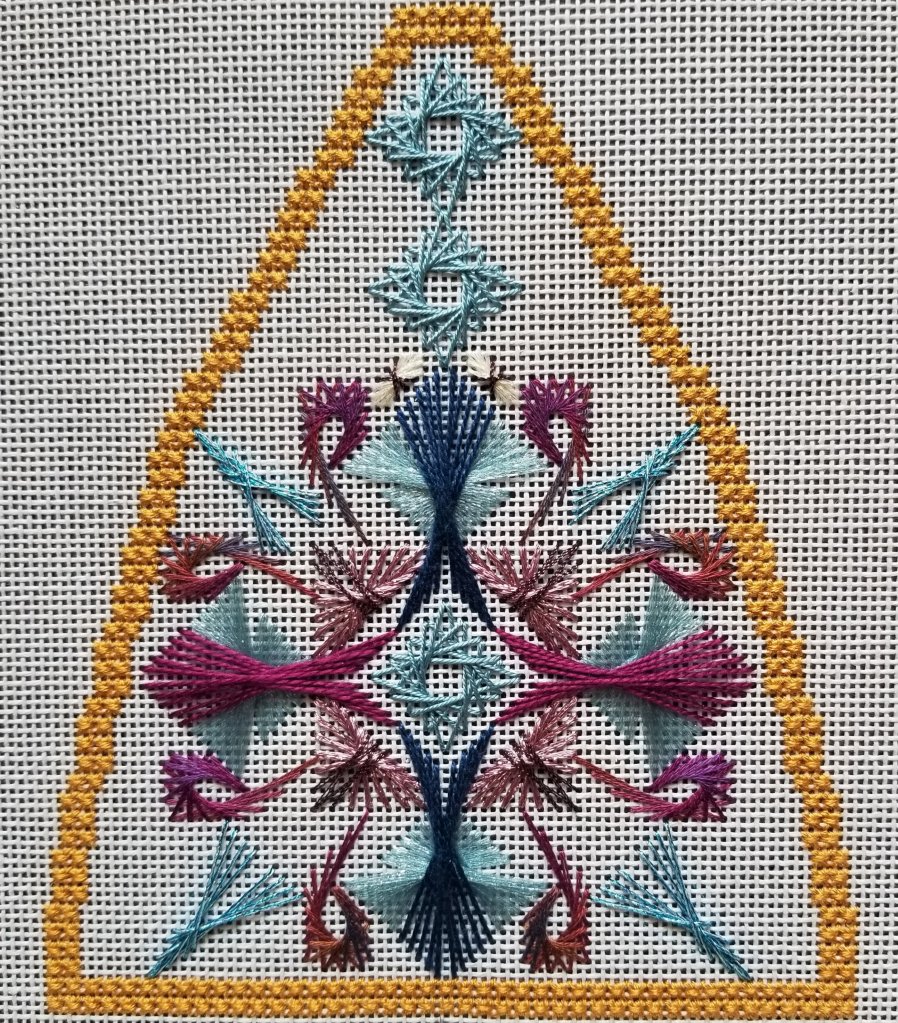
The center was squared off with Two Tone Sprats Head (Entice and Bijoux). For the eight crescents, I used Harmony, a natural-dye (explained on the Treenway website), 6-strand silk floss (from a particular silk worm also described on their website). I didn’t try to color match the skein (find the repeating color pattern). Instead, I used 4 of the 6 strands and started on the top on each side by working 2 strands counterclockwise to the left and 2 strands clockwise to obtain matching color movement.
I love the shape of the blue Plaited Ray’s between the Sprats Heads in the corners.
The 2 tiny Diagonal Sheaf stitches use 4 strands of Accentuate. It’s not my favorite thread and I realize that I have 2 spools of it. Each spool is 50M. I better learn to like it! But, for now, I was given the option to add some sparkle on the last 3 stitches. So, I did and used 2 strands of Bijoux in the center for the last 3 stitches.


Filed under: General comments, Woodlawn Needlework Exhibition
March means the Woodlawn Needlework Show. The weather did not cooperate with our schedule and Bill and I didn’t get to visit until March 30. It was chilly and sunny (so photos may not be great due to glare or appear washed out – sorry) but no rain. It is unfortunate to see the number of judged entries has dropped to 296. But, the quality is more important than sheer numbers and it is always a joy to share and celebrate needlework.
Plus, there was a wonderful display of over 60 pieces by the Winchester Chapter of EGA who were celebrating their 10-year anniversary. Among pieces displayed by the Winchester Chapter were 3 of Toni Gerdes designs Klimt Kimono (a WIP for me), Autumn 3-Ways (a class I’m taking in October 2022 with the Central Jersey Chapter), and Bronze Purse (I finished stitching it but never did anything with it – I love what this person did with it). The fourth, is Donna’s 32-count miniature tiger stitched on gauze that won 1st Place and the Pope-Leighey Award in 2020 and one of our favorites! Good to see it again.
And, there were a number of pieces by Eleanor Parke Custis Lewis aka Nelly for whom the Nelly’s Needlers were named after. The design for the fireplace screen is available in the gift store and the others are pieces from the 1800’s on perforated paper!
Speaking of Nelly’s Needlers, the folks who run the exhibit, always sell ginger cookies and we got some. I also picked up this bargello purse they called Nelly’s Purse. I love how the design looks open as much as when it’s closed. The finishing is impeccable. I found out the purse was designed by Pat Mazu for her journeyman level Master Teacher Program and named it Flowers on a Trailing Vine. Pat taught it 3 times, once in the Potomac/Washington DC area. No wonder I fell in love with it. Pat’s designs are amazing!
Now, on to the main exhibit. I did ask and was told that they will definitely be placing photos of the pieces in an online exhibit again this year. I don’t have an exact date. So, I am going to limit the photos I show in hopes you support them online. Looking at them online is like seeing the exhibit again but from a different viewpoint. It can be a lot to take in at one time. So, seeing it again online is great. And, their photos will not be taken with glare or sun streaming into the room.
Apparently, the Beach colorway of my Crescent Journey impressed these judges more than the original colorway did in 2019 because this version got a 2nd Place Award. They did not offer critiques but I do believe this colorway is more balanced and allows the crescents to be seen better.
I was one of the four ANG New Jersey Needle Artists (NJNA) to submit the Star of Stitches by Kathy Rees which was an ANG Stitch of the Month for 2020. Linda and I framed ours, Sue made hers into a tray, and Diane made hers into a pillow. Rosie, Sue (Honorable Mention), and Linda all members of the NJNA also sent Celestial Twist. The ANG Main Line Stitchers followed suite this year stitching Celestial Twist too and Heather got hers done quickly enough to enter it as well. Seeing multiple colorways of the same design is fantastic. You’ll be able to see the NJNA pieces on their blog at some point.
Speaking of Heather, Patti Lynn stitched her design called Once in a Blue Moon which was published in the EGA magazine, Needle Arts, in September 2020. And, Patti Lynn also stitched my design Overdyed Spools which I taught at the EGA Mid-Atlantic Regional meeting this past October using an overdyed thread of her choice. I love how Patti Lynn’s turned out. What is the chances the same woman would stitch both our designs and exhibit them in the same year! Very cool.
There were a good number of counted cross-stitch pieces that were stunning. In fact, Bill’s second People’s choice award went to Dimensions Lakeside Village by Elizabeth (readily found on a Google search). And, I love the Starry Night by Erin- several versions are available through a Google search but I think it might be by Artecy Cross Stitch. Both are cross stitch and such detail is achieved.
Speaking of Bill’s People Choice vote, his went to Heather’s Philadelphia Sunrise (Honorable Mention) which she did as Step 4 of the EGA Master Craftsman Canvas program. It incorporated 8 bargello patterns (all had to touch but did not have to cover the entire canvas). It is an original design that has not been published and so I will not show it here. It really does capture our city skyline. My People’s Choice vote went to an original work by Beth called Triptych on Blue which is all beads in 3 different yet coordinated designs. Her other original designs were equally as impressive: Fall Leaves (better than the next 2 that won awards in my opinion), Silver Roots (1st Place), and Blue Waterfall (2nd Place and Judge’s Choice Award) which were all beading draped on/around different bottles. Again, I won’t post pictures of original designs – you’ll have to see the exhibit online!
I was interested to see 3 versions of Maharajah’s Elephant by Kathy (left), Patti Lynn (center), and Kathleen (right) because the ear is appliqued onto the main canvas. The applique technique appears to be slightly different than what must be done for Step 5 of the EGA Master Craftsman program that I am working on now. The elephant is a design by Mary Long and was available through EGA (https://egausa.org/courses/maharajahs-elephant/). Again, seeing multiple colorways of a piece is such fun and these were all in the same room making it easy to view in person.
Under the category of Counted Thread: Blackwork, Cheryl submitted 2 pieces from Peppermint Purple’s (Google search finds them easily) 2020 and 2021 Stitch-a-longs (First Place). There are many lovely designs on their website. The only other Blackwork on display was in the Winchester Chapter exhibit of one of a butterfly and another of some flowers. I have only done a very small square of Blackwork. It’s lovely but didn’t seem easy which may be why there aren’t a lot of them on display any given year. It probably would get easier once you get used to it. I’m not sure if the addition of the text is Chery’s idea or was part of the design but it’s cute.
The following award winners are all submitted under a Commercial design heading which means they are available to the public. If anyone knows who the designer is for any of these, please leave a comment. There are lots more in these and other categories.
Under the category of Canvaswork: Multi-stitch (4+) was Sonoma Rose by Joanne (Second Place; left photo). She had to lay long threads and they are perfect.
Under Canvaswork: Traditional (which must mean less than 4 different canvas stitches were employed) was Cheri’s Favorite by Cheri (First Place; center photo). I love the use of all overdyed threads.
Under the category of Embroidery: Goldwork was Kingfisher by Stephanie (First Place; shown in the right photo as a close up without the frame for details). I don’t recall seeing any colored goldwork and the way she applied the gold to appear like feathers is fantastic.
Hopefully, you will enjoy the online exhibit once it is made available because you’ll see lots more great needlework. A few of the special award winners can be found on the Woodlawn & Pope-Leighey House Facebook page (keep scrolling down).